
Antiquities Provenance: What Old Labels and Owners Names Tell You About a Piece
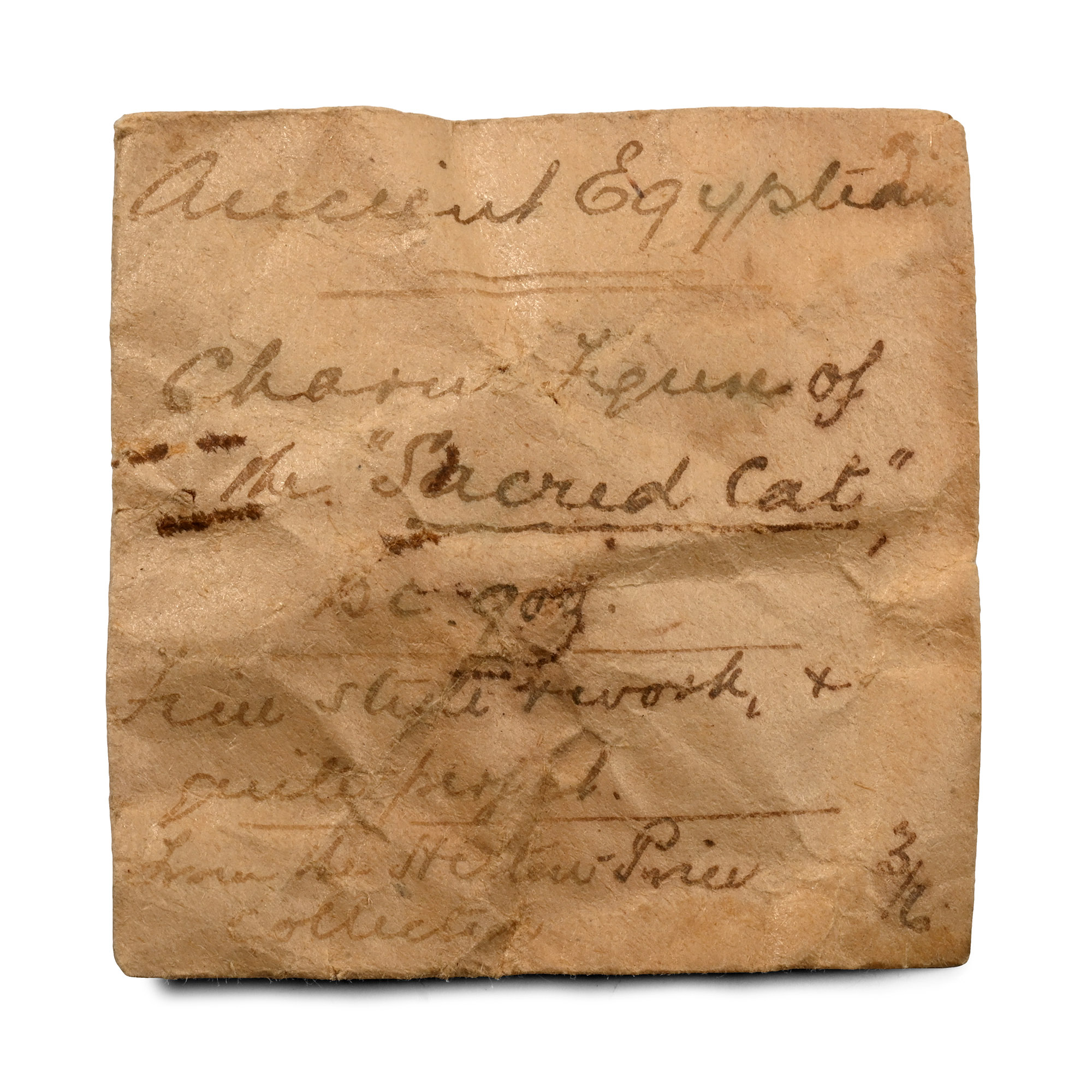
The label is a square of soft, creased paper written in brown ink: "Ancient Egyptian / Charm Figure of / the 'Sacred Cat' / B.C. 900. / Fine style & work, & / quite perfect. / From the Hilton Price / Collection". In the bottom right-hand corner is "3/6", the pre-decimal way of writing three shillings and sixpence. It belongs to a seated cat of greenish-brown faience 23 mm high, its head turned, and cat and label have been together in a Sussex collection since the early twentieth century.
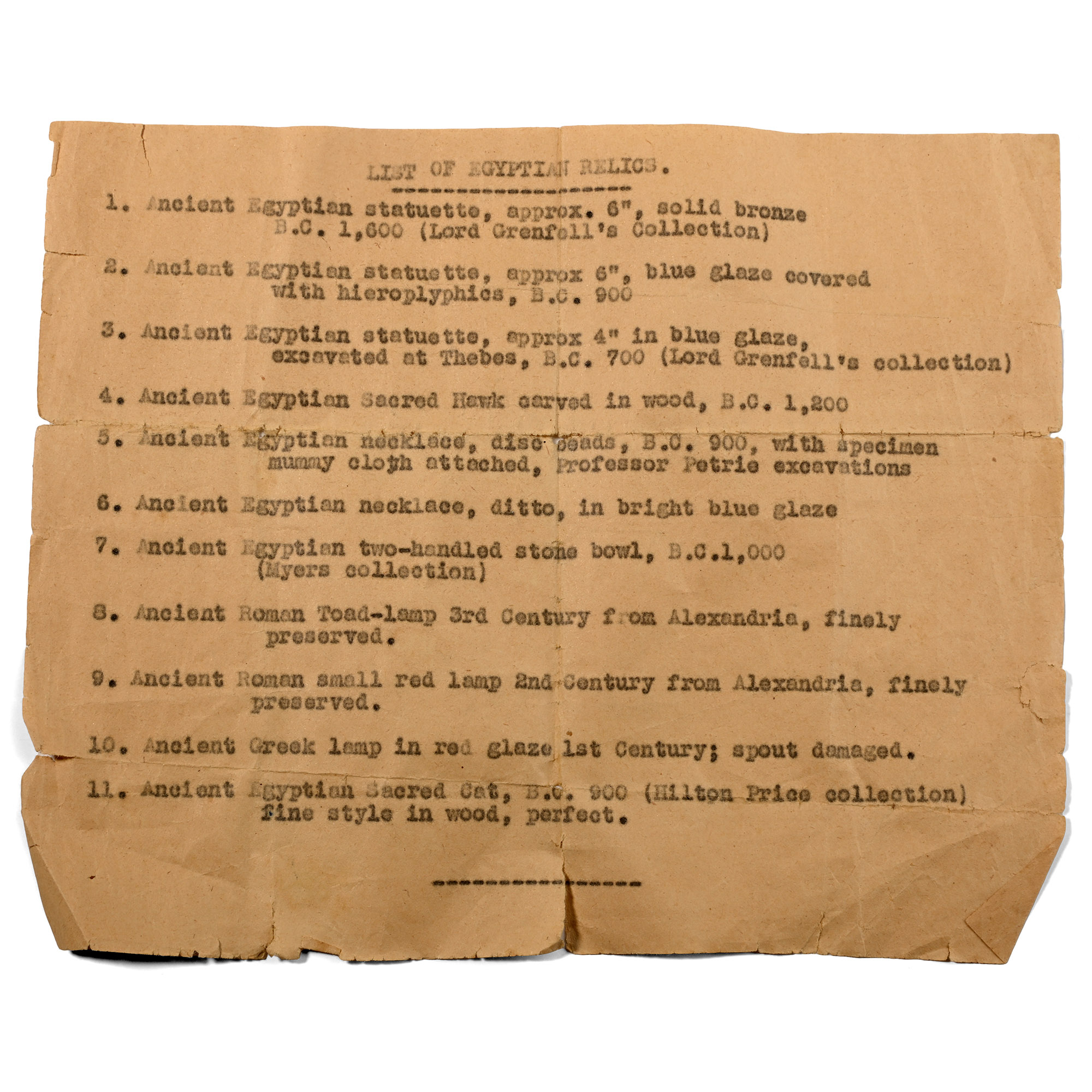
Antiquities provenance, the record of who has owned an object and where it has been, often starts with paper like this. The cat is one of eleven lots from the same Sussex estate, and the group comes with a typed sheet headed "LIST OF EGYPTIAN RELICS.", whose numbered entries name Lord Grenfell's collection twice, the Myers collection, the Hilton Price collection and "Professor Petrie excavations". All eleven lots are in TimeLine's sale opening on 1 December 2026, together estimated at £1,300-1,700, and the same sale has a Greek coin that was photographed for a London auction in 1908, a bronze cat that belonged to Charlie Watts and a garnet eagle from one of the most famous houses in Brussels.
What is provenance, and what does each entry tell you?
The cat's provenance has three entries: it comes from the collection of Frederick George Hilton Price (1842-1909), it has been in a Sussex private collection since the early twentieth century, and it is accompanied by its old handwritten label. That is a provenance line, one entry to a sentence, and most auction houses write theirs in the same shorthand. "Ex", Latin for "out of", means formerly in a collection or sale, and "with" before a dealer's name means the piece was in that dealer's stock. "Thence by descent" means it was inherited, and dates in brackets after a name are usually the owner's lifespan. The rest of the saleroom's vocabulary is in TimeLine's auction glossary.
A label records what was known about an object in its day and how it was valued, so the cat's "quite perfect" and its "3/6" belong to its history as much as Hilton Price's name does. An old sale catalogue dates a change of hands, and often describes or photographs a piece closely enough for it to be recognised a century later. A great collector's name places an object in a life the buyer may already know, a house places it in a room, and a run of recent sales puts every step in print.
What old collectors' labels tell you
The handwritten labels in the Sussex group are all in one hand, which shows that the group was kept together, and their vocabulary is that of collecting a century ago, when things were "quite perfect" or "of pretty style" and above all "specimens", the word a natural-history collector used for a beetle or a fossil. Six of the eleven lots carry no collector's name, and three of those are lamps "from Alexandria" (lot 582, lot 657, lot 774), the last labelled "Quite perfect: a cabinet specimen". One is a wooden hawk with traces of gilding, of the kind that decorated coffins and canopic chests (lot 503). Two are blue-glazed shabtis, the small servant figures buried with the dead, one of them inscribed for a man named Hornakht and his mother Nefertyti (lot 42, lot 625).
The other five carry the four names on the list, the first of them Francis Grenfell, later Lord Grenfell, who in the 1880s was Sirdar, the commander-in-chief of the Egyptian Army, and who opened the rock tombs at Aswan that are still called the Grenfell tombs. The first entry on the list, a bronze statuette from "Lord Grenfell's Collection", is an Osiris holding the crook and flail, labelled under its stand "Osiris (Judge of the Dead)". The third entry is a blue-glazed shabti excavated at Thebes, which its own note calls "A very choice & desirable specimen from Lord Grenfell's collection" (lot 737).
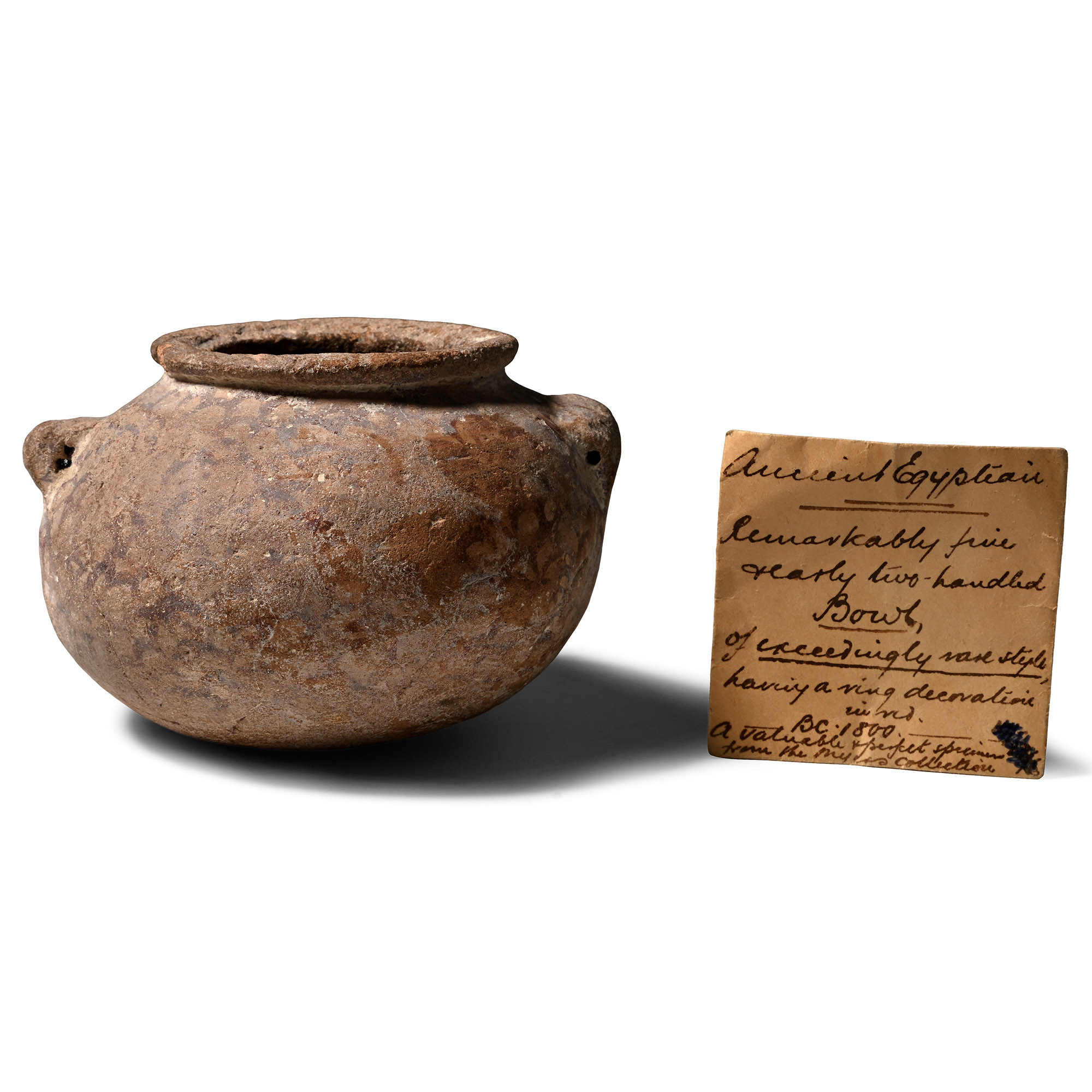
William Joseph Myers, another British officer, went out to Cairo in 1882 and bought steadily until his last visit in 1896. He was killed in the Boer War in 1899 and left about 1,300 objects to Eton, his old school, where the Myers Collection still is. The bowl in the Sussex group is a piece of his that stayed in private hands, a squat pot 10.3 cm across, painted in red-brown to imitate the veining of a hard stone. It dates from the Predynastic-Protodynastic period, c.3900-3200 BC, and its card calls it "A valuable & perfect specimen from the Myers Collection".
One of the two labels with the necklaces (lot 620) reads "From Prof. Petrie's Excavations at Gurob", and both strands of beads, one blue and one mainly white, still carry a scrap of linen mummy cloth. Flinders Petrie dug at Gurob, on the edge of the Fayum, in 1888-90, and his team went back in 1920 and opened some 550 tombs. His share of each season's finds went to London, where he showed it every summer at University College, and the sponsors who had paid for the dig then chose pieces for their own collections according to what they had given.
Hilton Price, whose name is on the cat's label, was a London banker with more than 4,000 Egyptian objects, and in 1897 he published his own catalogue of them. He had no mummies and no large stone sculpture, which he thought belonged in a public museum, but he did have pages of small cats, most of them faience and most from Bubastis in the Delta, the city of the cat goddess Bastet. He died in 1909, and in July 1911 Sotheby, Wilkinson & Hodge sold the collection in 1,512 lots. Some of it went back to Egypt with Cairo dealers who had come to London for the sale.
How far back can a coin's provenance go?
Fifteen years before Hilton Price's sale, in March 1896, the same auctioneers sold the Greek coins of Hyman Montagu, and lot 592 was a silver tetradrachm of Samos that is now lot 3875 at TimeLine. One side has a lion's scalp seen face on, the other the forepart of an ox inside a sunk square, with ΣA for Samos above it and the letter Γ below. The coin is Near Extremely Fine, with the deep old toning that silver takes on after decades in the wooden drawers of a coin cabinet.

Montagu was a London bankruptcy solicitor who collected beetles before he turned to coins. A surviving copy of his sale catalogue has a buyer's name written in the margin beside lot 592, "O'Hagan", and a price of four guineas. Henry Osborne O'Hagan was the leading company promoter of his day, a man who floated tramways, collieries and breweries, and when he gave up collecting his coins filled four sales at Sotheby, Wilkinson & Hodge. In the sale of 4 May 1908 the Samos coin was lot 591, "very fine and rare; from the Montagu collection", with a weight of 200 grains.
Plate X of the 1908 catalogue is a photograph of plaster casts of the coins, and cast 591 has the same irregular outline as the coin now offered and the Γ in the same place by the ox's forelegs. The weight agrees exactly, since 200 grains is 12.96 g, so a collector with the plate open beside the coin can see it as the bidders saw it that May.
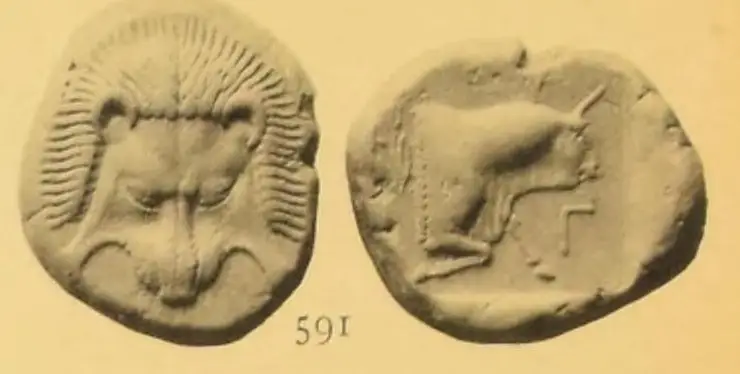 Coin 591 on Plate X of the O'Hagan sale catalogue, Sotheby, Wilkinson & Hodge, London, May 1908, photographed by the London Stereoscopic Company. Public domain, American Numismatic Society copy via the Internet Archive.
After O'Hagan the coin passed to Cahn in 1951, through a Paris sale at the Hôtel Drouot in 1952, and then to Münzen und Medaillen of Basel, Rollin & Feuardent in London and Jean Vinchon of Paris, from whom it was acquired privately. It is also number 72a in John Barron's 1966 study The Silver Coins of Samos, which reads the Γ as the third year of a dated series struck between 454 and 440 BC.
Famous owners: a drummer, an archaeologist and a polar photographer
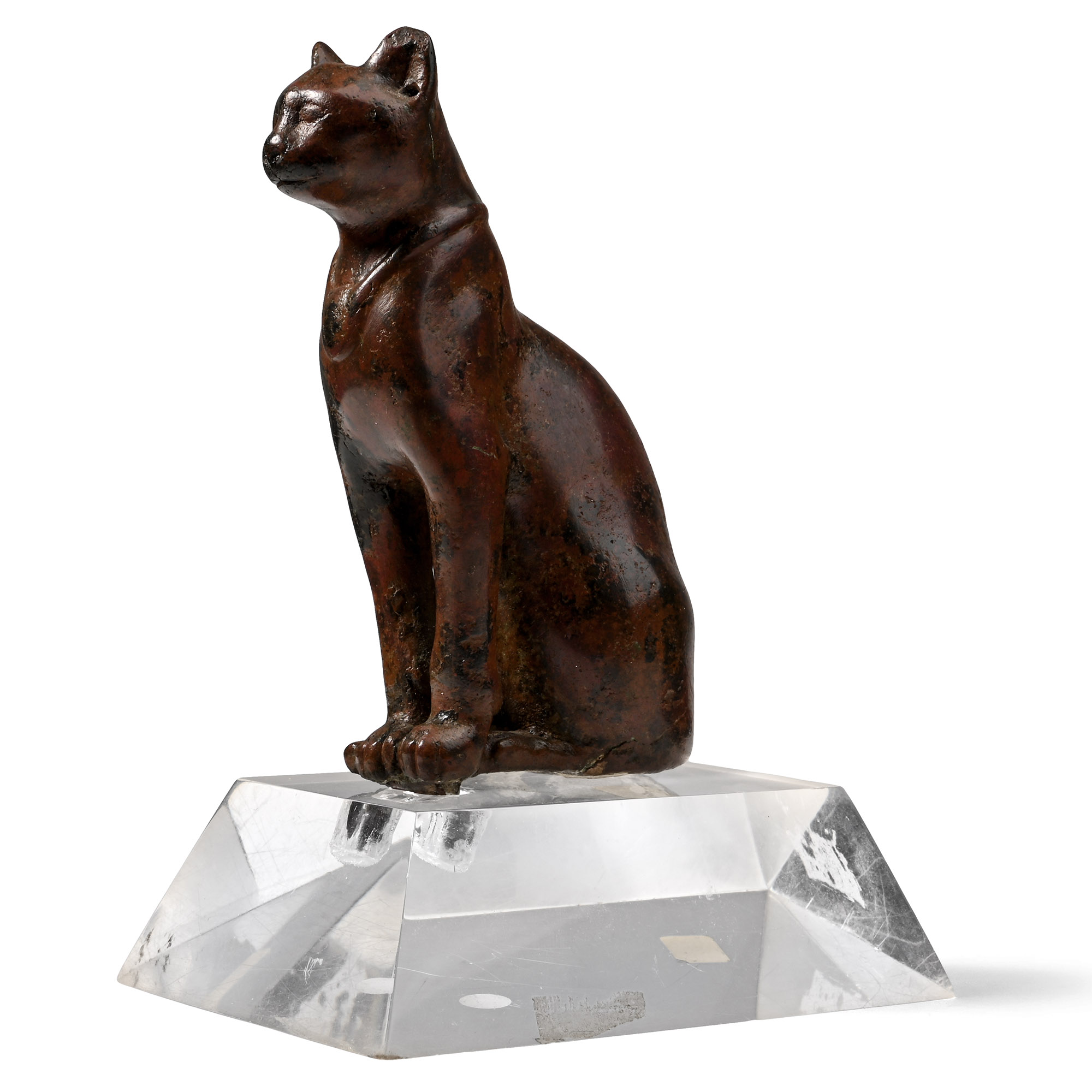
The bronze Bastet of lot 60 sits upright with her tail wrapped round to rest on a front paw, both ears pierced and a large amulet hanging from her collar, 11.2 cm high on a perspex stand made for her in the 1970s. She was number 28 in Dr Desmond Fitzgerald's collection, and in 1990 Charlie Watts, the Rolling Stones' drummer, and his wife Shirley bought her by way of Nick Wright. The Wattses bred Arabian horses at Halsdon House in Devon, and the Exeter auctioneers who sold the residue of their collection in May 2026 called them "avid collectors of just about everything". An Assyrian bronze roundel fragment that was also Fitzgerald's came to TimeLine from that sale (lot 1811).
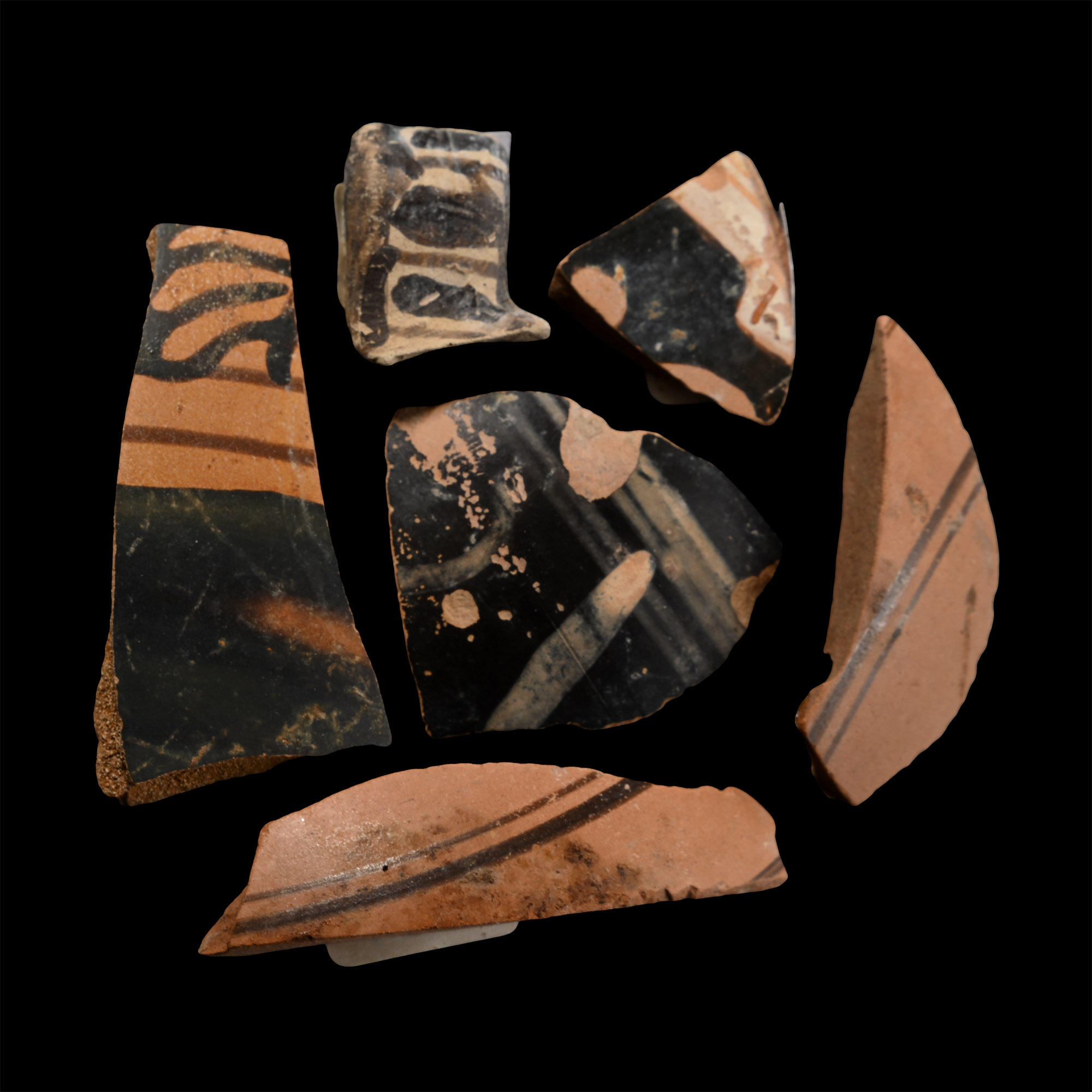
The Wattses' Bastet is estimated at £3,000-4,000, but a famous name can come for far less, since a small group of Greek red-figure sherds of the fifth century BC, each with an old collector's label, is estimated at £50-70 and belonged to the archaeologist Iris Love (1933-2020). At Knidos in south-west Turkey she found a temple of Aphrodite on the same summer day in 1969 that Neil Armstrong walked on the moon, and she bred champion dachshunds, which she named after figures from Greek myth. For about thirty years, until the late 1990s, her sherds were on loan to Dietrich von Bothmer, the Metropolitan Museum's curator of Greek and Roman art.
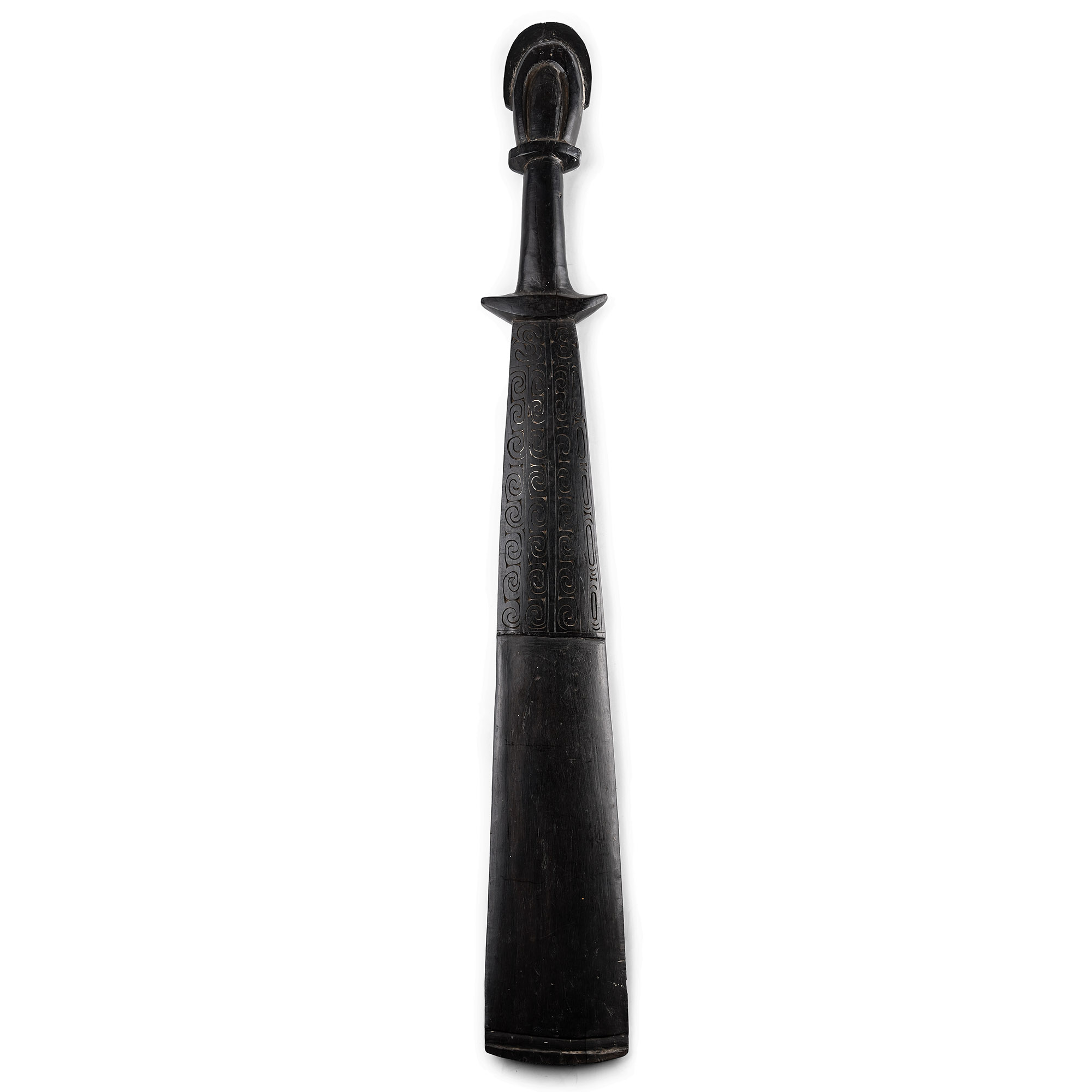
Frank Hurley (1885-1962) took the photograph of Endurance held in the pack ice on Shackleton's expedition of 1914-17. In the 1920s he went on expeditions to Papua New Guinea to film and to collect, and in 1922 he took two seaplanes there, the first aircraft seen in the colony. He kept a number of artefacts in a log cabin at Whale Beach, where Sydney's fashionable set came for raucous parties in the 1930s. When he sold the property after the war he left the cabin's contents to the new owners, who moved to London in 1959. The club of lot 2791, which later belonged to Carlos Bahamonde of Manchester, is a Massim paddle club from the Trobriand Islands, 74.2 cm long, with carved scrolls at the top of the blade. Such clubs served in fighting and in ceremony, and some were tied to sorcery, so that a shaman who pointed one at someone was passing a death sentence.
A palace in Brussels and an abbey above the Neckar
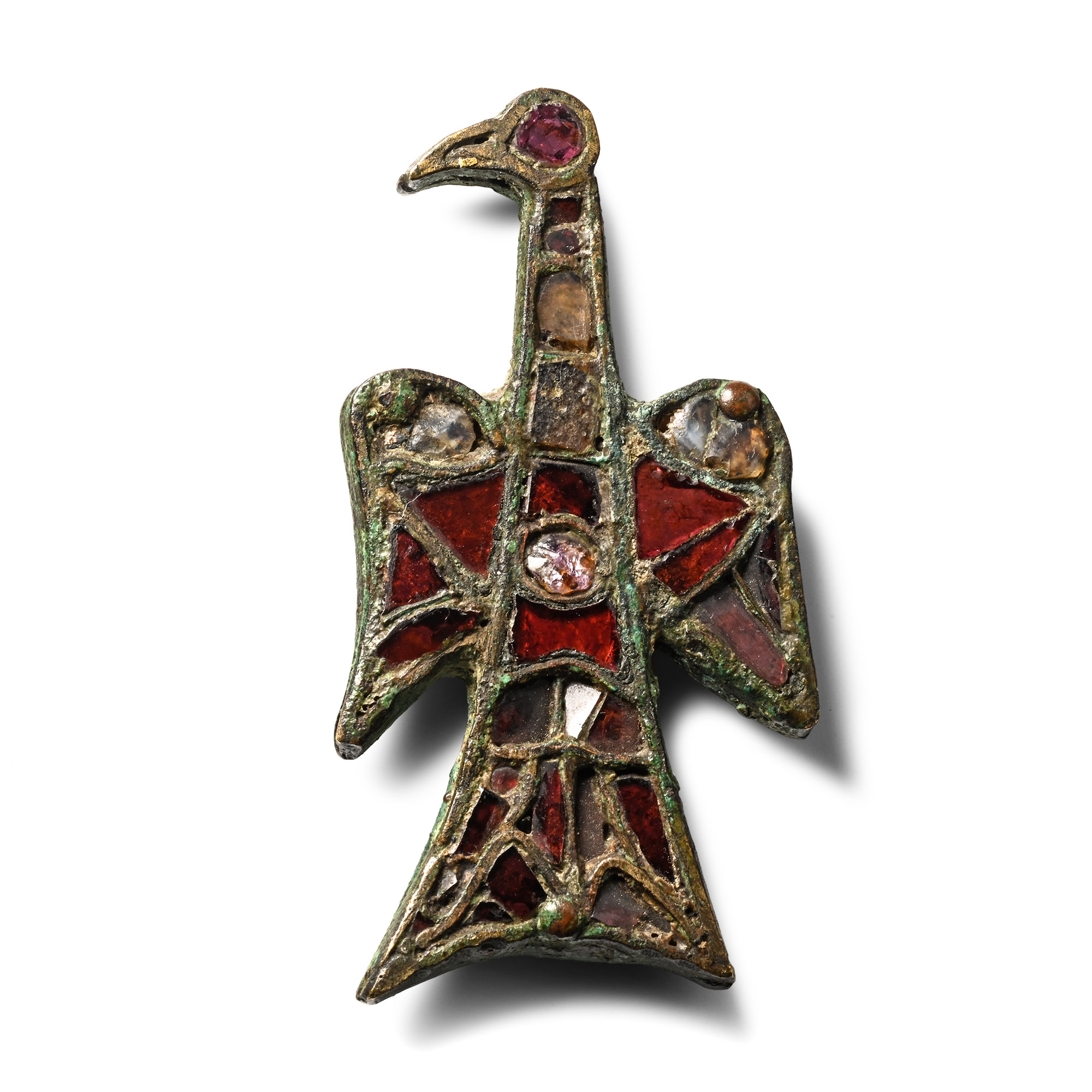
Adolphe Stoclet (1871-1949), a Belgian industrialist, kept his collection in the Brussels house that Josef Hoffmann of the Vienna Secession built for him, with a frieze by Gustav Klimt in the dining room. From about 1915 he filled it with early Italian paintings, medieval enamels, Chinese bronzes, pre-Columbian art and Egyptian sculpture, at a time when mixing ages and cultures in one house was a new taste. In 1931 he bought a bronze eagle 68 mm high, with garnets set in cells along its neck and body and a domed stone at the centre of its chest. The eagle is Visigothic in style and may have been a saddle appliqué, like those found in the fifth-century princely graves at Apahida in Romania. It stayed with Stoclet's family until Sotheby's sold it in London in 2018, and it then passed to Dr Ernst Boehlen of Bern.
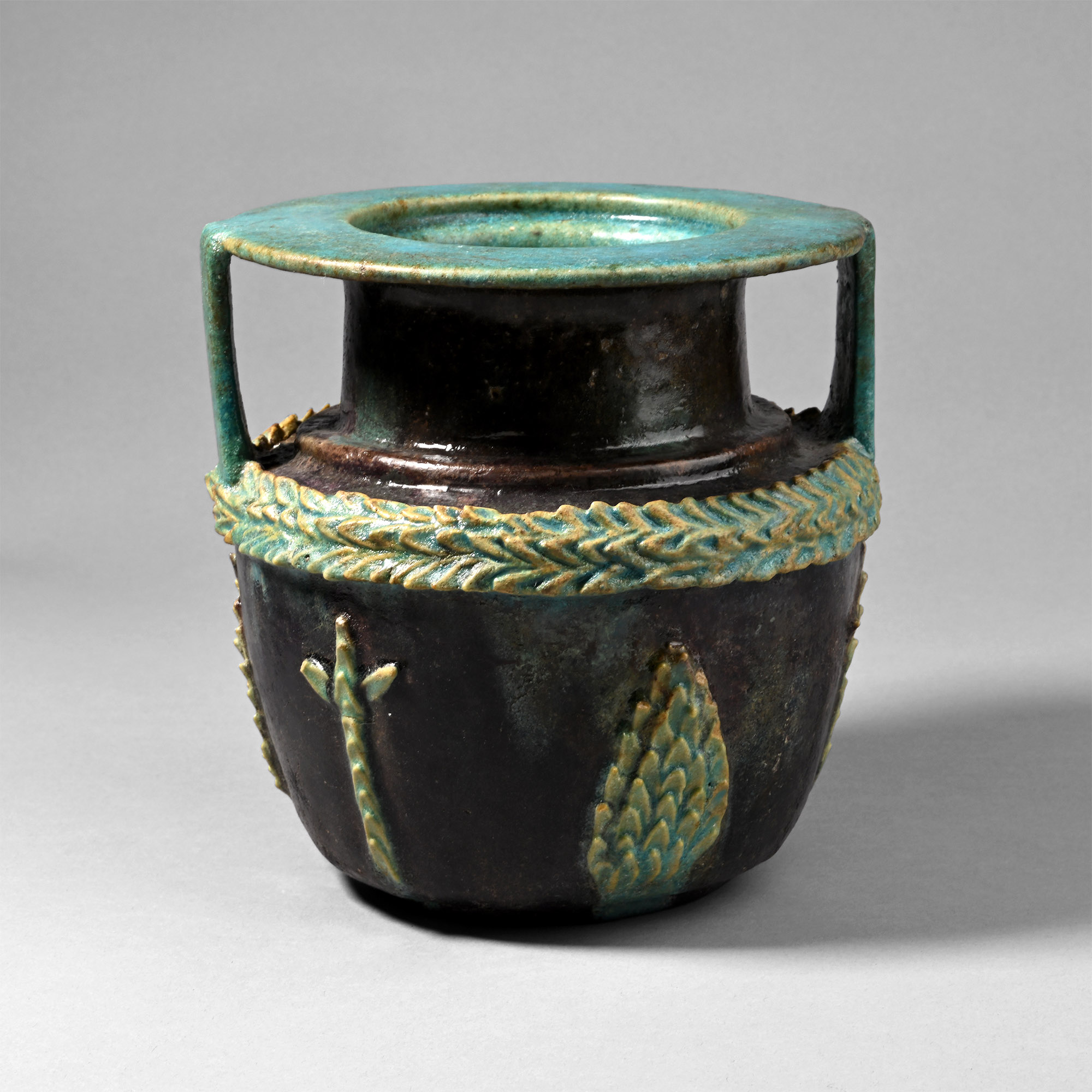
Stift Neuberg, the old abbey above the Neckar at Heidelberg, was in private hands from 1798 until 1926, and by 1893 a collection of antiquities had been assembled there. The faience amphora of lot 75 belonged to that collection into the twentieth century, and is believed to have been acquired by Friedrich Alexander von Bernus (1838-1908), who inherited the house from his relative Johann Friedrich Schlosser, a nephew of Goethe. The amphora was made in Roman Egypt around the second century AD and stands 17.8 cm high, its body a deep, glossy cobalt, with turquoise handles and rim, a turquoise wreath round the shoulder and fronds rising up the sides. From Heidelberg it went to a sale at Münzen und Medaillen in Basel in 1972, then to Fiorella Cottier-Angeli in Geneva, to Herbert A. Cahn, to the Galerie Günter Puhze in Freiburg and, in 2007, to a private collection in the American Midwest. Cahn was a founder of Münzen und Medaillen, and both his name and his firm's are in the Samos tetradrachm's provenance too.
A rare gold coin
Magnentius seized power in Gaul in 350 and held the West until 353, and his mint at Trier struck the gold solidus of lot 4206. It has his bare-headed bust on one side and, on the other, Victory and Liberty holding a trophy between them. The coin is extremely rare and graded Mint State by NGC, and another from the same pair of dies was in the Trau collection sold in 1935.
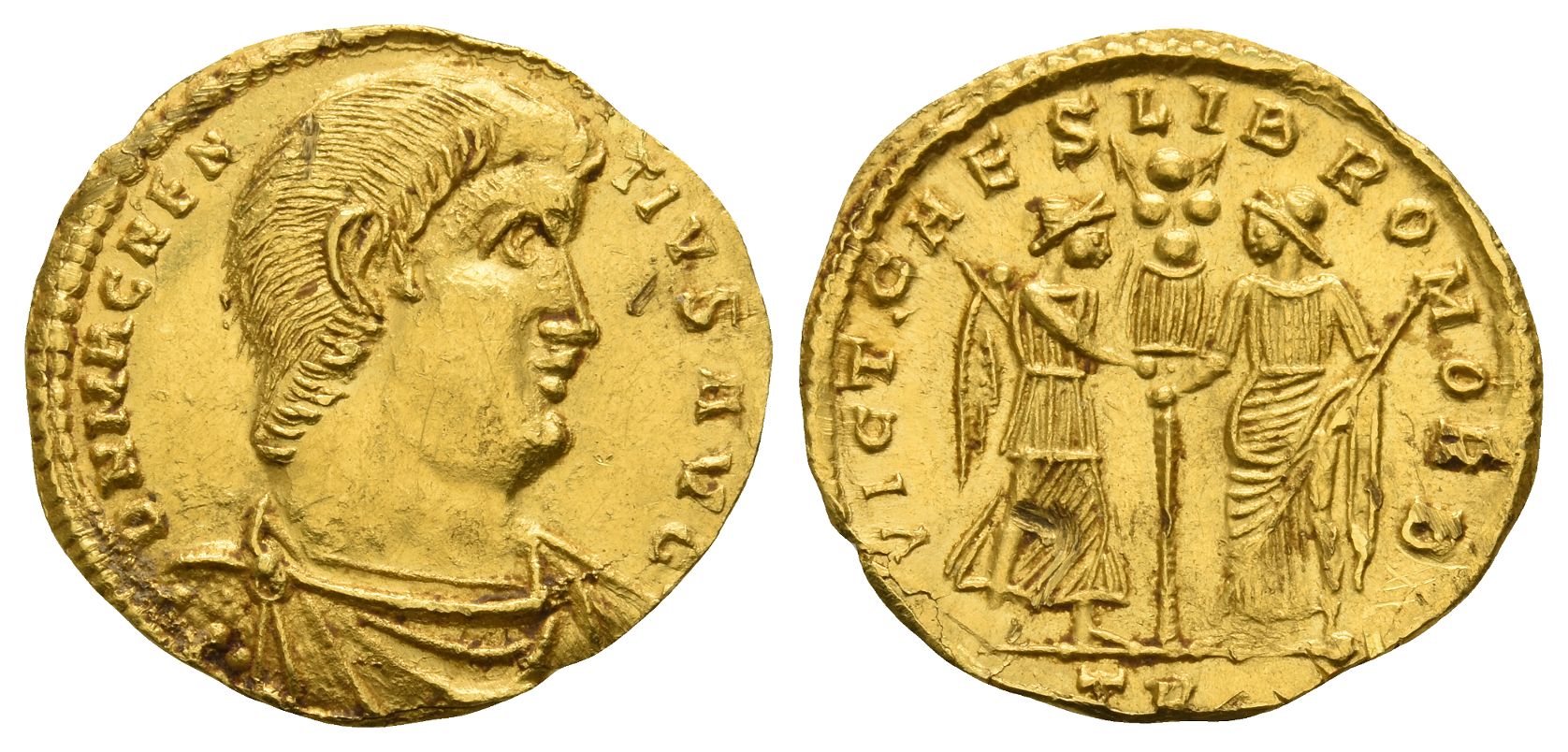
Since October 2013 the solidus has appeared in eight sales, at Künker, Hess-Divo and Nomos and then, from the GK Collection, at Roma Numismatics, Baldwin's and The Coin Cabinet. Each entry gives the house, the auction, the date and the lot, so every step of its recent history can be looked up. An Old Kingdom alabaster duck (lot 33) has a line of the same kind: carved in stone as an offering of food that would never perish in the tomb, and trussed for cooking with its head and neck laid back along its spine, it was in a private French collection before 1970, passed through two Bonhams sales in 2009 and 2013, and was in the Prince collection in the UK until 2017.
Where the Sussex cat's line begins
The Sussex cat's line begins with Hilton Price, who signed the preface to his catalogue at 17 Collingham Gardens, South Kensington, in February 1897. The book has been digitised, and on page 314 thirteen cats are listed one under another, eleven of them from Bubastis.
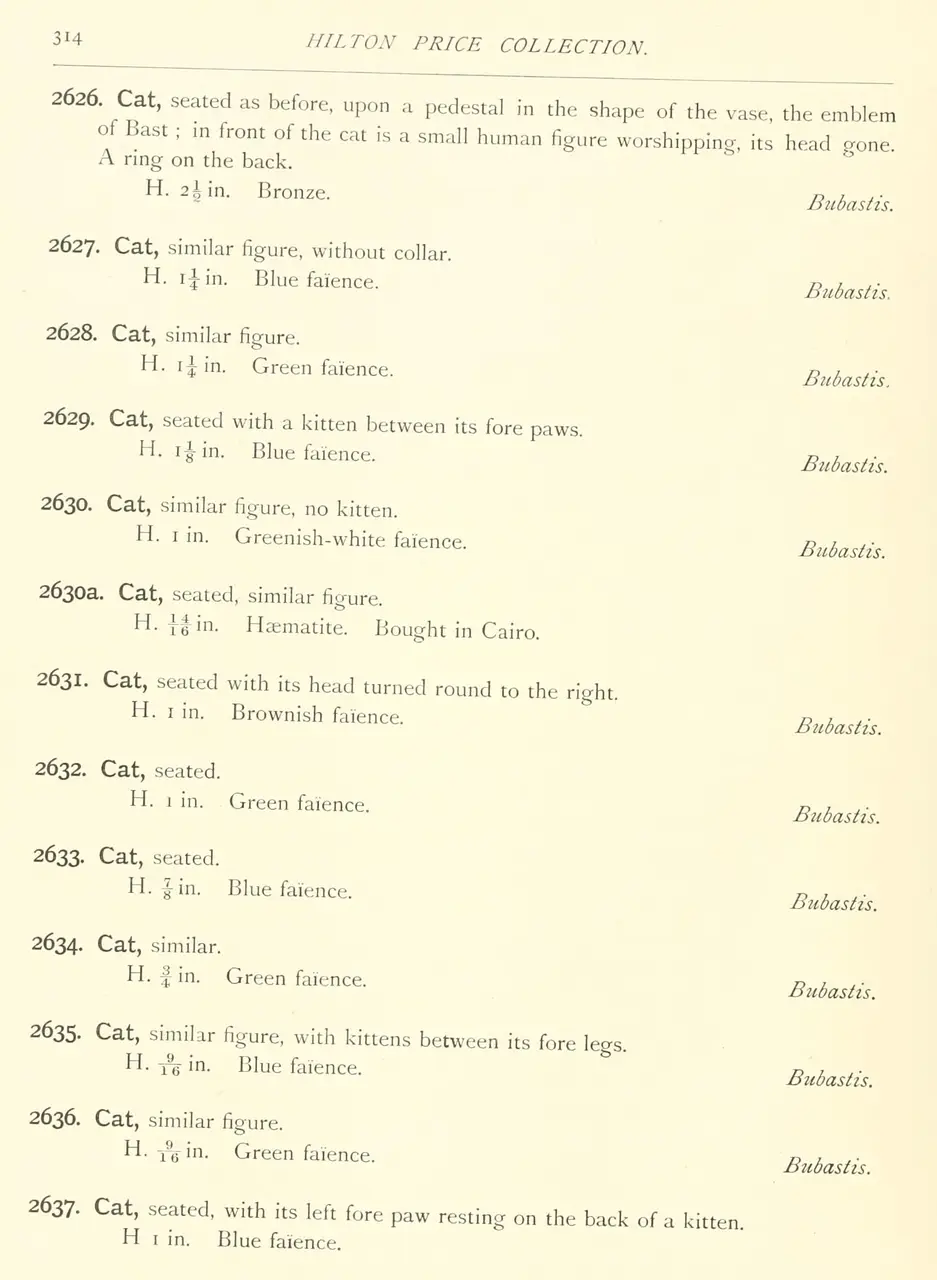 Page 314 of F.G. Hilton Price's catalogue of his Egyptian antiquities, published by Bernard Quaritch in London in 1897, with no. 2631 halfway down. Public domain, New York University Institute of Fine Arts Library copy via the Internet Archive.
No. 2631 is "Cat, seated with its head turned round to the right. H. 1 in. Brownish faïence. Bubastis." It is a description the Sussex cat would fit, a little under an inch of brownish faience sitting with its head turned, with Hilton Price's name on the square of paper that came with it and three shillings and sixpence in the corner.
TimeLine Auctions
