
Loading, please wait...
LOT 0060
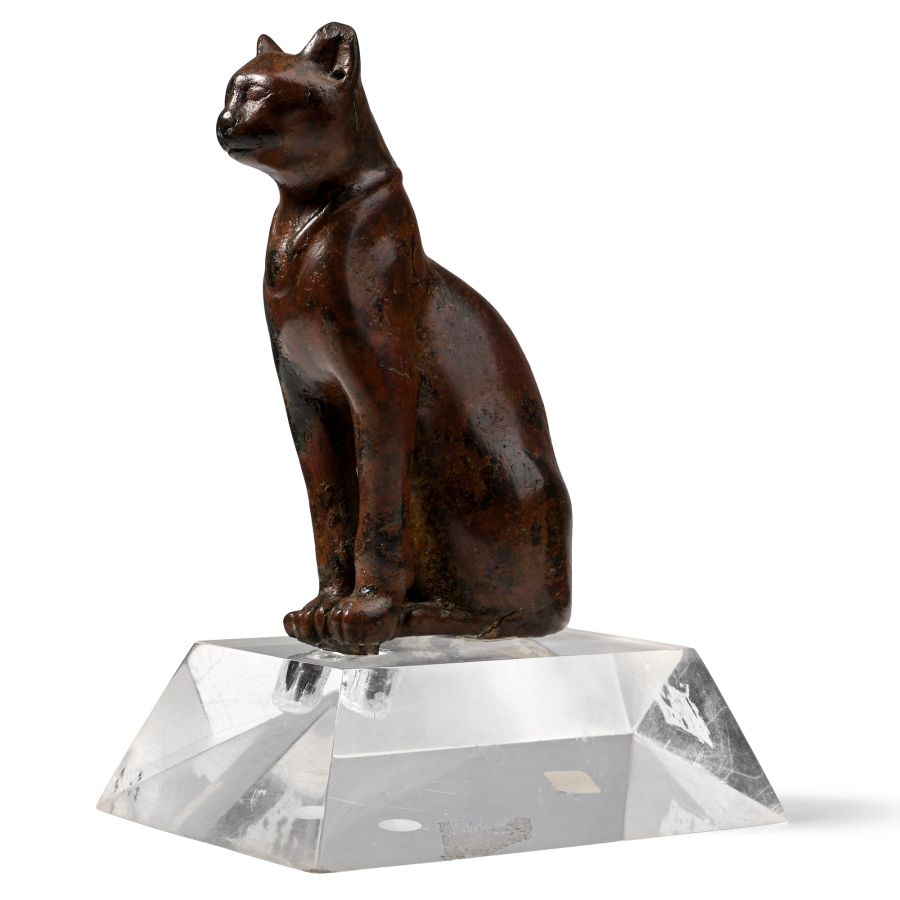
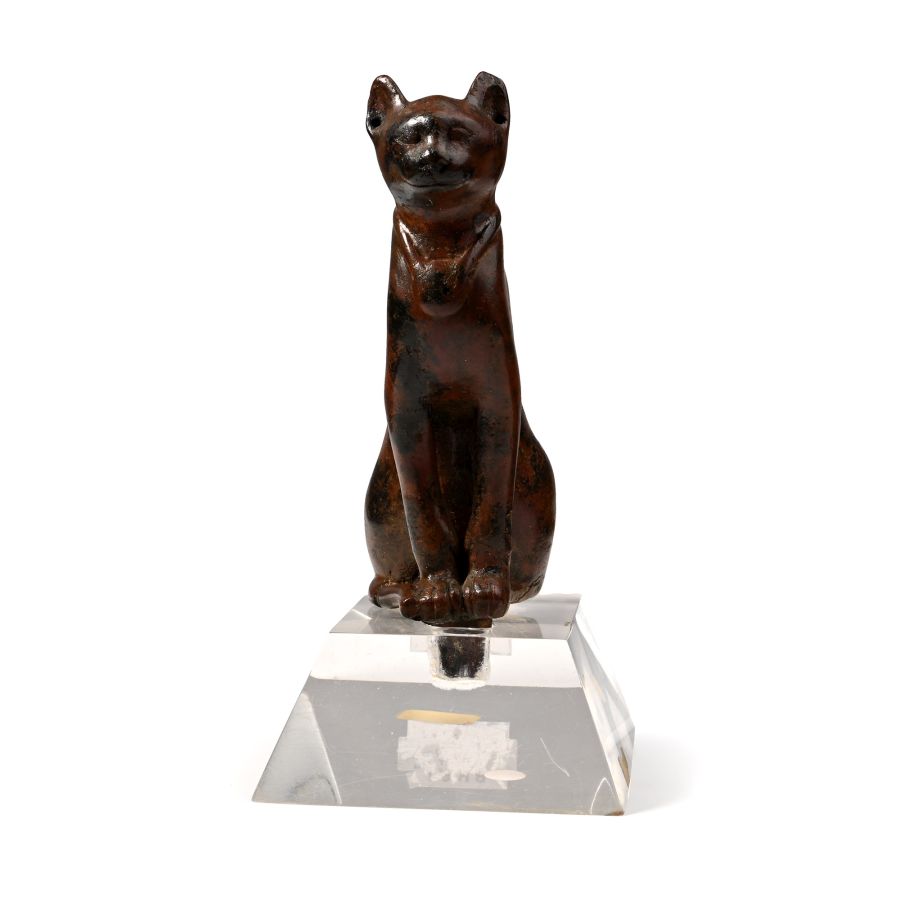
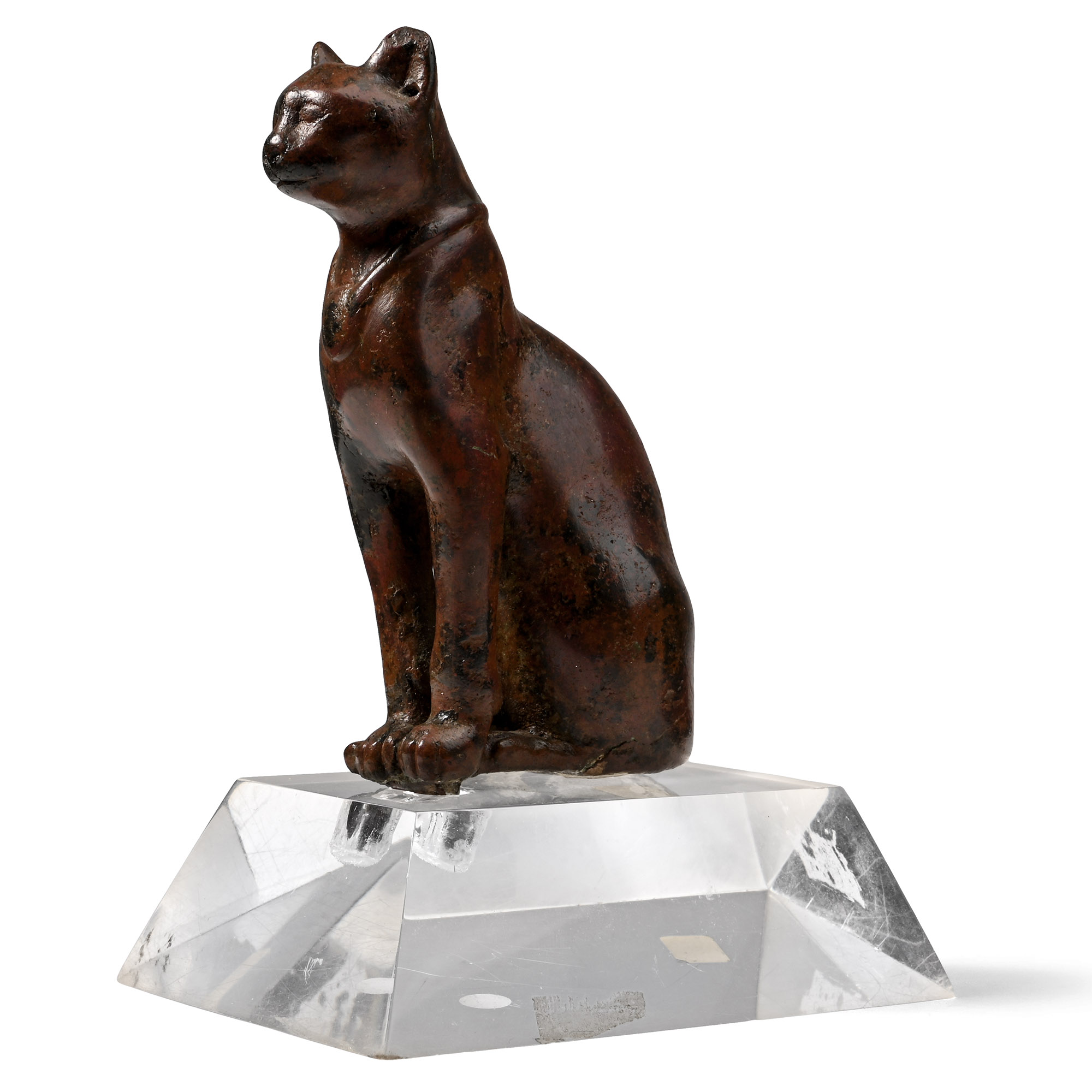
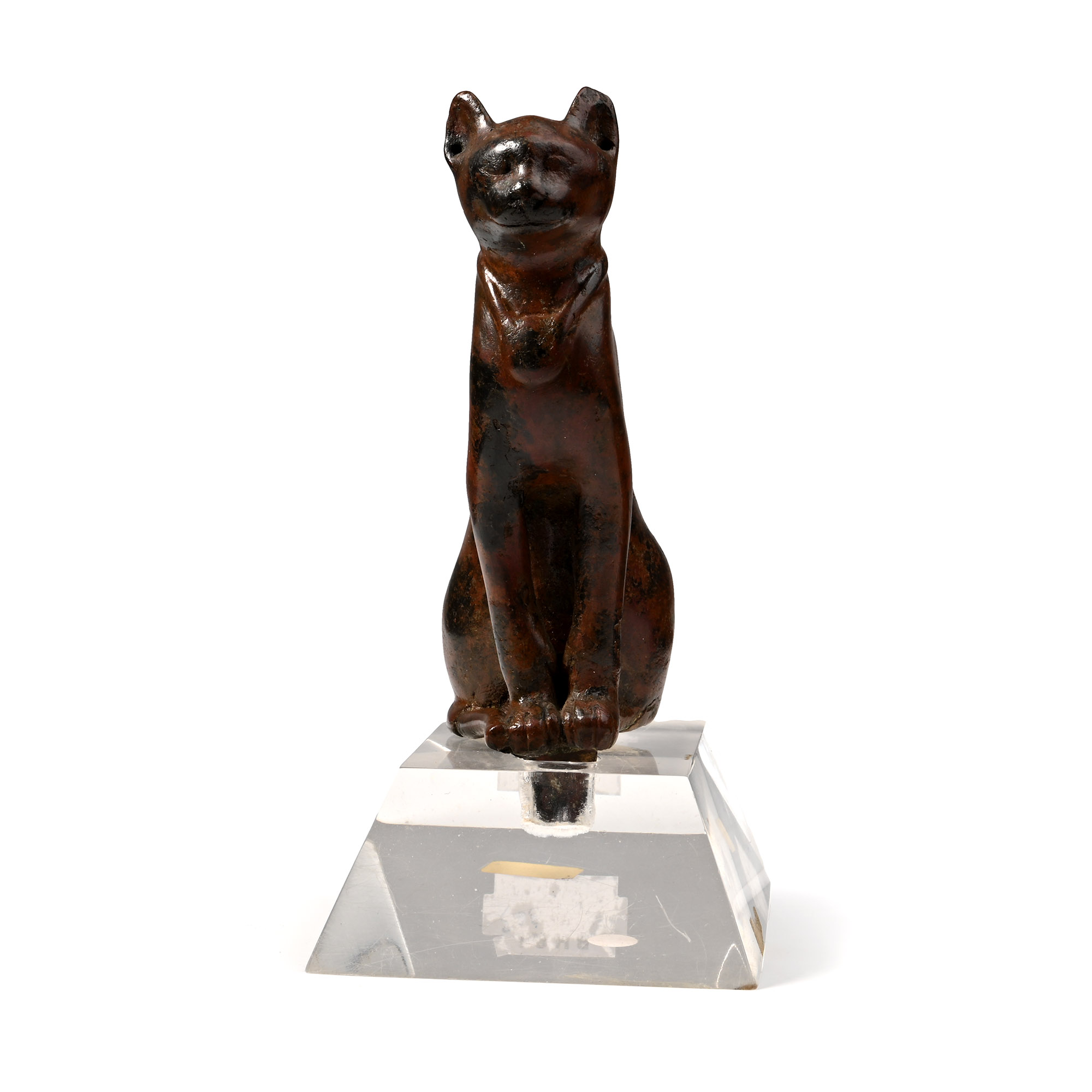
'The Fitzgerald' Egyptian Bronze Statue of the Seated Cat Goddess Bastet
LATE PERIOD, 26TH-30TH DYNASTY, CIRCA 664-332 B.C.
4 3/8 in. (470 grams total including stand, cat: 11.2 cm high).
Modelled seated, its tail wrapped around one side of its body and resting on a front paw, both ears pierced, wearing a collar featuring a large amuletic pendant, a rectangular tang for attachment to a separate element below; mounted on a 1970s custom-made perspex display stand. [No Reserve]
ProvenanceDr Desmond Fitzgerald collection, no.28.
Ex Nick Wright, 1990.
From the collection of Charlie Watts (The Rolling Stones drummer).
This lot has been checked against the Interpol Database of stolen works of art and is accompanied by search certificate no.13462-261733.
Cf. similar cat on display in the Capitoline Museum, Rome, Italy, accession number 18292; Scott, N.E., The cat of Bastet, in The Metropolitan Museum of Art Bulletin, xvii [1] Summer 1958, New York, 1-7; see also Malek, J., The Cat in Ancient Egypt, London, 1993.
FootnotesThe cat was the most sacred animal in ancient Egypt and associated with the cat-headed goddess Bastet, daughter of Re. When represented in human form as a cat-headed female, she usually holds a sistrum (a musical rattle) in her right hand with a supine cat on its top, and an aegis in her left. Small kittens are often shown at her feet. Her most important cult centre was at Bubastis (Tell Basta) in the north-east Delta. The site today is heavily ruined and the temple destroyed. Sir Flinders Petrie excavated at Bubastis and other nearby Delta sites in the 1880s. Tombs of some of the temple officials have been found nearby, and vast cemeteries of mummified cat burials left as votive offerings; so many thousands were found that they were used locally as fuel. Since Petrie’s investigations, the site has been abandoned and only in recent years have excavations begun to be undertaken. In painted nobles’ tombs at Thebes, a cat is often represented seated beneath the chair of the noble’s wife. In the 5th century BC, the Greek historian Herodotus wrote that the festival of Bastet at Bubastis was the most elaborate of all those in Egypt. The Roman geographer Strabo wrote that the cat was so revered in Egypt that an Egyptian dashed into his burning house to save the cat, then returned to rescue his family.
CONDITIONTimeLine Auctions follows a vetting process to ensure the authenticity and legality of all items, reinforcing our commitment to integrity and responsible trading. Each antiquity, antique, and coin lot undergoes thorough examination by a vetting committee of at least ten external specialists, professional trade association members, scientists, and archaeologists: Our Vetting Process
AUCTIONS:
TimeLine is a leading auction house specialising in antiquities, ancient art, collectables, natural history, coins, medals, and books. Our auctions offer museums, collectors, historians, and enthusiasts the opportunity to acquire unique and historically significant pieces.
LOT 0060
'The Fitzgerald' Egyptian Bronze Statue of the Seated Cat Goddess Bastet
Estimate £3,000 - 4,000€3,480 - 4,640 (for guidance only)$4,050 - 5,400 (for guidance only)
-
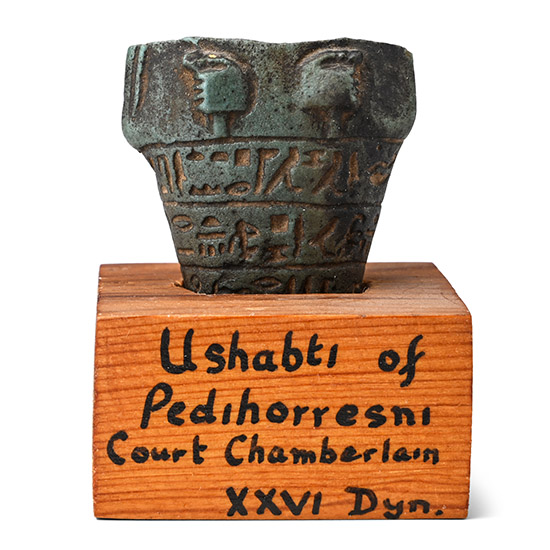
Egyptian Green Stone Shabti Fragment of Padihorresnet, Chief Steward of Amun
Late Period, Reign of Necho, 26th Dynasty, 609-593 B.C.Estimate: £100 - 140 (+bp*)
Bids: 1 | Current Bid: £5
Upper torso fragment with crossed hands, horizontal bands of hieroglyphic text to back and front, display stand with legend 'Ushabti of Pedihorresni, Court Chamberlain XXVI Dyn.'; son of Akhanenru. 30.6 grmas total, 48 mm including stand
Acquired Portabello Road, 14 December 1957, for 5 shillings. From the private collection of Peter Clayton, FCILIP, Dip, Arch, FSA, FRNS, Hemel Hempstead, Hertfordshire, UK; formed since the late 1950s. Accompanied by an old handwritten information card by Peter Clayton, collection no.5.
Padihorresnet served as the chief steward of the God’s Wife of Amun, Nitokris, during the reign of Necho. His monumental tomb (TT 196) is in the Asasif necropolis at Thebes alongside other high officials of the early 26th Dynasty. Padihorresnet's hardstone shabtis lack a back pillar, linking them more closely to the previous 25th Dynasty than to those of the 26th. -
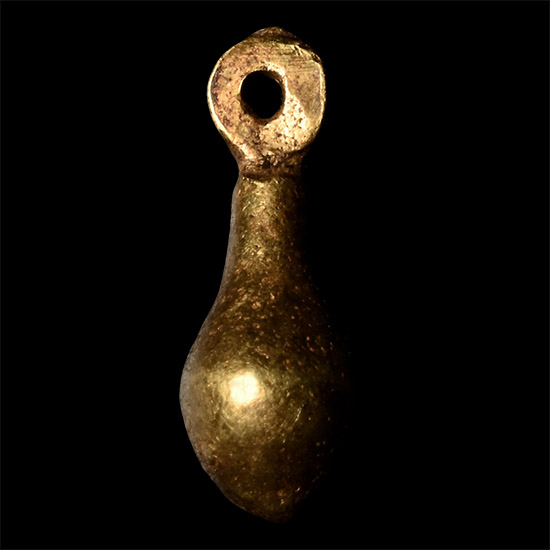
Egyptian Gold Pendant Amulet
Late New Kingdom-Third Intermediate Period, circa 1069-900 B.C.Estimate: £100 - 140 (+bp*)
Opening Bid: £50
Formed as a bulbous seed with a tapering stalk, a ribbed suspension loop above. 0.56 grams, 9 mm
Ex early 20th century French collection. -
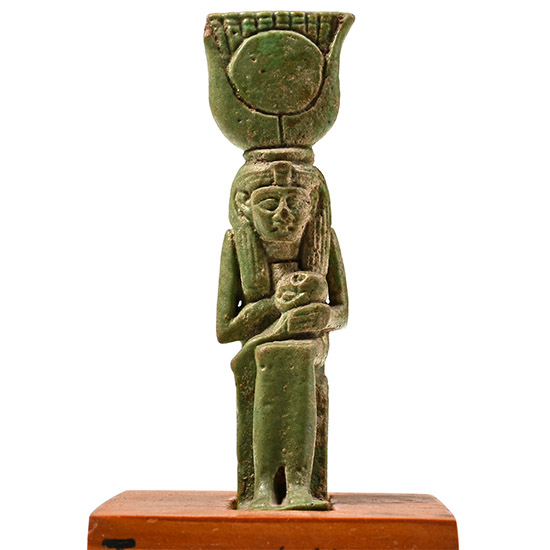
Egyptian Green Glazed Faience Amulet of the Goddess Isis with Horus
Late Period, 26th Dynasty, circa 600-700 B.C.Estimate: £400 - 600 (+bp*)
Bids: 6 | Current Bid: £45
Figurine of Isis nursing Horus, seated with a sun disc and a horned headdress; dorsal pillar with hieroglyphic text; suspension hole pierced through the back of the headdress; on a display stand with the legend 'Isis and Horus XXVI Dynasty'. 36.12 grams total, 80 mm including stand
Acquired Herne Bay High Street, circa June 1957, for £1.00. From the private collection of Peter Clayton, FCILIP, Dip, Arch, FSA, FRNS, Hemel Hempstead, Hertfordshire, UK; formed since the late 1950s. Accompanied by an old handwritten information card by Peter Clayton, collection no.3.
Isis, one of the principal goddesses of the Egyptian pantheon, was revered as the divine mother, protector of kingship, and mistress of magic. As Osiris's wife and Horus's mother, she embodied maternal care, resurrection, and cosmic order, playing a central role in mythological narratives of death and renewal. Isis lactans statuettes, in particular, emphasise intimate maternal interaction, embodying the protective and regenerative aspects of the Isis-Horus myth. Such bronzes were widely dedicated in temple contexts and domestic shrines, where they served as votive objects invoking divine protection, healing, and royal legitimacy.
