
Loading, please wait...
LOT 0650
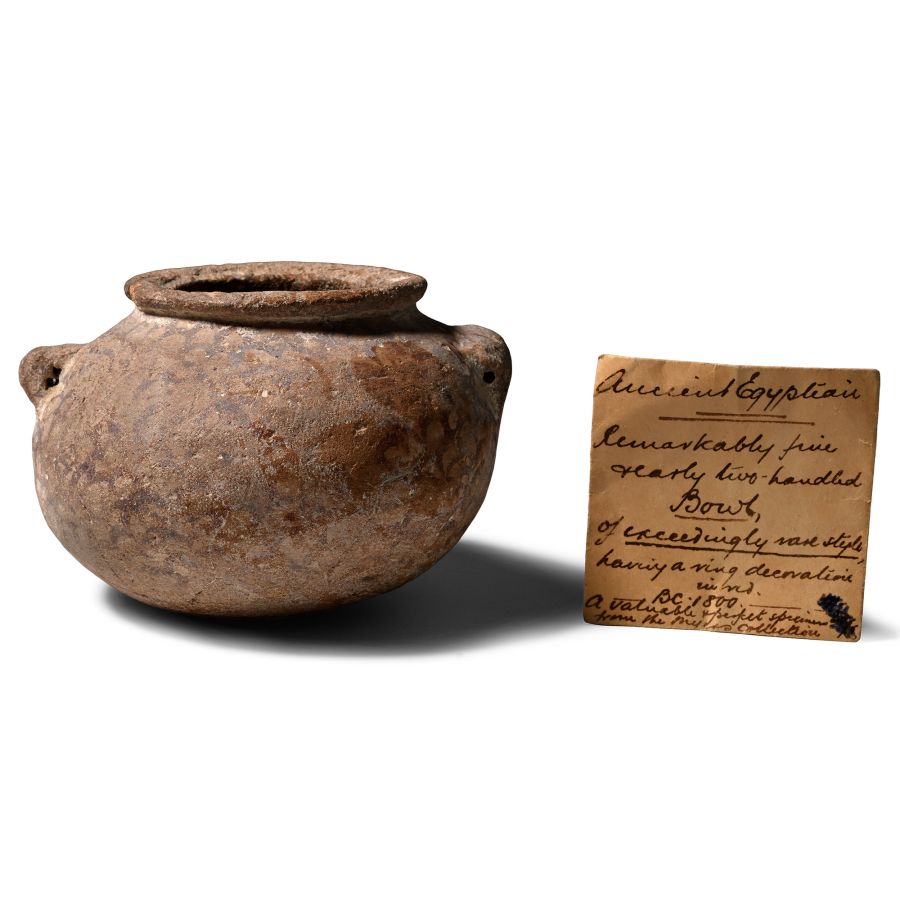
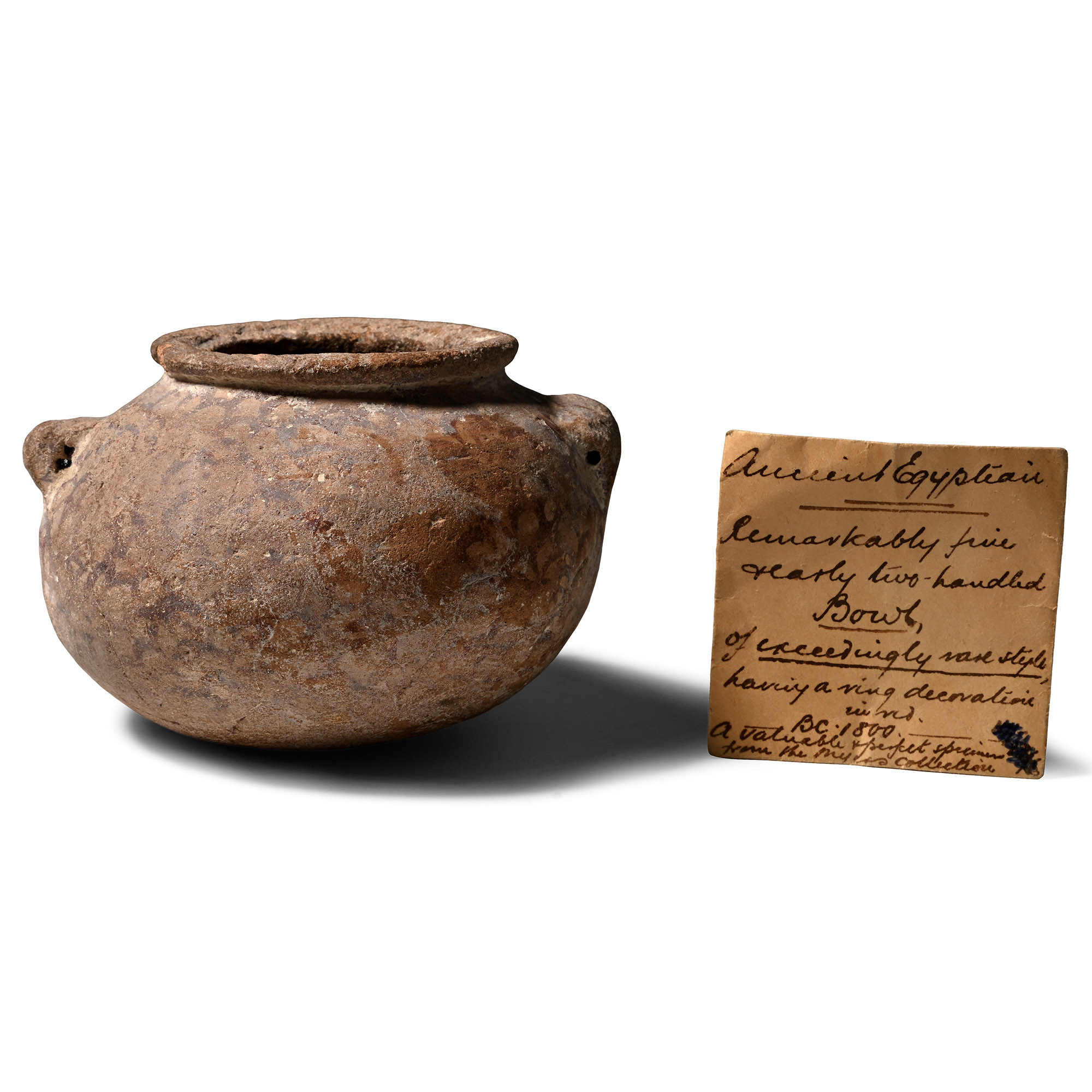
Egyptian Painted Terracotta Bowl
PREDYNASTIC-PROTODYNASTIC PERIOD, CIRCA 3900-3200 B.C.
4 in. (271 grams, 10.3 cm wide).
Squat in profile with everted rim to the mouth, two lateral pierced lugs; old collector's handwritten card 'Ancient Egyptian remarkably fine & early two-handled bowl of exceedingly rare style, having a ring decoration in red. B.C. 1800. A valuable and perfect specimen from the Myers Collection'. [No Reserve]
ProvenanceFrom the private collection of Major William Joseph Myers (1858-1899).
From the estate of a deceased Sussex private collector since the early 20th century.
Accompanied by a copy of an illustrated academic report by Simone Musso.
Accompanied by an old original handwritten information card.
Cf. Petrie, W.M.F., Prehistoric Egypt in Egypt 31, London, 1920, nos.63A-B, pl.XXXVI, Class D.
FootnotesThe painted decoration imitates the veining of a hardstone such as basalt or breccia.
CONDITIONTimeLine Auctions follows a vetting process to ensure the authenticity and legality of all items, reinforcing our commitment to integrity and responsible trading. Each antiquity, antique, and coin lot undergoes thorough examination by a vetting committee of at least ten external specialists, professional trade association members, scientists, and archaeologists: Our Vetting Process
AUCTIONS:
TimeLine is a leading auction house specialising in antiquities, ancient art, collectables, natural history, coins, medals, and books. Our auctions offer museums, collectors, historians, and enthusiasts the opportunity to acquire unique and historically significant pieces.
LOT 0650
Egyptian Painted Terracotta Bowl
Estimate £80 - 100€93 - 116 (for guidance only)$108 - 135 (for guidance only)
Opening Bid
£5 (EUR 6; USD 7) +BP*
-
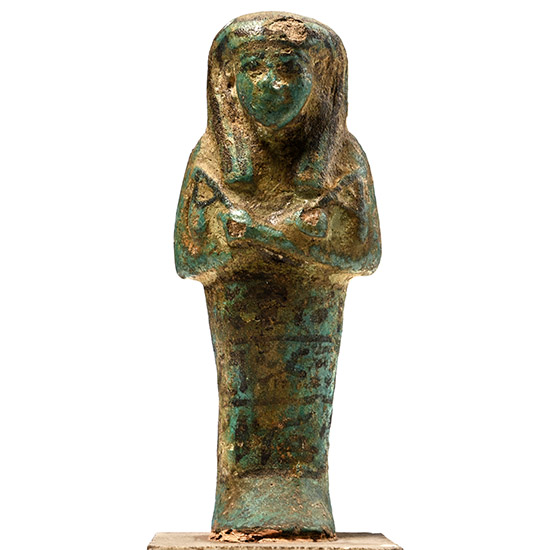
Egyptian Blue Faience Shabti of Pa-Ka
Third Intermediate Period, 21st Dynasty, circa 980-935 B.C.Estimate: £500 - 700 (+bp*)
Opening Bid: £5
Mummiform type wearing a lappet wig, with arms crossed and hands holding hoes; the wig, facial details, and hoes are highlighted in black; three horizontal lines of hieroglyphic text on the lower body, giving the owner's name and an abbreviated version of the shabti spell; mounted on a stand. 192 grams total, 13 cm including stand
Ex E.B.W. Chappelors collection, July 1958. From the private collection of Peter Clayton, FCILIP, Dip, Arch, FSA, FRNS, Hemel Hempstead, Hertfordshire, UK; formed since the late 1950s. Accompanied by an old handwritten information card by Peter Clayton, collection no.42. -
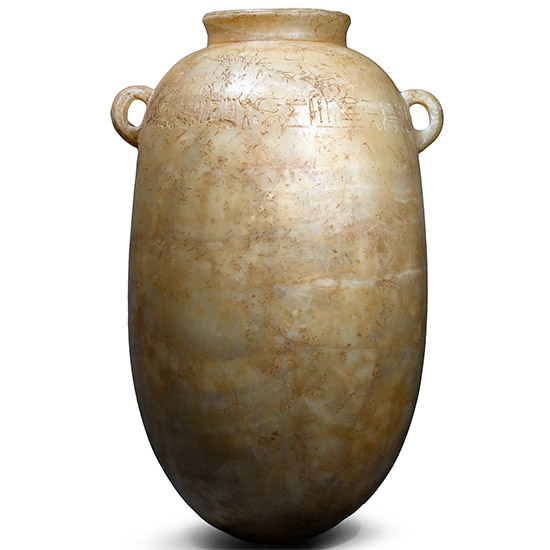
Very Large Egypto-Phoenician Alabaster Alabastron with Hieroglyphic Inscription
Third Intermediate Period-Late Period, circa 1077-525 B.C.Estimate: £12,000 - 17,000 (‡+bp*)
Opening Bid: £6,000
Barrel-shaped in profile, with a rounded base, broad shoulder and flared mouth, and two integral lateral loop handles; a single line of incised hieroglyphic text around the shoulder. 420 grams, 37 cm
Formerly in a private collection, Beirut, Lebanon, 1990s. Swiss private collection, acquired from Mr H., Geneva, 2010. Accompanied by a copy of an Art Loss Register certificate, no.S00059830 This lot has been checked against the Interpol Database of stolen works of art and is accompanied by search certificate number no.13221-249178.
In the Phoenician necropolises of Andalusia, the deceased's ashes were enclosed in luxurious alabaster urns of Egyptian manufacture. At Almuñécar, for example, some urns in the Phoenician necropolis preserved inscriptions and emblems of various Egyptian pharaohs, who ruled the Nile region between the 16th and 8th centuries B.C. Alabaster vessels of this type, originally containing fine wines, have been discovered, albeit in smaller numbers, in the royal palaces of Assur and Samaria in the East, as part of war booty or gifts exchanged between royal houses. -
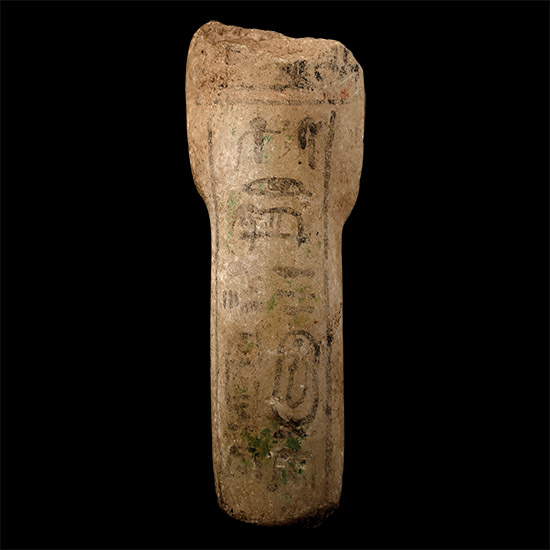
Egyptian Alabaster Shabti of Pharaoh Ramesses VI
New Kingdom, 20th Dynasty, circa 1140-1132 B.C.Estimate: £1,000 - 1,400 (+bp*)
Opening Bid: £5
Formless mummiform shape (head missing), with the lower portions of a lappet wig, schematically represented arms and hands, a collar, and an inscription added in black, with traces of green pigment; the inscription, including two cartouches, reads: 'The illuminated one, the Osiris, Lord of the Two Lands Neb-Maat-Re, beloved of Amun, Master of Appearances, Ramesses', sḥḏ wsı͗r nb tꜢwy (nb-mꜢꜤt-rꜤ mry ı͗mn) nb ḫꜤw (rꜤ-ms.sw). 431 grams, 14.7 cm
Acquired March 1977. From the private collection of Peter Clayton, FCILIP, Dip, Arch, FSA, FRNS, Hemel Hempstead, Hertfordshire, UK; formed since the late 1950s. Accompanied by an old handwritten information card by Peter Clayton, collection no.126.
This rather rudimentary, peg-like shabti is characteristic of those for Ramesses IV, VI, and VII, as well as of non-royal figurines of the 20th Dynasty. Because of their virtually featureless appearance, which relies entirely on painted details, this shabti type has been referred to as 'à contours perdus' ('with lost outlines').
