
What Does "Hammer Price" Actually Mean? An Auction Glossary
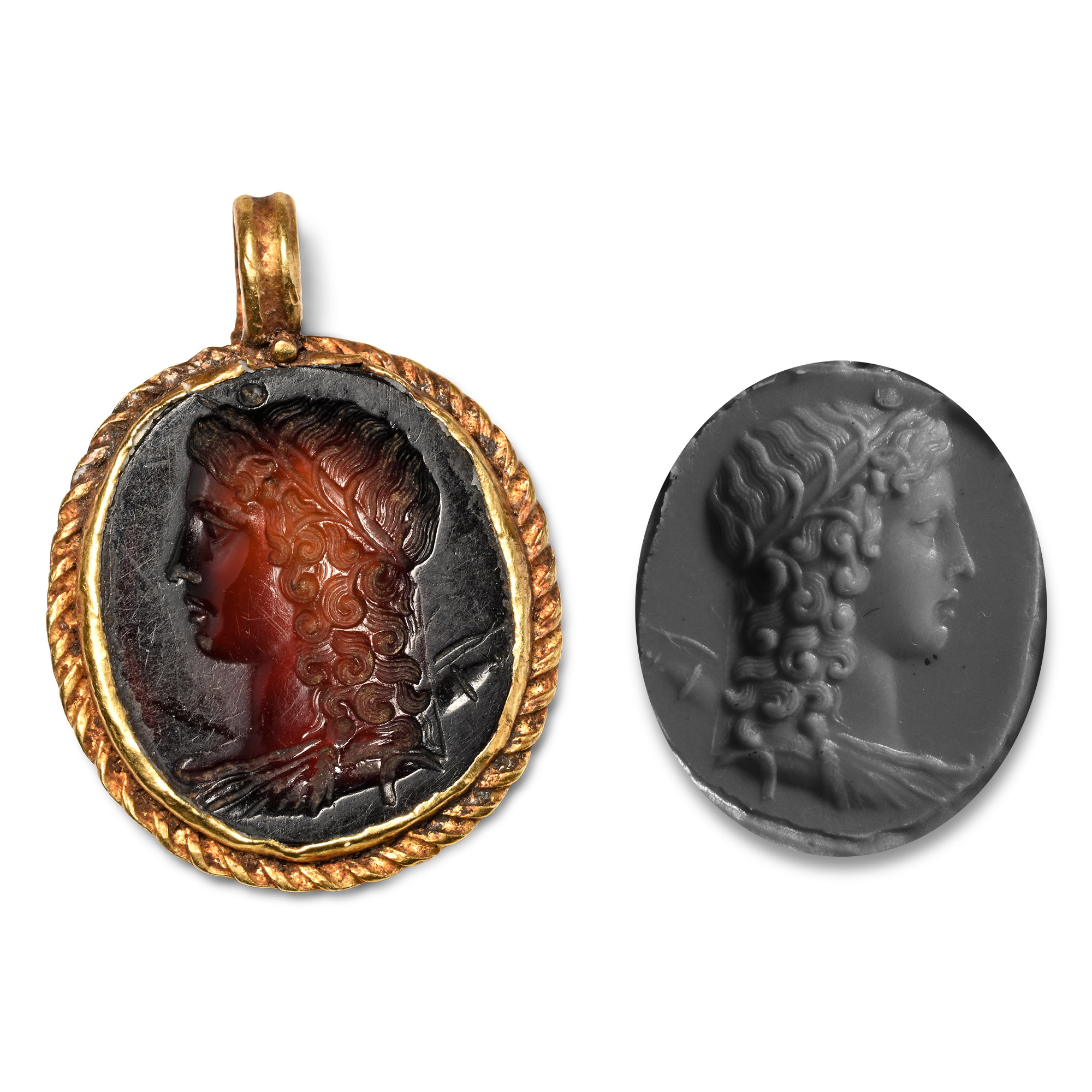
At our sale of 3 March 2026 a small Graeco-Roman gemstone, a sard engraved with the god Apollo and set in a later gold mount, carried a pre-sale estimate of £1,200. The bidding ran past it and did not stop. The hammer fell at £10,000, and the buyer paid £13,000.
Three different numbers, and every one of them has a name. The hammer price was £10,000: the winning bid, the figure the auctioneer accepts as the hammer comes down and the lot is sold. It is the number quoted in results and the one collectors mean when they say what a piece "made." It is not the number on the invoice. On top of it the buyer pays the house a percentage called the buyer's premium, plus any tax, so the sum that actually leaves your account is always larger than the bid you made. Almost every tangle at a first auction is this same one: the bid, the fees added to it, and the total that results are three different figures, and telling them apart is most of the battle.
"Strike price" is a finance term, not an auction one
Strike price belongs to a different trade. In finance it is the fixed price at which the holder of an option may buy or sell the thing the option is written on, and it has nothing to do with a saleroom. It wanders into auction talk because the language of the rostrum is full of striking: a lot is knocked down, or struck down, to the highest bidder when the hammer falls, and to strike a bargain is older still. So when someone uses "strike price" about an auction, they almost always mean the hammer price, and once in a while they mean the reserve, the floor the bidding has to clear. No auction house prints the term on anything. If you meet it, read it as hammer price and confirm which figure the other person has in mind before any money moves.
The estimate and the reserve
Every lot goes to sale carrying an estimate, a low and a high figure printed in the catalogue that the specialists expect the bidding to reach. It is an informed opinion and nothing more binding than that. The Apollo gem's estimate of £1,200 was an honest reading that the room disagreed with by a factor of ten, which is what an auction is for: the estimate is a suggestion, the hammer is the verdict.
Underneath the estimate, usually out of sight, sits the reserve. The reserve is the confidential figure the seller has agreed the lot will not sell below. By long convention it may not be set above the low estimate, and it is often set under it, so a lot listed at £1,000 to £1,500 might carry a reserve of £800. If the bidding never reaches the reserve, the lot goes unsold, or in the trade's own word, is bought in, and returns to the seller. You will never be told the reserve outright, but you always know its ceiling: it cannot be higher than the low estimate.
Buyer's premium and seller's commission
Two commissions pay for the house, one from each side of the sale, and between them they keep the hammer price from ever being the whole story.
The buyer's premium is the percentage the winning bidder pays on top of the hammer. At TimeLine it is 30 per cent of the hammer price, VAT included; rates at other houses vary but sit in a similar band, and some are tiered so the rate drops as the hammer climbs. On the Apollo gem, 30 per cent of the £10,000 hammer carried the total to £13,000. This is the single figure new bidders most often leave out of their sums, and there is no opting out of it.
The seller pays as well. The seller's commission, also called the vendor's commission or a seller's premium, is the house's percentage of the hammer taken out of the consignor's proceeds. At TimeLine it is 18 per cent including VAT on a single item of modest value, with lower rates for high-value pieces, significant collections and regular consignors. A seller who set a reserve on a lot that then fails to sell pays a smaller charge, 6 per cent at TimeLine, for the cataloguing and the offering. Put both commissions side by side on a lot hammered at £10,000: the buyer pays £13,000, while the seller, on the standard rate, keeps about £8,200. The difference is what the house earns, and it earns it for the audience it assembles and the sale it runs, not for owning the object, which it never does.
The catalogue description
The catalogue entry is the house's formal statement about the object, and its wording is chosen with care, because it is the part a buyer can later hold the house to. A description sets out the material, the type, the measurements, the date and, where it is known, the provenance, meaning the documented record of who has owned the piece before. In antiquities the dating is the load-bearing phrase, and the confidence of the wording is deliberate: "Roman, 1st century AD" claims more than "Roman provincial, probably 2nd to 3rd century AD," and a careful house pitches the words at exactly what it can defend.
Read the description closely, because the qualifiers carry the meaning. "Probably," "possibly," "in the style of" and "of the period" each tell you where the specialist's certainty ran out. The headline attribution is generally what the house guarantees, subject to the terms printed at the front of the catalogue, while the softer clauses show you where it stopped short. What the entry leaves out matters too: if a repair or a restoration bears on value, an honest catalogue names it, though the full account of an object's physical state lives in a separate document.
The condition report: what it promises and what it doesn't
A condition report is a written account of the object's physical state, supplied by the house on request and frequently not printed in the catalogue at all. It records what a photograph hides and what bears on value: chips, cracks, losses, old repairs, restoration, resurfacing, whether a bronze has been cleaned and stabilised, whether a vessel has been reassembled from fragments. For an antiquity, some wear and some repair are normal and expected; the report is how you learn which is which before you bid rather than after the parcel arrives.
 The François Vase, an Attic black-figure volute-krater signed by the potter Ergotimos and the painter Kleitias, about 570 to 565 BC, in the Museo Archeologico Nazionale, Florence. Found in fragments at Chiusi in 1844, it has been reassembled with the missing areas left plain. Photo: Ancient History Encyclopedia, CC BY-SA 3.0, via Wikimedia Commons.
A condition report is an opinion given in good faith, not a warranty. It describes what a trained eye saw under gallery light, and it will usually say as much. If condition is going to decide your bid, ask for the report in writing, ask in particular about restoration and repair, and where the piece is valuable enough, see it in person or send someone who can. A point not mentioned is not a point guaranteed absent; it is the edge of what one examination found.
The academic report: a scholar's name on the object
Some lots come with an academic report: a written opinion commissioned from an outside specialist, a scholar or curator with standing in the field, on the object's attribution, date and cultural context, and sometimes its authenticity. It is not a condition report, which describes physical state, and not a scientific test such as thermoluminescence, which measures the age of the material itself. The academic report is a considered human judgement, and its weight rests on the reputation of whoever signed it.
For a collector it does two jobs. A report from a recognised authority raises confidence at the moment of purchase, and it travels with the object as part of its documentation, which strengthens the piece when it is next sold. It stays an opinion, though, and opinions in this field are revised as scholarship moves; a second specialist may read the same object differently. Weigh a report by who wrote it and how specific it is, treat it as evidence rather than proof, and remember that the safest ground is several independent lines agreeing at once: a sound provenance, a description the object supports, a clean condition report and, where it exists, a scientific test.
A few more terms you'll meet
A handful of smaller words fill in the rest. A lot is the numbered unit offered for sale, whether that is a single object or a group sold together under one number. Provenance, as above, is the documented history of ownership, and in antiquities it does real work: a piece recorded in a named collection decades ago sits in a different position, legally and commercially, from one that surfaces without a history. Price realised is the hammer plus the premium, the total a house reports once a lot has sold. A commission bid, also called an absentee or left bid, is the maximum you lodge with the house to execute for you when you cannot attend, bid live online, or take a telephone line during the sale. And the under-bidder is the person who pushed you to your winning bid and then let it go: the price you paid is one that somebody else was prepared very nearly to match.
None of it is difficult once the words stop hiding the mechanism. Before you bid, read the catalogue description for what it claims and what it carefully declines to claim, ask for the condition report, and note whether an academic report travels with the lot. Then set your limit at the total you are willing to pay, premium and tax already inside it, and let the hammer fall where it will. You can watch the whole vocabulary at work across a live sale in TimeLine's saleroom, where four times a year every lot arrives with its estimate, its description, and its condition report for the asking. Do that, and the hammer will hold no surprises about the money. The only surprise left is the Apollo gem's kind: how far past its estimate a small carved stone can travel when two people in a room both decide they want it.
TimeLine Auctions, 2nd August 2026
