
Egyptian Bronze Statues Were Sized to the Gift: Why a Large Osiris or Thoth Is Rare
In January 1860 the museum that became the Egyptian Museum in Cairo took delivery of bronze Osirises from Medinet Habu, the temple of Ramesses III at Thebes, and entered them in its register by the batch: eighty-six complete, sixty-five with their feet missing, nineteen in fragments, and seven heads "kept for their fine style". When Georges Daressy catalogued the museum's statues of gods in 1906, he found that figures counted this way had gone into baskets with no label or number, and that a good part of them had later been written off as rejects.
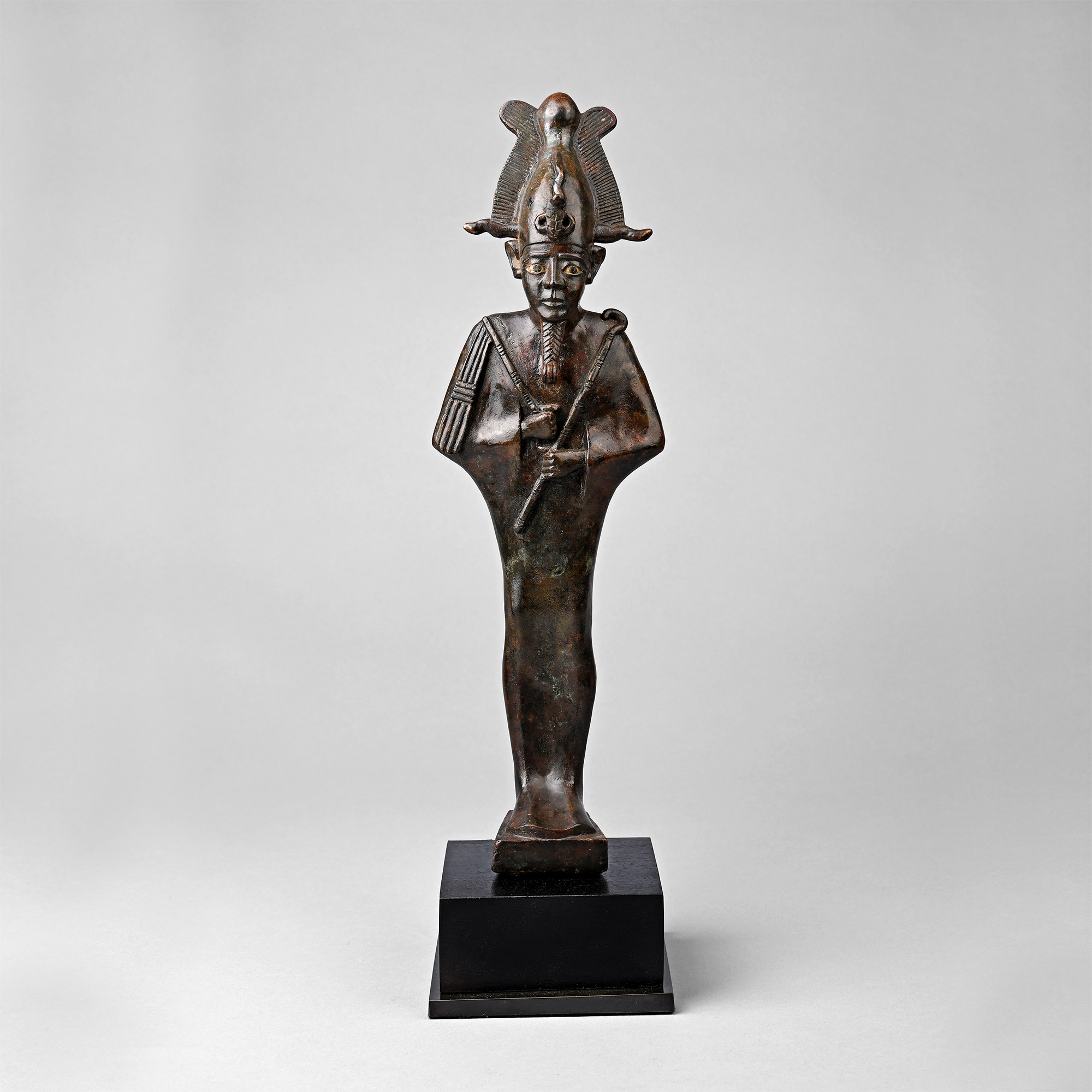
Most Egyptian bronze statues of gods are figures like those: temple gifts of the last seven centuries B.C., made by the thousand and smaller than a hand. A figure's height seems to have followed what its donor could pay, so large ones were always few, and collectors still pay for them by height. TimeLine's sale of 1 December 2026 has both ends of the range, from lot 536, a 15.7 cm Osiris, stand included, at £80 to £100, to lot 46, an Osiris with glass-inlaid eyes that stands 41.5 cm high on its stand, at £18,000 to £24,000.
Why are there so many Egyptian bronze statues?
Between 1903 and 1907 Georges Legrain emptied a single pit at Karnak of more than 700 stone statues and some 17,000 bronzes. At North Saqqara British excavators have registered some 2,400 more since the 1960s. The metal was cheap enough to allow such numbers, because Egyptian founders mixed their bronze with lead, nearly 30 per cent of it in some Osirises, and lead was a by-product of silver smelting.
Gaston Maspero, twice head of Egypt's antiquities service, called most of them "merely articles of commerce, made on the same pattern, and possibly cast in the same moulds, for centuries". The Cairo museum traded its doubles, gave sets of them to dignitaries on the Viceroy's orders and sold others through the sale room it ran for the public. The small ones have stayed within a modest buyer's reach ever since. The Egyptologist Peter Clayton bought two on Herne Bay High Street in June 1957, and both are in this sale: lot 476 at £120 to £170 and lot 423 at £150 to £200.
Gods sized to the gift
'Ayn Manawir was a farming village in the south of the Kharga Oasis, some 150 miles from the Nile Valley, which grew up around 470 B.C. on water channelled from deep underground. When French archaeologists began digging its mud-brick temple of Osiris in 1993, the chapels beside the sanctuary still held nearly four hundred bronzes, some 370 of them Osirises. A few are under 5 cm and the largest is 29 cm, but most come in three heights, about 7, 9 and 11 cm. Many of them, the largest included, stood grouped around the shrine of the cult statue. Dedication formulas of the 26th Dynasty show a donor entrusting a junior priest with a figure's upkeep before the god, in return for the god's protection, and the excavators concluded that the size of a statuette almost certainly followed the size of the donation.
At Saqqara most of the bronzes are between 3 and 30 cm high, with only a few between 30 and 45. Of the four dozen standing bronze Osirises in the Metropolitan Museum in New York, half are under 12 cm and four reach 30 cm or more. Far above them stands Leiden's 106 cm Osiris of the 26th Dynasty, once sheathed in precious-metal leaf.
What is a large Osiris statue worth?
Twenty-one bronze Osirises with recorded sizes have sold through TimeLine since 2020, and their prices climb with height. Those under 10 cm made a median £156, those of 12 to 16 cm £1,170, and those of 21 to 35 cm, stands included, £6,500. The highest was £11,430 for a 33.5 cm figure in September 2020 (all prices include buyer's premium).
Lot 46 stands 41.5 cm on its custom-made stand, taller than any of TimeLine's twenty-one. The feathered white crown carries ram's horns and a uraeus, the rearing cobra, and the eyes are inlaid with glass. The braided beard is braced behind by a short tab, and the hands come out through openings in the tight garment, one fist above the other, to hold the crook and flail. It has been in private hands since the 1970s, first in an old Japanese collection and from 1988 in a British one.
What the donors asked for
Bronze groups survive in which a small worshipper kneels or strides before the god, and their inscriptions say what the gift was for. One in Boston shows a man striding before an ibis, and its text asks "Thoth, God Twice Great, Lord of Khemenu", the god of Hermopolis, for "life, health, strength, a long life, and a great good old age" for Tja-a'a, son of Iretiru, born of Heqer. Such texts are scarce, since of the 2,400 bronzes registered at Saqqara only about sixty published pieces are inscribed, and most of those are ritual vessels and other temple equipment, so the great majority of figures carry no words at all.
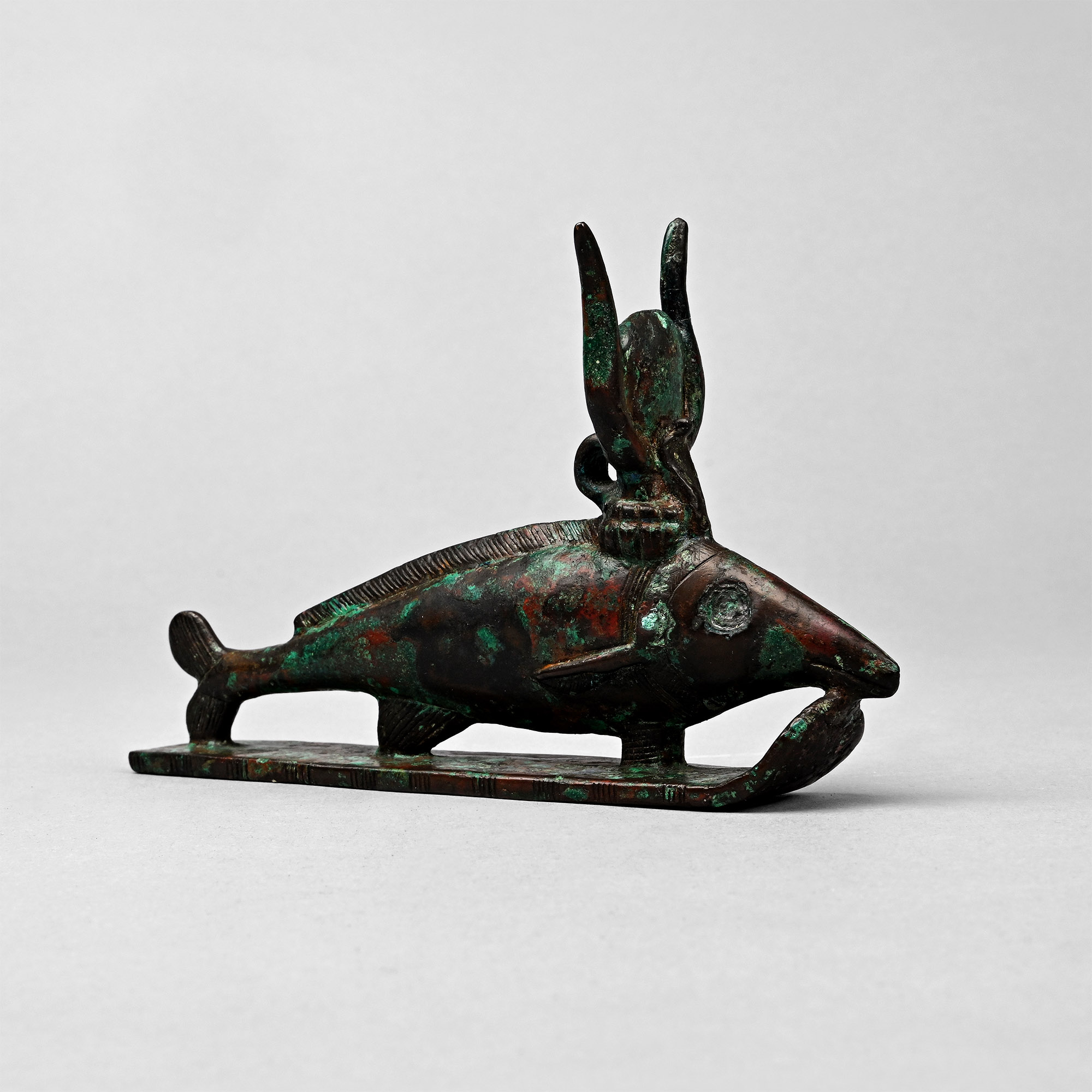
Lot 616 is one of the inscribed few, a 17 cm bronze of the Oxyrhynchus, the elephant-snout fish of Per-Medjed, which was believed to have swallowed the penis of the dismembered Osiris. The fish wears the horned sun disc of Hathor and Isis and rides a sledge. Under the sledge a few hieroglyphs of its dedication survive, with part of a name, ...Ta-ir-di-ankhet..., which is built, like the formula itself, from the signs for "give" and "life".
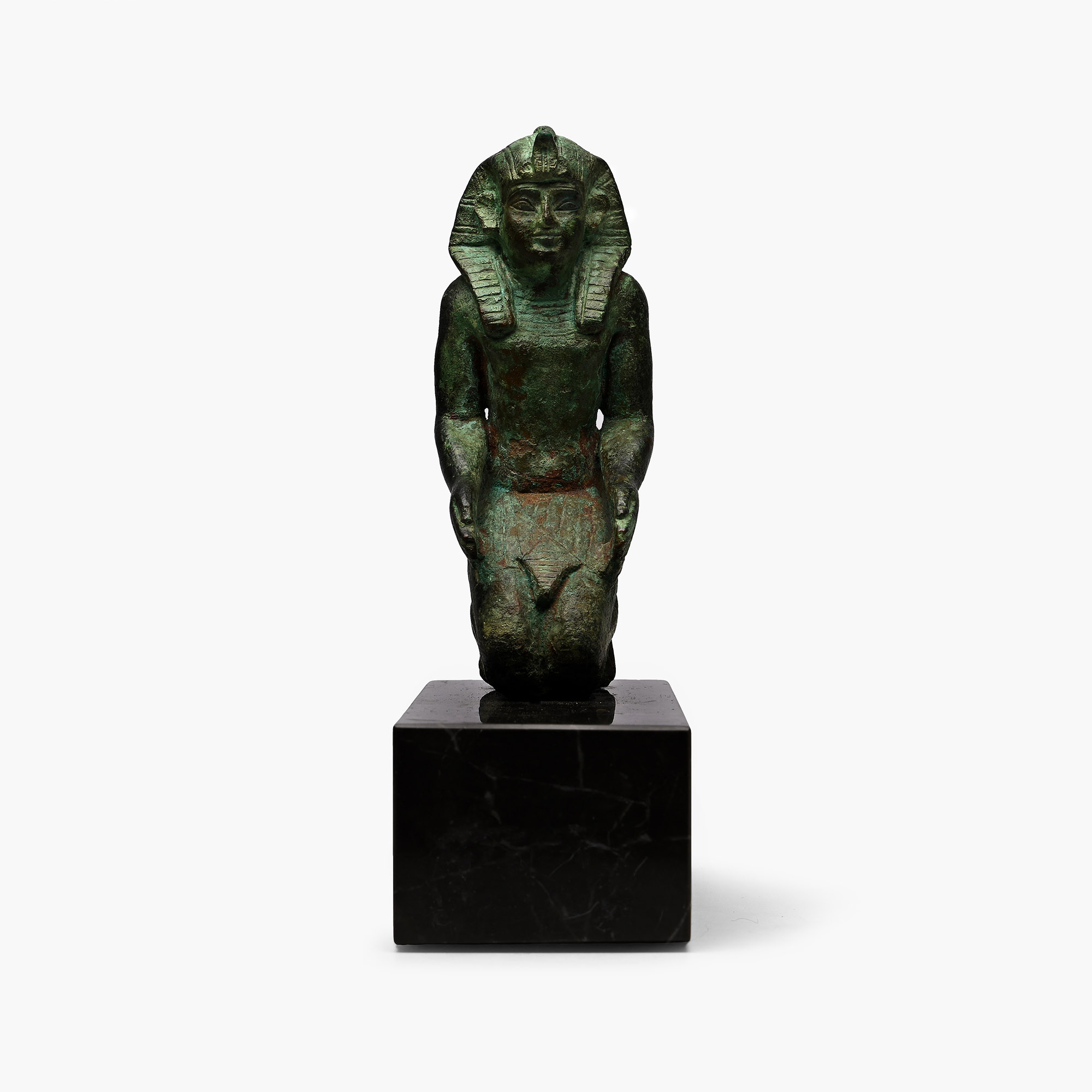
Marsha Hill's 2004 study of royal bronzes counted only 301 from the New Kingdom to the Roman period, most of them kneeling, where one pit at Karnak held 17,000 bronzes of all kinds. Lot 61 is a royal bronze of that kneeling type, a solid-cast king in the nemes headcloth and shendyt kilt, his open hands placed as though they once held an object. Its closest relatives are kneeling bronzes in Brooklyn and Philadelphia that bear the cartouche of Necho II (610 to 595 B.C.). A figure like this stood in for the pharaoh in the rites between king and gods, while the private bronzes carried their donors' prayers.
Why were the statues buried?
A gift could stand in its temple for generations, and one ritual bucket from Saqqara seems to have gone into the ground some 220 years after it was given. In 2014 archaeologists at Karnak found a pit in which fourteen Osiris figures had been arranged around a larger statue of Ptah, with three baboons of Thoth among the other pieces. They explain such caches as an "Osirian burial", in which a retired image was laid down as a dead god and so became Osiris. An earlier TimeLine story on a 70 cm Osiris, Deactivated for Burial, follows another reading.
Why a Thoth statue can be a baboon
Thoth appears most often as an ibis-headed man, the form of the little striding figure that Clayton bought for four shillings at the Caledonian Market in January 1960, now lot 395 at £80 to £100, but the baboon was his animal as much as the ibis. At dawn a baboon sits upright, waves its front paws in the air and screeches, which made it a creature of the sun god. It was more commonly linked with the moon, though, under whose light the performance takes place, and so it became the form of the lunar gods, Khonsu of Thebes and Thoth of Hermopolis.
Amenhotep III set up colossal quartzite baboons at Hermopolis, and from his reign comes a small stone group in the Louvre in which the royal scribe Nebmerutef sits cross-legged with a papyrus unrolled across his lap, below a caped baboon crouched on a tall pedestal with its paws on its knees.
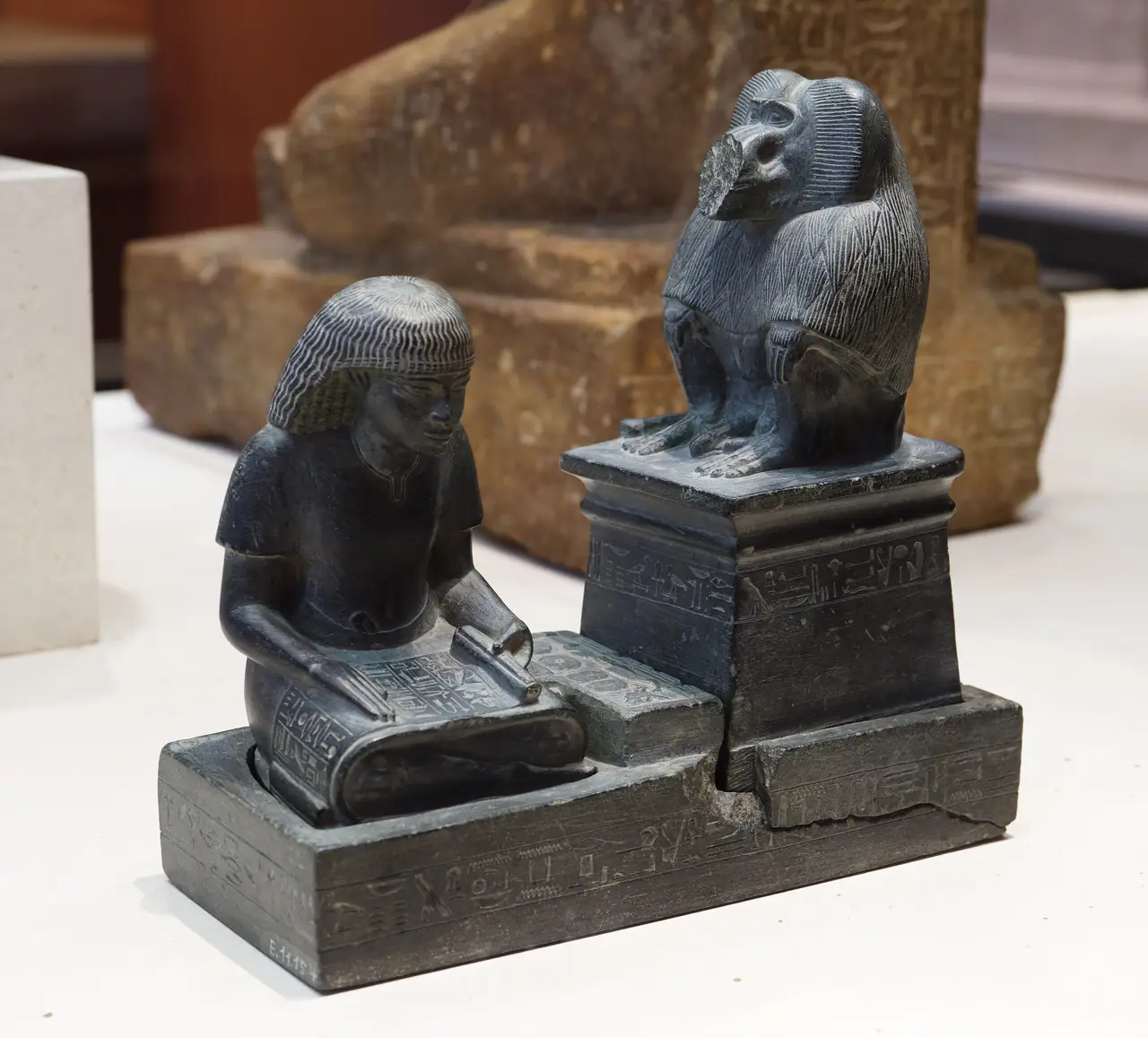 The royal scribe Nebmerutef reading before Thoth in the form of a baboon, reign of Amenhotep III, about 1390-1352 B.C. Musée du Louvre, Paris, E 11154. Photo: Shonagon, CC0, via Wikimedia Commons.
Late Period temples kept colonies of live baboons imported from the south, looked after by priests with titles such as "Priest of the Living Baboon". Horapollo, whose Greek book on hieroglyphs dates from the fourth or fifth century A.D., says that when a baboon was first brought into a temple, "the priest places before him a tablet, and a reed, and ink, to ascertain whether it be of the tribe that is acquainted with letters, and whether it writes." Aelian, two centuries earlier, had heard that under the Ptolemies baboons learned letters, dancing and the harp, and would "demand money for these accomplishments". Both are Greek beliefs about Egypt, part fantasy, built on animals that were really there.
At Hermopolis the temple baboons were buried from the 26th Dynasty in the galleries of Tuna el-Gebel, among ibises that ran into the millions. Under the Ptolemies each had a name, often "Thoth-has-come", and was deified at death as an Osiris. Most of the baboons buried there and at Saqqara were olive baboons, yet the bronzes favour the male hamadryas, the baboon with the heavy cape.
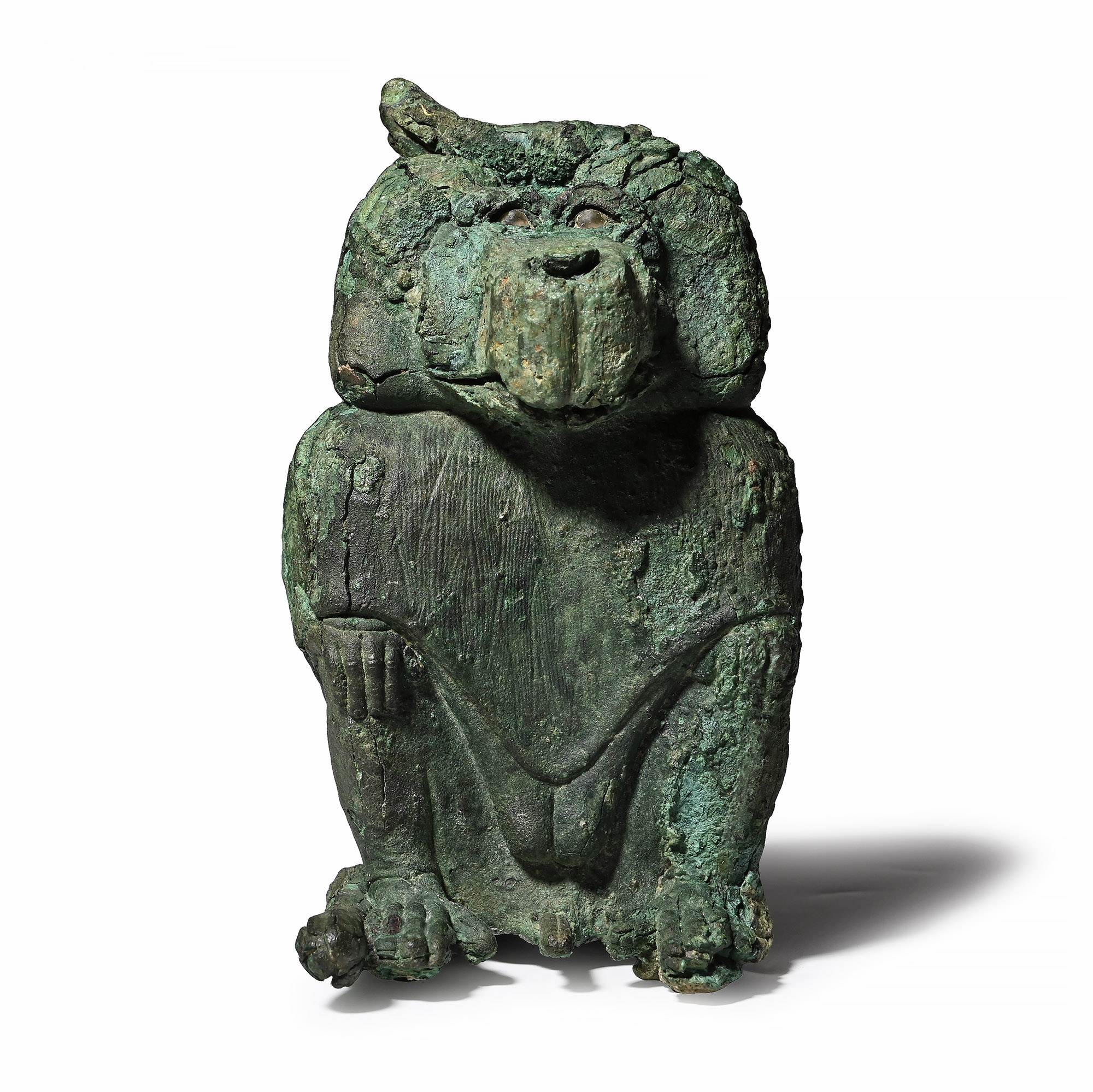
Lot 64 has that cape, a thick cowl of fur round its shoulders. The baboon is hollow-cast and sits on its haunches with its front paws on its knees and a long tail curling from the back. The coat is finely incised, the knuckles and nails are picked out, and the heavy corrosion has been stabilised. The inlaid eyes, most likely glass or quartz, still show pupil and white. On the head are the remains of a crescent moon with traces of gilding, perhaps once topped by a full moon disc, the lunar crown that marks a baboon as Thoth.
A seated bronze baboon in the Walters Art Museum is 4.8 cm high, and two that sold at auction for £15,535 and £21,590 in 2004 and 2025 were 8.3 and 7 cm, so lot 64, at 11.8 cm without its stand, is large for the type. From 1981 it belonged to Max Willborg (1933 to 2001), a dealer in tribal art with galleries in Stockholm and London.
How was an Egyptian bronze statue made?
Hollow figures like lot 64 were cast by the lost-wax method, in which the founder modelled the figure in wax over a core of clay, sand and organic matter, and held the core in place inside the mould with small metal rods. The wax was melted out and the bronze poured in, and afterwards the rods were cut flush and the core, charred black, was usually left inside, so each figure made this way is one of a kind. At 'Ayn Manawir the method was kept for the largest and most elaborate pieces, and most of the Osirises were poured into simple moulds.
Lot 2554, estimated at £100 to £140, is a 20th-century cast by the Morris Singer foundry after a black basalt Osiris carved under Psamtik I. It stands 43.5 cm, a little taller than lot 46 on its stand, weighs 6.2 kg, and comes from Clayton's collection, like the ibis-headed Thoth and the two Herne Bay Osirises. Its tall base carries a prayer of the kind most ancient bronzes lack: "Osiris, who is (in the West), may he give life (to) Amen-en-Nyut, son of Ipa-dy-su, born of the Mistress of the House, Ta-Horbes".
Ancient bronzes were fixed by tangs into wooden bases, and the wood has rarely lasted, with only three bases surviving among the four hundred bronzes at 'Ayn Manawir. The Metropolitan Museum has an Osiris that kept its own, excavated in 1902 and 1903 at el-Hiba, on the east bank of the Nile. The bronze is 35 cm high, taller than any gift in the oasis temple, and it still stands in a cracked block of wood. An inscription on the block, in ink or black paint, has Osiris Wennefer, lord of Busiris, "giving life, soundness, and health to the astronomer of the House of Amun, Ibeb, son of the astronomer of the House of Amun, Ankhpekhered".
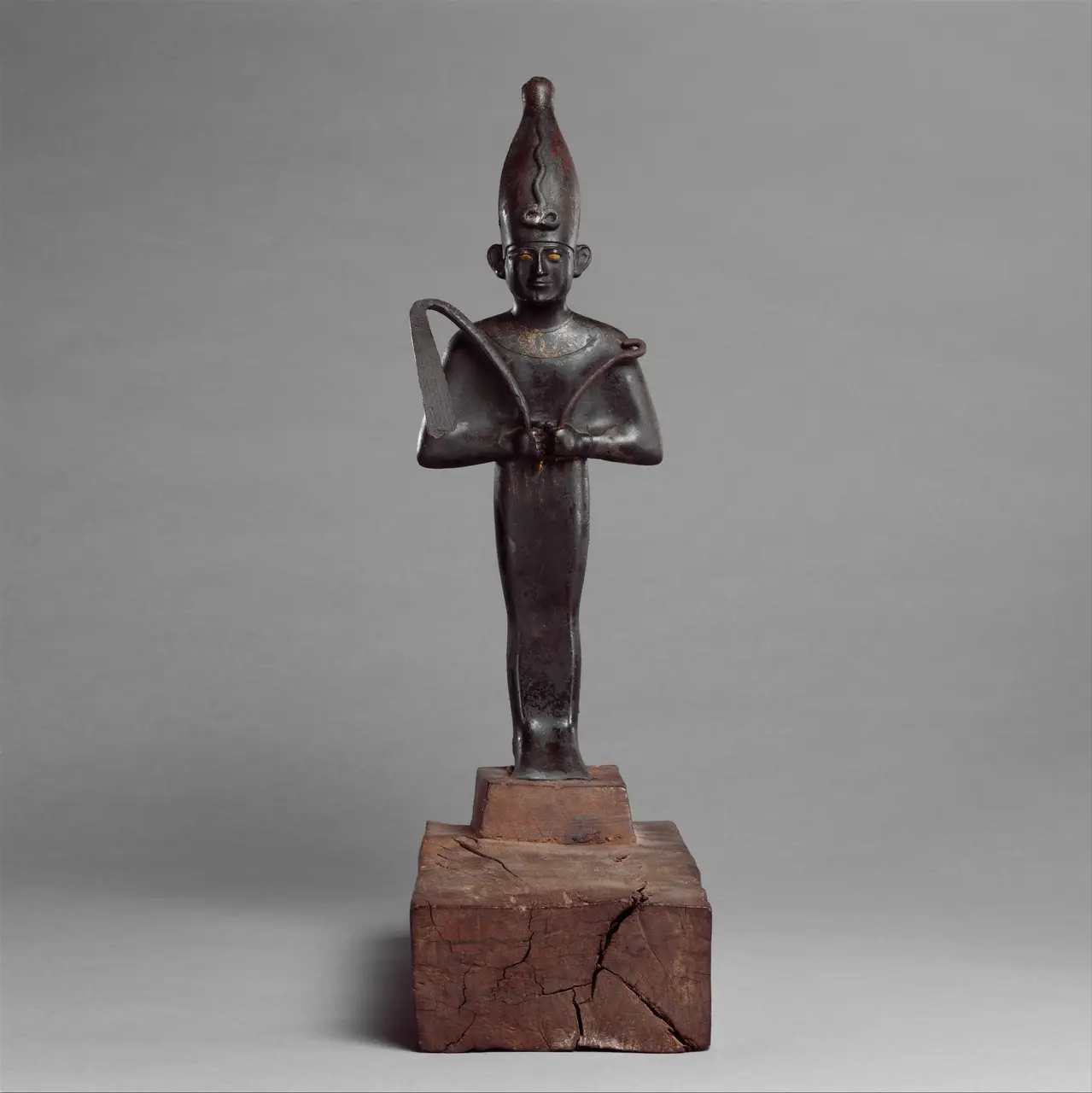 Osiris offered by Ibeb, astronomer of the House of Amun, on its original wooden base, from el-Hiba, Third Intermediate Period, about 1080-721 B.C. Metropolitan Museum of Art, New York, 03.4.11a-d. Public domain, via The Met Open Access.
The Osiris of lot 46 belongs with Ibeb's among the tall ones, a figure of the height that at Saqqara only a few pieces reached, and it is offered on 1 December 2026 alongside the kneeling king, the baboon of Thoth and Clayton's four-shilling ibis-headed god.
TimeLine Auctions
