
Loading, please wait...

LOT 0423
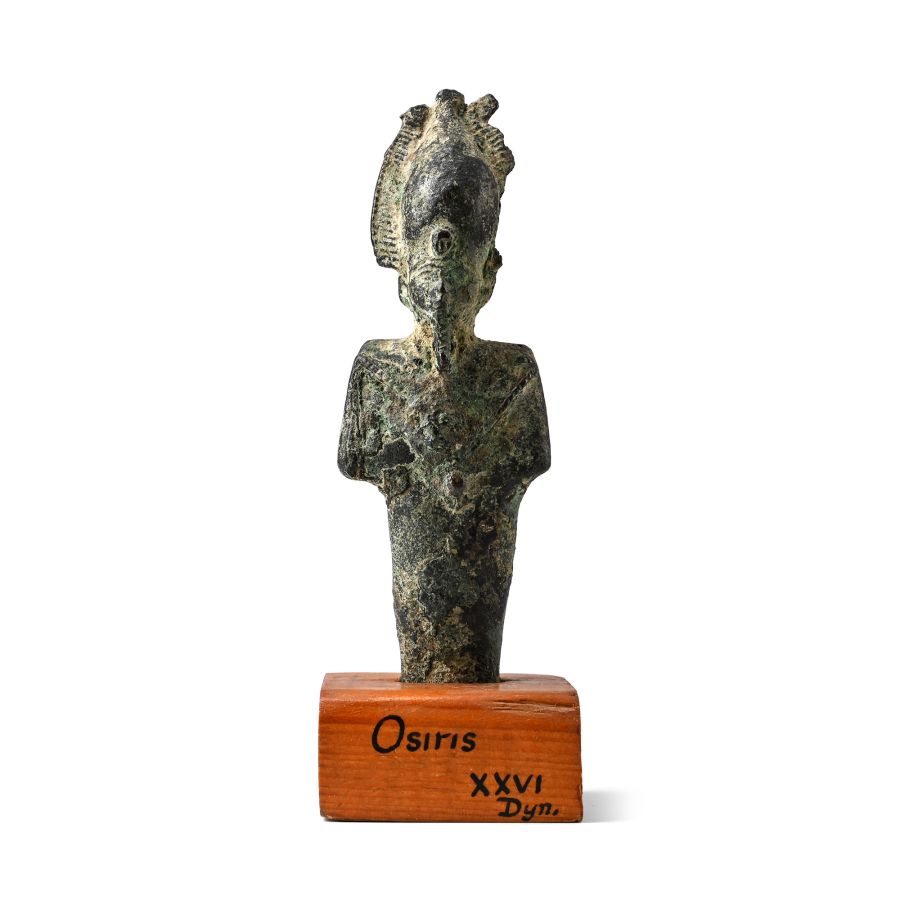
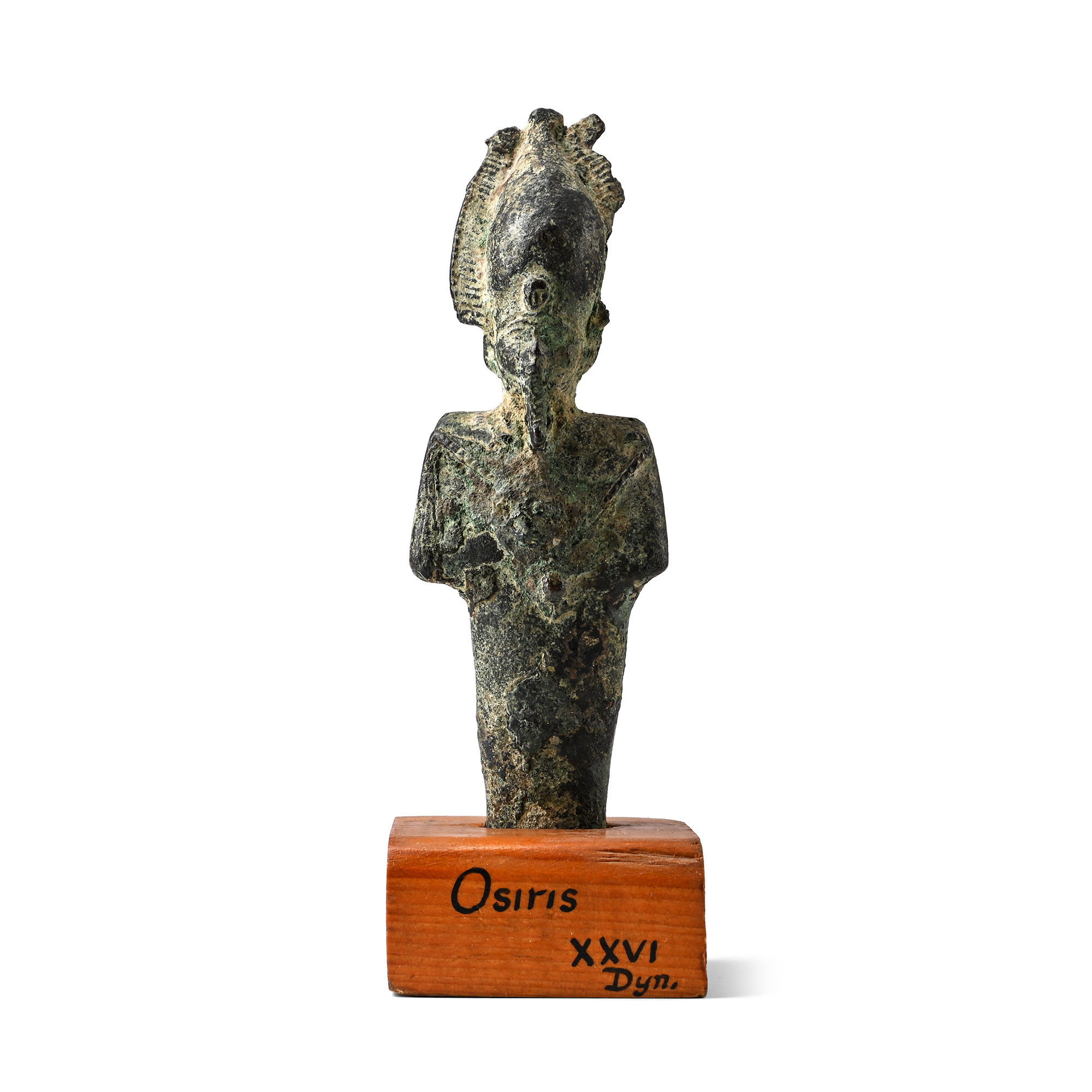
Egyptian Bronze Figure of the God Osiris
LATE PERIOD-PTOLEMAIC PERIOD, 664-30 B.C.
4 3/4 in. (95.6 grams total, 12 cm high including stand).
Modelled in the round with a tall feathered atef crown and uraeus, arms set one above the other at the chest, hands holding Osiris's royal regalia, lower legs absent, with a custom-made display stand. [No Reserve]
ProvenanceAcquired Herne Bay High Street, June 1957.
From the private collection of Peter Clayton, FCILIP, Dip, Arch, FSA, FRNS, Hemel Hempstead, Hertfordshire, UK; formed since the late 1950s.
Accompanied by an old handwritten information card by Peter Clayton, collection no.9.
TimeLine Auctions follows a vetting process to ensure the authenticity and legality of all items, reinforcing our commitment to integrity and responsible trading. Each antiquity, antique, and coin lot undergoes thorough examination by a vetting committee of at least ten external specialists, professional trade association members, scientists, and archaeologists: Our Vetting Process
AUCTIONS:
TimeLine is a leading auction house specialising in antiquities, ancient art, collectables, natural history, coins, medals, and books. Our auctions offer museums, collectors, historians, and enthusiasts the opportunity to acquire unique and historically significant pieces.
LOT 0423
Egyptian Bronze Figure of the God Osiris
Estimate £150 - 200€170 - 230 (for guidance only)$200 - 270 (for guidance only)
-
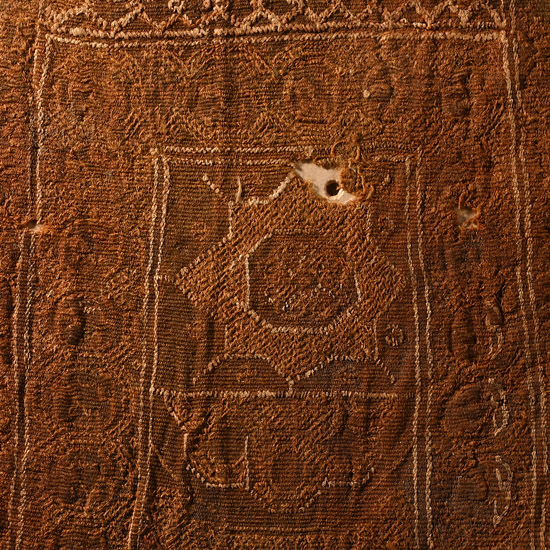
Egyptian Mounted Coptic Textile Fragment of a Central Clavus
Circa 6th-7th century A.D.Estimate: £40 - 60 (+bp*)
Bids: 1 | Current Bid: £5
Wide tunic fragment in coarse linen and purple-violet wool with animal figures enclosed within an orbiculi, the central part of the fragment featuring a geometric decoration of stars and lozenges; mounted on cardboard backing. 45 grams total, 22 cm
Acquired 1970s-1996. Property of a North American collector. London collection, 2016.
Among the many fragments from wool tunics, there are several long strips that match to form nearly full-length central pectoral clavi. They are patterned with a profusion of small figures or interlaced abstract designs, birds, plants and animals, with a contrasting border filled with geometric motifs. -
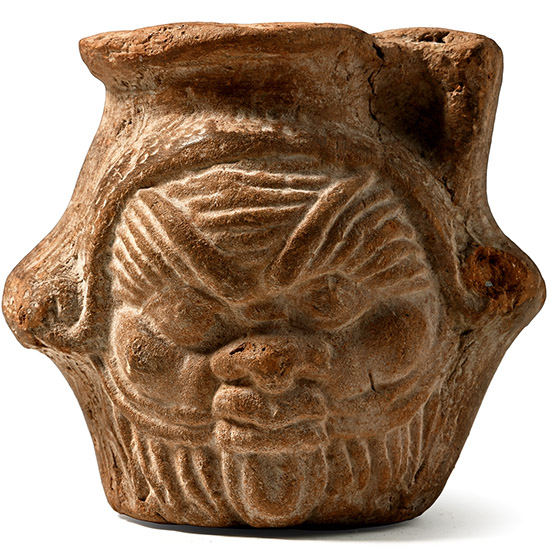
Egyptian Terracotta Bes Vessel
Graeco-Roman Period, 332 B.C.-323 A.D.Estimate: £500 - 700 (+bp*)
Opening Bid: £250
Bulbous in profile, with a short, broad neck, a rolled rim, and an angled handle; obverse with a moulded mask of Bes, with lentoid eyes and a hatched face. 140 grams, 68 mm
From the private collection of Peter Clayton, FCILIP, Dip, Arch, FSA, FRNS, Hemel Hempstead, Hertfordshire, UK; formed since the late 1950s.
Bes, a dwarf deity primarily of the household, was a powerful apotropaic entity who warded off evil spirits, guarded homes, and protected vulnerable family members, especially pregnant women and infants. Bes vessels were thought to imbue their contents with healing properties. Chemical analysis of some Graeco-Roman Bes vessels shows they held hallucinogenic, medicinal, and alcoholic blends explicitly tied to pregnancy rituals and ritual intoxication. During the Graeco-Roman period, mould-made figure vessels and terracotta figurines became very common. By contrast, earlier eras produced almost none of these vessels; only one ceramic example is known from the New Kingdom, and none from the Third Intermediate or Late periods. These mass-produced terracottas allowed non-elites to venerate cult images at home altars or leave them as accessible votive offerings at local sanctuaries. -
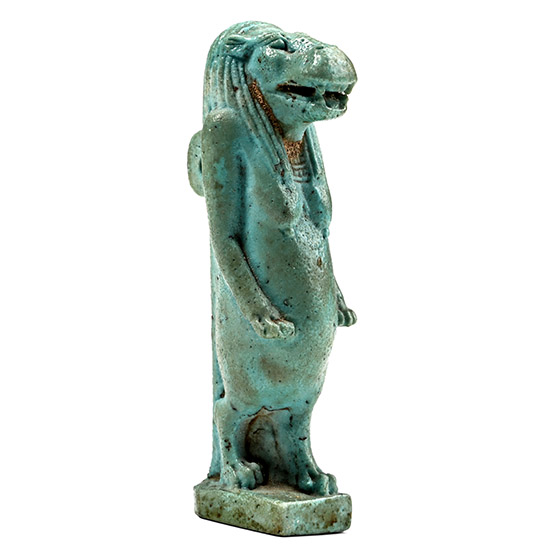
Egyptian Turquoise Blue Glazed Faience Amulet of Taweret
Late Period, circa 664-332 B.C.Estimate: £600 - 800 (+bp*)
Bids: 11 | Current Bid: £220
Amuletic pendant with the deity's characteristic hybrid animal elements, dominated by its hippopotamus head, with a plain dorsal pillar with a loop. 16.58 grams, 61 mm
Received as a gift from archaeologist Cyril Aldred, April 1970, when expecting their son Rupert. From the private collection of Peter Clayton, FCILIP, Dip, Arch, FSA, FRNS, Hemel Hempstead, Hertfordshire, UK; formed since the late 1950s. Accompanied by an old handwritten information card by Peter Clayton, collection no.124.
Taweret is an ancient Egyptian goddess associated with fertility, childbirth, motherhood, and protecting women during pregnancy and labour. She is depicted as a composite being with animal features and stands out as one of the most distinctive and striking deities in the Egyptian pantheon. Taweret’s name derives from the Egyptian word for "great" or "large" (tꜣwꜣrt), emphasising her formidable and protective nature. Cyril Aldred (1914-1991) was a British Egyptologist and art historian who served at the Royal Scottish Museum, Edinburgh, from 1937 until his retirement in 1974. He published widely on Egyptian art, including Old Kingdom Art in Ancient Egypt (1949) and Akhenaten, Pharaoh of Egypt (1968), and became a leading authority on Amarna Period art, notably through his 1973 Brooklyn Museum exhibition catalogue, Akhenaten and Nefertiti.
