
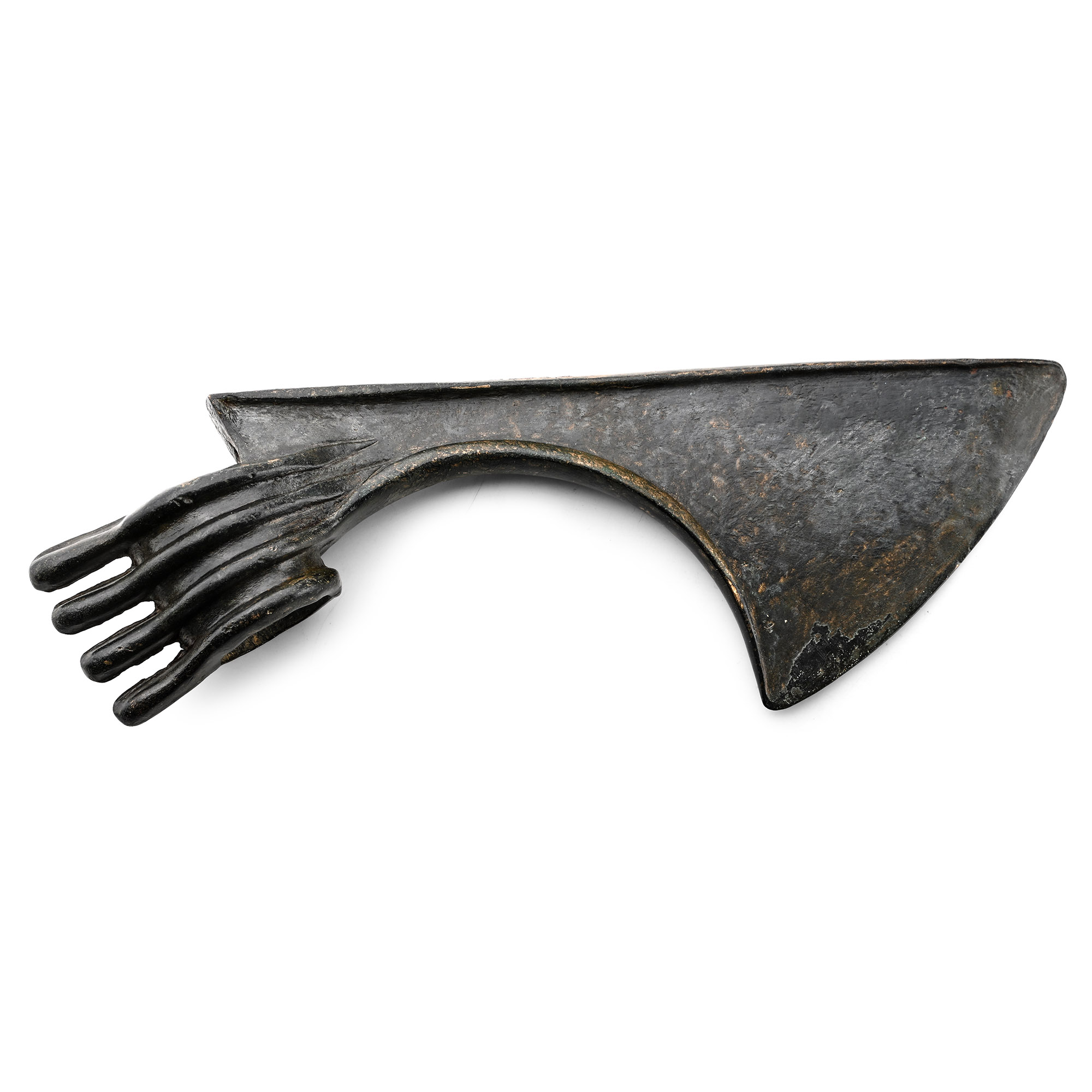
Two bronze axeheads once in the Foroughi collection in Tehran carry the same prayer in cuneiform: "O god Marduk... Strengthen my weapons so that I may overthrow my foes!" The last line names their owner as "Nebuchadnezzar, king of the world", the first Babylonian king of that name, who reigned from 1125 to 1104 BC. His axes are of the spike-butted kind, among the best known of all Luristan bronzes, with a socket ridged at the back into a row of spikes and a curved blade sweeping away from it. Lot 282 in our December sale is built the same way, with a ribbed socket, a butt of four cones and a blade that swings out in an arc to a length of 21.5 cm.
Luristan bronze is the cast bronze of the central Zagros mountains of western Iran in the Iron Age, roughly 1250 to 650 BC: daggers and axes, pins and bracelets, whetstone handles, horse bits and small idols of rearing animals, most of it buried with the dead. There is so much of it because the valleys hold hundreds of cemeteries, each burial took a handful of objects, the custom ran for some six centuries, and from 1930 the finds reached the dealers and museums of Europe and America in their thousands.
Where is Luristan, and when were the bronzes made?
Luristan is the mountain country between the Mesopotamian plain and the Iranian plateau, with Babylonia to its west and Elam to its south. The ridge of the Kabir Kuh divides it in two: the Pusht-i Kuh, "behind the mountain", runs down towards the lowlands of Iraq, and the Pish-i Kuh, "before the mountain", lies to the east. Erich Schmidt of the Oriental Institute in Chicago, who photographed western Iran from the air in the mid-1930s, found the cemeteries tucked into corners of the valleys, each beside a spring that showed from above as "a dark patch on the soil, a tree or two".
 The Zagros mountains, shaded, run from south-eastern Turkey to the Strait of Hormuz; Luristan lies in the central stretch, where the range faces the plain of Iraq. Map: BenJenkins, CC BY-SA 4.0, via Wikimedia Commons.
The earliest graves can be dated by the shell finger rings found in them, which were imported from Babylonia and belong to the years around 1225 to 1160 BC. Nebuchadnezzar's axes give a second fixed point in the twelfth century, and the tradition ran on until about 650 BC. Iron was almost unknown in Iran when it began, which is why these pieces are often called Bronze Age. The new metal was used first for jewellery, and weapons were not generally made of it until the eighth century BC. No text in the makers' own language survives, so what they called themselves is lost.
What did a Luristan grave hold?
Between 1965 and 1979 a Belgian mission under Louis Vanden Berghe excavated 121 Early Iron Age tombs in eleven cemeteries of the Pusht-i Kuh, and found that a burial rarely held more than four to six objects. Many tombs were reused for generations: when a new body came in, the older bones and their goods were pushed to the back, and nothing seems to have been taken out. Weapons mark a man's grave and anklets a woman's, and the classic Luristan bronzes turned up only in the tombs of men. At the back of tomb 2 at Bard-i Bal lay a broken flanged dagger, a broken whetstone and a spike-butted axe that is 21.5 cm long, the same as lot 282.
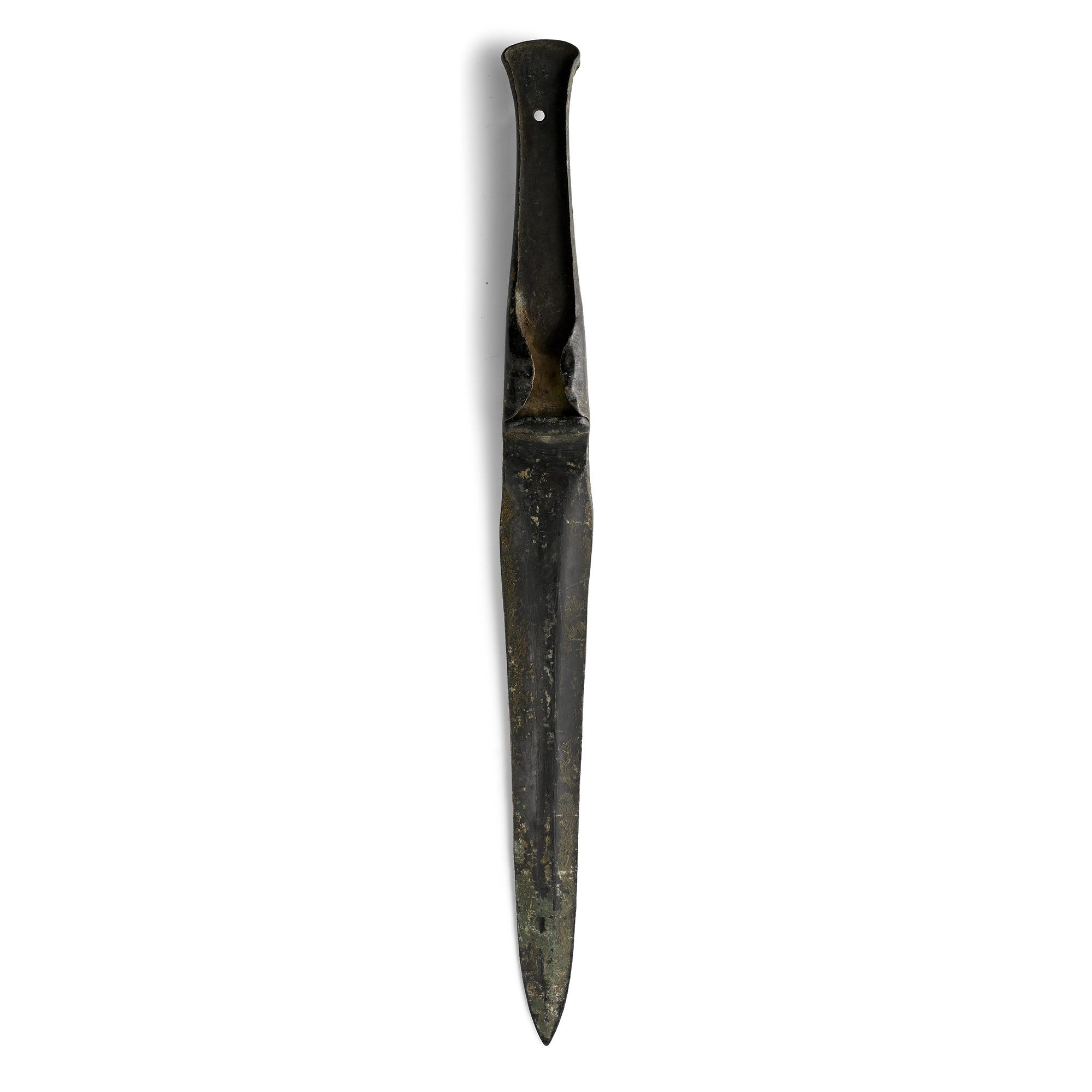
The commonest blade was the flanged dagger, of which the mission found 53. Its hilt is cast in one piece with the blade and edged with raised flanges, and plates of wood or bone were set between them to make the grip. Lot 1932 is a dagger of this kind from the thirteenth century BC, with a flared finial and flanges that held a bone panel on each face of the grip. At 32.5 cm it sits in the middle of the excavated range, which runs from 22.5 to 43.6 cm, and a 40 cm example with wooden grip plates lay on the floor of a building at Tell Zubeidi, in the Diyala region, that burned around 1230 BC. Length also decides whether a Luristan blade counts as a dagger, a dirk or a sword, on a scale set out in ten great pieces from our past sales.
Babylonian kings had their names cut on daggers of this family for more than two centuries, from Adad-shuma-usur, who came to the throne about 1210 BC, to Eulmash-shakin-shumi, whose reign ended about 988. Most carry a plain label of ownership, such as "(Property) of Marduk-nādin-ahhē, king of the world, king of Babylon", and the findspots reported for them are almost always Kermanshah or Luristan. The Babylonians may have given such weapons as offerings to sanctuaries in the Zagros, which would account for Nebuchadnezzar's two axes as well.
Lot 2016, a 38.5 cm dagger with a crescent guard and a socket on each face of the grip for a bone inlay, is of a kind typical of the Marlik culture of northern Iran, where such daggers were cast in a one-piece mould.
A dagger usually came with a whetstone, since bronze blades need sharpening far more often than iron ones, and the stone was sometimes fitted into a bronze handle in the form of an animal. The handles from Bard-i Bal are recumbent goats whose horns curve back to the body and make a loop for the belt. In tomb 68 there, a man's dagger, spike-butted axe, goat-handled whetstone and bronze idol had all been damaged on purpose before burial, the axe bent and broken and the goat's horns snapped off. The excavators met the custom at no other cemetery, and its meaning is unknown.
Idols, horse bits and a dog on an axe
The idol from tomb 68 is of the earliest kind the Belgians found: two goats rearing face to face, hind legs on one ring and forelegs against another, set on a separate stand shaped like a bottle. Later the animals became predators flanking a human figure, the "master of animals", and in an undisturbed grave at Tattulban one of these lay on its stand beside an iron sword, iron arrowheads and a bronze shield.
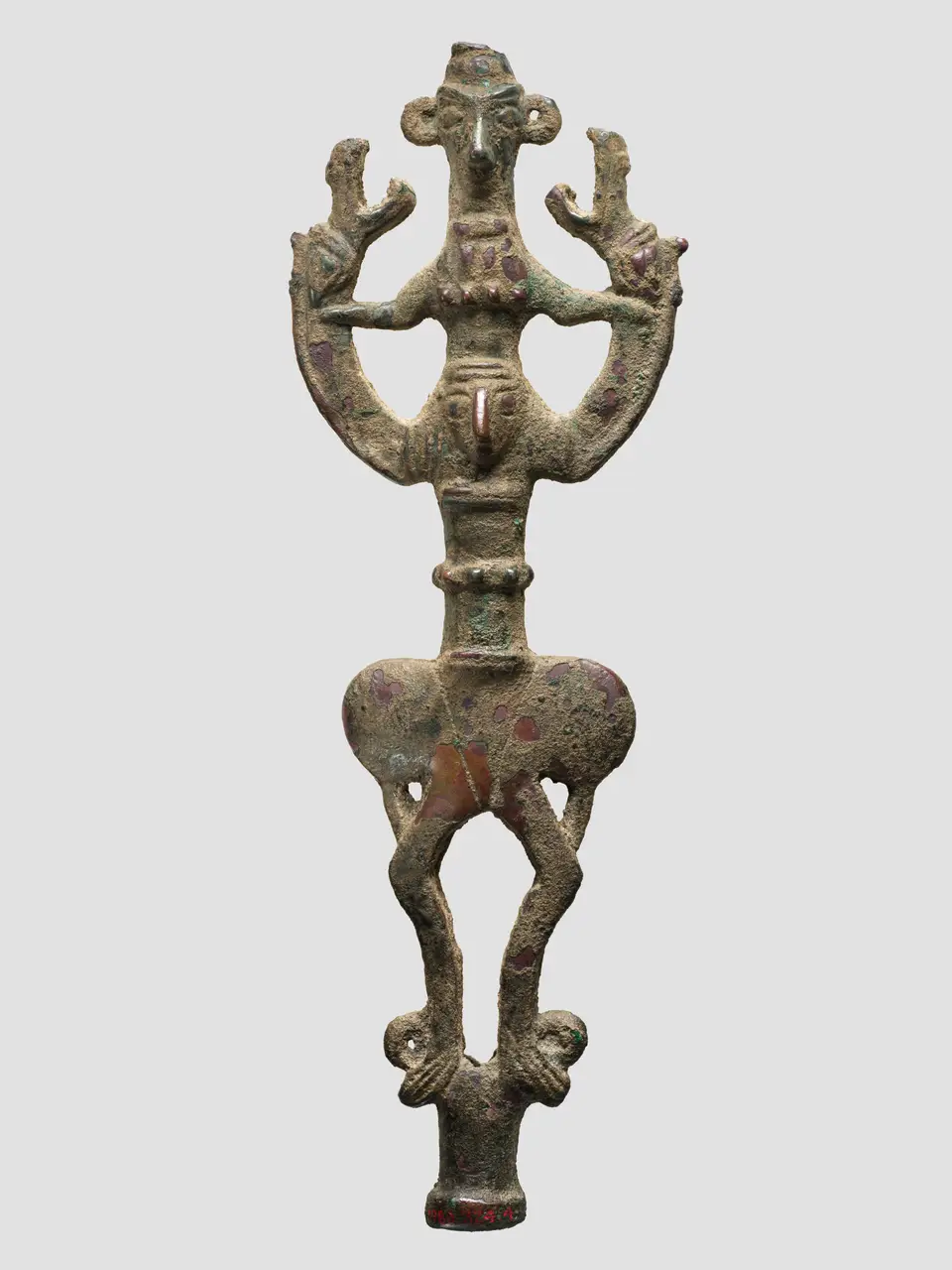 Top of a standard with a master of animals, Iran, probably Luristan, 8th-7th century BC, 17.1 cm high. The Metropolitan Museum of Art, New York, gift of Louise Crane, 1980 (1980.324.4), CC0.
The idols were found only with men, and P. R. S. Moorey compared them with the household gods named in texts from Nuzi in Iraq, which stood for a man's legal position in his family and so might have gone with him to the grave, though the beliefs behind the Luristan idols were never written down.
On a horse bit the animals are the cheekpieces, cast as horses, goats, boars, cocks or griffins at either end of a rigid mouthpiece. At Tepe Giyan an iron bit lay under the head of the dead, and the local diggers met the custom so often that they called horse bits zir-sar, "head-rests". Many bits show wear, and almost all have spikes on the back that could have served as goads, so they were probably used on living horses before they went into the ground. The idols and the bits with cast animals are the most sought-after Luristan bronzes, and they stand apart from the plain weapons much as painted figures set apart the finest Greek oil flasks.
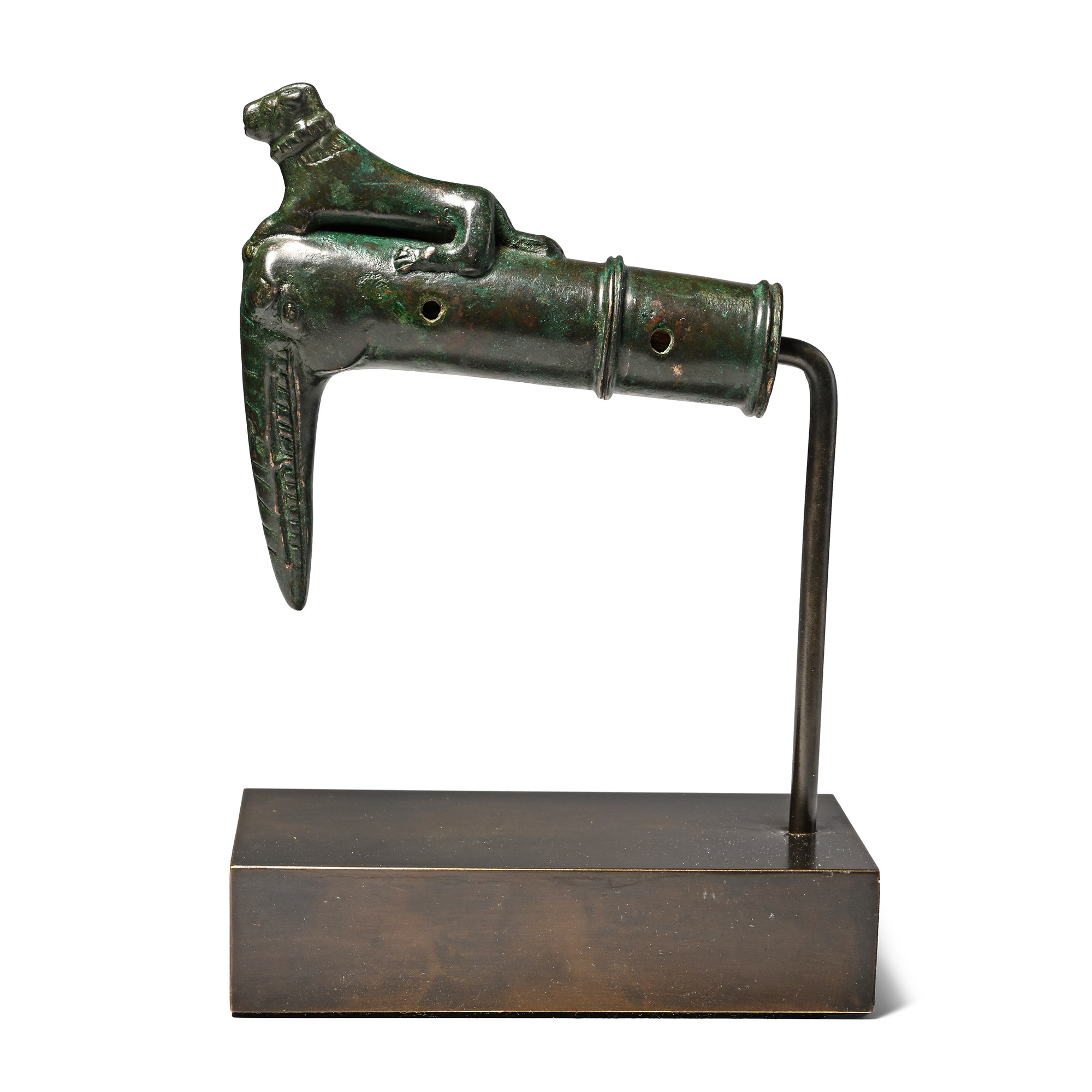
Small animals are sometimes mounted on Luristan axes too. Lot 280 is a pickaxe of the early first millennium BC whose body is shaped like a stork's head, with incised lines along the sides, and a collared dog reclines on top of its socket. Schmidt found a small bronze pendant that seems to be a dog in the sanctuary he excavated at Surkh Dum, and in Mesopotamia bronze and clay dogs were buried under doors and pavements, some of the clay ones inscribed "Don't stop to think, bite". The dog was also the animal of the Babylonian healing goddess Gula, though what this one meant to the owner of the axe is not recorded.
Pins for the shoulders and a sanctuary full of them
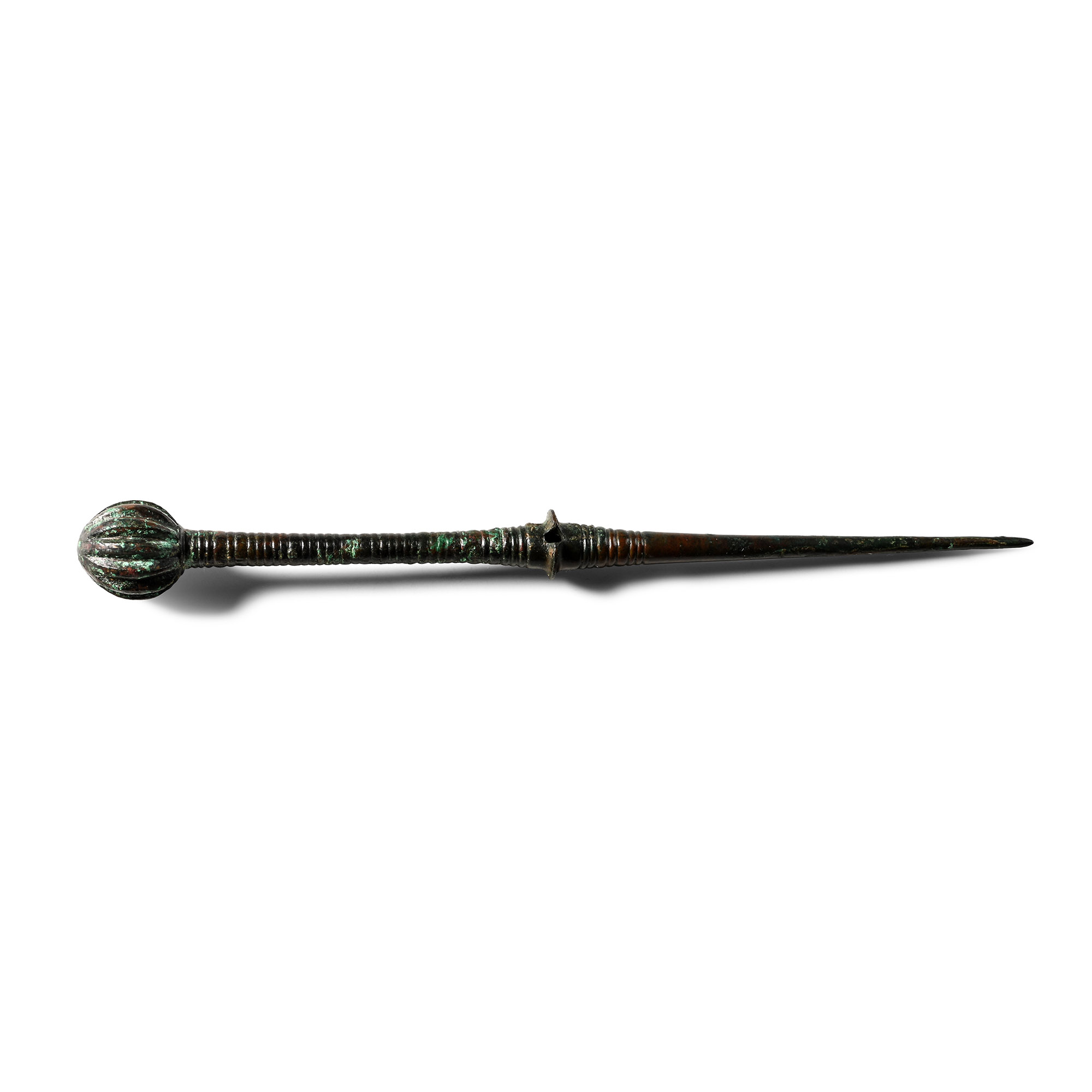
A fragment of a pin from Surkh Dum shows a seated figure with two large pins on the breast, their heads pointing to the shoulders, and pins turn up in pairs in several Luristan graves. Seventeen with poppy-shaped heads came from five tombs at Bard-i Bal, the complete bronze ones up to 16.4 cm long, and the vertical grooves on some of the heads suggest the seed case of a poppy or a pomegranate.
Lot 1566, 13.8 cm long, has a ribbed melon head of this kind over a ribbed shank, with a collar halfway down that is pierced to take a ring. Pins pierced through the shank were worn across the Near East from the third millennium BC, held in the cloth by a string threaded through the hole and wound round the pin.
In June 1938 Schmidt's expedition dug the sanctuary at Surkh Dum, "the red slope", in the Pish-i Kuh, and registered 1,804 objects in less than three weeks. Many lay in deposits under the floors and inside the walls, and some carry dedications to the goddess Ninlil. Decorated pins came out in quantity, but not one idol or stand.
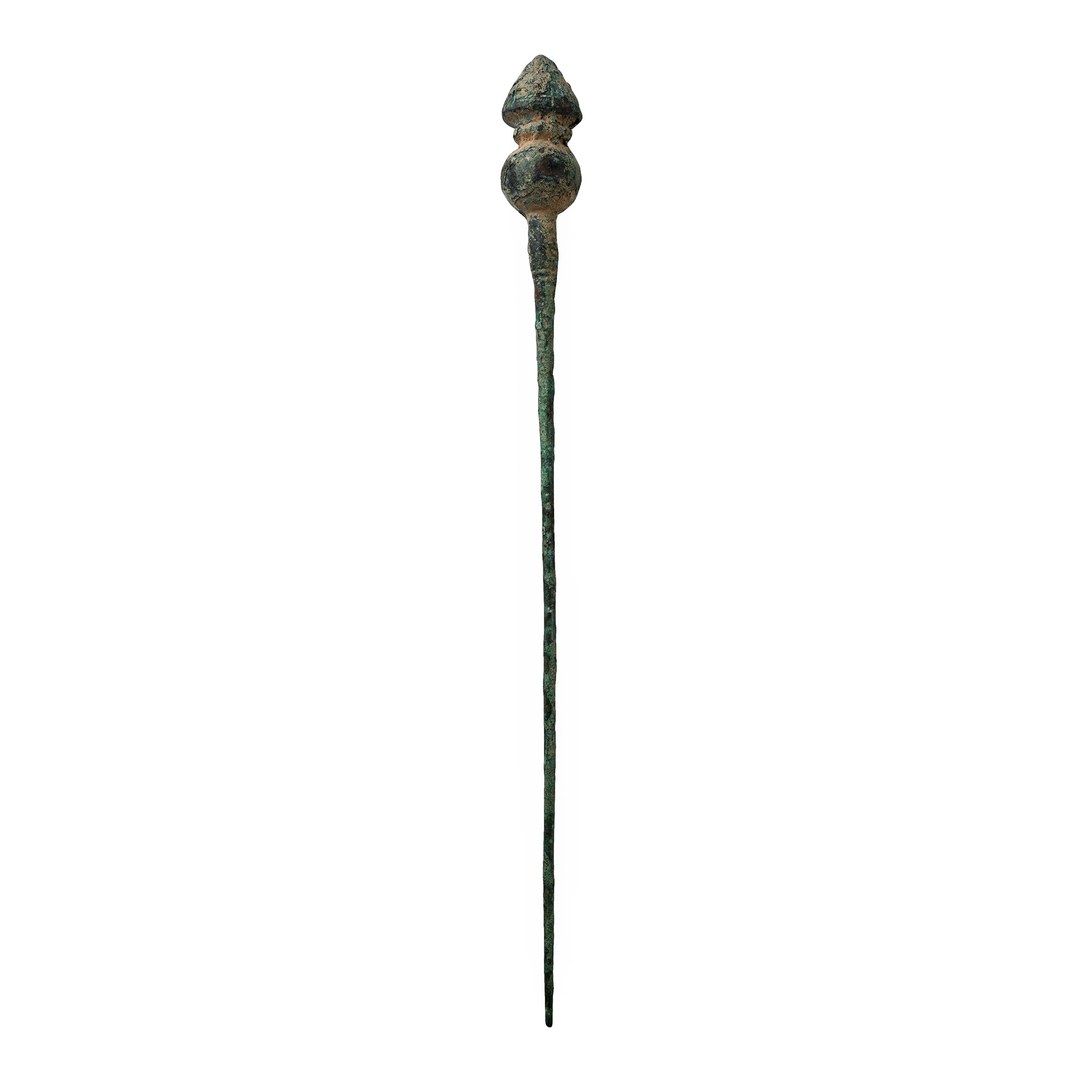
Lot 1770 is a much larger pin, with a poppy-shaped conical head on a round shank 30.3 cm long, nearly twice the length of any poppy-headed pin from Bard-i Bal. It dates from the eighth or seventh century BC and compares with a pin now in the Metropolitan Museum, which Schmidt excavated at Surkh Dum.
Why is there so much Luristan bronze?
Luristan's burials were shallow, stone-lined graves, often visible above the surface, and Seton Lloyd estimated in 1961 that four or five hundred burial grounds, each of about two hundred graves, were dug between 1930 and 1934. The cemeteries were easy to find because they all lay in the same kind of place, as Schmidt saw from the air a few years later: the spring, the dark patch, the tree or two, in valley after valley.
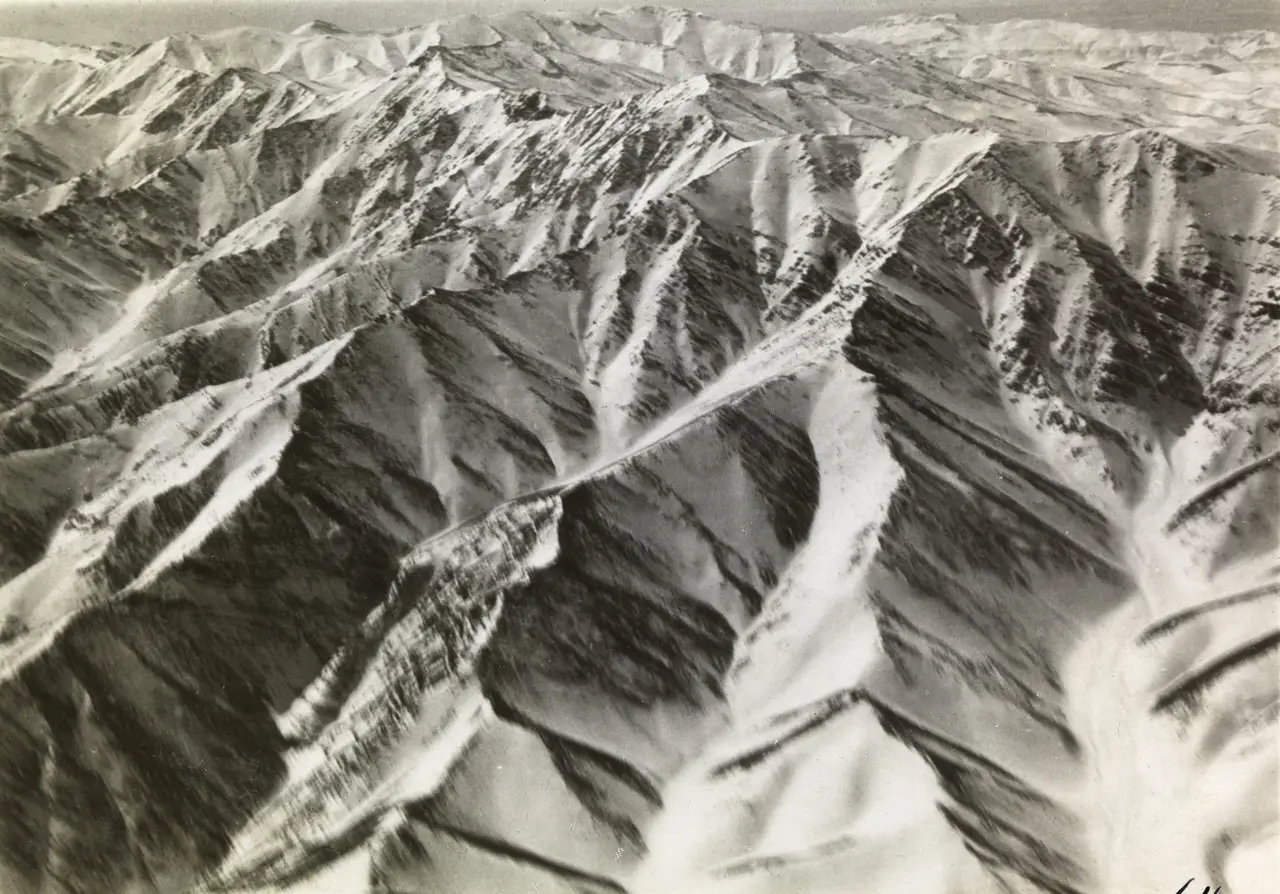 The mountains near Khorramabad, photographed from 4,000 metres by the Swiss aviator Walter Mittelholzer on his flight to Persia in 1925. ETH-Bibliothek Zürich, public domain, via Wikimedia Commons.
The bronzes "began to appear in numbers in March, 1930", Arthur Upham Pope wrote, "and by the summer of 1931 a mass of several thousands had reached various markets". Nobody yet knew how old they were, and Pope reported expert opinions that ran from the third millennium BC to the Christian era. The International Exhibition of Persian Art at Burlington House put them on show in London in early 1931, and in the same year the Detroit Institute of Arts reported that almost every public and private collection in America and Europe had several. Some of the early collections went on to museums: Nasli Heeramaneck's to the Los Angeles County Museum of Art, David David-Weill's to the Louvre, and Mohsen Foroughi's, which held Nebuchadnezzar's two axes, partly to the Louvre and partly to the national museum in Tehran.
Bronzes are still coming out of the ground. In 2003 workmen repairing water pipes at Sangtarashan, about 50 km south-east of Khorramabad, turned up a dozen that had been buried together, and six seasons of Iranian excavation recovered 2,349 objects around a circular stone wall some 50 m across, with no graves at all. Among them were flanged daggers, spike-butted axes and bronze whetstone handles, the kinds that lay together at the back of tomb 2 at Bard-i Bal. Two of the daggers had been pushed point-down into the red clay, so that the excavators found the handles in one layer and the blades in the next.
Our December sale has 26 Luristan lots, from an arrowhead and cloak pins to daggers, axes and the pickaxe with its dog, and a search of the sale for Luristan brings them all together.
