
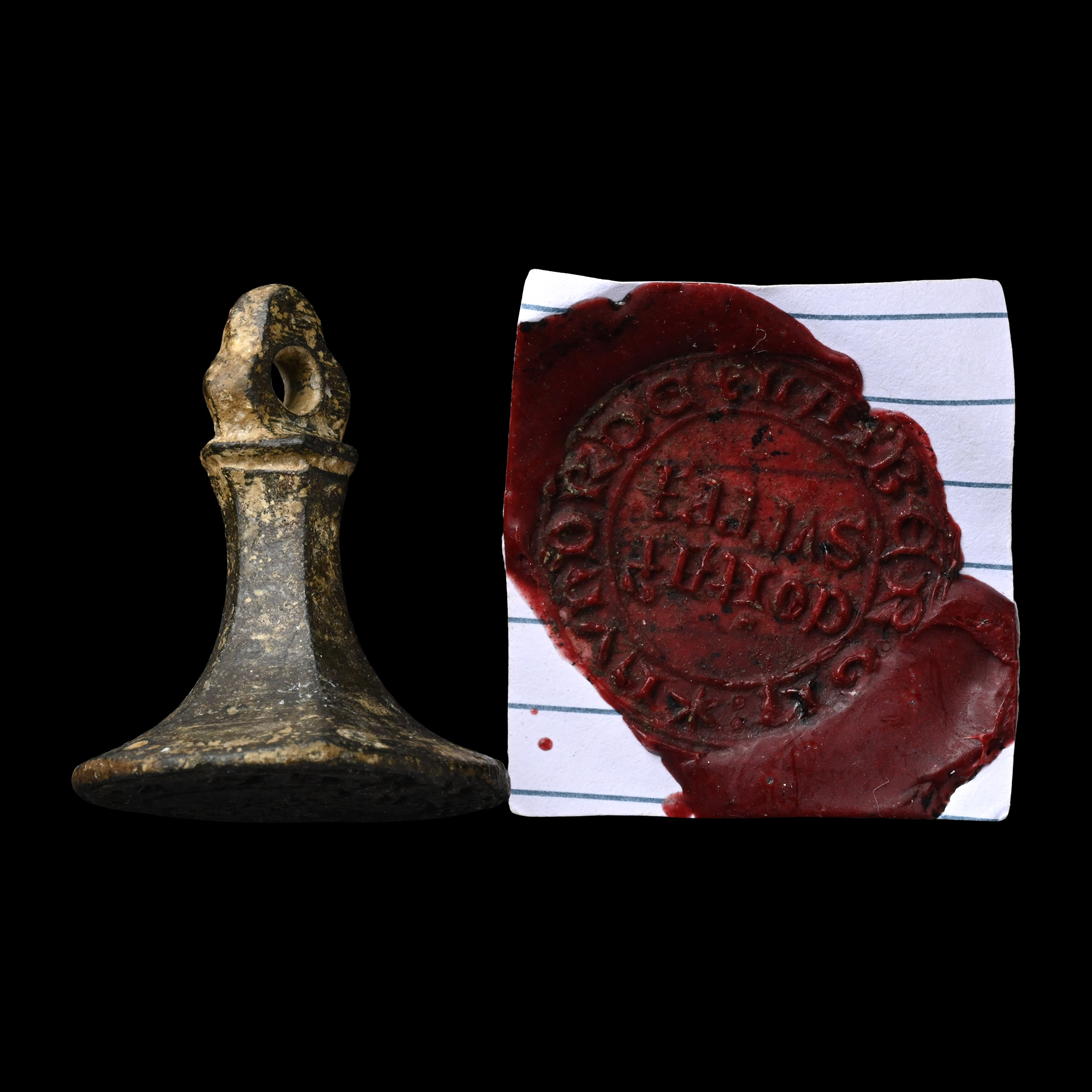
Round the edge of a small bronze stamp found near Lewes in August 2024 runs * hVnDR DE FLAXBERGh, "hundred of Flexborough", and across its centre, COitat SVSSEX, "county of Sussex". It is a medieval seal matrix, an engraved metal die an owner pressed into warm beeswax to seal a document, with the letters cut in mirror image so that they come out the right way round in the wax. This one stands 36 millimetres tall on a six-sided handle with a pierced trefoil at the top for a cord, and it is the official seal that Flexborough hundred, one of the districts into which Sussex was divided, used for labourers' passes.
At Cambridge in September 1388 Parliament ordained that no servant or labourer, "be he man or woman", should leave the hundred where he lived, whether to work elsewhere or to go on pilgrimage, without a letter giving the reason for his journey and the date of his return. The letter had to be sealed with a seal kept by a trustworthy man, and nobody was to charge more than a penny for writing and sealing one. Anyone found wandering without a pass went to the stocks. The statute described the seal as well, with the county's name round the edge and the hundred's across the middle.
More than four thousand medieval seal matrices have been recorded as finds in England and Wales, and most of them, unlike Flexborough's, were the personal seal of a single owner. A personal seal of the thirteenth century usually carries its owner's name, and with a little practice the name can be made out and the seal dated to within a century or two from its shape, its back and its lettering. The December sale has more than fifty to practise on, and they are cheap for what they are: medieval matrices often sell for less than a hundred pounds, while the best silver, heraldic and official seals sell for thousands.
Who owned a medieval seal matrix?
In a lawsuit before Henry II, probably in the 1160s, the king's chief justiciar Richard de Lucy complained that "it was not the custom in the past for every petty knight to have a seal. They are appropriate for kings and great men only". By the end of that century, though, anyone in England who granted free land by charter had to put a seal to it, and by the early thirteenth century probably as many people were using seals as at any time in the next three hundred years. For example, between 1217 and 1232 fifty-six tenants of Butterwick and Frieston in Lincolnshire made an agreement with the earl of Chester, and every one of them attached a seal.
A seal back then was close to what we would consider a signature now, with the royal courts treated it as binding: "The man who acknowledges a seal to be his," ran a ruling of the early fourteenth century, "acknowledges the ink and parchment attached to the seal to be his deed." No law stopped unfree peasants from owning seals, and those who had them used them chiefly to buy and sell pieces of free land.
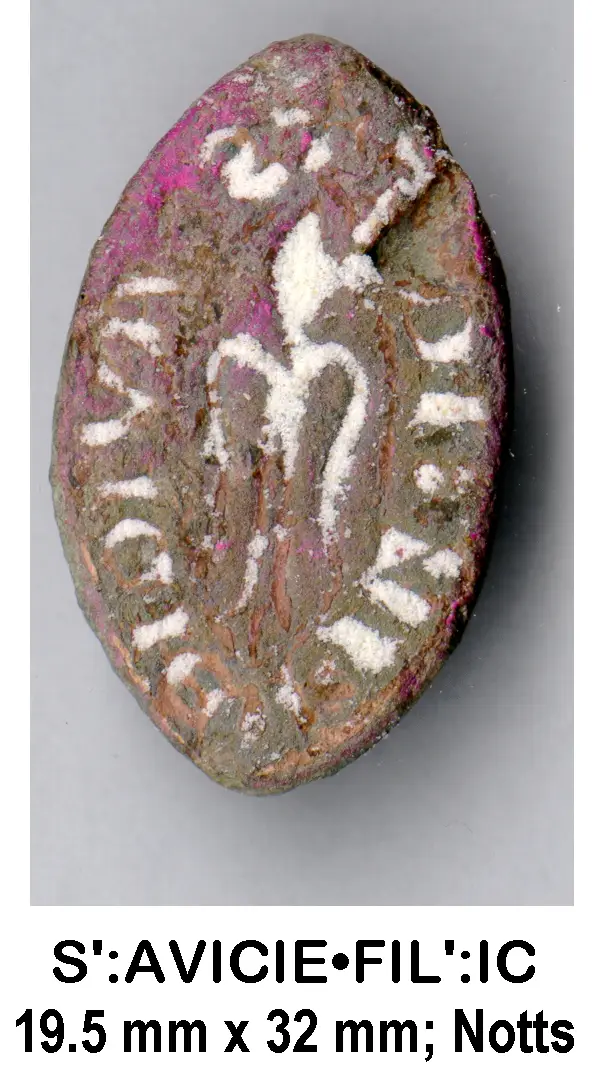 Lead seal matrix of Avice, her father's name now unreadable, with a fleur-de-lys, thirteenth century, recorded with the Portable Antiquities Scheme (FindID 86414). Photo: I.H. Szymanski, The Portable Antiquities Scheme / The Trustees of the British Museum, CC BY-SA 2.0, via Wikimedia Commons.
Lead was the cheap material, and in the thirteenth century the simplest designs were often engraved on it. A study of the matrices found in Norfolk between 1996 and 1998 judged that many had belonged to people quite low down the social scale.
What the legend on a seal matrix says
Agnes, daughter of Adam of Walpole, had her seal cut in silver. It is a pointed oval 36.4 millimetres long, with a fleur-de-lys in the centre and the legend + S' AGNETIS FILE ADE DE WALEPOL round the border. A legend starts at the cross at the top, where S' is short for sigillum, "seal of", and the names that follow are in the Latin form meaning "of", so AGNETIS is "of Agnes", FILE "daughter", ADE "of Adam" and DE WALEPOL "of Walpole", one of the two East Anglian villages of that name. This is the standard wording of the thirteenth century, and the fleur-de-lys was the commonest design of all.
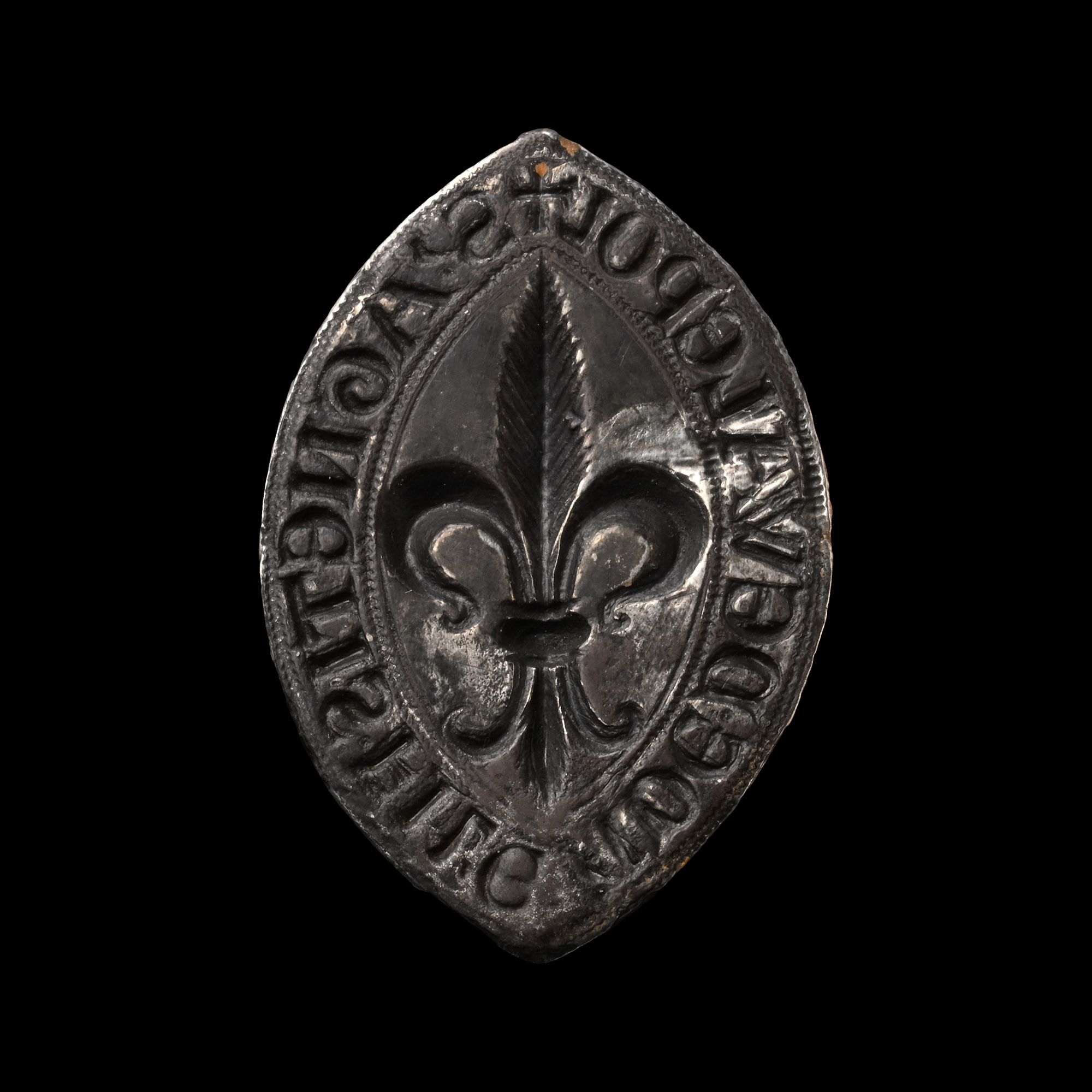
The pointed oval became common in the early thirteenth century, especially for women: in one sample of surviving seals two-thirds of the women's were pointed ovals, against a tenth of the men's. Eleven of the named seals from Norfolk were women's and seven of those were pointed ovals, one of which, from Topcroft, is a lead version of Agnes's own, with a fleur-de-lys and the name of another Agnes, the daughter of Alan.
The seal of Avice daughter of Aelbel in the sale is the same type but in lead, a pointed oval 29 millimetres long with an eight-rayed star and +S'AVICIE F AELBEL. It was found at Brookland on Romney Marsh and is estimated at £30-40, very little for the seal of a named woman of the thirteenth century. It is one of thirty-five lots of matrices from a Kent collector of medieval objects.
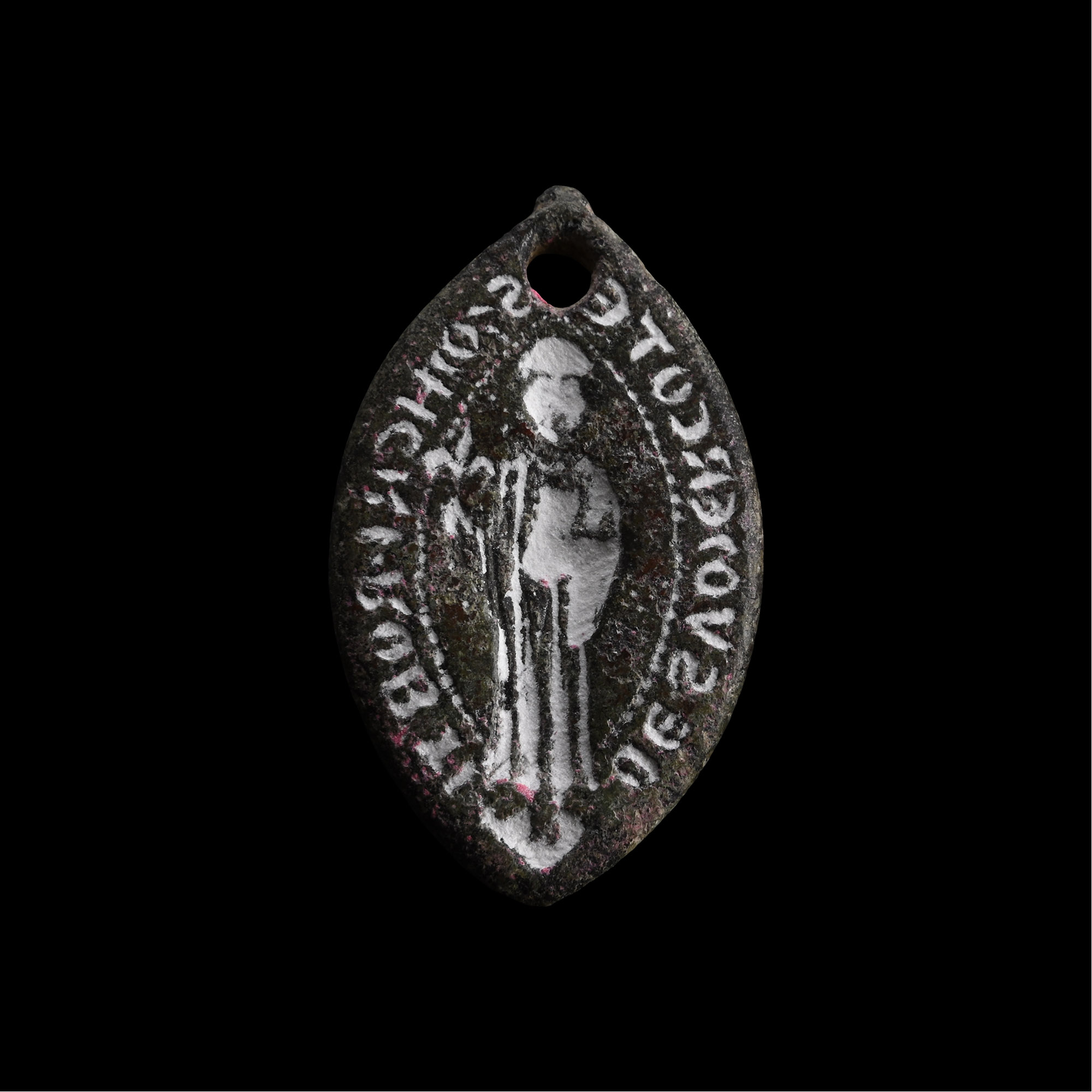
Pointed ovals of this period usually name either women or priests. Master Robert of Somercotes, in Derbyshire, whose matrix was also found on Romney Marsh, had a bronze one with a standing robed figure holding a flower and the legend S' MHCRI ROB'TI DE SVMERCOTE. The second word is MAGRI, short for magistri, "of Master", the title of a man who had taken a university master's degree.
Religious houses had seals of their own, and a large lead pointed oval from Romney Marsh is the seal of the brothers' community of a hospital. Its legend, S' FRATRVM OSPITAL' SCI' TOME, means seal of the brothers of the hospital of St Thomas, with COMENAL on a band across the centre. More than one hospital was dedicated to Thomas Becket, among them St Thomas the Martyr at Swale and the hospital at Eastbridge in Canterbury, which was founded within a decade of his murder to shelter poor pilgrims visiting his shrine.
How to date a seal matrix by its back and lettering
Thirteenth-century matrices tend to be flat, with either a ridge down the back ending in a loop or a pierced tab at the top for a cord. Agnes's silver seal has the ridge and loop, and Avice's lead one has the tab. In the fourteenth century the commoner form became a conical handle, usually six-sided and topped with a pierced trefoil, as on the Flexborough seal.
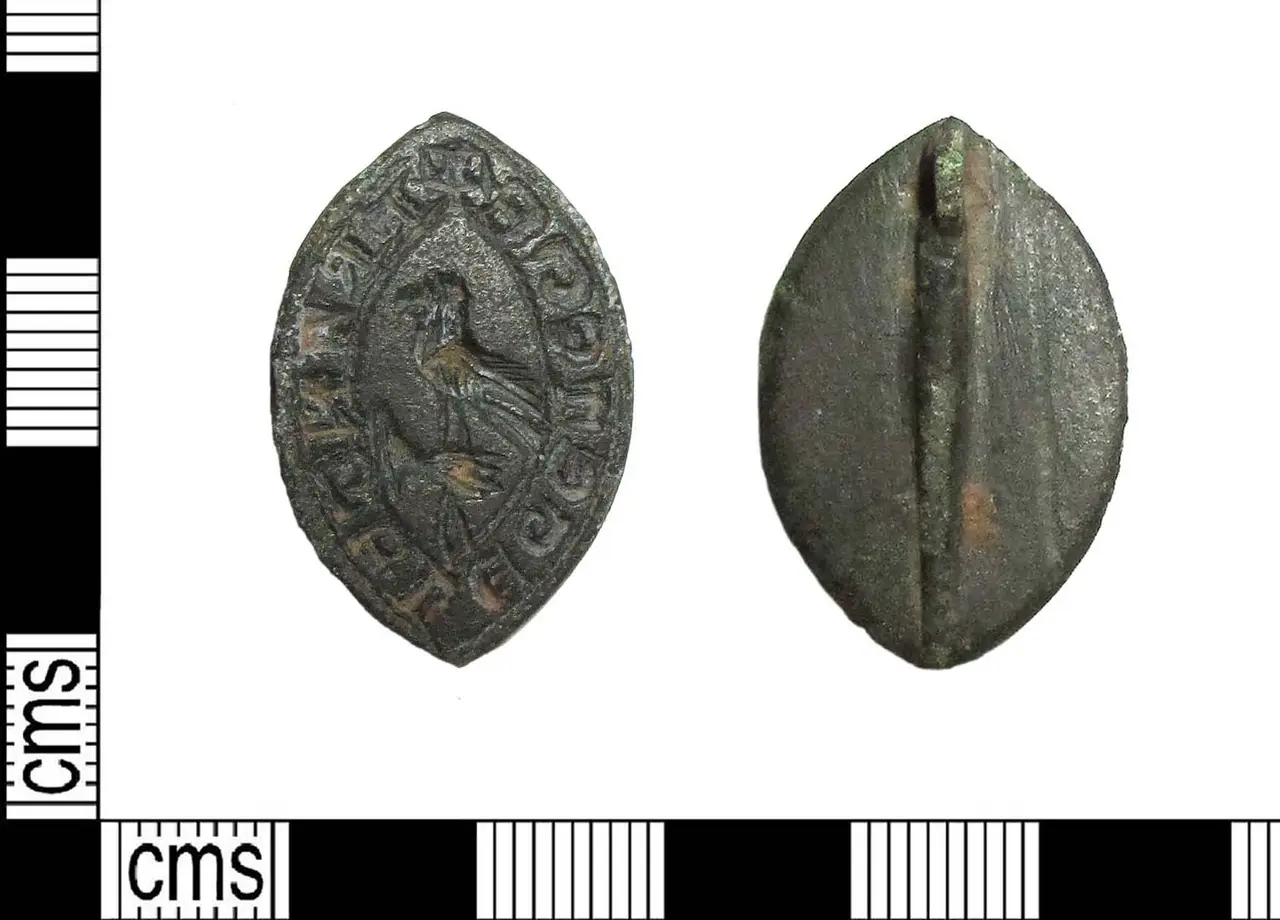 Copper-alloy pointed-oval seal matrix with a bird perched on a hand and the motto FRANGE LEGE TEGE, 1300-1400, found in Lincolnshire, shown with the ridge and loop on its back. Photo: Adam Daubney, Lincolnshire County Council, The Portable Antiquities Scheme / The Trustees of the British Museum, CC BY-SA 2.0, via Wikimedia Commons.
Most legends of the thirteenth and fourteenth centuries are in Lombardic capitals, which are broad and rounded, and black letter, the narrow Gothic script, was introduced much later. Every letter had to be cut in mirror image, and engravers often got N and S back to front. The user also had to know which way up to press the die, so some matrices carry a mark at the top for alignment, as Flexborough's does with a small notch. The matrices in the sale are photographed beside a wax impression, or with white powder rubbed into the engraving, so that the reversed letters stand out.
Mottoes, jokes and seals bought off the shelf
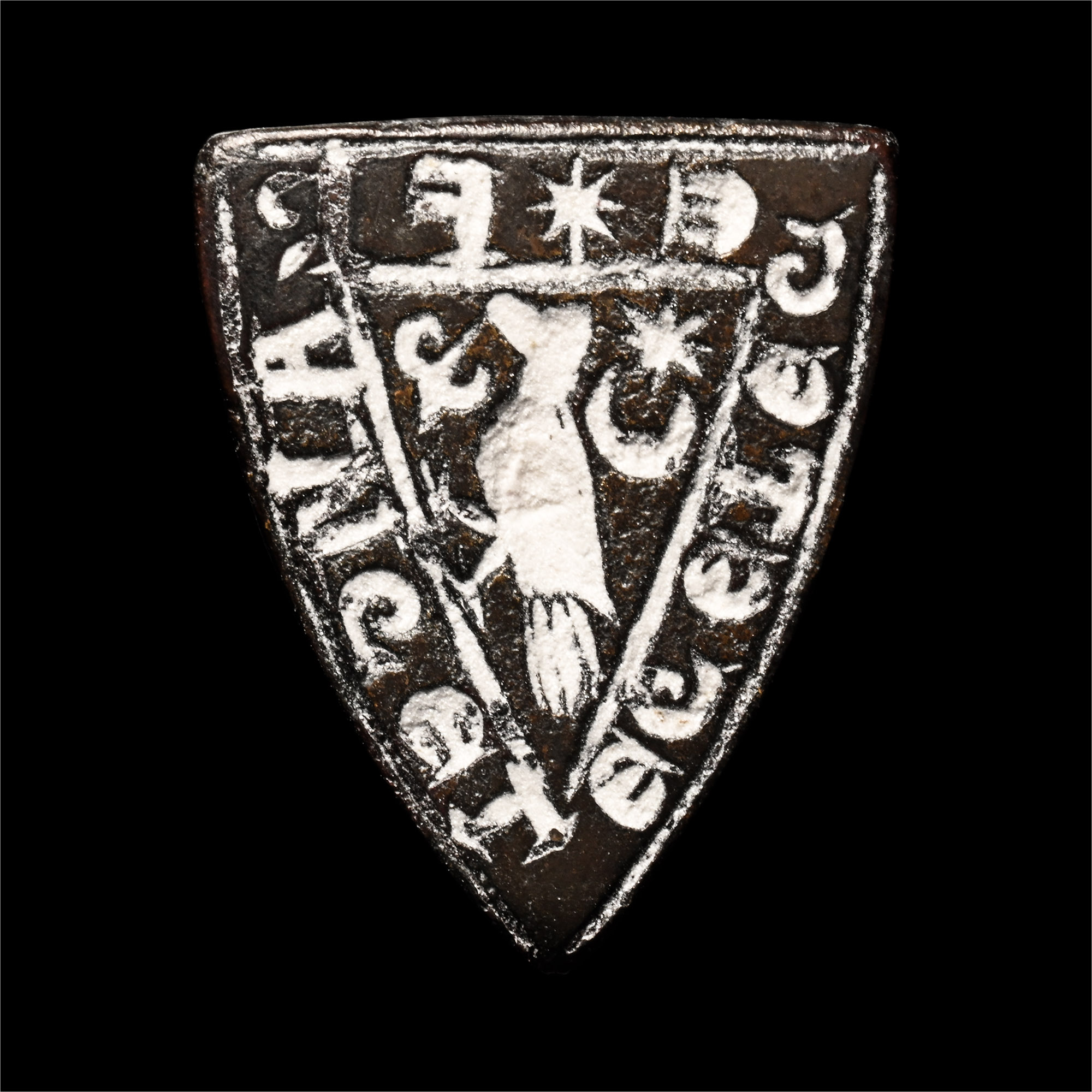
From the 1270s more and more seals left out the owner's name, and early in the fourteenth century anonymous seals became the commonest kind apart from those with a coat of arms. A shield-shaped bronze matrix found at Hothfield in Kent, with a walking bird in front of a star and a moon, is inscribed FRANGE LEGE TEGE, "break, read, conceal", and a round seal from Folkestone and Hythe with a hare says prive su, "I am private".
Some were jokes, like the bronze matrix from Ivychurch, 19 millimetres across, which has a clean-shaven man in a hood, probably a jester, and the legend *S' NVLLVM TALE, "the seal of none such". The hare riding a hound and blowing a horn, the world turned upside down, was probably the most popular of all medieval seal designs. The example in this sale has SOHOV ROABIN, which is the hunting cry Soho! followed by the dog's name, Robin.
Seals like these could be bought ready-made: in 1380 two men in London sealed a forged will "with a seal marked with an H, which they had bought at Paul's Gate", and matrices survive with a space left blank for a name or motto to be added to the customer's order. Two lead pieces from Romney Marsh in the sale, a pointed oval and a disc each with a fleur-de-lys, are masters for producing blank seals of that kind, and come from the workshop side of the trade.
What is a medieval seal matrix worth?
Lead matrices usually sell for less than a hundred pounds, with bronze ones about double that and silver ones selling for multiple thousands. Heraldic seals, those with a shield of arms, come in at about a thousand to two thousand pounds. Seals of offices and of the Crown take the top of the range: the matrix of the almoner of St Augustine's Abbey, Canterbury, made £7,865 in May 2014, and the two-part customs seal of Dunfermline, whose counterseal names King Robert the Bruce, made £151,250 that December. Silver, a name, an office or a religious house, a shield of arms and good engraving each move a matrix up the range.
The December sale runs from £20-30 for a plain lead pointed oval to £1,200-1,700 for Agnes's silver one. Lead name seals like Avice's are estimated at £30-40, less than any of the ten real antiquities TimeLine has sold for under £200. None of the 204 medieval matrices TimeLine has sold was a hundred seal, with Flexborough's estimated at £600-800.
The hundred seals of 1388
Three years after the statute, a writ of March 1391 ordered the sheriffs to have the seals made at once and delivered to a good man of each hundred. In Sussex they were likely used by constables, two of whom had been appointed in every hundred since 1285 and whose duties came to include providing passes for workmen. More than a dozen of these hundred seals are known today, in museums and as finds.
One of them turned up in 1996 at the foot of a rose bush at Detling in Kent, where Mrs M.A. Gillet was gardening. It is the seal of South Greenhoe hundred in Norfolk, and Detling lies on the Pilgrims' Way to Canterbury. The archaeologists who published it wondered whether the good man of the hundred had lost it on his way to Becket's shrine, when the workers of South Greenhoe, by the letter of the law, needed a sealed pass even for a trip to Walsingham.
Black letter first appears on the king's great seal in 1360, and the hundred seals show it reaching the shires within a generation, since South Greenhoe's hundred name is cut in it. Flexborough's seal, made between about 1350 and 1400, mixes Lombardic capitals with a black-letter h at each end of its outer legend.
Why the Sussex seals are back to front
The Flexborough seal has a twin in the seal of Foxearle hundred, in the east of Sussex, which was found within its own hundred and recorded with the Portable Antiquities Scheme in 2008. It has the same six-sided handle, a millimetre shorter, and the same layout, with *hVnDR DE FOXhERLE round the edge and COitat' SUSSeX across the centre, in the same mixed lettering.
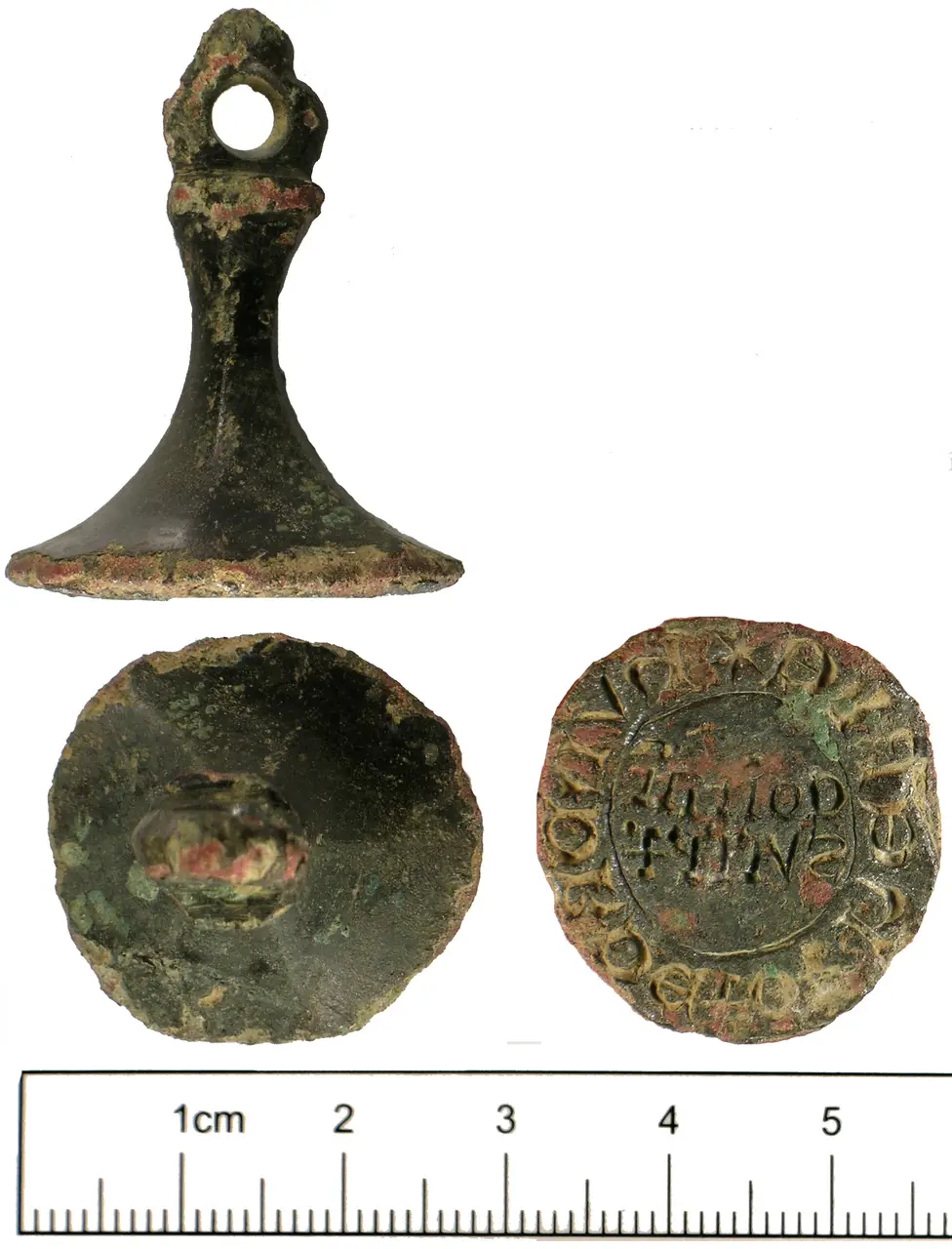 The seal matrix of Foxearle hundred, Sussex, fourteenth century, from the side, the back and the face, with the hundred named round the edge and the county across the centre. Photo: Laura Burnett, Sussex Archaeological Society, The Portable Antiquities Scheme / The Trustees of the British Museum, CC BY-SA 2.0, via Wikimedia Commons.
Side by side, the two could be the work of one engraver, or of one order placed for all the hundreds of Sussex. Christopher Whittick, working in the archives of Battle Abbey, found a third Sussex seal of the kind, known from its wax impression: a seal for Battle hundred, with the county in the middle and the hundred round the edge, on a private charter dated 1361. The Sussex hundreds, it seems, were using standard seals a generation before the statute of 1388, and seals like these may have given Parliament the idea.
Whether Parliament took a Sussex design and turned it inside out rests for now on the Battle charter and the two Sussex matrices, of which Flexborough's is the one for sale. The hundred took in the parishes of Seaford, South Heighton and East Blatchington, and a labourer, man or woman, leaving them for work or pilgrimage needed the impression of this seal on a pass, and paid no more than a penny for it.
