
The Bright Disc: A History of Ancient Mirrors, from Neolithic Obsidian to Roman Glass
Seven discs of obsidian, ground flat and polished on one face, came out of the Neolithic houses of Çatalhöyük in south-central Anatolia. The largest is about eight centimetres across and nearly four thick, a heavy lens of black volcanic glass with limestone paste still packed around the rim where a hand once held it. Five were finished, two left half-made. They are roughly eight thousand years old, and they are the earliest objects anyone has called a mirror.
Whether they are mirrors at all is not settled. James Conolly, who studied the site's obsidian industry, holds that the reflective surface was the functional point and that this "cannot be disputed." A separate study, pointedly titled "Cause for Reflection," is skeptical, observing that there is no direct evidence of what the discs were actually for. Pauline Albenda's wording is the careful one to keep: the earliest known mirrors, "if correctly identified," are these plain polished obsidian disks.
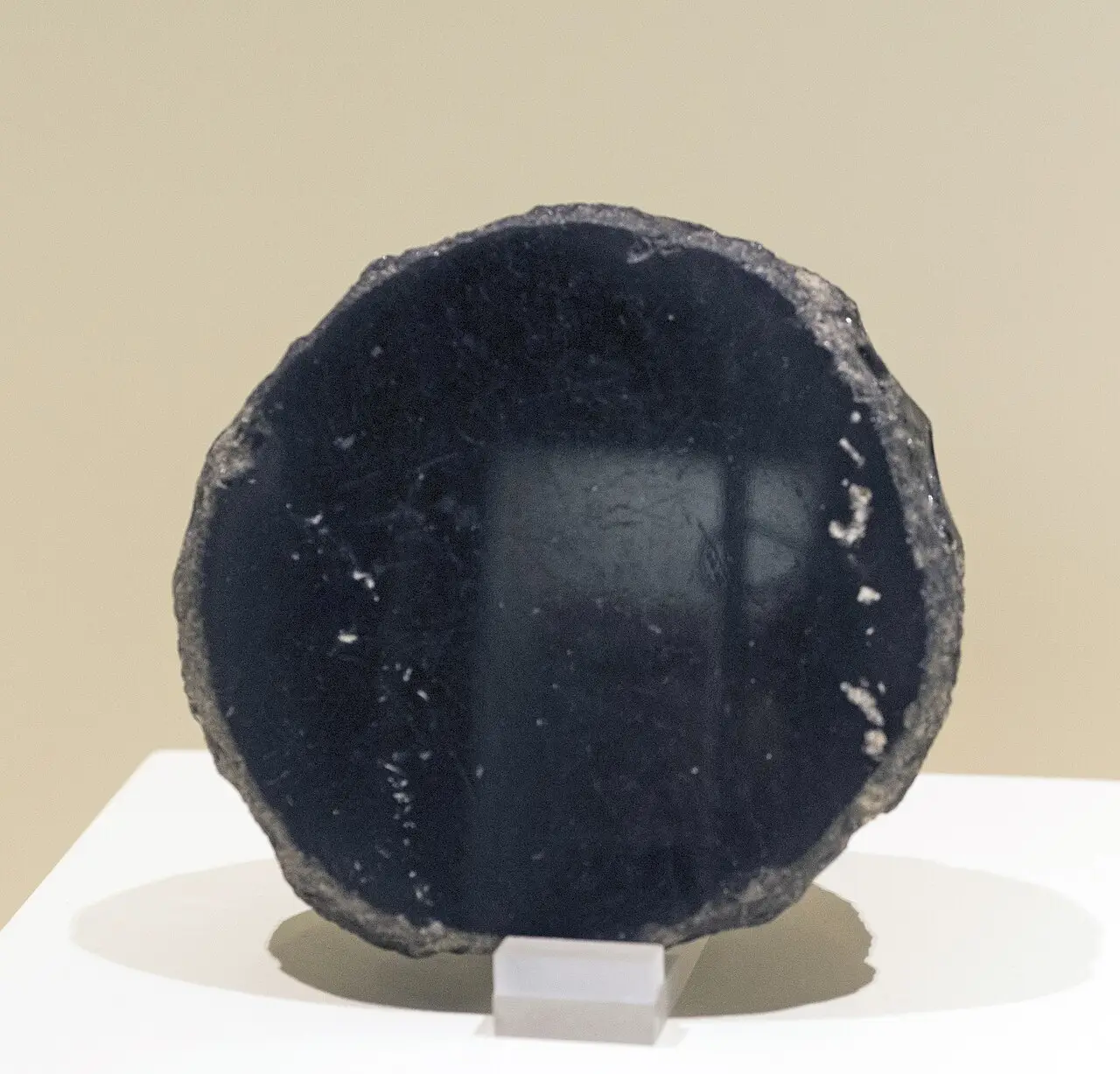 A polished obsidian disc from Neolithic Çatalhöyük, about 6000 BC, in the Museum of Anatolian Civilizations, Ankara. Photo: Dosseman, CC BY-SA 4.0, via Wikimedia Commons.
What is not in doubt is where they were found. The discs came from graves, set with the dead, in a settlement that had no metal mirrors and would leave no imitators: there are no other obsidian mirrors like them anywhere in the Near East. Before anyone had a reliable way to make a bright surface, someone had already decided one belonged in a grave.
That is the pattern the whole story follows. A mirror is the simplest thing on a dressing table, a hard surface polished until it throws your face back at you, and from Çatalhöyük to imperial Rome almost no one was content to let it stay that simple.
What a mirror is, and what came before it
Strip the word back and a mirror is only a surface smooth and bright enough to return a coherent image. By that test the first mirrors were not made at all. Still water in a pool or a bowl, dark wet stone, polished rock crystal, haematite, even the eye of an animal: the world had reflective surfaces long before anyone manufactured one, and people used them.
Reflection is a spectrum rather than a category, and the distinction runs through everything that follows. Some surfaces give back a recognisable image; some shine but distort; some shine and return nothing. The capacity to shine is common to all of them; the ability to render a true image is not. A good deal of what gets called a mirror in the archaeological record was valued for its glitter as much as for any clear reflection.
The made mirror changed something basic. Before it, in one archaeologist's phrase, people "were reliant on others to tell them how they looked." To own a polished disc was to become your own witness.
Seneca, writing in the first century AD, gave the sequence as the Romans pictured it: first "a clear fountain or a polished stone returns to each man his image," then a bronze vessel kept for some real use and noticed to reflect, and finally "a disc prepared especially for this function." The same pattern shows up in the myths, and it is worth being exact about them, because the popular versions get the object wrong. Narcissus fell in love with his reflection in a pool, not a manufactured mirror; Ovid even has him reach the truth, "He's me." Perseus looked at Medusa in the polished bronze of his shield, and "mirror-shield" is a modern phrase. Neither story needs a made mirror, because for most of human time there was not one.
When the made object did arrive, it arrived more than once. Copper mirrors appear in southern Mesopotamia at Tello around 3200 BC and in Egypt at roughly the same time; bronze mirrors turn up in the Qijia culture of north-west China by about 2000 BC; and the Olmec of the Gulf coast of Mexico were polishing concave mirrors out of iron ores, magnetite and hematite, by around 1200 BC. These are separate inventions on separate continents, with no single point of origin and no tidy line of descent. The mirror is the kind of plain technology that almost every complex society works out for itself. What follows keeps to one connected strand of it, the line that runs from Anatolia and the Near East through Egypt, Greece and Etruria to Rome; China, the Americas and Iron Age Europe each deserve their own telling.
Making a surface bright enough
Polishing stone to a mirror finish was slow handwork. A study of a polished-obsidian bracelet from nearby Aşıklı Höyük clocked about seven hours of grinding and buffing to bring a surface that far. Metal offered a brighter result faster, but only with the right alloy.
Bronze is copper and tin, and for most purposes a smith wants only a tenth or so of tin. Push it past a fifth and the metal turns pale, hard and brittle, useless for a blade and close to ideal for a mirror. David Scott, whose metallography of ancient metals is the standard reference, sets out what happens at the top of that range: above about seventeen per cent tin a brittle compound called the delta phase begins to form, hard, stable and silvery. At its saturation, the archaeometallurgist Sharada Srinivasan notes, this phase can be "polished with the best possible reflectance." Mirror-makers from Italy to China converged on the same recipe, copper with twenty to twenty-five per cent tin and a few per cent lead, almost always cast rather than worked, because the metal was too brittle to hammer. The Romans called the alloy speculum, and the word is still used for it.
Not everyone went so high. The figures from analysed mirrors run from around nine per cent tin in Egyptian and Greek pieces to the low twenties in Roman and Chinese ones, and as much as a third in early India, where a high-tin tradition survives in the Aranmula mirrors of Kerala. British Iron Age smiths, who could make speculum if they had wanted to, kept their mirror-plates near ten per cent, and why they preferred a yellower, softer reflection to the silvery Roman one is an open question of taste rather than skill.
The disc was cast, then ground true on a simple lathe and polished. Some Greek and Cypriot mirrors had their faces tinned or silvered for a whiter image. And the face was usually made slightly convex on purpose. A flat mirror of hand size shows you a flat mirror's worth of face; a gently curved one widens the field, enough to take in the whole of the user's head at once.
Almost none of this survives as it looked. The reflecting face is the first thing burial destroys; polished speculum corrodes to a green or black crust, and the bright surface that was the entire point is the part we almost never see. When we handle an ancient mirror in the cataloguing room, a dull dark disc is the rule and a still-reflective one the rare exception. They are, even so, among the antiquities a collector is most likely to meet, in bronze and occasionally in silver, from Egypt to the Roman provinces.
A woman's object, mostly
By the time the mirror reaches Egypt it is plainly a thing of the dressing table and the goddess. The Egyptian disc is never quite round; it takes the slightly flattened oval that scholars read as an echo of the sun's disc, and from the early Middle Kingdom its handle is shaped as the face of Hathor, goddess of love, music and the toilette, or as a papyrus stem, whose form doubles as the hieroglyph for "green, fresh, flourishing." The richest surviving example belonged to a princess, Sithathoryunet, buried at El-Lahun in the nineteenth century BC: an elliptical silver disc on a handle of polished black obsidian, its papyrus umbel sheathed in electrum, crowned with gold faces of Hathor whose brows are inlaid with lapis. It stands twenty-eight centimetres high and weighs most of a kilogram. Silver, not bronze, because in the Middle Kingdom silver gave the clearest reflection and was the most prized mirror metal of all.
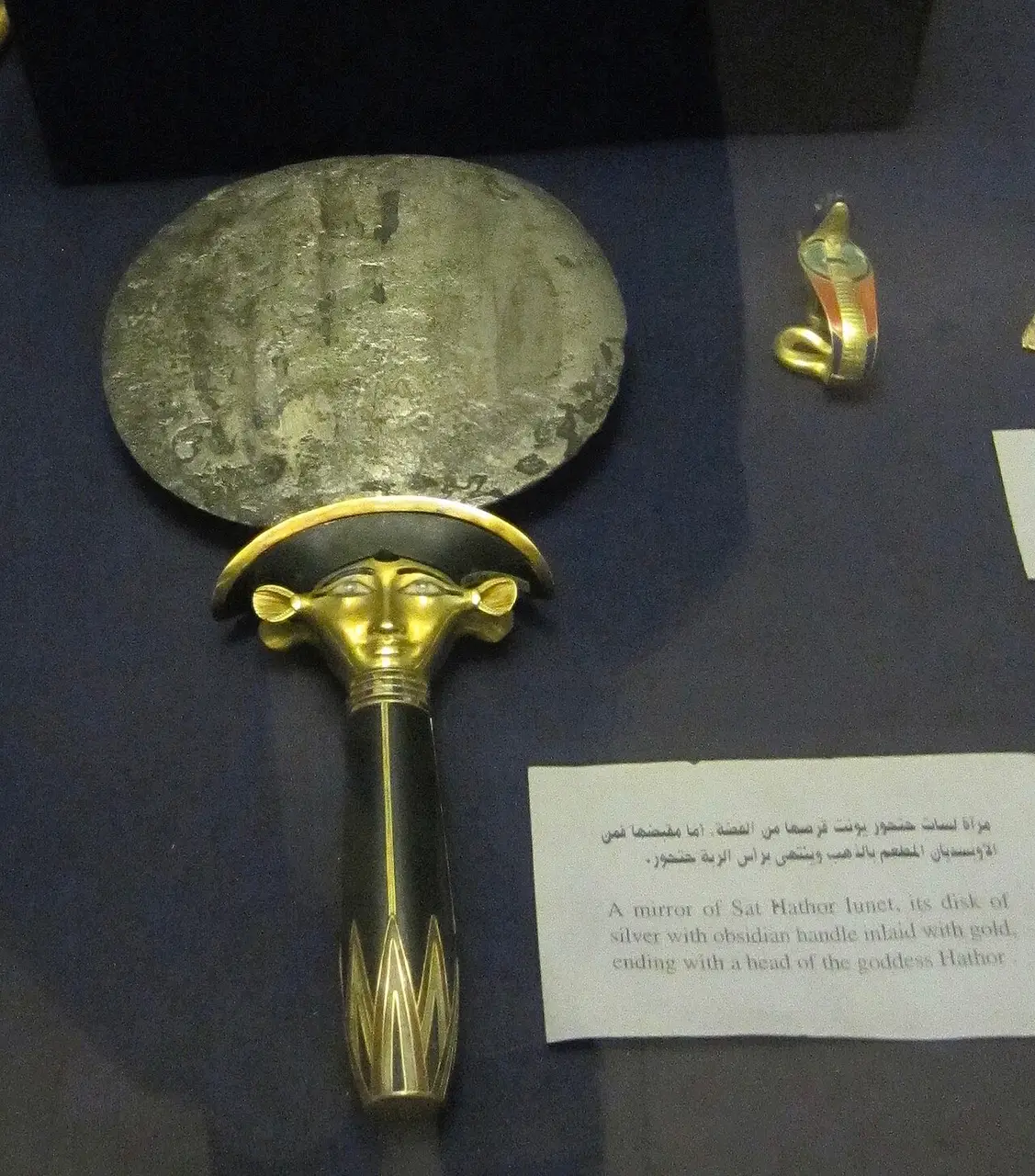 The mirror of the princess Sithathoryunet, nineteenth century BC: a silver disc on an obsidian handle that ends in a gold head of Hathor. Egyptian Museum, Cairo. Photo: A. Parrot, CC0, via Wikimedia Commons.
Around the object grew a tangle of meaning that the popular version flattens. It is often said that the Egyptian word for mirror was ankh, "life," so that the mirror itself stood for rebirth, but the symbolic reading is contested at the root: the Egyptians used several words for the object across their history, and R. S. Bianchi argued that the ankh-naming was practical, that the mirror "caused the features of the beholder to live in the reflection," not a statement about the afterlife. Tutankhamun's mirror case, made in the shape of the ankh sign, is best read as a pun on two similar words, not proof that they were the same.
The deeper association is with women, and it is both genuine and half an artefact of how graves are read. Mirrors cluster in burials identified as female, and the object was tied to goddesses of love and beauty everywhere, to Hathor in Egypt, Aphrodite in Greece, Turan in Etruria. The poet Philitas called it "Aphrodite's shining bronze mirror that never lied to her." Greek women dedicated mirrors by name in sanctuaries: an inventory of dedications to Artemis Brauronia lists "bronze mirrors: 119," and at Locri a woman called Xenodoka had her mirror engraved, the letters running backwards, to Persephone.
The catch is that many of the graves doing the work of that argument were sexed by their contents in the first place. A burial with a mirror gets called a woman's, a burial with weapons a man's, and then the mirror is offered as evidence that mirrors belonged to women. Where bones or inscriptions survive, the picture loosens. At the Late Minoan cemetery of Zafer Papoura near Knossos, twelve bronze mirrors belonged as readily to the men's graves as to the women's. In Egypt men were buried with mirrors inscribed with their state titles. The Etruscan specialist Richard De Puma warns that nineteenth-century excavators under-recorded male burials with mirrors, so that even the strong Etruscan link to women is partly a trick of recovery.
The back of the mirror
For a long time the front of a mirror was the whole object and the back an afterthought. In the Greek world that reversed. The earliest Greek mirrors were plain hand discs, but by the seventh century BC the disc was being set on a cast bronze figure, usually a standing woman, who held it up above her head: the caryatid mirror, a small piece of sculpture that happened to carry a reflector. They run to the middle of the fifth century, and of the hundred-odd survivors catalogued by Congdon about half cluster in the single generation around 480 to 450 BC. The nude-girl supports seem to have been a Spartan idea, tied to the cult of Artemis Orthia, and only a handful of the figures are male.
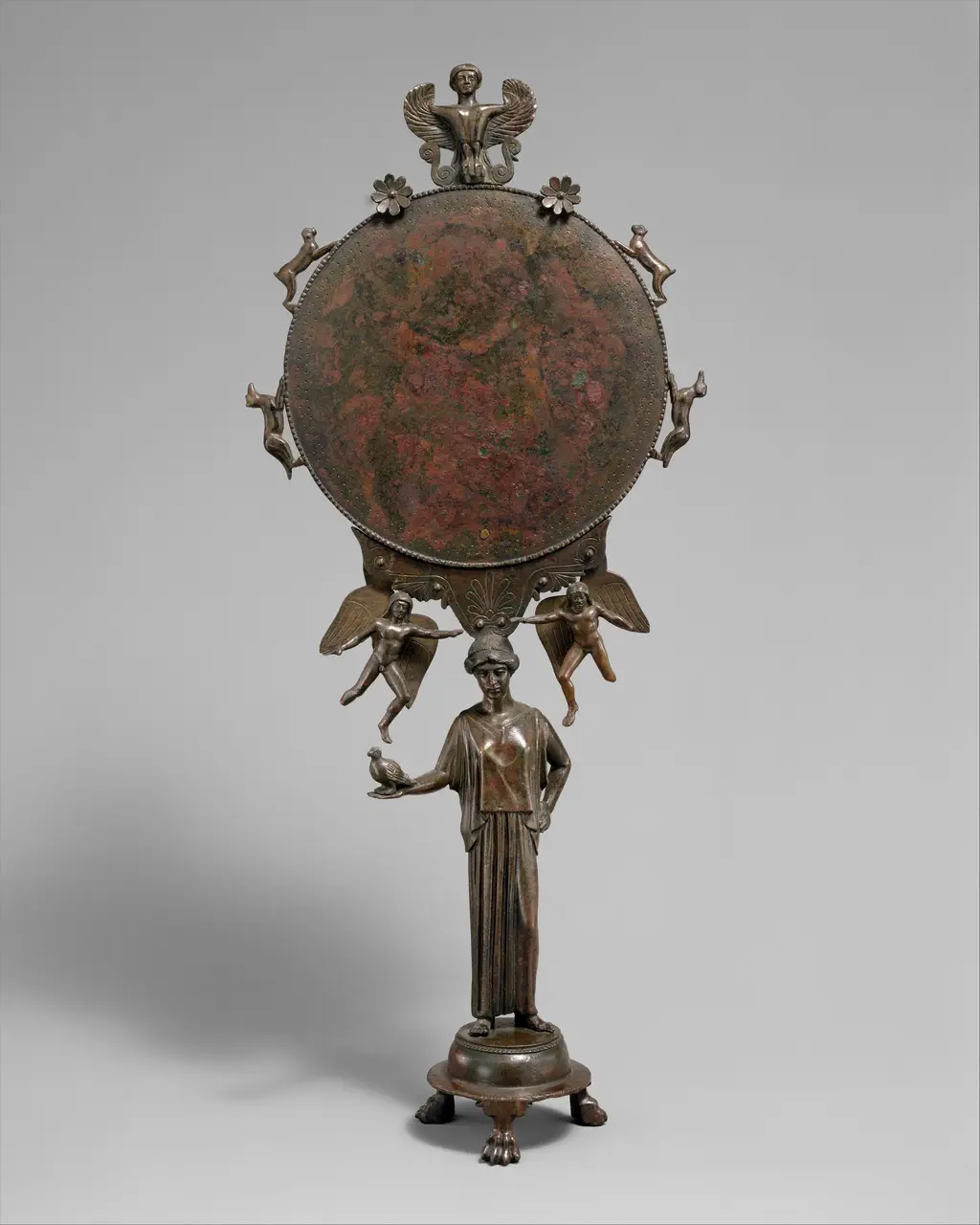 A Greek bronze caryatid mirror of the mid-fifth century BC: a draped woman holds the disc above her head, a winged Eros to either side. The Metropolitan Museum of Art, New York.
Then, in the second half of the fifth century, the caryatid mirror disappears almost overnight, perhaps too costly to keep making as the Peloponnesian War drained the cities, and the box mirror takes its place: two hinged bronze discs, one carrying the polished face inside and a relief outside, the other a plain protective lid. The face was cast, spun on a lathe and left gently convex, so that the viewer's head and shoulders could be seen at once. The reliefs on the covers ran from the decorous to the frankly erotic.
The Etruscans took the back of the mirror furthest of all. From the late sixth century BC they cast hand mirrors with a convex face that widened the field of view, and on the flat reverse they engraved scenes, line by incised line. Something between three and four thousand Etruscan mirrors survive, many of them engraved on the reverse, a body of imagery large enough to have its own multi-volume catalogue, the Corpus Speculorum Etruscorum, begun in 1981 to replace Eduard Gerhard's nineteenth-century one.
What they engraved was Greek myth in Etruscan dress, the figures labelled in Etruscan: Tinia for Zeus, Uni for Hera, Menrva for Athena, Turan for Aphrodite. The choice of subject often plays on the object itself. One mirror in the British Museum shows Perseus and two gods looking down at the head of Medusa as a reflection in a pool, a Gorgon safe to stare at because she is only an image, which is exactly the trick of a mirror. The finest of them, from Vulci and now in the Vatican, shows a winged figure labelled Chalchas, the Greek seer, bent over a table reading a liver in the manner of an Etruscan haruspex, the diviner and his Greek counterpart folded into a single person. Many mirrors carry their owner's name: mi malena larthia puruhenas, "I am the mirror of Larthia Puruhena," though malena may instead mean a wedding gift, a question still argued. On the Latin mirrors of Praeneste the engraver sometimes signed his work: "Vibius Philippus engraved this."
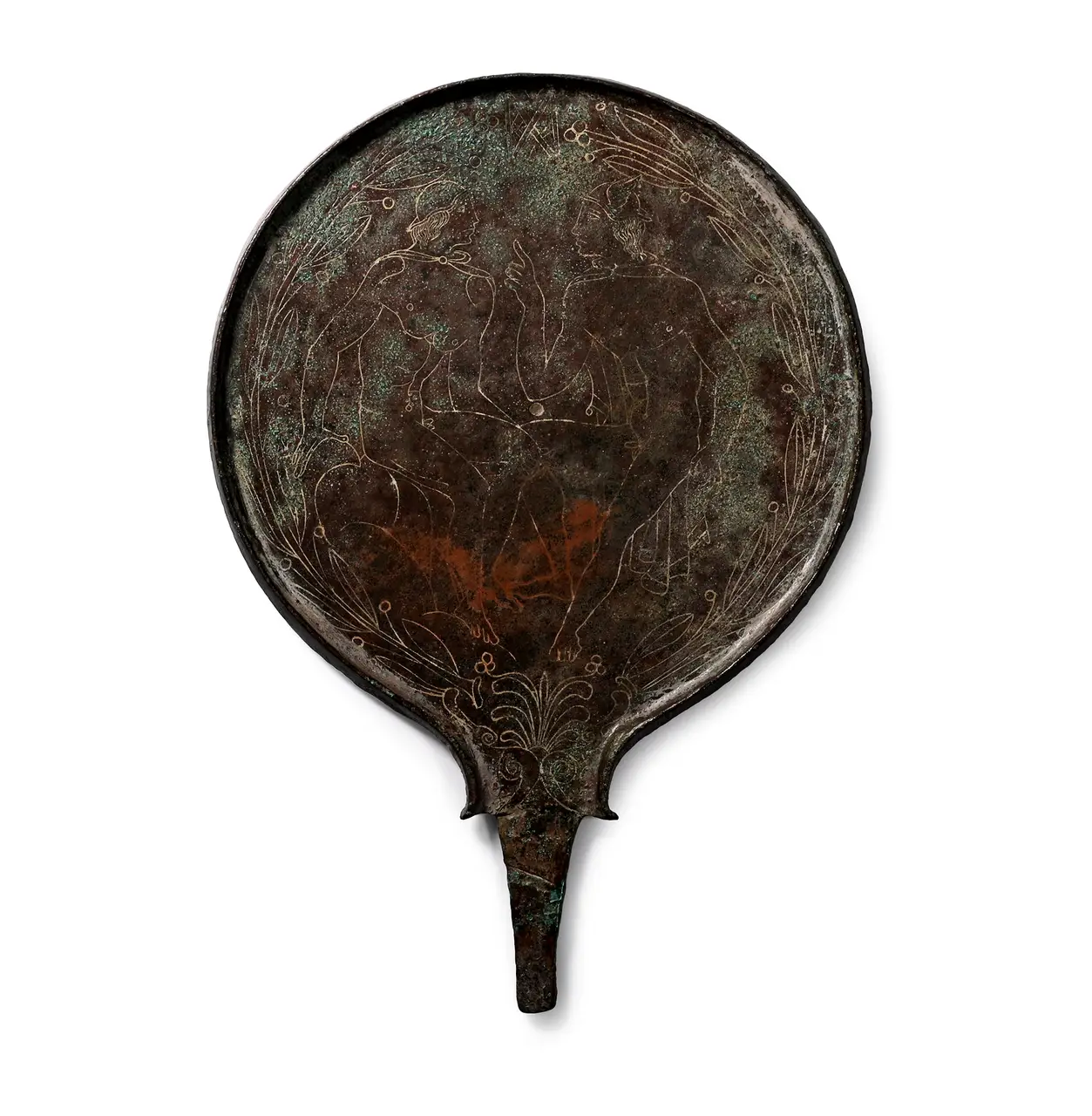
And a number of these mirrors were deliberately ruined. The word śuθina, "for the tomb," was scratched across some twenty of them, often straight over the polished face, defacing the one surface that worked so that the living could not take the object back. Around eleven more were bent, folded or punched through before burial. To see why anyone would wreck a costly thing on purpose, you have to follow the mirror into the grave.
Killed for the dead
Breaking a grave-good was a way of sending it with its owner. At Roman Chester a young woman, not yet twenty, was buried with her mirror broken into twelve pieces and placed inside a beaker, the act read as making the object lifeless so that it could go with the spirit. The same logic ran from the Etruscan śuθina mirrors to the bronze mirrors hung inside Chinese coffins above the dead person's head, where the mirror was thought to make malign spirits visible and drive them off.
The mirror kept appearing at the edge of death because it was also an instrument for seeing what could not otherwise be seen. The traveller Pausanias, in the second century AD, described an oracle of Demeter at Patrai for the seriously ill: a mirror was let down on a cord until its rim just touched the water of a sacred spring, and after a prayer the patient's friends looked in, and the mirror showed them the sick person "either alive or dead." At Lykosoura, he wrote, a mirror set into the temple wall returned a visitor's own reflection dimly or not at all, while the images of the gods came through clear. To dream of yourself in a mirror, the dream-interpreter Artemidorus noted, meant marriage or death.
This is catoptromancy, divination by mirror, studied in detail by Armand Delatte, and it shaded into the older practice of scrying in a bowl of water or oil. The magical papyri of Roman Egypt give recipes for it, most of them needing a child as the medium through whom a god would speak. The darkest version sits inside a myth. In the Orphic story the Titans lure the infant Dionysus with toys, a spinning top, a ball, knucklebones and a mirror made by Hephaestus, and while the child is lost in his own reflection they fall on him and tear him apart. A Dionysiac mirror was found in a sixth-century BC tomb at Olbia on the Black Sea, and the Neoplatonist philosophers later read the whole story as an image of the soul scattering into matter, seeing itself "as if in the mirror of Dionysus."
Burning the fleet
All of this rested on a surface that obeyed simple rules, and the Greeks worked them out. The law that light reflects at equal angles is stated plainly in the Catoptrica attributed to Euclid; Hero of Alexandria derived it from the principle that a ray takes the shortest path, and designed trick mirrors for temples that swapped a worshipper's reflection for the image of a god. Around 200 BC Diocles proved, in On Burning Mirrors, that a spherical mirror does not bring sunlight to a true point but a parabolic one does, the larger the better.
Which is the real science behind the most famous mirror story of antiquity, and the reason to doubt it. Archimedes is said to have burned the Roman fleet at the siege of Syracuse by focusing the sun with mirrors. The trouble is that the contemporary historians who describe the siege at length, Polybius, who interviewed survivors and lovingly catalogued Archimedes' catapults and his ship-grabbing claw, and after him Livy and Plutarch, say nothing of any mirror. The burning-mirror version appears first in the sixth century AD, in Anthemius of Tralles, the architect of Hagia Sophia, who offers it as his own conjecture, and the circumstantial detail arrives only with twelfth-century Byzantine writers, more than thirteen hundred years after the siege. Modern attempts to reproduce the feat have been, in one verdict, spectacular and unconvincing. The real Archimedes built siege engines that worked; the mirror that boiled a navy is a legend that grew up long after he died.
Glass, and a tool for knowing yourself
Roman mirror-making took the old metal forms and mass-produced them. Under Augustus the trade spread to every province, and the large silver hand mirrors of Pompeii and Herculaneum were copied as smaller versions found from Britain to the Danube. Many of those copies were not silver at all but high-tin bronze, polished white enough to pass for it. Solid-silver mirrors did exist, and they were costly enough to moralise about.
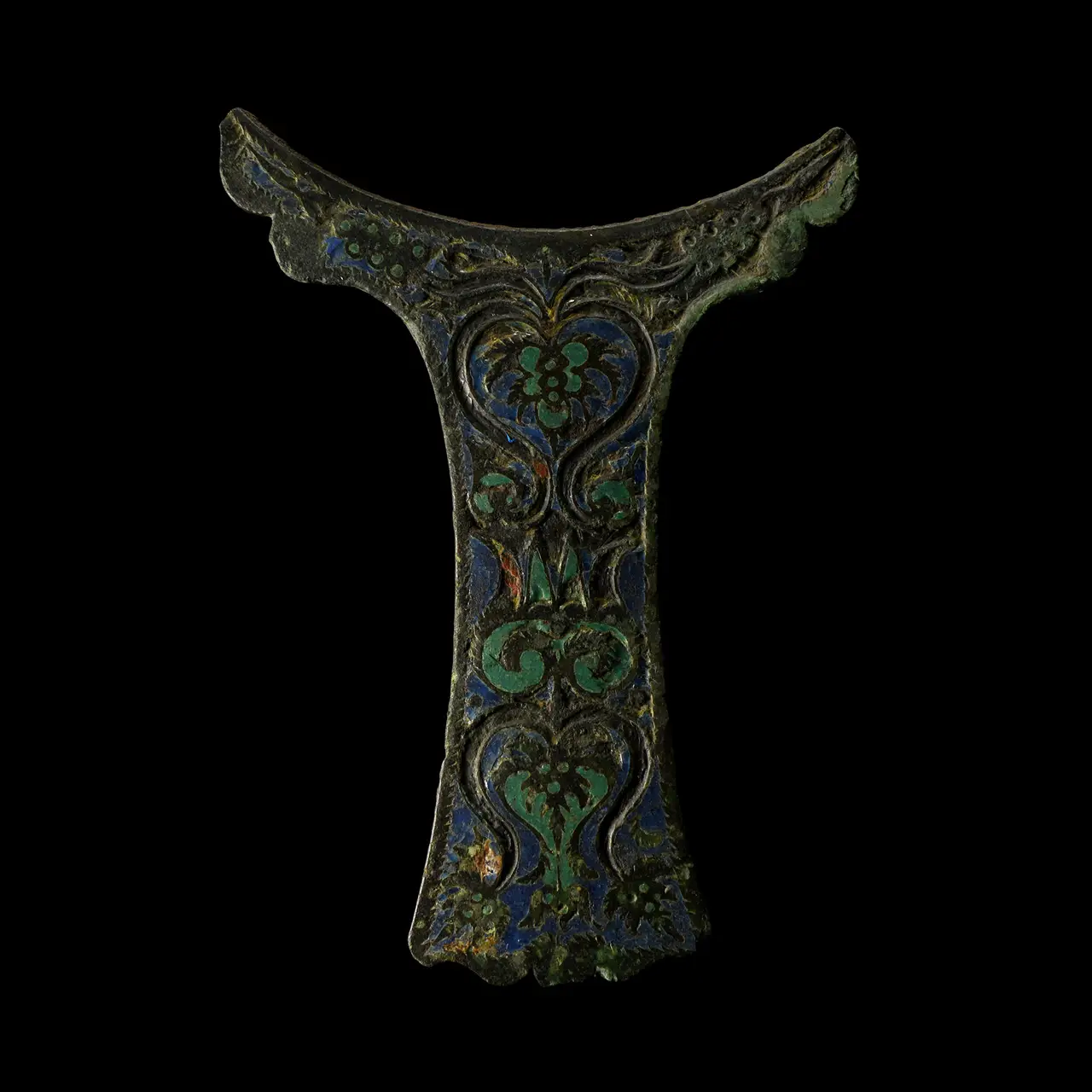
It was the Romans, too, who first backed glass with metal to make a mirror. Pliny credits the invention to the glassworkers of Sidon, and lead-backed glass mirrors do appear from the second and third centuries AD, most surviving only as their little lead frames, among them a hoard from Sucidava on the Danube. They were poor things: tiny, often no wider than a few centimetres, and curved, because the way to coat glass was to blow a globe, pour molten lead inside and cut out a piece, which left every mirror convex and distorting. The gentle convexity that flattered a bronze disc became, in cheap small glass, simply a fault. Metal stayed the better mirror throughout antiquity. The flat, clear glass mirror the word now brings to mind is a medieval achievement, perfected in Venice more than a thousand years after Pliny. Roman bronze mirrors, and the occasional silver one, still come up at auction, and our catalogue of ancient bronzes is the place to see what survives.
The Romans argued about mirrors more than anyone before them, and the argument is the oldest one about the object still running. Seneca set the two poles in a single passage. "Mirrors were invented," he wrote, "in order that man may know himself," the comb-side tool turned into an instrument of self-examination, heir to the Greek habit of telling young men to study their faces in a mirror and either live up to them or make up for them. In nearly the same breath he turned on his own age. Full-length mirrors were now framed in gold and silver and set with gems, one of them costing more than a respectable dowry once had, and what used to be "the ornament of a woman is now a man's accoutrement." He told the story of Hostius Quadra, who ringed his bed with magnifying mirrors so that every act was enlarged in the reflection, and ended it with a flat sneer: go now and say the mirror was invented for the sake of cleanliness. Juvenal supplied the matching image, the emperor Otho carrying a mirror among his baggage to the battlefield.
The quarrel never resolved, because both halves of it were true at once. The mirror that let a person be their own witness, instead of relying on others to say how they looked, was the same object that made vanity portable and turned self-knowledge into self-regard. And the surface where that argument happened is the one part that does not come down to us. Speculum corrodes from the face inward; the bright disc goes black. What reaches us is the back, not the reflection: the Hathor handle and the engraved gods, the owner's name and the cosmos laid out in bronze, every meaning the ancient world loaded onto a mirror, and almost none of the plain bright surface it was all built around.
TimeLine Auctions, 25th June 2026
