
Loading, please wait...
LOT 0370
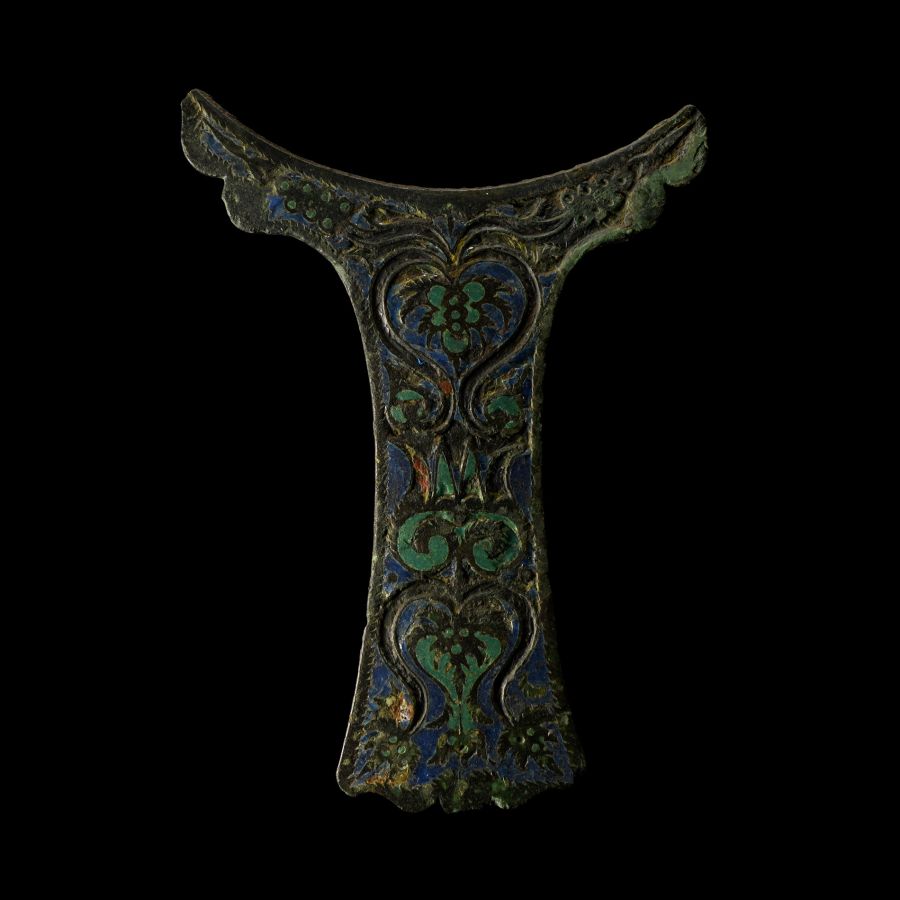
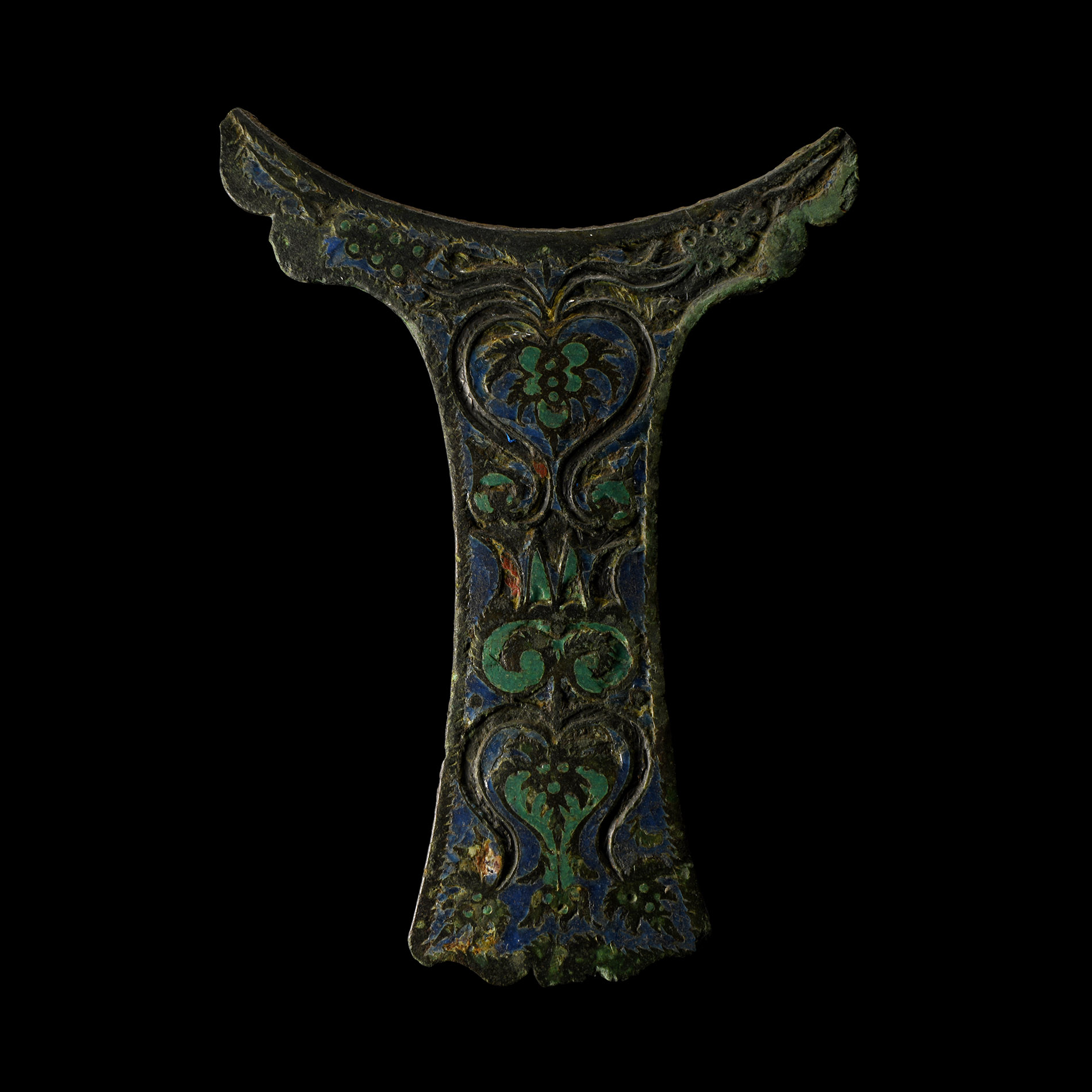
Romano-British Enamelled Bronze Mirror Handle
1ST-2ND CENTURY A.D.
5 in. (94 grams, 13 cm).
Flat in section with crescentic upper end and scrolled lower end, the surface formed with symmetrically placed low-relief palmettes, vine tendrils with grapes and foliage, reserved against the field enamelled in green, dark blue and red.
ProvenanceAcquired in the early 1980s.
with Edward Smith, USA.
From the collection of a Connecticut, USA, collector.
with TimeLine Auctions, 23 May 2017, no.251.
Private American collection, New York, USA.
Accompanied by an academic report by Dr Raffaele D'Amato.
This lot has been checked against the Interpol Database of stolen works of art and is accompanied by search certificate number no.11994-210999.
Cf. Tassinari, S., La vaiselle de bronze, Romaine et Provinciale, au musée des antiquités nationales, Paris, 1975, fig.20, for a similar handle; Mattusch, C.C., Pompeii and the Roman Villa: Art and Culture Around the Bay of Naples, Washington, 2008, item 30, for type; for decoration and similar types in Britain see PAS WMID-3FE965, LVPL-39BCF5,YORYM-20B68C.
FootnotesThis could be an example of a Romano-British bronze and enamel handle from a mirror or patera, similar to some other existing examples in museums. The shape of the handle is similar to one of the famous pateras from Pompeii. Our specimen is decorated with 'Celtic-style' motifs consisting of a curvilinear scrollwork design of turquoise and blue enamel. A bowl with almost identical enamel work was found in Staffordshire, known as 'The Staffordshire Pan' (WMID-3FE965), while a complete patera was excavated in Amiens (known as the Amiens Patera).
CONDITIONTimeLine Auctions follows a vetting process to ensure the authenticity and legality of all items, reinforcing our commitment to integrity and responsible trading. Each antiquity, antique, and coin lot undergoes thorough examination by a vetting committee of at least ten external specialists, professional trade association members, scientists, and archaeologists: Our Vetting Process
AUCTIONS:
TimeLine is a leading auction house specialising in antiquities, ancient art, collectables, natural history, coins, medals, and books. Our auctions offer museums, collectors, historians, and enthusiasts the opportunity to acquire unique and historically significant pieces.
-
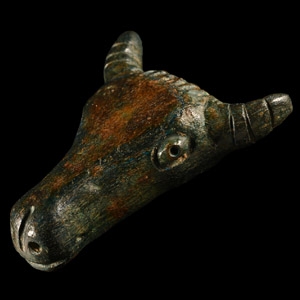
Iron Age Celtic Bronze Bull's Head Mount
Circa 1st century B.C.-1st century A.D.Sold for (Inc. bp): £130
Modelled in the half-round with hatched fur detailing to the forehead, tiers to the horns. 46 grams, 41 mm
From a collection acquired on the UK art market from various auction houses and collections mostly before 2000. From an important Cambridgeshire estate; thence by descent. -
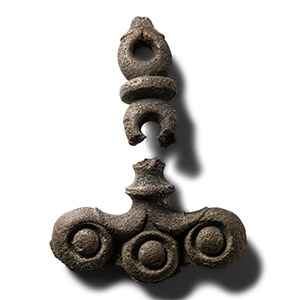
Iron Age Celtic Bronze Mirror Handle
Circa 1st century B.C.-1st century A.D.Sold for (Inc. bp): £208
Two fragments from a decorative mirror handle comprising a portion of the shank formed as two loops joined by a transverse disc, and a bifacial finial with volute scroll enclosing three domed discs (reversed and three round sockets for enamelled studs (obverse). 132 grams total, 46-67 mm
From a collection acquired on the UK art market from various auction houses and collections mostly before 2000. From an important Cambridgeshire estate; thence by descent. -
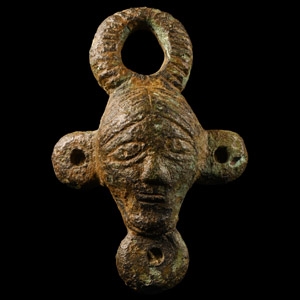
Iron Age Celtic Bronze Bowl Mount
Circa 1st century B.C.-1st century A.D.Sold for (Inc. bp): £260
Piriform mask with centre-parted hair almond-shaped eyes, keystone-shaped nose and slit mouth; hollow to the reverse, three radiating pierced attachment lugs and loop above with hair texture. 45.2 grams, 58 mm
From a collection acquired on the UK art market from various auction houses and collections mostly before 2000. From an important Cambridgeshire estate; thence by descent.
