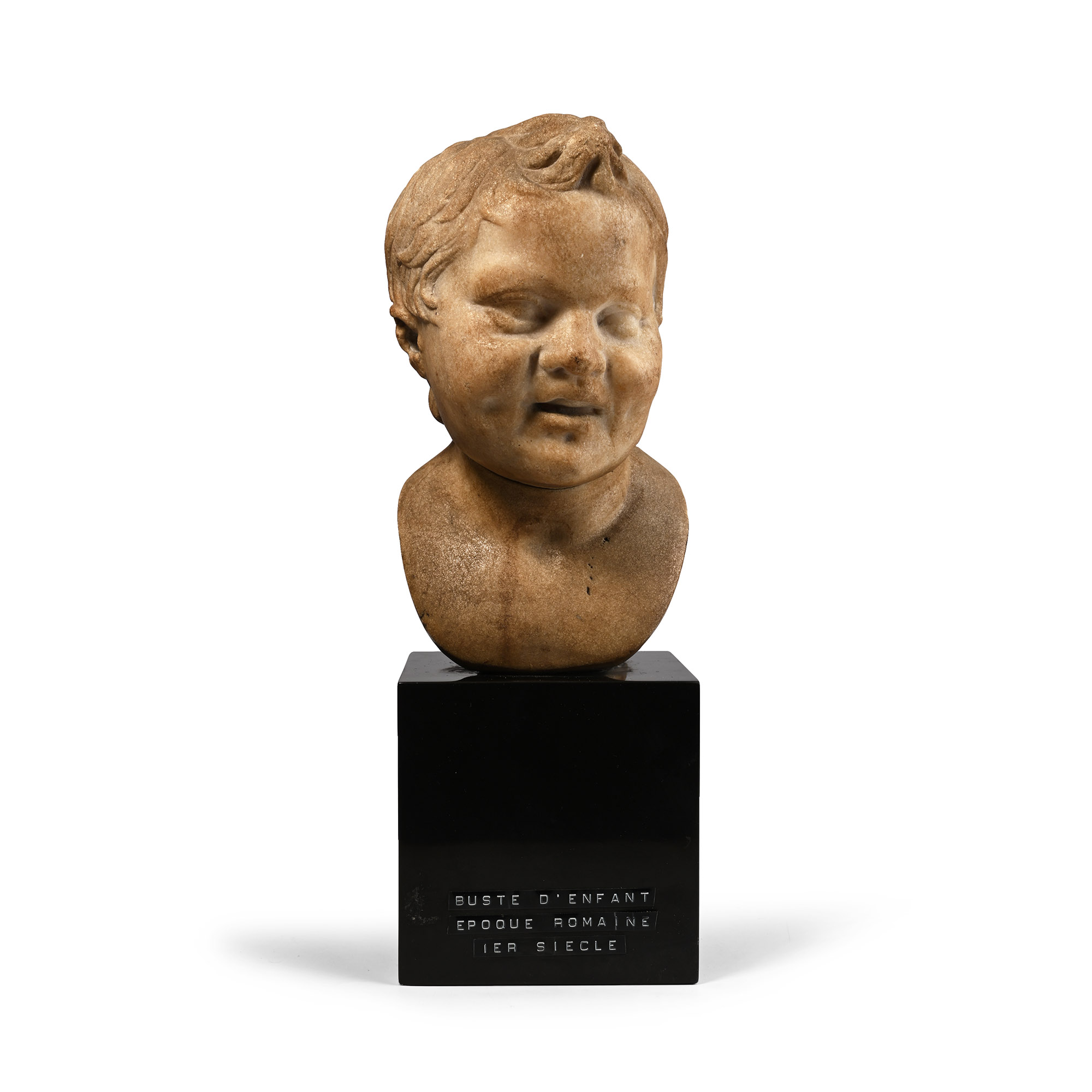
The child is laughing, cheeks full and lips slightly parted, his hair combed up into a peak over the forehead, and he has been laughing since a Roman sculptor carved him in the first or second century AD. He is Eros, the god of love the Romans called Cupid. Like a good deal of Roman marble sculpture, the head has been fitted to a much later pedestal, here of eighteenth-century marble, and it stands on a black base with a collection note in French.
Around AD 77 Pliny the Elder complained in his Natural History that "heads of statues are exchanged for others", because his contemporaries cared more for costly material than for a true likeness of themselves. His ancestors, he wrote, had kept wax masks of their own family in their halls, "not statues by foreign artists, nor bronzes nor marbles", whereas the Romans of his day "prize likenesses of strangers", decorated their anointing-rooms with portraits of wrestlers and hung likenesses of the philosopher Epicurus round their bedrooms.
Pliny meant every line as a reproach, but his list comes close to a full answer to why people still collect Roman marble: for likenesses of strangers, in his phrase, and for Greek statues that survive only as Roman copies. The twelve marbles in TimeLine's sale of 1 December 2026 come out of the world he was scolding.
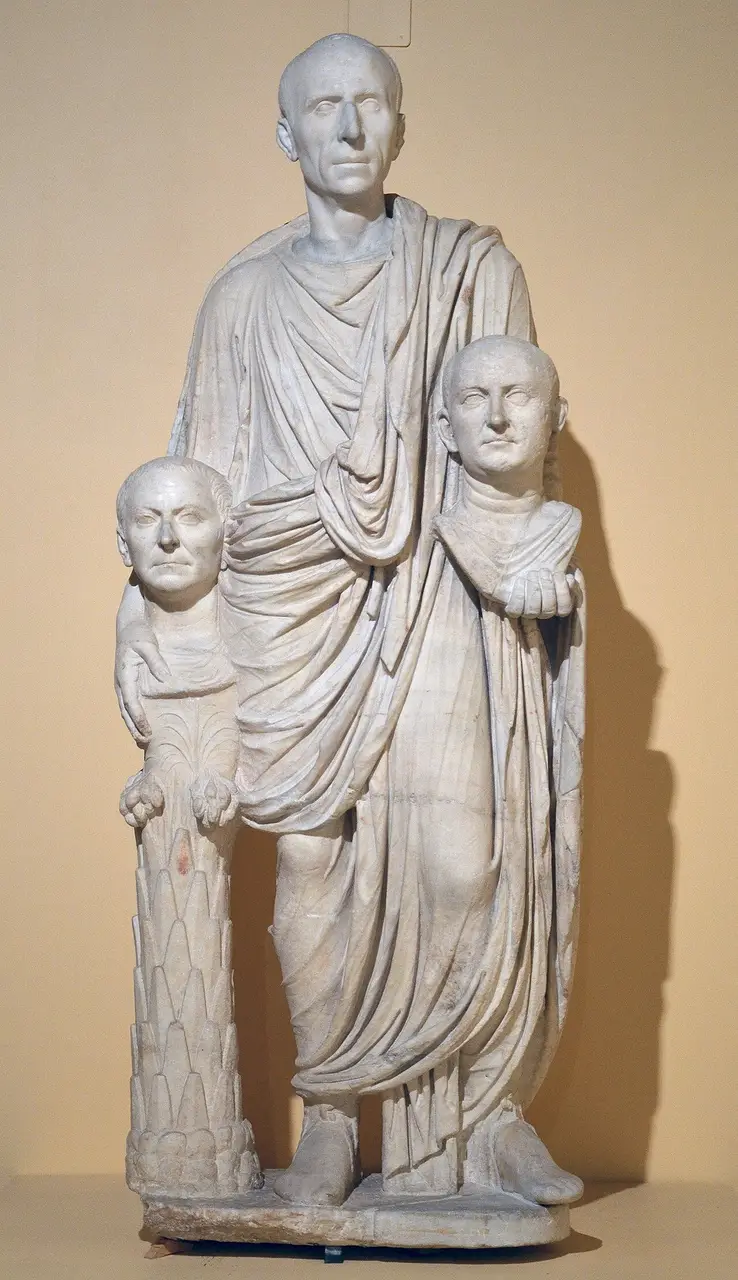 The Barberini Togatus, a Roman in a toga holding two portrait busts usually taken for his ancestors, late first century BC; the head is ancient but comes from another statue. Centrale Montemartini, Rome. Photo: Carole Raddato, CC BY-SA 2.0, via Wikimedia Commons.
How do you put a name to a Roman marble head?
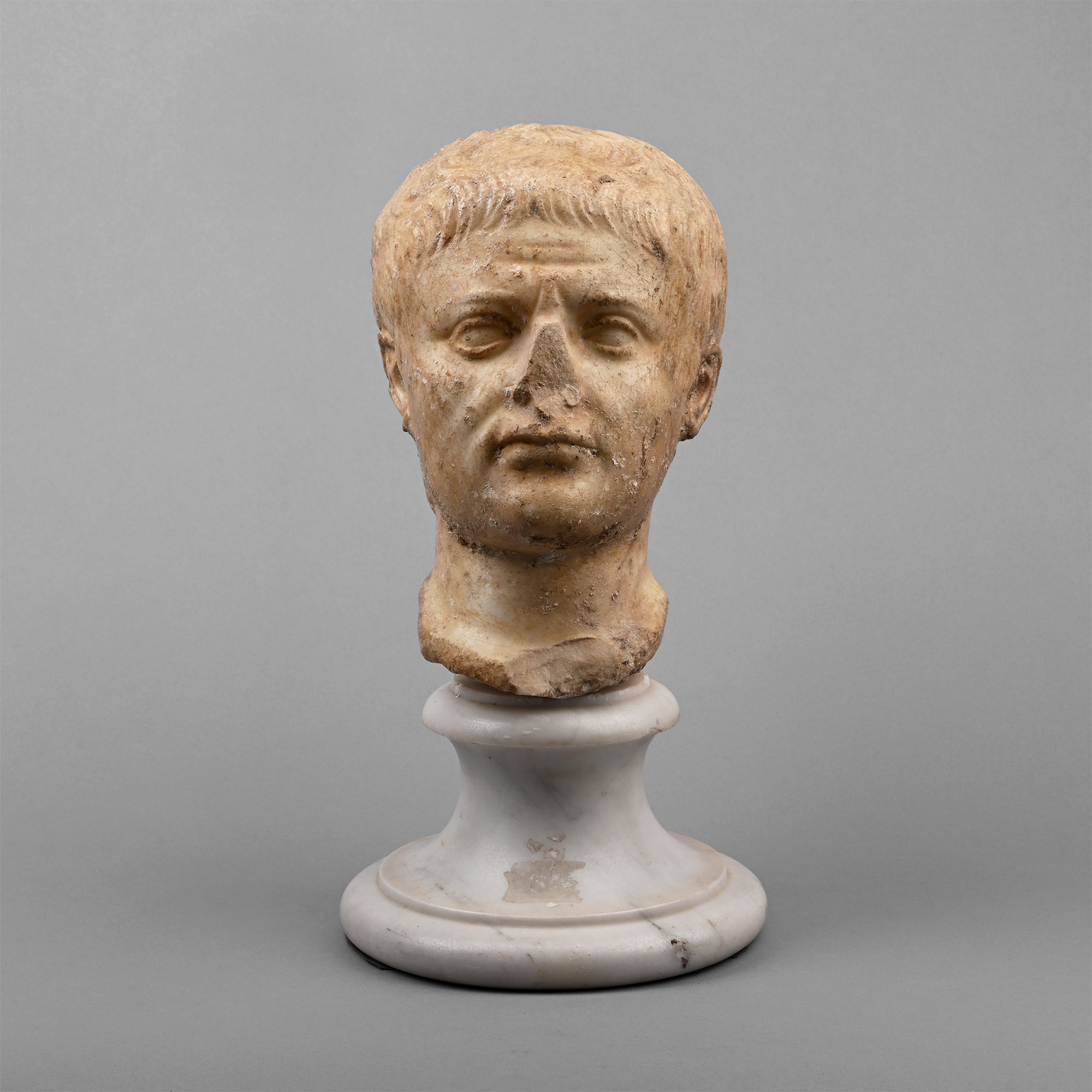
The first question anyone asks of a Roman marble head is whose face it is, and for an emperor the hair usually gives the answer. Tiberius was in his mid-fifties when he succeeded Augustus in AD 14, yet most of his portraits give him the unlined face of a young man and a cap of comma-shaped locks across the forehead, modelled on his predecessor's. The resemblance is thought to be deliberate, a family likeness between two men related only by adoption, and workshops kept producing versions after he died.
Lot 137 is a youthful, beardless head with short, softly modelled wavy locks, carefully defined eyes and full lips, 34.5 cm high on an antique white marble base. Its features and hairstyle are close to the established portraits of Tiberius, and it was carved in the second century AD, long after the emperor died in AD 37, most likely as an idealised later version of the imperial type, by a sculptor reaching back a century for an emperor's face.
A philosopher is named by matching his face to a portrait inscribed with his name. For Hermarchus of Mytilene, who succeeded Epicurus at the head of his school, that portrait is a bronze bust from the Villa of the Papyri at Herculaneum, whose carbonised scrolls are now being read and which Vesuvius buried in the eruption that killed Pliny. Lot 162 is a middle-aged bearded man with short wavy hair, deep-set eyes and lips almost hidden in the beard, possibly Hermarchus, and close to the life-size head of him that the Ny Carlsberg Glyptotek in Copenhagen bought in Rome in 1923. The fashion designer Kenzo Takada (1939-2020) acquired it in the early 1980s, and it is known as the Kenzo head.
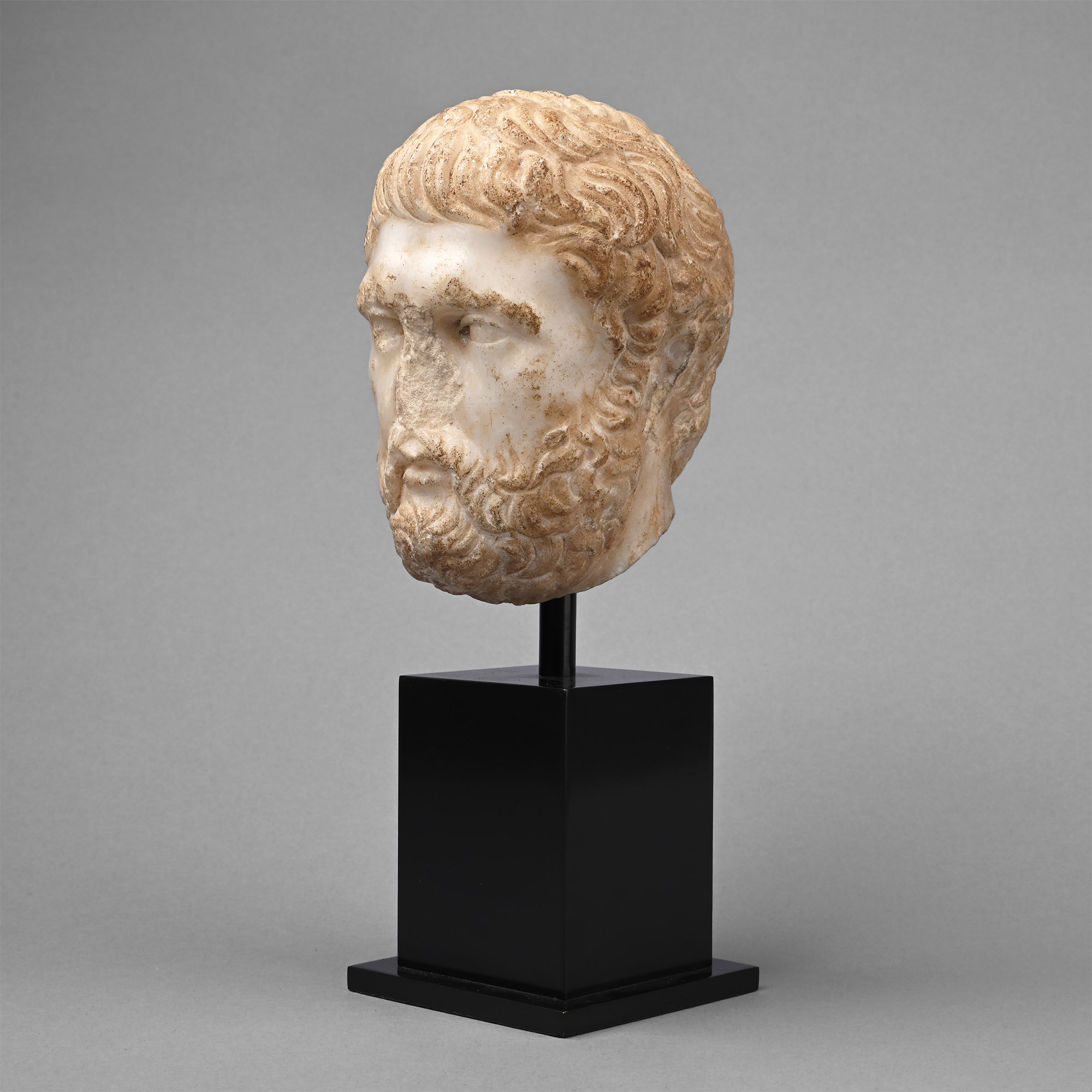
Few people now know Hermarchus's name, yet by one count more portrait busts survive of him (21) than of Aristotle (18), because the Epicureans liked to surround themselves with images of their masters. Cicero has his friend Atticus say that they had Epicurus's image "not only in our paintings but also on our cups and rings".
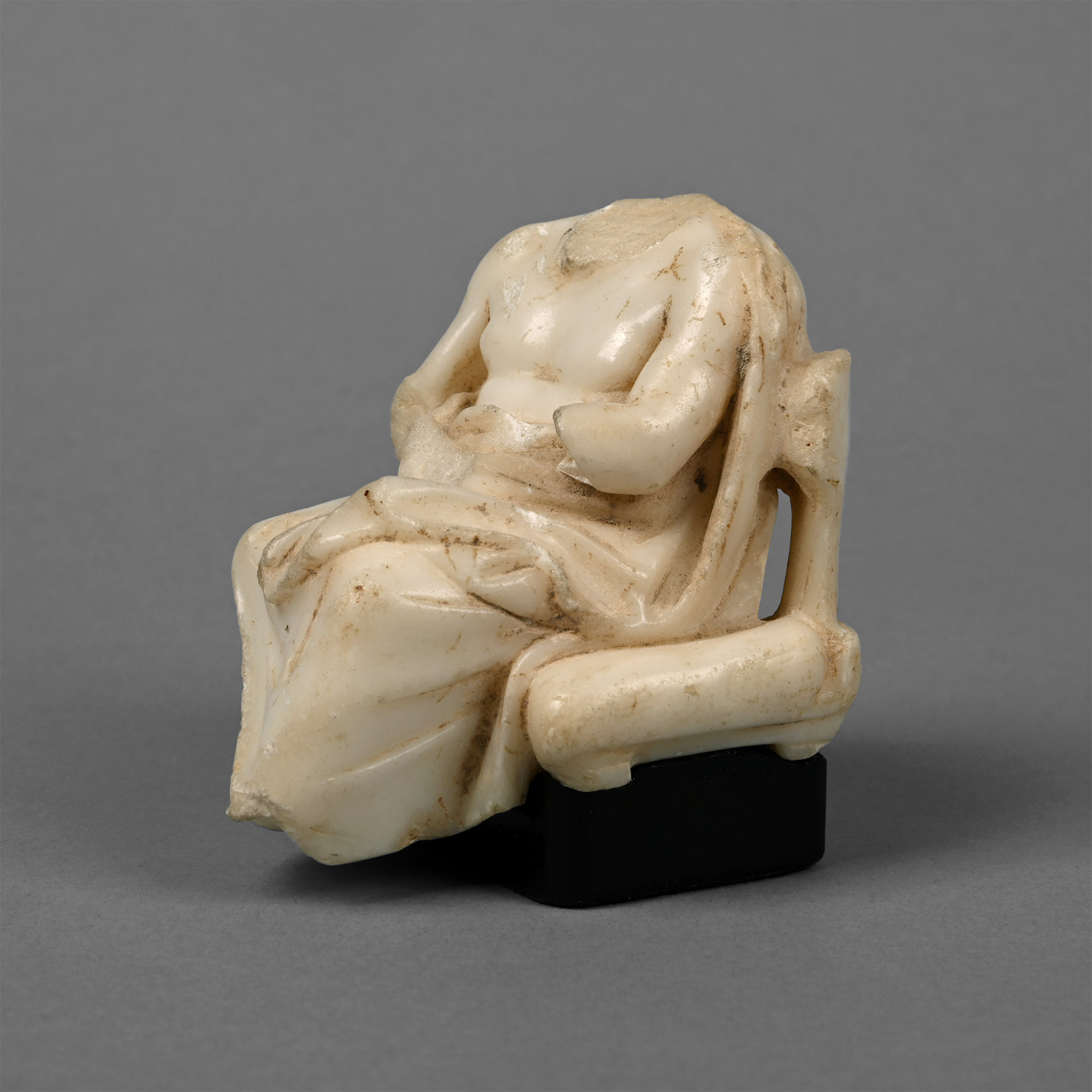
Lot 163 is an image of that portable kind, 86 mm high with its stand: a seated philosopher with his legs crossed at the knee and his cloak loose over the shoulders and lap, on a chair whose openwork frame is deeply undercut. By comparison with statues in the Vatican and at Thebes he could also be Zeus or Chronos, with the left hand that holds the sceptre in statues of seated Zeus stretched across his legs.
Why collect Roman copies of Greek statues?
The "statues by foreign artists" that Pliny's ancestors did without had filled Rome by his day, so thoroughly that he admitted nobody knew who had made even the Venus that the emperor Vespasian dedicated in his Temple of Peace. The Greek statues Rome most admired were often bronzes, and few large Greek bronzes survive, while Roman versions of them in marble are plentiful. In the art historian Richard Neer's phrase, "some copies are faithful, some are not, and none is exact", so a Roman marble is evidence for a lost Greek work, passed through a Roman workshop and a Roman client's taste.
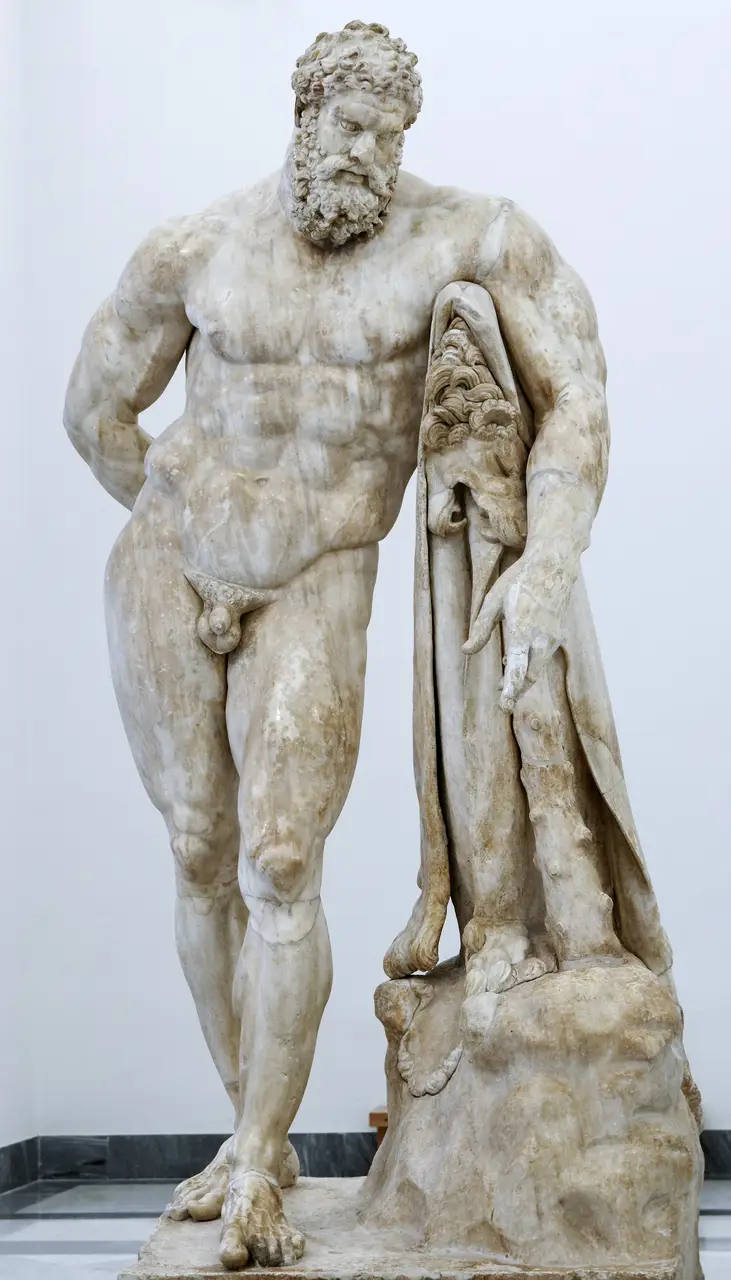 The Farnese Herakles, 2.92 m high, carved in the late second or early third century AD. Museo Archeologico Nazionale, Naples. Photo: Marie-Lan Nguyen (2011), CC BY 2.5, via Wikimedia Commons.
The Weary Herakles shows the hero after he has held up the sky for Atlas, leaning on his club with the Apples of the Hesperides hidden behind his back. Its bronze original is lost, but a replica found on the Palatine in 1540 is inscribed "Work of Lysippos", the sculptor of Alexander the Great. In antiquity that statue's head was exchanged in just the way Pliny complained of, for a portrait of Commodus, an emperor eager to identify himself with Hercules.
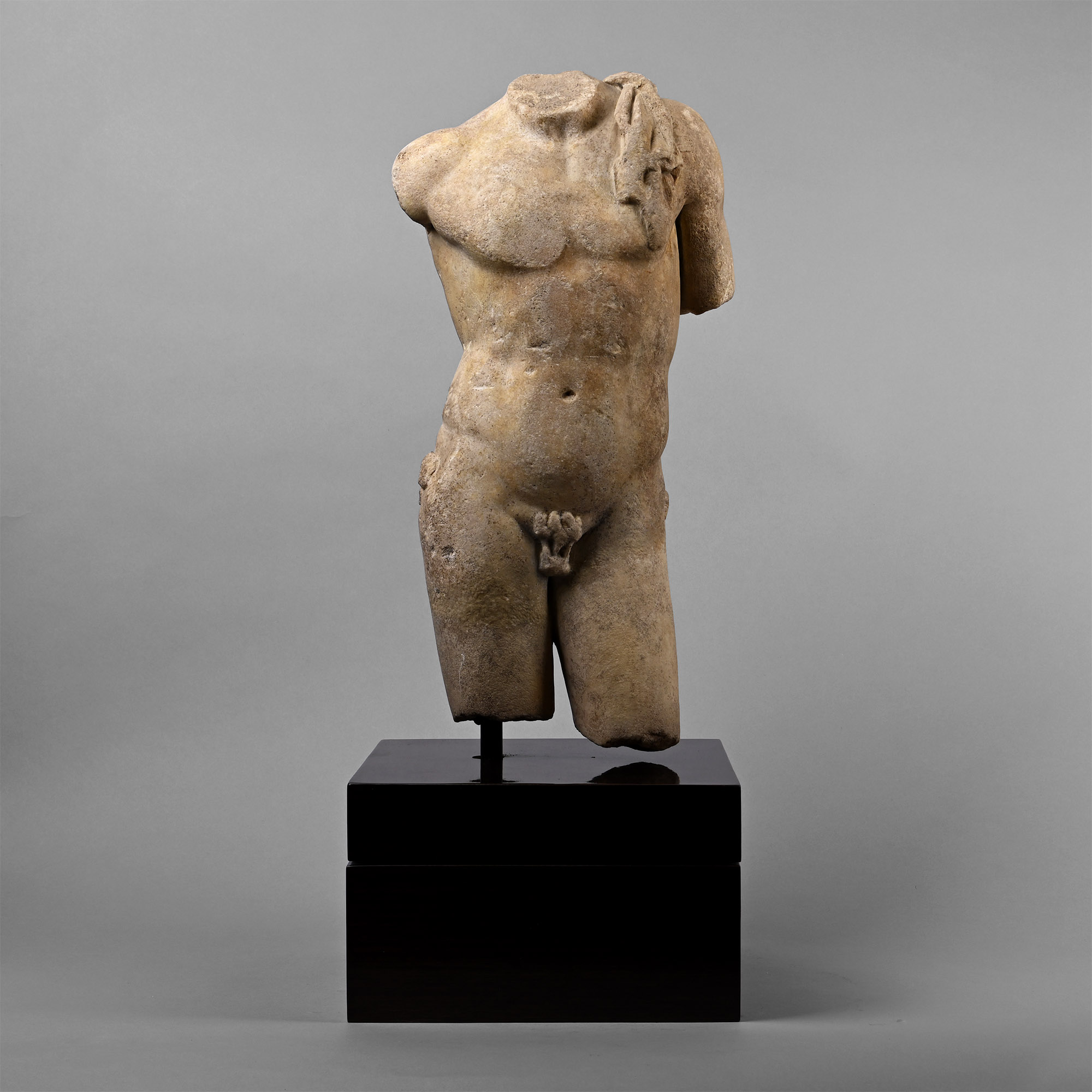
The Farnese colossus in Naples, carved from a single block of more than 20 tons, was found in the Baths of Caracalla, and the gym learned the pose again when Eugen Sandow, founder of modern bodybuilding, was photographed in it in 1893. The hundred or so other replicas are smaller and leaner, and lot 169 is of their kind: the torso of a youthful male in relaxed contrapposto, 65 cm high on its stand, with the weight on the right leg and an animal pelt draped over the left shoulder, a Roman adaptation of established Greek prototypes at a size that suits a house.
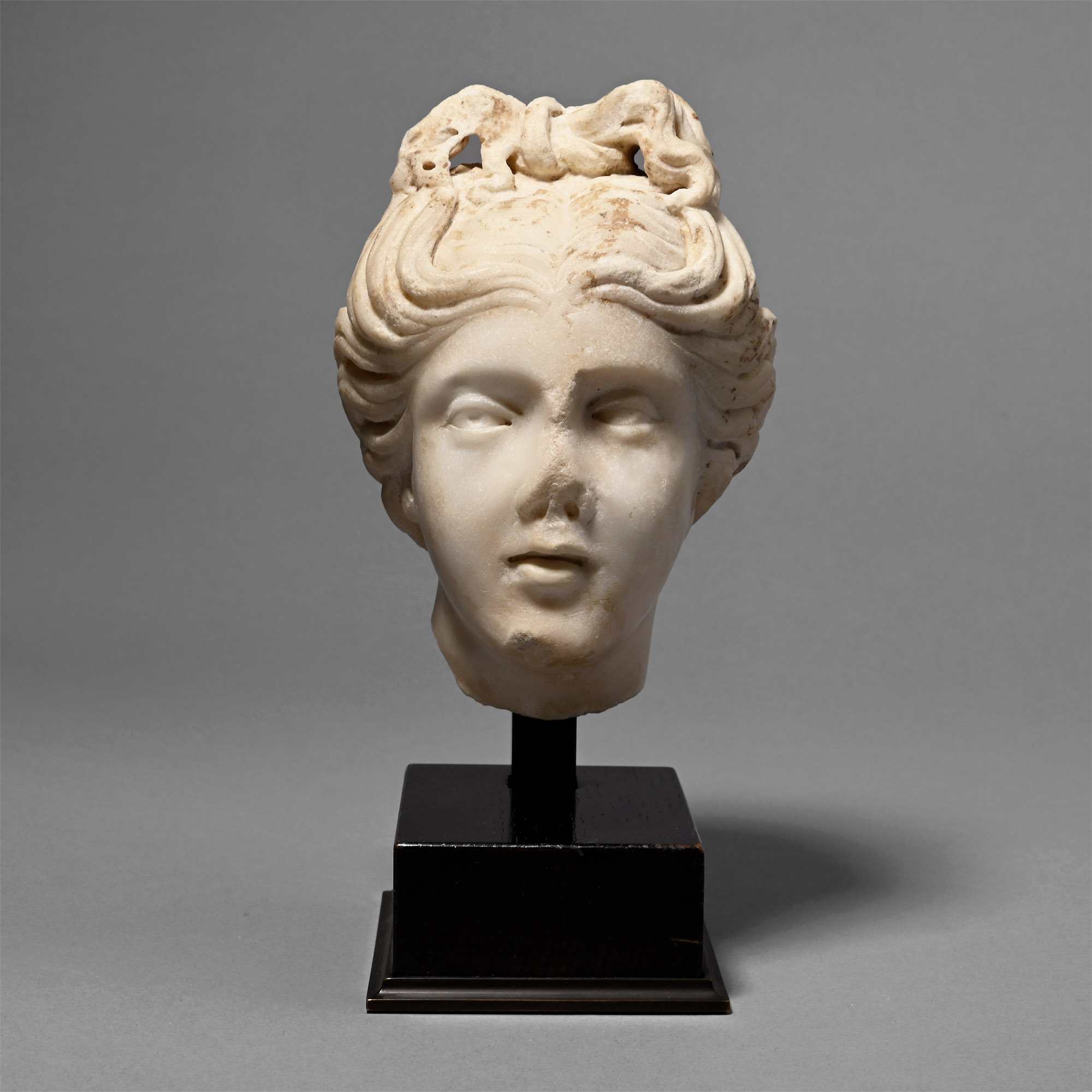
Lot 151, a head of Venus, wears her hair in a chignon at the nape with the tails swept up and tied in a bow above the brow, cut in deep undercuts and openwork, in the manner of the Medici Venus, which like the other best-known Venus types takes its name from those who later owned it: Cardinal Ferdinando de' Medici bought it for the Villa Medici in Rome in 1575. Her earlobes are pierced, probably for earrings of gold or another precious material, and in the 1970s she belonged to the Paris collection of Doctor C.
Roman sculptors also imitated Greek work of the sixth century BC, in what is called the Archaistic style, which lent an air of age to new statues and new cults alike. The stance and folds of lot 166, the large lower section of a robed woman or goddess of the second century AD with one sandalled foot advanced, are those of an Archaistic statue, perhaps the goddess Isis (estimate £6,000-8,000).
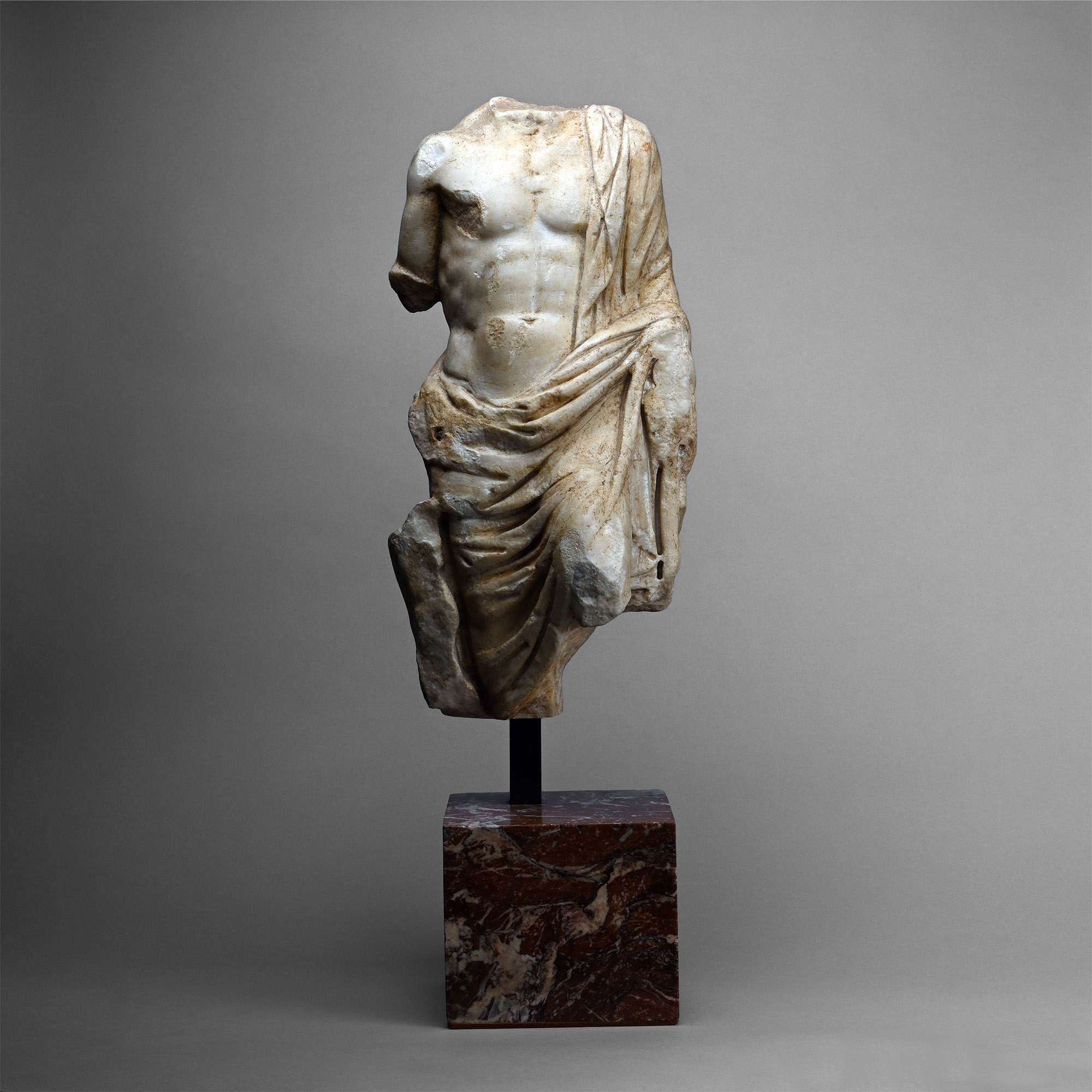
Asclepius, the god of medicine, had his types too, and lot 168, a torso in contrapposto 71 cm high on its stand, with the drapery falling over the left shoulder and wrapped round the lower body in deep folds, is similar in pose and drapery to a statue in the Vatican's Pio-Clementino Museum. He was the son of Apollo and the mortal Coronis, a healer who could bring the dead back to life until Zeus struck him down with a thunderbolt.
Likenesses of strangers on a Roman funerary stele
A priest of Apollo, the healer's father, is named on the largest stone among the twelve. Lot 150 is a funerary stele of the third century AD, 164 cm high on its stand and weighing 443 kg, carved in three groups under a pediment that frames a woman's head with long braided hair, probably Persephone, queen of the underworld. Below her the portraits of Apellinarius and Kallisti sit side by side as equals, he in toga and tunic with stylised curls, she veiled, beside a protective hand carved in a square border. Then comes a funeral banquet, with Apellinarius reclining on a dining couch, a laurel wreath raised, and Kallisti behind him, while a young man holds a bird and a small slave girl carries a cup to the offering table. At the bottom are eight lines of Greek, with a ninth cut on the frame.
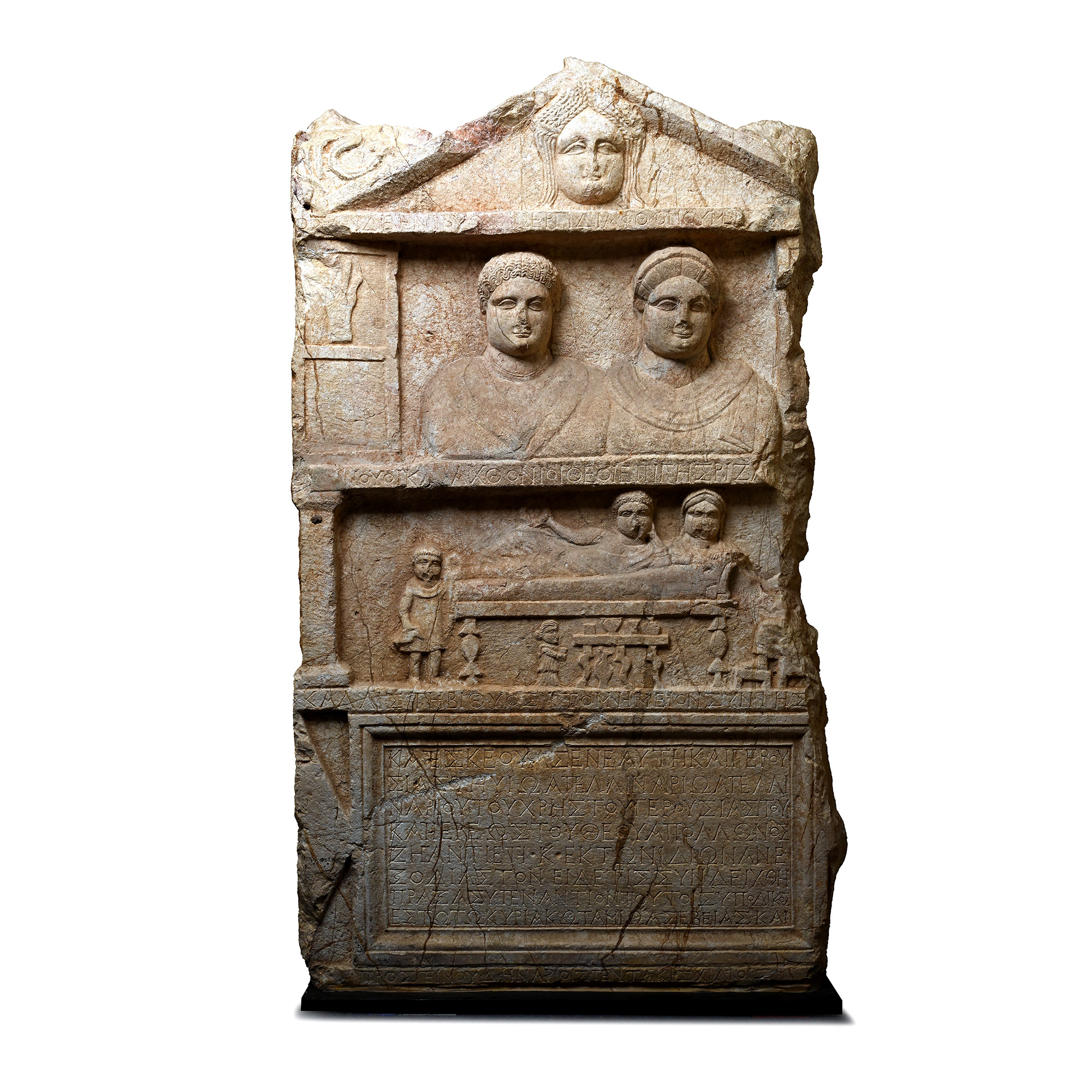
The inscription says that Kallisti "of Bithys" built the monument for herself and for her son Apellinarius, son of Apellinarius, "the worthy senator and priest of the god Apollo", and records that "he lived twenty years". In Greek the title is gerousiastes, a member of the gerousia, literally a council of elders, though in the Greek cities under Rome it was an association of leading men and the title went to the eminent whatever their age.
Anyone caught doing something against the grave, the text goes on, is to be "brought to justice and fined 5000 denarii for impiety", payable to the imperial treasury. Tomb fines in Asia Minor generally ran from 1,000 to 2,500 denarii, so Kallisti's stone names twice the top of the usual range, and at about 450 denarii a year, a legionary's pay under the emperor Septimius Severus, the fine came to some eleven years of a soldier's wages. A band above the banquet adds an older, religious sanction by calling on the gods of the underworld.
Pliny grumbled that his contemporaries "leave behind them portraits that represent their money, not themselves", but Kallisti's stone is a costly monument and a likeness at once, and whoever owns it next will be prizing the likeness of a stranger as Pliny's Romans did: a woman whose name means "the most beautiful" in Greek, and a young man with a bird in his hand, a motif most probably connected with premature death.
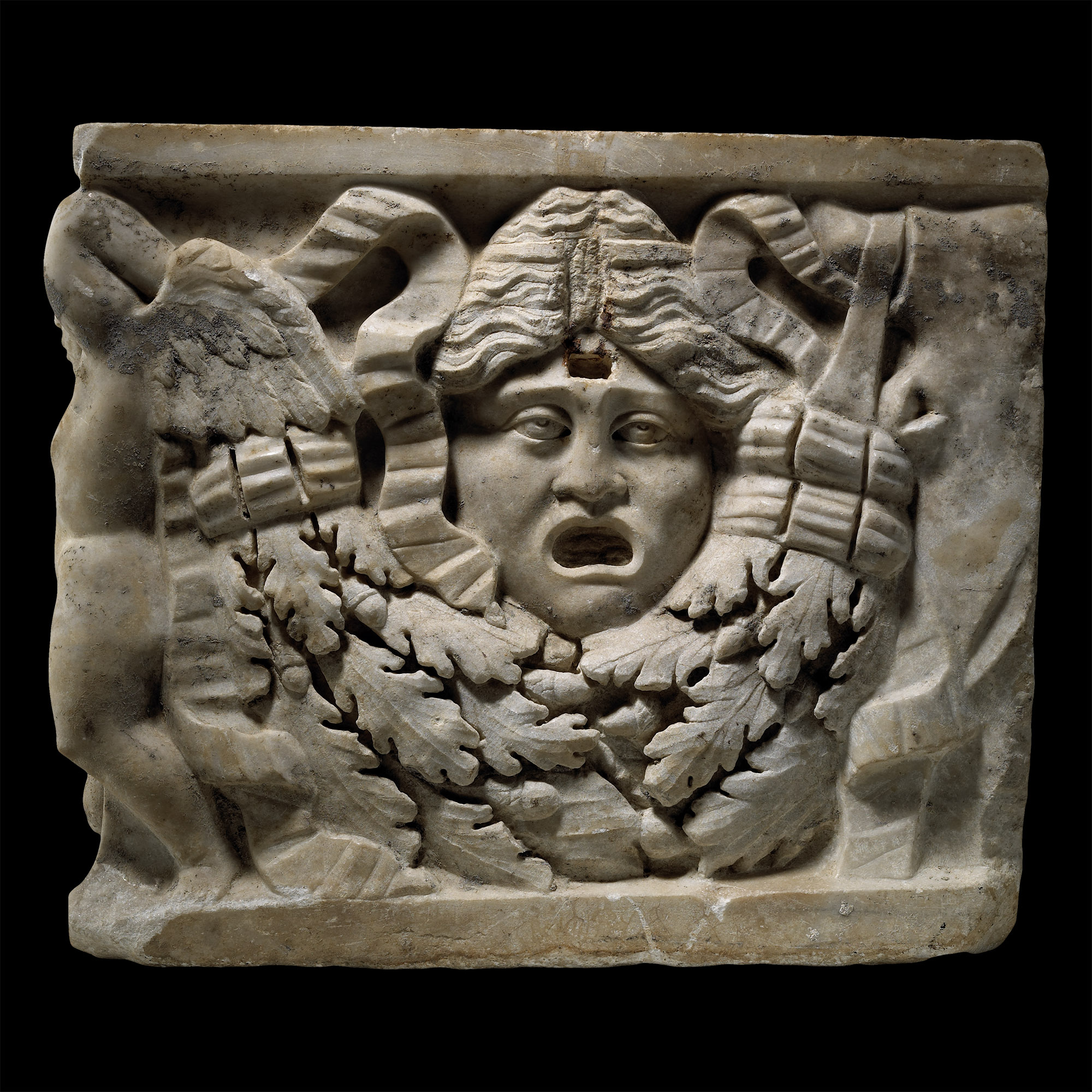
Another young figure, the winged Eros, holds up one end of the garland on lot 142, the right end of a garland sarcophagus of about AD 135, beneath a theatrical mask with open mouth and drilled eyes; the other end of the garland is tied to an ox skull. The opposite short end of the same sarcophagus is in a New York private collection, so one coffin furnishes at least two collections.
Children and captives in the Roman house
The coffin's Eros is one of a crowd of children in Roman marble sculpture, where mortal and divine children appear in the home and on tombs as well as in the state art of the emperors, and the highest estimate among these twelve pieces is for another of them. Lot 167 is a statue of a young naked boy of the first century AD, 66 cm high, standing in contrapposto with his right hip raised and his left leg slightly forward, a narrow torso and slim arms above a rounded belly and chubby thighs.
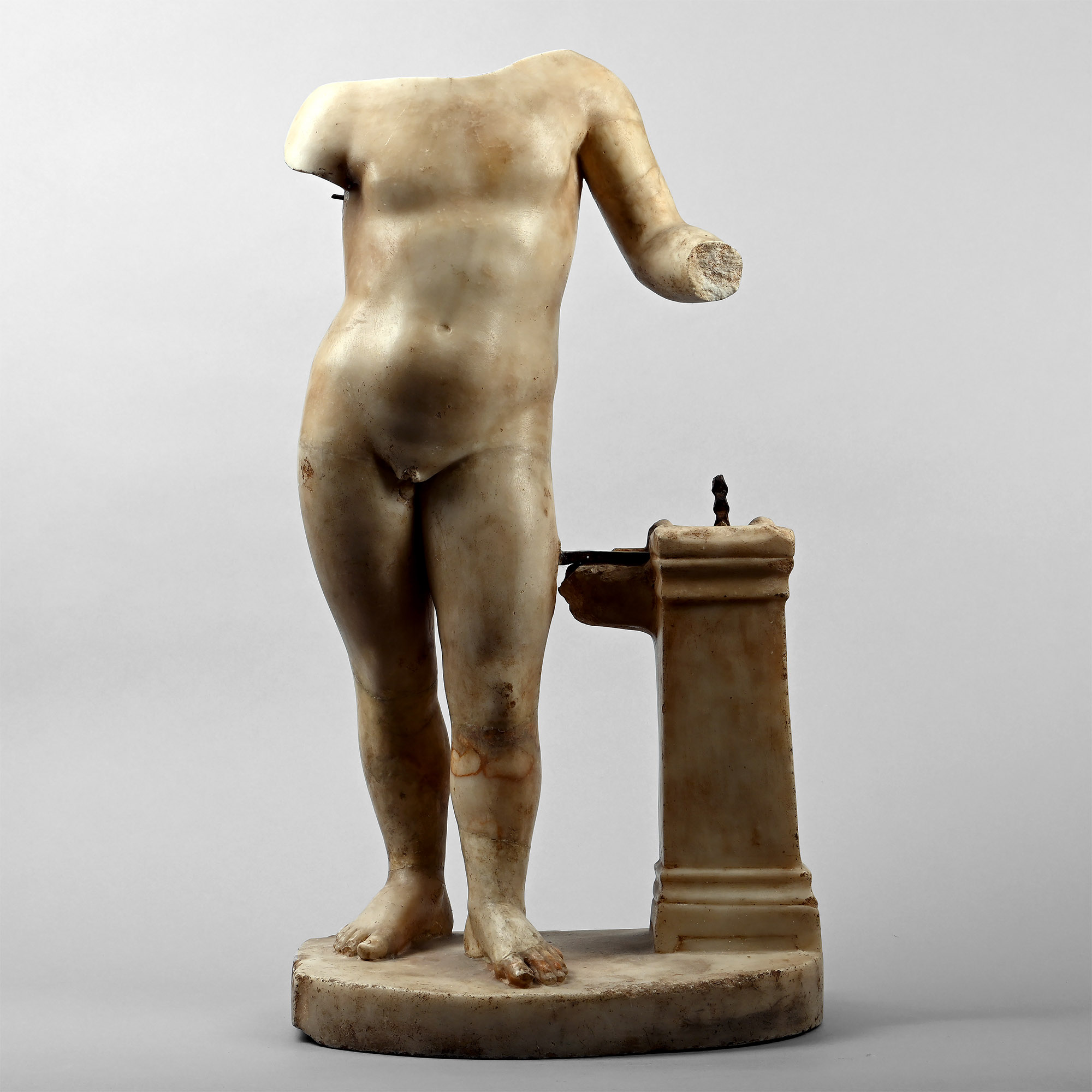
The boy is carved in Parian or Carrara marble, and Pliny knew both quarries. Marble from Paros, he wrote, was called lychnites because it was quarried underground by the light of oil lamps, though whiter stone had since been found at Luna, now Carrara, and he passed on a story from Paros that when quarrymen split a block with their wedges, "a likeness of Silenus was found inside".
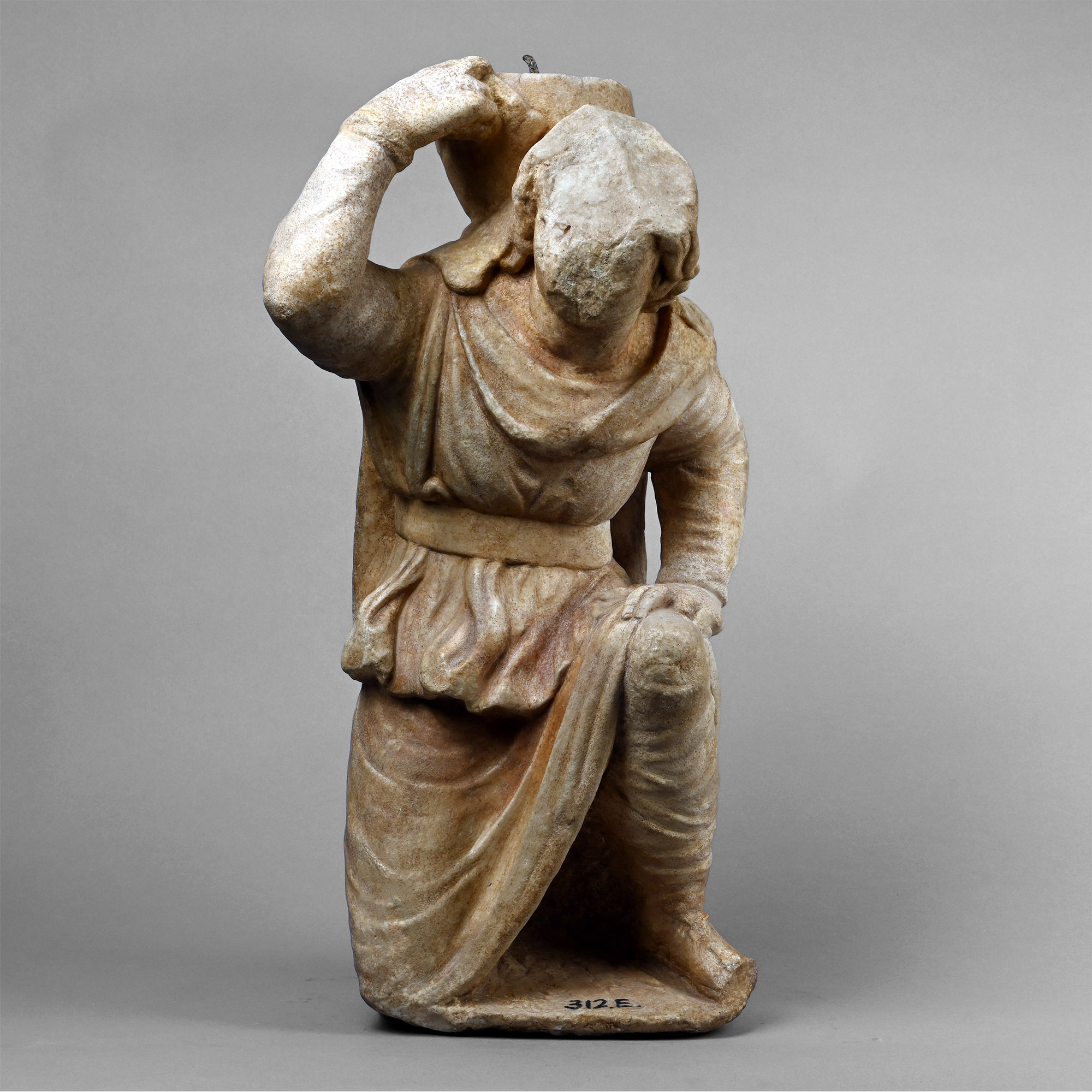
The kneeling easterner in Phrygian dress, one knee down and a weight on his shoulder, was an invention of Augustus's reign, prompted by the Parthians' return of Rome's lost standards in 20 BC. Trajan revived the image more than a century later, in years when the subjected foreigner became particularly prevalent in the imagery of empire and triumph.
Lot 164, of the second century AD, kneels on his right knee, left hand on the left knee and right arm raised to support the water jar on his shoulders, in a Phrygian cap, belted tunic, leg straps and a cloak pinned at the right shoulder, 59.7 cm high on an integral base. His clean-shaven face marks him as an easterner, a Persian, where a European captive would be bearded. The older Greek habit of picturing defeated easterners has its own history on painted pottery, told in TimeLine's story of how the Scythian archer changed sides on Greek vases.