
Two Herculaneum Scrolls, Read at Last, Take Opposite Sides on Whether the Gods Run the World
On 25 June 2026, researchers announced that they had read two carbonized scrolls without unrolling either one. One of them carries its own title, in Greek, across the inner columns: Philodemus, On Gods, Book 8. The Epicurean case inside it is that the gods are real, deathless and wholly at peace, and that they take no hand in the running of the world; among the words the scan pulled back is the phrase χωρὶς προνοίας, choris pronoias, "without providence." The other roll is about a century older, and nothing on it gives a name. It runs to some twenty columns of the technical Greek of Stoic ethics, the school that built its entire account of the cosmos on the opposite claim, that a divine reason governs all of it, down to the smallest detail.
Both came out of the same building. The Villa of the Papyri at Herculaneum, buried by Vesuvius in AD 79, holds the only library to survive intact from the Greek and Roman world, and these two rolls had sat on its shelves a short reach apart for the whole of the time since. Neither had been read. They were scanned with X-rays at a particle accelerator, traced layer by layer in software, and handed to papyrologists who read the Greek off a screen, the method the Vesuvius Challenge has used to pull text from these eruption-charred rolls since 2023. Set side by side, the two readings are one library keeping both halves of an argument the two schools had with each other.
One roll names itself, the other does not
The roll catalogued PHerc. 139 is the more forthcoming of the two. Rare for these scrolls, it kept its end-title, the line a Greek scribe wrote at the close of a book to record what it was: Φιλοδήμου περὶ θεῶν, "Philodemus, On Gods," followed by the numeral for eight. A book that announces itself is a piece of luck, because most of these rolls do not.
PHerc. 1667 announces nothing. It is the smallest roll on its tray in the Officina dei Papiri Ercolanesi, the Naples workshop where the collection is kept: about eight centimetres tall and two across, less than half the height of an ordinary book-roll, closer in size to a thick cigar. From that, the scan recovered close to a metre and a half of continuous writing, roughly twenty columns, in a hand older and more angular than Philodemus's. There is no title and no author's name anywhere in what survives.
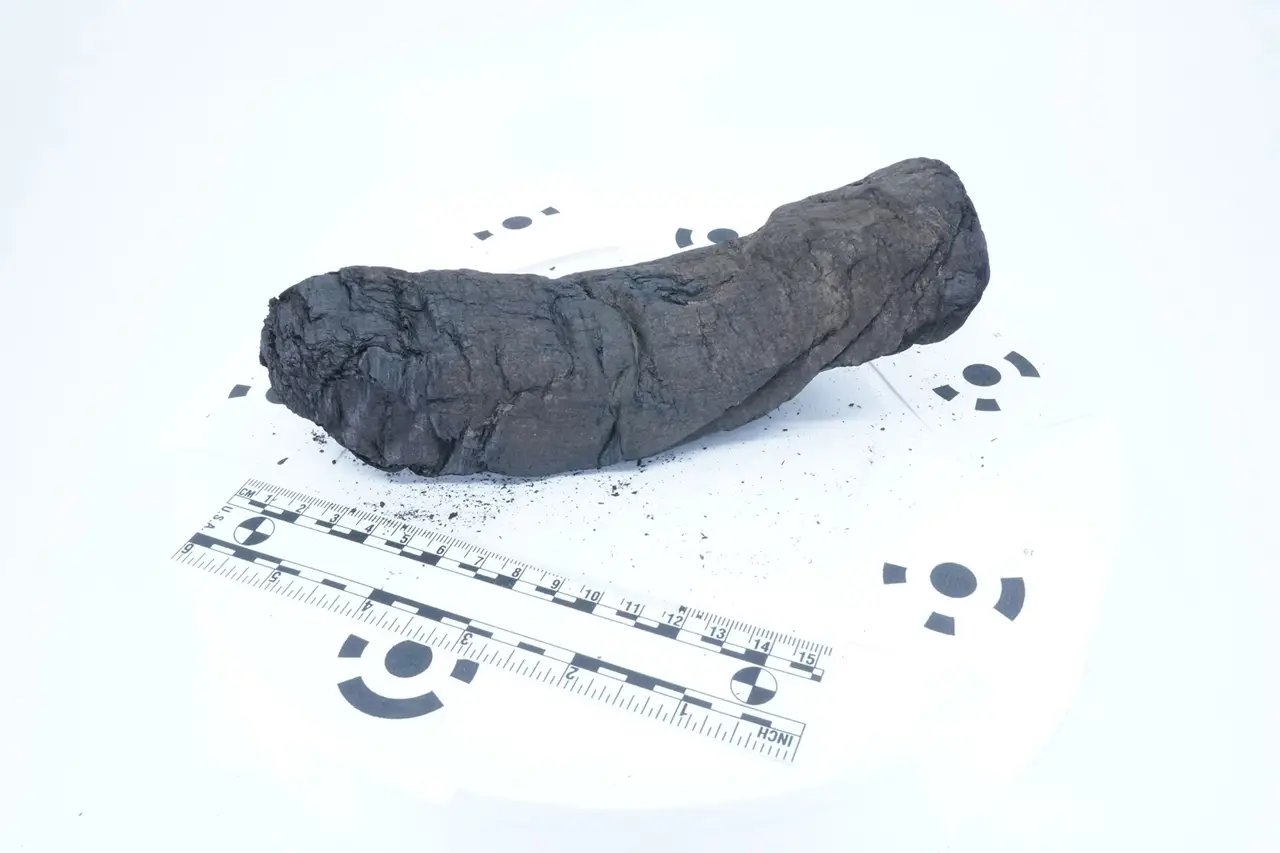 An intact Herculaneum scroll, carbonized in AD 79 and never unrolled, photographed against a scale that shows how small these rolls are. It is one of the Institut de France rolls scanned for the Vesuvius Challenge. Photo: University of Kentucky.
Both rolls came out of the ground in the same place. When Bourbon tunnellers cut through the hardened rock above Herculaneum in the 1750s and broke into the rooms of a seaside villa, they found, among the bronzes and the marble, hundreds of objects that looked like sticks of charcoal. Several were thrown out before anyone noticed the writing on them. They were papyrus rolls, around eighteen hundred in all, carbonized in the eruption and kept by the same heat that charred them. Everything else that reaches us from antiquity was copied and recopied across centuries of monks and scribes, each generation deciding what to save; the Herculaneum rolls skipped all of that. They are the books themselves, as one Roman household shelved them.
The Vesuvius Challenge has read words, then columns, then whole titles out of these rolls over the past three years, working from scans made at synchrotron laboratories in Britain and France. Among the readings announced this June were these two. One roll is Epicurean and one is Stoic, the two dominant schools of the Hellenistic world, and on the single question of whether a god designs and runs the universe they took, flatly, opposite positions. The villa shelved both.
Providence: the word both scrolls turn on
The hinge is a single Greek noun: πρόνοια, pronoia, providence. In ordinary Greek it means forethought. In philosophy it came to mean the forethought of a divine intelligence that designs the world and watches over what happens in it, and whether such a thing exists was one of the real dividing lines of ancient thought.
For the Stoics, providence was close to the whole of their theology. They held the cosmos to be a single living, rational body, ordered throughout by a divine reason and governed in its slightest details by pronoia. God, fate, nature and that providence were very nearly one thing under four names. On their account nothing happened by accident; the order of the world was the mind of god expressing itself, and to study nature was to read that mind. For the Epicureans, providence was the error to be removed. Their gods existed, but they did nothing, and a phrase like choris pronoias, "without providence," is the doctrine packed into two words.
The quarrel was public and well documented. Cicero wrote a whole dialogue, On the Nature of the Gods, in which an Epicurean speaker denies providence and a Stoic rises to defend it, announcing in turn that his task is to show the world is ordered by the gods' forethought. The two new readings sit on opposite sides of that line. The Epicurean roll states the negative of exactly the claim the Stoic roll was written to defend. They are the two ends of one argument, and for two thousand years they lay a short reach apart in the dark, both unreadable, neither able to answer the other.
Gods that exist and do nothing
Philodemus of Gadara is the reason a roll like Book 8 exists at all. A Greek Epicurean who settled on the Bay of Naples in the first century BC, he was the resident philosopher of a wealthy Roman household, and the villa's library is in large part his own working collection; something like forty-four of the identified rolls are his. On Gods is his systematic Epicurean theology, and the position it lays out has been misread since antiquity.
The Epicureans were not atheists. They insisted the gods are real: blessed, deathless, and perfectly content. What they denied was that the gods made the world or take any interest in it. The reasoning is tight, and Cicero preserves it in the mouth of his Epicurean: a blessed being is troubled by nothing and troubles no one, so a god who built a universe, listened to prayers, rewarded the good and punished the wicked would be permanently at work, and so not blessed at all. A god, to be a god, has to be left in peace. The gods of the Epicureans live in that peace and pay us no attention.
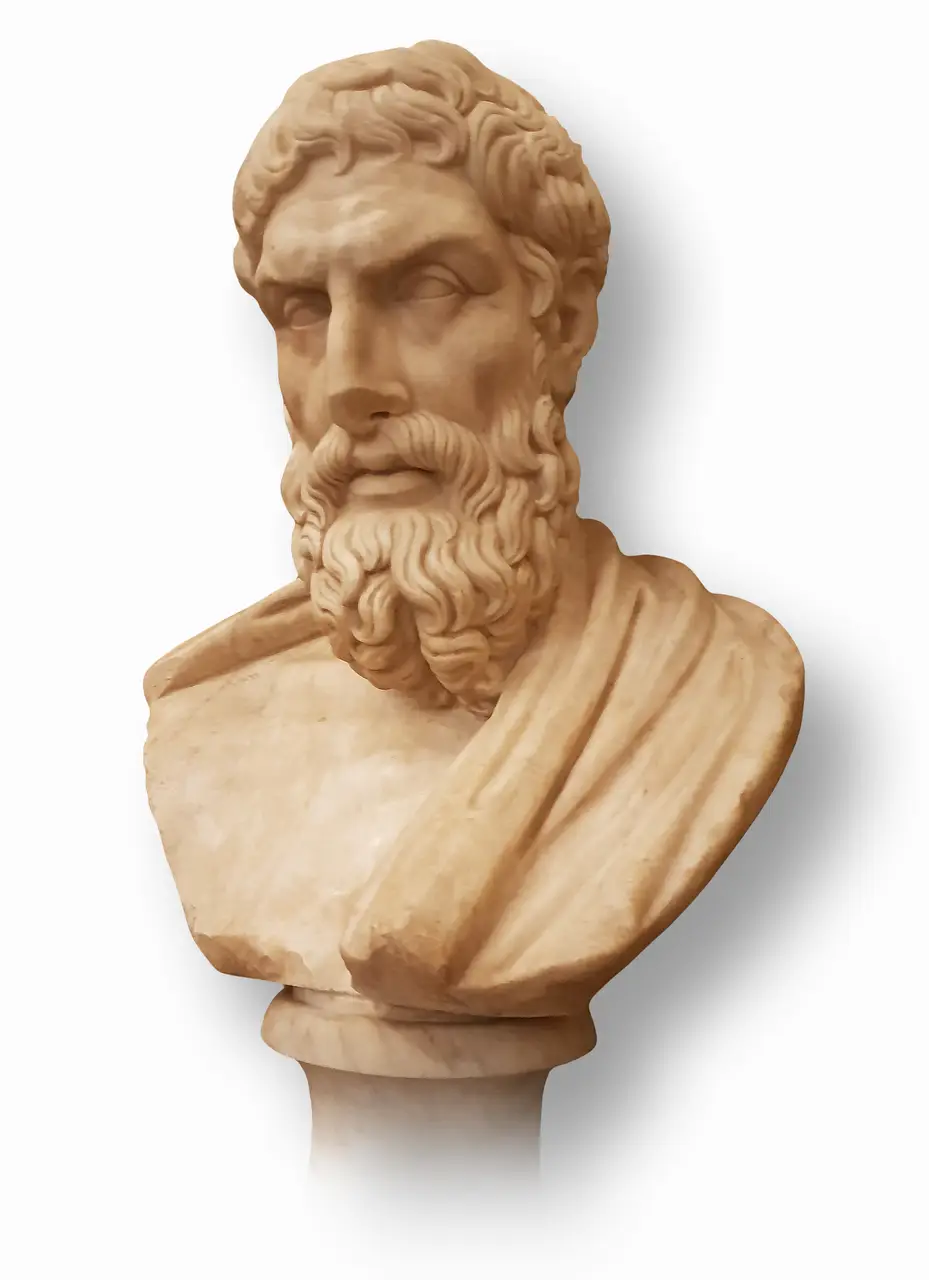 A Roman marble portrait of Epicurus, copied from a Greek original of the third century BC, in the Capitoline Museums in Rome. His school held that the gods are real and perfectly content and take no part in running the world, the position Philodemus sets out in On Gods. Photo: Jamie Heath, CC BY-SA 3.0, via Wikimedia Commons.
The purpose of saying so was practical: to take away the fear of them. Removing the terror of divine punishment was the first clause of the Epicurean remedy for living, and Lucretius, who put the whole system into Latin verse, gave the case its sharpest line when he charged that fear-driven religion had itself been the cause of human crimes, tantum religio potuit suadere malorum, "so much wrong has religion been able to urge." None of this made Epicureans drop out of public worship. Epicurus recommended joining the festivals and the rites, on the grounds that contemplating the gods as a model of perfect calm did a person good, even though the gods themselves neither heard the prayer nor answered it.
On the question of where such beings could be, Epicurus placed them in the empty spaces between worlds, the intermundia, far from the turbulence of any cosmos, where nothing could ruffle their calm. As for how anyone could claim to know they exist at all, he pointed to a prolepsis, a preconception: every people, he held, forms some notion of gods without being taught it, and that shared notion is evidence enough that there is something there to conceive. Philodemus defended all of this in a companion treatise, On Piety, against the charge his school heard constantly in antiquity, that to strip the gods of any power over us was atheism in disguise. His answer was that fearing the gods is the impiety, and seeing them clearly, as they are, is the genuine reverence.
Quite what these gods were is still argued. Following A. A. Long and David Sedley, some scholars read Epicurus's gods as thought-constructs, ideals of the untroubled life that exist in the mind rather than as bodies somewhere in space; others, David Konstan among them, defend them as literal if very rarefied beings, and the question stays open. The fresh columns of Book 8, with their vocabulary of the divine and of aorata, the "invisible" things, will be read closely by both camps.
Here the announcement in Naples reached a little further than the evidence allows, and the correction sharpens what is genuinely new. The official line was that On Gods had been known only from its first book. It had not. Book 1 (PHerc. 26) and Book 3 (PHerc. 152/157) were both edited more than a century ago, by Hermann Diels in Berlin in 1916 and 1917, and Book 3 has since had a modern editor of its own. What Book 8 changes is the scale of the work. Before, the treatise was attested across at least three books; now it is attested up to an eighth. The numeral on the end-title sets a floor, not a count: it tells us On Gods ran to at least eight books, not that it ran to exactly eight, and not that the missing books between are now in hand. A theology that reached eight books is a more ambitious and stranger thing than a short tract on the subject.
The Stoic words that give the roll away
The older roll has no title to correct anyone about. What it has is vocabulary, and the vocabulary is a fingerprint.
Three terms recur in what the scan recovered. The first is ὁρμή, hormē, impulse: in Stoic psychology the movement of the mind toward or away from something, the thing that makes an animal act. The Stoics held that in a grown human being an impulse simply is a judgement, the mind's assent to the thought that some act is fitting, which is how they could treat what we do as something we are answerable for. The second term is the diagnostic one: ὁ πλεονασμός κατὰ τὴν ὁρμήν, the "excess of impulse." That phrase is, almost word for word, Chrysippus's definition of a passion, an emotion such as fear or grief or craving. A passion, on his account, is an impulse that has run past the control of reason, gone to excess and stopped obeying. Chrysippus had an image for it that the ancient sources liked to repeat: a runner at full sprint who cannot pull up at the finish, carried on by his own momentum past the point where he meant to stop. The third term, φρόνησις, phronēsis, practical wisdom, is one of the four Stoic virtues, and for the Stoics every virtue was a form of knowledge, so to name it is to be inside an ethics where doing right and knowing the truth are the same act.
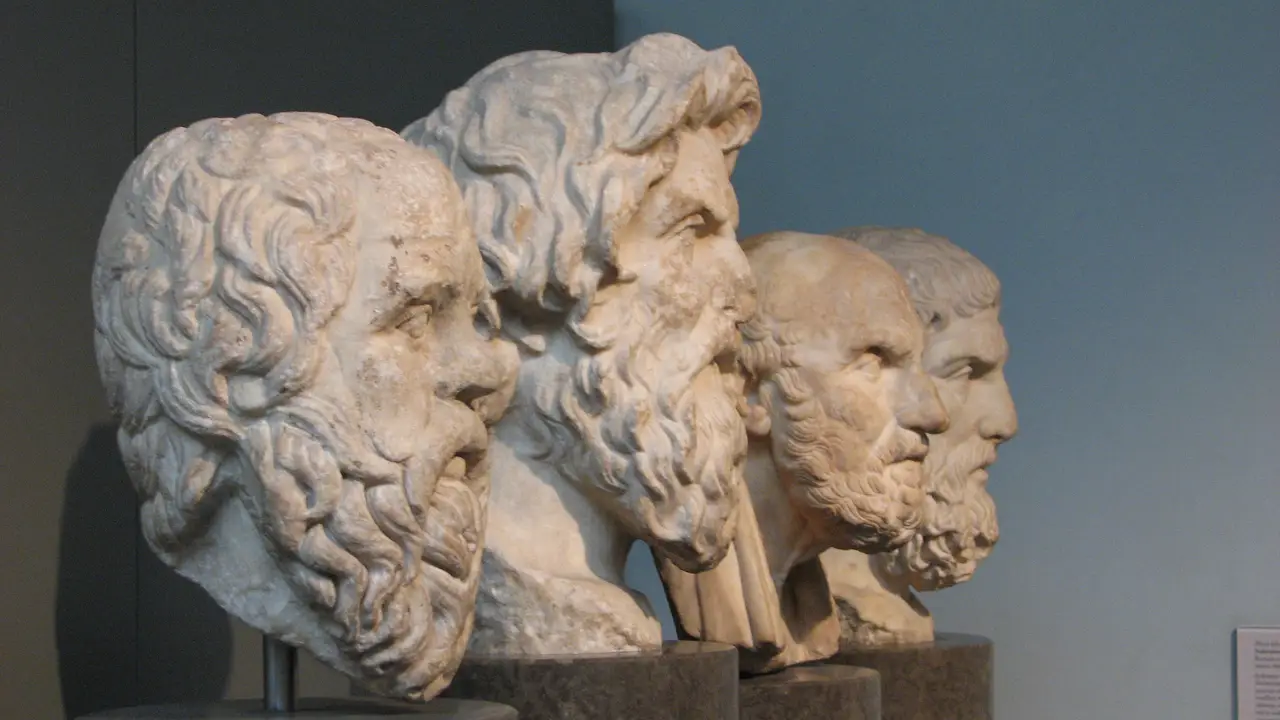 Roman marble heads of Socrates, Antisthenes, Chrysippus and Epicurus in the British Museum, copies after Hellenistic originals. Chrysippus systematized the Stoa, the school of the older roll; Epicurus founded the school of Philodemus, who wrote On Gods. Photo: Cristian Bortes, CC BY 2.0, via Wikimedia Commons.
One sentence of the roll has been given a provisional English rendering: "We will inquire into something, but we will not grasp it, if in some way we depart from ourselves and from our own nature." The wording is a working translation of a damaged passage and should be held loosely, but the thought behind it is recognizably Stoic. It reads as oikeiōsis, "appropriation," the doctrine that ethics grows from an animal's relation to its own constitution, rather than from any code of rules handed down. The Stoics took the ordinary word for what belongs to a household and turned it to the self's belonging to itself, and built outward from there to our care for other people. To depart from our own nature, in that frame, is to lose the ground that knowledge and right action stand on.
The early Stoa is the great gap in ancient philosophy. No complete work survives by any of the school's first three heads. Chrysippus, its systematizer, of whom Diogenes Laertius reports the verdict that without him there would have been no Stoa, was credited in antiquity with more than seven hundred books, and almost none of them survives. Even his treatise On Affections, the best attested, reaches us at perhaps a fifth of its length, and most of that survives only because Galen quoted it in order to attack it. Nearly everything we know about the founding Stoics has come down through their opponents' summaries and their critics' hostile excerpts. A long, continuous stretch of early Stoic prose, read more or less in its own words, is a kind of evidence the field has effectively never had.
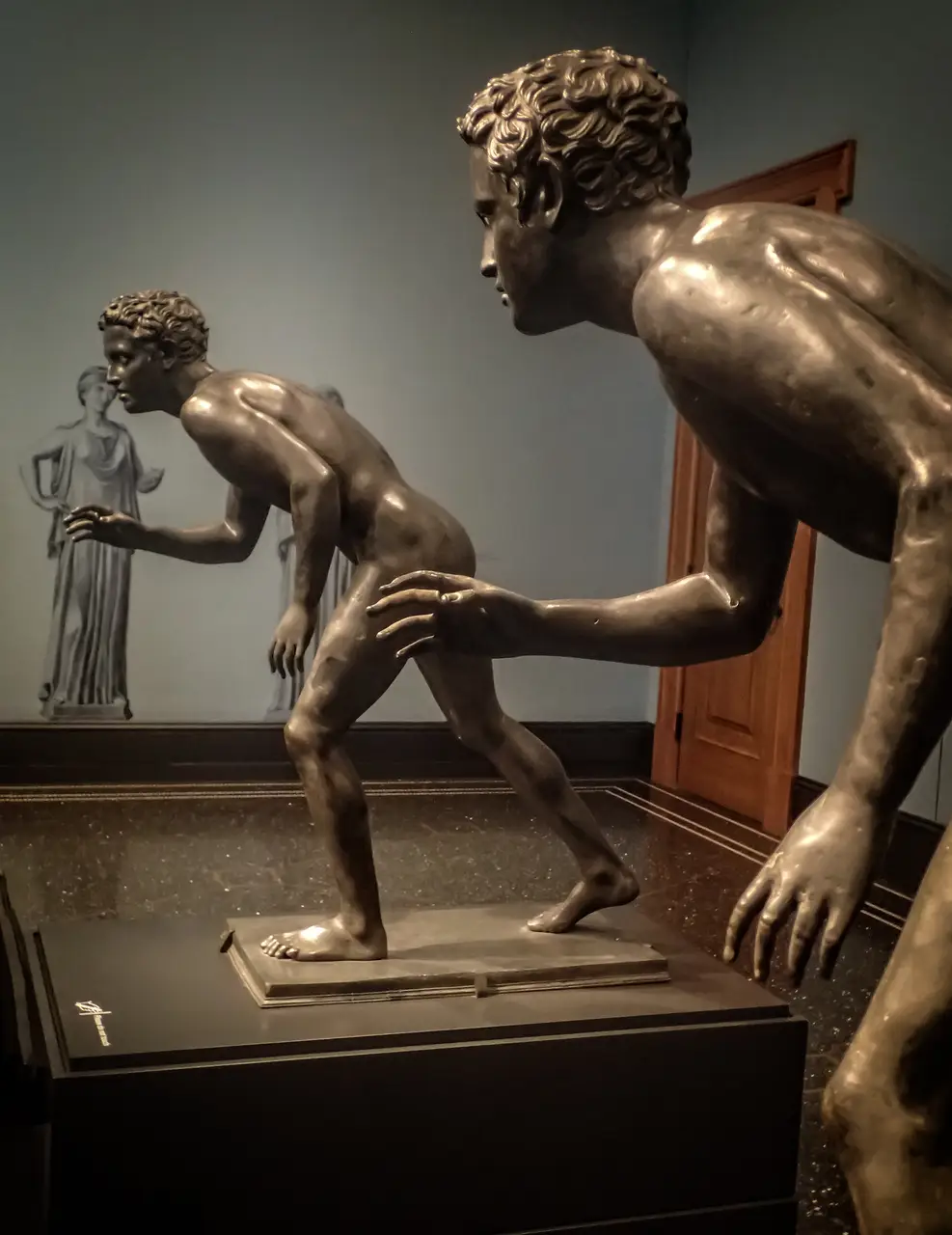 One of the bronze "Runners" excavated from the Villa of the Papyri in the 1750s, now in the National Archaeological Museum in Naples. Chrysippus likened a passion to a runner at full sprint who cannot pull up at the finish, carried past the point where he meant to stop. Photo: Mary Harrsch, CC BY-SA 4.0, via Wikimedia Commons.
The Stoic theory of the passions is among the most disputed things in ancient psychology, precisely because it reaches us through hostile witnesses. Did Chrysippus think a passion was a mistaken judgement and nothing more, or a judgement plus some further movement of the soul? Galen, who preserved much of the argument, said Chrysippus had tied himself in knots. He had every reason to. A continuous page in an early Stoic's own hand, using hormē and pleonasmos in their proper setting rather than in a critic's paraphrase, is the kind of thing that could move a debate that has run, on very little new evidence, for a very long time.
It also closes the circuit with the other roll. For the Stoics, the impulse and the practical wisdom this text takes apart belong to the same picture as their providence. The divine reason that orders the cosmos is the same reason that, in a person, shows up as a well-governed impulse; a passion is what happens when that governance slips. From the self's grip on its own nature the Stoics drew an expanding circle of concern, out to family, city, and at last the whole of humanity, all of it bound by the one logos that is also fate and also god. The word the Epicurean roll denies is the word the Stoic roll assumes. Read together, the two are one disagreement seen from both sides.
Why the readings stop short of a name
Book 8 carries its title and its author's name in the scribe's own hand; calling it Philodemus's On Gods is about as secure as these identifications get. PHerc. 1667 carries neither. That it is Stoic is a strong inference from the vocabulary; that it is by Chrysippus is a weaker one, drawn from the doctrine, the early date and the angular script, and the team has been careful to say it could be Chrysippus or could be someone else entirely. Other early Stoics wrote on the passions too, Cleanthes and Sphaerus and Herillus among them, and any of them, or a writer whose name is lost, could have held this pen. One detail in the readings sharpens the picture without settling it: the roll names Aristocreon, Chrysippus's nephew and pupil, the man to whom Chrysippus dedicated several of his own books. That places the text inside Chrysippus's circle and close to his lifetime, and it cuts both ways on authorship, since a book that mentions Aristocreon could be one Chrysippus addressed to him or one written by another hand around him.
The date wants the same caution. "Second century BC, perhaps late third" rests on the handwriting and on datable references in the text, the mention of Aristocreon among them, not on a laboratory measurement; that evidence places the roll within a band of years, and the band is real but not a fixed date. And the word that travelled fastest, "oldest," needs its edges drawn in. The roll is among the oldest in the Herculaneum library, and among the oldest surviving book-rolls of Greek philosophy anywhere, which is claim enough; it is not the oldest papyrus, nor the oldest written thing, and older Greek literary fragments exist. The honest version of the news is large without the inflation: a securely identified eighth book of a known Epicurean theology, and a long, continuous early-Stoic text of a kind we almost never see, very possibly older than anything else of its school still legible.
Both of those claims will be tested. The columns of Book 8 have to be edited, set against the books of On Gods already in print, and read for what they actually argue; the older roll has to be transcribed in full, its hand compared with dated scripts, its doctrine matched against what the fragments of the early Stoa lead us to expect. The headline arrived in a single day. The scholarship will take years, and it is the scholarship that will decide how much of the headline holds.
A Stoic book on an Epicurean's shelf
There is a smaller puzzle folded inside the larger one. The recovered rolls are overwhelmingly Greek philosophy, most of it Epicurean, much of it Philodemus, down to duplicate copies, drafts, and the books of authors he argued against. A Stoic treatise a hundred years older than him is not what the shelf leads you to expect.
There are several plausible explanations, and the honest course is to hold them open rather than pick one for the sake of a tidy story. A polemicist keeps his opponents close: an Epicurean writing against the Stoa would want Stoic books on hand to quote and refute, exactly as Galen kept Chrysippus by him in order to demolish him. Philodemus wrote pointed polemics against rival schools, and a working philosopher's library holds as many of the books he meant to refute as of the ones he agreed with. Or the villa's collection was wider than one philosopher's toolkit, the general library of a rich house rather than only Philodemus's working set. Or an old roll simply arrived by some route we can no longer trace. Which it was, the find does not say.
The building itself complicates the picture. Its probable owner was Lucius Calpurnius Piso, Caesar's father-in-law and Philodemus's patron, though the identification rests on the patronage link and circumstantial reasoning rather than proof. Whoever he was, he filled the house with Epicurean books and also set, among the bronzes dug out of the villa in the eighteenth century, a portrait of Zeno of Citium, the founder of Stoicism, alongside the herms of Epicurus, Hermarchus and Demosthenes that were found in the library room and gave it its character. The man who collected the case against providence kept the founder of the opposing school in bronze.
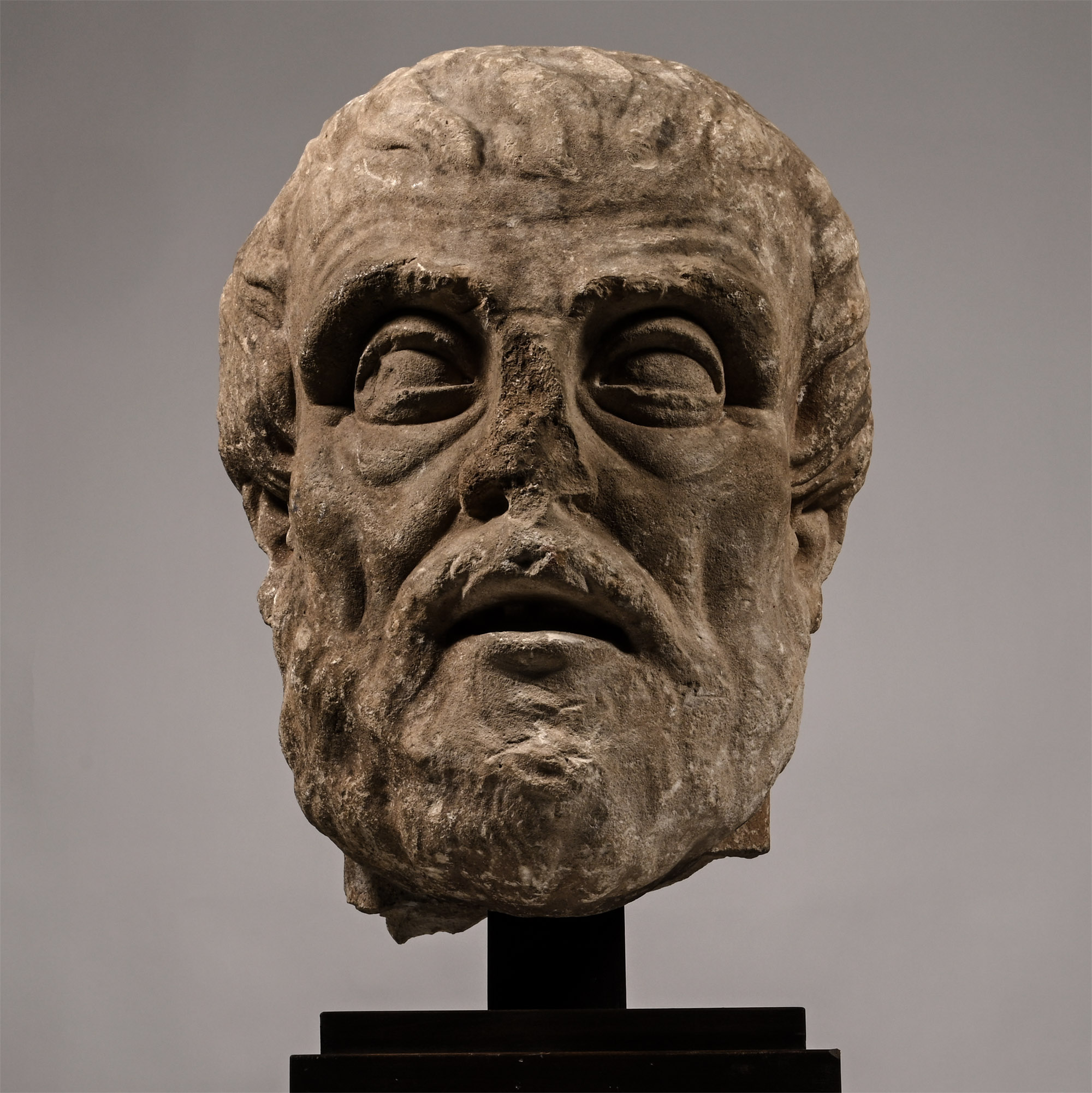
The busts and the rolls went into the ground together and came out very differently. The carbonized books are unique and stay where they are; Roman portrait heads and herms of philosophers, in marble and in bronze, have passed through collections since those same eighteenth-century excavations, and pieces of that kind still reach the market, as do the styli and inkwells and lamps of the households that read such books. TimeLine's classical sales regularly include Roman portraiture of this sort, for collectors who want the face of a philosopher on a shelf of their own.
How you read a roll without opening it
Start with a correction the whole enterprise turns on: these scrolls were not burned. Burning leaves ash, and ash holds no text. What happened at Herculaneum was carbonization. Pompeii was buried by ashfall; Herculaneum was overrun by surges of hot gas and debris that charred the organic material where it lay and then sealed it under some twenty metres of volcanic rock that set like concrete, shutting out air and water. The rolls were baked to brittle black carbon and held that way. The same event that destroyed the library is the only reason any of it is here.
Carbonization is also why the rolls are so nearly impossible to read. Ancient ink was carbon, the soot of burnt oil mixed with water and gum; a carbonized papyrus is carbon too. The writing is black on black, the same element on the same element, and to an X-ray scanner the ink and the page have almost the same density, which is to say the ink is very close to invisible. This is what makes Herculaneum harder than the one earlier triumph of the method. When Brent Seales, the computer scientist whose lab has worked at this for some twenty years, virtually unwrapped a charred Hebrew scroll from En-Gedi in 2015 and found the book of Leviticus inside it, the ink there held metal, and metal shows up plainly on a scan. Carbon ink on carbon paper gives the scanner nothing to take hold of. Reading one off the other was the problem Seales's lab spent the better part of two decades learning to solve.
The way around it runs through several stages, each its own hard problem. The intact roll is scanned at a synchrotron, a machine that throws off X-rays bright enough to record the internal structure in cross-section, slice after slice, down to about two microns, a fraction of the width of a human hair; a single scroll can generate as much as three hundred terabytes of data, recorded at the Diamond Light Source in Britain and the European synchrotron at Grenoble. Software then traces each wound layer of papyrus through the three-dimensional block and flattens it into a readable page. Tracing those layers is the hard part: a tightly wound roll, crushed and buckled by the heat, has sheets that touch, merge and double back on one another, and following a single surface through the block without slipping onto its neighbour took years of work to do at all reliably. Only then comes the part loosely called the artificial intelligence. Because the ink will not show by density, a model is trained to notice something fainter: a slight texture, a kind of crackle that the dried ink left on the surface of the fibres, first spotted by one of the competitors, Casey Handmer, and barely there to the eye. The model learns to mark where that texture sits. Where it sits, ink was.
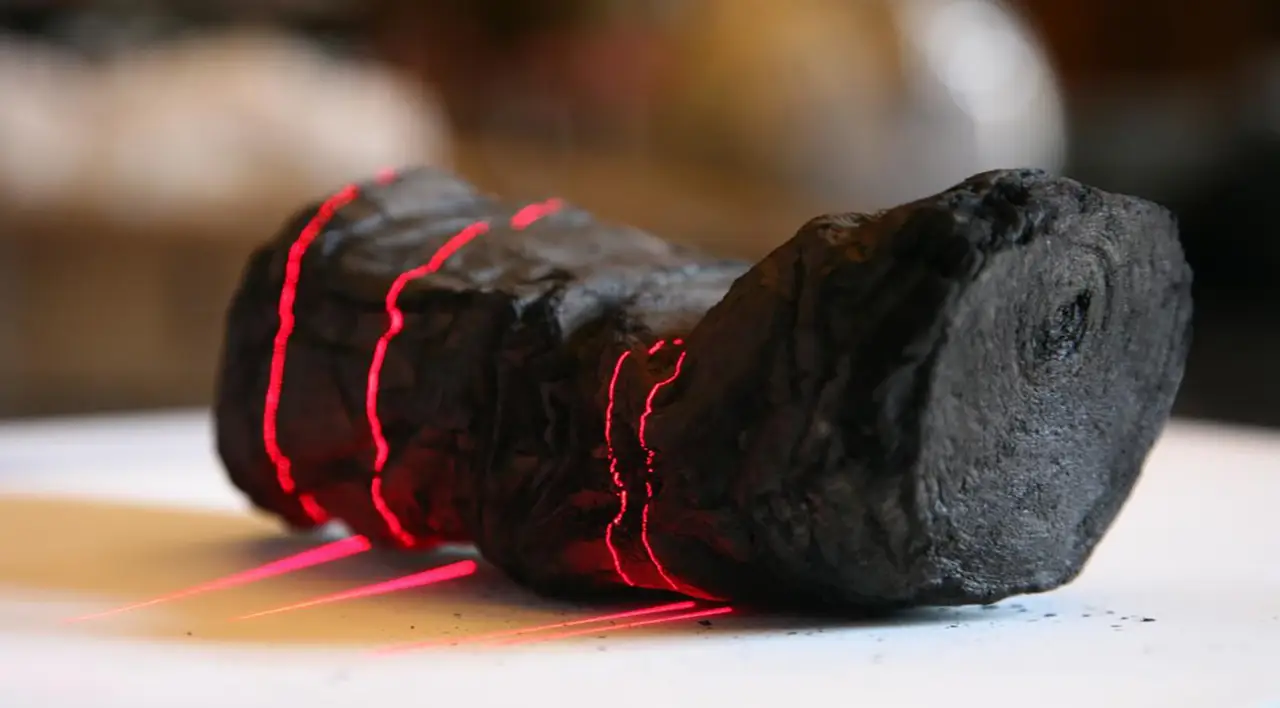 A carbonized Herculaneum scroll under a laser scan, part of the digitization that records each roll's shape before software traces its buried layers. Photo: University of Kentucky.
This is the place to be exact, because the headlines are not. The model is not reading Greek. It is not optical character recognition, and it is not a language system guessing at words; it finds where the ink lies, nothing more, and only after thousands of those marks are assembled do letters appear. Trained papyrologists, led in Naples by Federica Nicolardi, then read and check the text the way papyrologists always have. "AI read the scrolls" folds a real division of labour into a phrase that gets it wrong. The machine finds the ink; the scholars read the writing.
The competition has been building toward this for three years. It was launched in March 2023 by the technology investors Nat Friedman and Daniel Gross together with Seales; that October a student named Luke Farritor read the first whole word out of an unopened roll, πορφύρας, "purple"; in early 2024 a three-way team took the project's main prize for the first substantial passage, an Epicurean text on pleasure; in 2025 came the first recovered title, Philodemus's On Vices, read inside a roll held at the Bodleian in Oxford. That last one is worth holding apart from this June's news, because the coverage keeps running them together: the On Vices scroll is a different roll, in a different country, read a year earlier. Book 8 and the Stoic roll are the new readings. The scans were released for anyone to download, and the contestants competed to build the software that read them, which is why the early breakthroughs came from students and outsiders rather than from one laboratory.
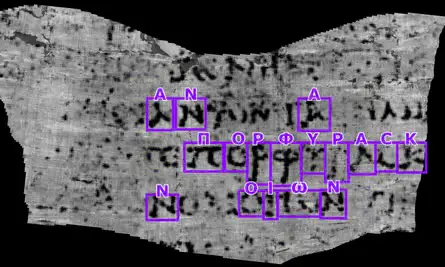 The machine-learning ink detection at work: a flattened patch of an unopened roll with the recovered letters boxed, spelling πορφύρας, "purple," the first whole word read this way from a Herculaneum scroll, by Luke Farritor in 2023. Image: Vesuvius Challenge.
For two hundred and seventy years, reading one of these rolls meant taking it apart, and taking one apart meant losing some of it. The crude early attempts sliced rolls in half with a knife and crushed every letter along the cut; later came liquid mercury, rosewater, a stinking gas that drove people out of the royal palace, and Father Antonio Piaggio's patient thread machine of the 1750s, which hung a roll so its own weight could separate the layers and opened the first one over about four years, at the cost of its outer columns. In the next century the chemist Humphry Davy brought chlorine gas to bear and parted the layers of a couple of dozen rolls before he too gave up; by then the collection had begun to scatter, six rolls to Napoleon in Paris, others to England, the rest kept in Naples. Every method that physically touched a roll, from the knife to the gentlest of them, paid for what it read in what it tore away. This June, two rolls were read while they were still shut.
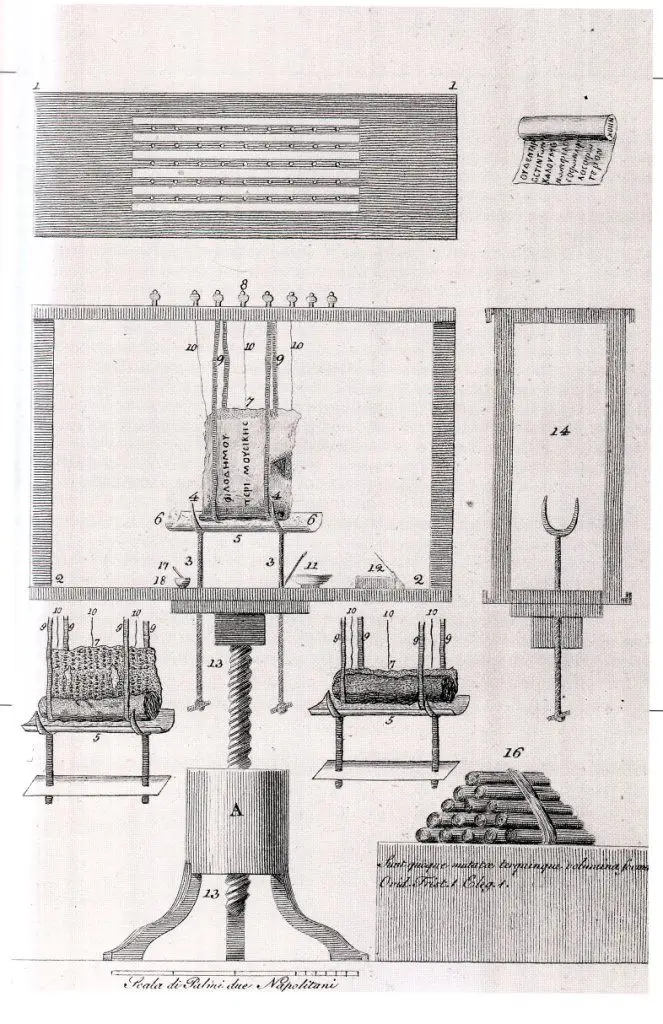 Father Antonio Piaggio's machine for unrolling the Herculaneum papyri, in a later engraving of the apparatus he devised in the 1750s. Threads fixed to the surface peeled the layers apart a little at a time. Public domain, via Wikimedia Commons.
What is still rolled
PHerc. 1667 is the sharpest measure of how far that goes, because the project did not start it from nothing. It had been opened before. In 1987, conservators using a method developed at Oslo, a bath of gelatin and acetic acid meant to soften the layers apart, partly peeled it; the technique was savage, and rolls put through it tended to shatter, one of them into some three hundred pieces. What was left of 1667 was logged, examined, and written off. On a scale of how much text might ever be recovered from it, it was given a readability score of zero.
That zero is now twenty columns of Stoic Greek, and the roll is not alone in waiting. Something like twenty-seven scrolls are under active study; hundreds more still-rolled survivors sit in the cabinets in Naples, scanned or not, unread.
The numbers there are slippery. Around eighteen hundred rolls and fragments were catalogued, but that is not the count of ancient books: the early restorers cut single scrolls apart and numbered the pieces separately, so one work can survive under a dozen entries, and the collection probably stands for somewhere between eight hundred and eleven hundred original volumes. Whatever the true figure, the contents disappointed the men who dug them out. They had wanted the lost classics, missing books of Livy, vanished tragedies, an autograph of the Aeneid; what they found, roll after roll, was Epicurean philosophy, much of it by an author most of them had never heard of. What they had instead was one philosopher's working collection, a rarer survival, and a stranger thing to inherit.
And the library itself is only partly out of the ground. The Bourbon tunnellers who struck it in the 1750s never cleared the building, and the southeast corner, where the late Robert Fowler and others have argued a second and possibly Latin library might lie, has never been dug. A trench sunk in the 1990s reached unknown lower floors and finely finished rooms, then stopped when the funding ran out, without turning up any such library. Whether to dig further is a live argument in its own right. The cost of excavating, and then of conserving whatever came up, would be enormous; the modern town sits directly on top of the buried wing; and a long line of competing claims on Italy's archaeological budget would have to be answered first. Fowler argued to the end that the objection is the sort that can be made forever, an argument for never digging anything at all, and that virtual reading shifts the ground under it, since a scroll no longer has to be destroyed in order to be read. The villa now sits below the water table, beneath the modern town of Ercolano; Vesuvius has erupted on average every twenty years since 1631, and last did so in 1944.
So the tally stands at one roll that gives the Epicurean case against providence a longer and stranger book than anyone could read before, and one that had been wrecked, written off, and scored at zero, and turned out to hold a stretch of the very earliest Stoic prose, the side of the argument we had almost entirely lost. Whatever else is on those shelves is still rolled, still black, and still as silent as 1667 was until this year.
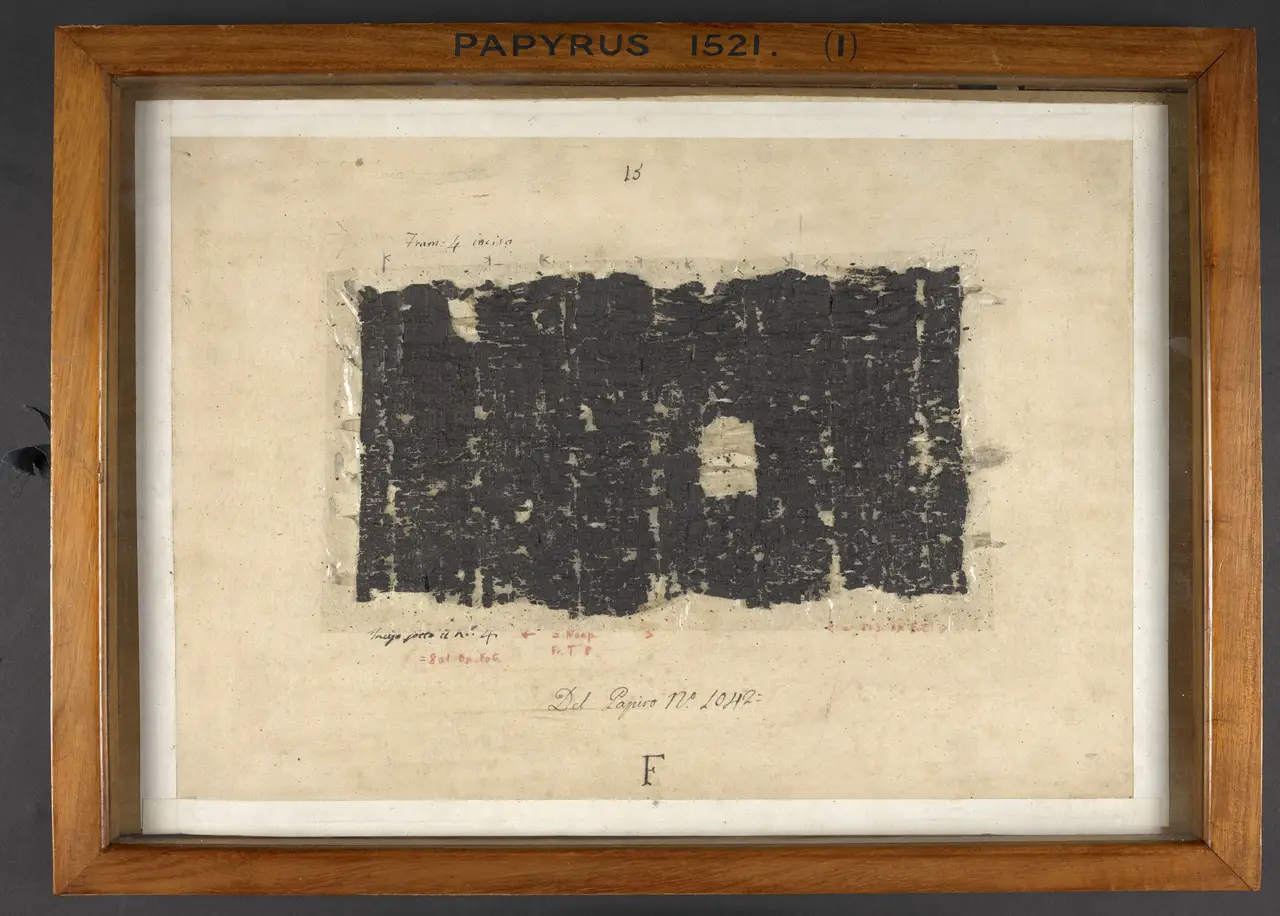 A carbonized Herculaneum papyrus held in the British Library, charred black by Vesuvius in AD 79. It is one of the surviving rolls, not one of the two read in 2026. Public domain, via Wikimedia Commons.
TimeLine Auctions, 1st August 2026
