
Nottingham Alabaster and the English Altarpieces That Survived by Leaving
In 1548 the churchwardens of St Michael and St Andrew in Lewes wrote down what the parish had sold that year. Second on the list, after sixpence worth of iron, is money received from Thomas Sentter, "put in trust by certen of the parish to make sale of thre aulters of alybaster to the frenche men in ptys of payment of xxxs". Three alabaster altars had gone to Frenchmen, in part payment of thirty shillings. They would have been the carved and painted altarpieces that stood over and behind the altars, of the kind we now call Nottingham alabaster.
The same list has twenty-five old books at 3s 4d and something called "ye popes hed", but it does not say who the Frenchmen were or where the altars went. Buyers like them help explain why more than half of the English medieval alabaster on record is now outside Britain, and why it is easier to find in Rouen, Santiago de Compostela or Reykjavík than in the very places that paid for them.
Two fifteenth-century panels in TimeLine's December sale, a Betrayal of Christ and an Entombment, are the kind of carving those Frenchmen were buying, and the Betrayal came back to London from Amsterdam with a Dutch dealer's paper label still on its back.
What is Nottingham alabaster?
English alabaster is a fine-grained gypsum, soft enough to scratch with a fingernail. Most of it was dug from shallow pits in south Derbyshire and the neighbouring corner of Staffordshire, at Chellaston and around Tutbury and Fauld, where the whitest stone usually lay in the top two or three feet. The carving trade centred on Nottingham, with alabastermen at Burton-on-Trent and York as well, and "Nottingham alabaster" has become the name for the whole English output. The earliest altarpiece on record is the one Edward III commissioned in 1367 from Peter the Mason of Nottingham for St George's Chapel at Windsor, at £200.
From the late fourteenth century the workshops began producing upright panels, on average about 40 centimetres high by 26 wide, carved in sets. The designs were probably traced through from pricked parchment patterns, which would explain why the same compositions turn up on panel after panel, sometimes in mirror image. Painters then added colour and gold leaf, almost always leaving bare white stone showing in between. The ground under the figures feet was dark green, dotted with white flowers with red centres, and the sky above was often gilded.
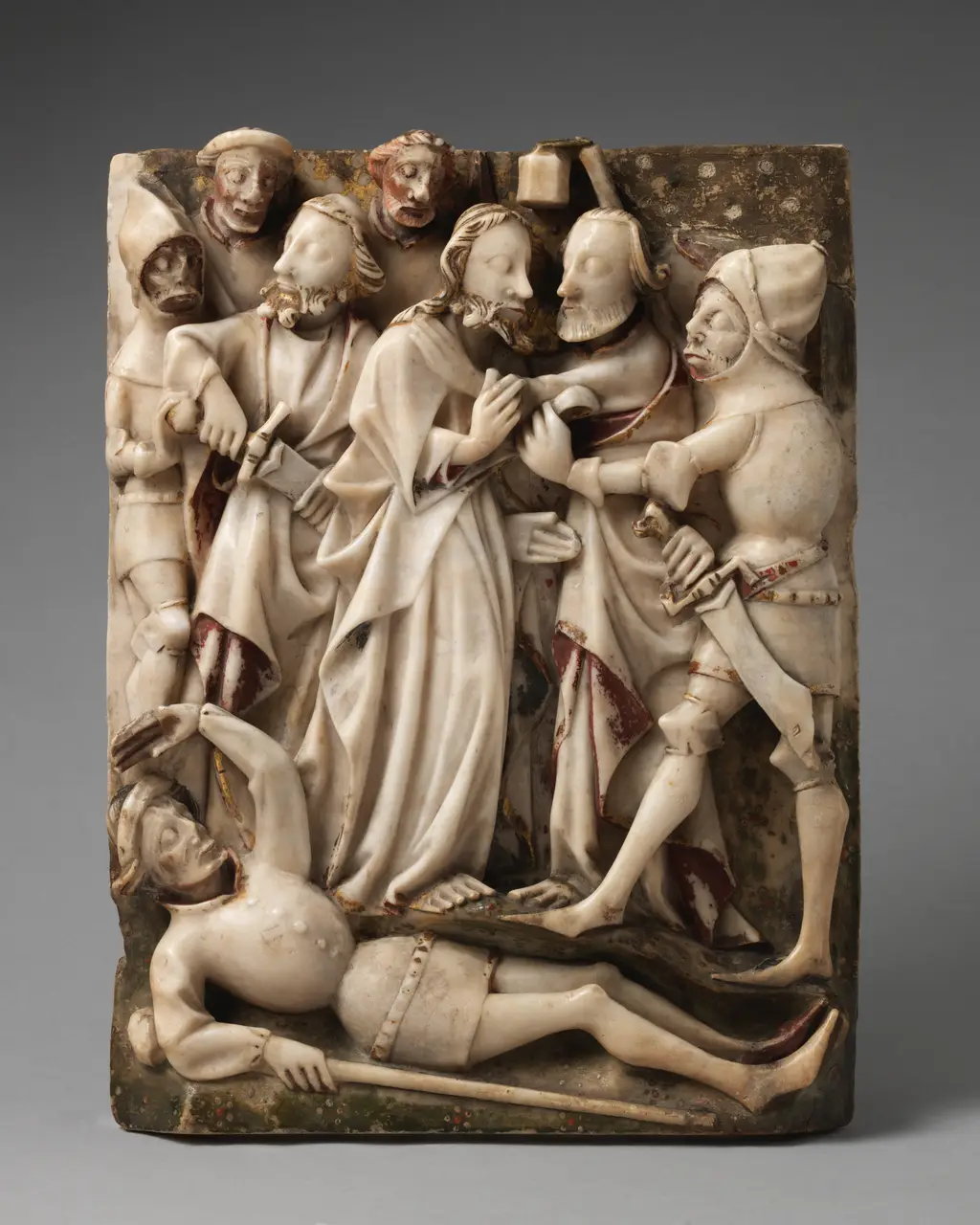 The Betrayal of Christ, English alabaster with paint and gilding, fifteenth century, 37.5 cm high. The Metropolitan Museum of Art, New York (48.175.1), gift of Myron and Anabel Taylor, 1948. Public domain (CC0), via The Met Open Access.
The finished panels were wired into a painted wooden case, often a hinged triptych that stood on the altar. The wires were set into lead plugs in the panels' flat backs. At Leverton, near the Lincolnshire coast, the churchwardens paid the alabasterman John Brooke £8 6s 8d in about 1521 for an altarpiece for St Thomas's altar. While he worked, the village collected cheese for "ye alybaster man", with 13d in money from those "yt gaffe no chesse".
Cargoes for Rome, Seville and Iceland
The carvings were going abroad almost as soon as they were being made, and in May 1382 Richard II licensed Cosmato Gentilis, the papal collector in England and later Pope Innocent VII, to take large alabaster figures of the Virgin, St Peter, St Paul and the Trinity to Rome free of tax. A Peter and a Paul in the museum of Santa Croce in Gerusalemme, his church as a cardinal, may be the ones he shipped.
On 10 August 1390 the brothers Henry and William Mayn loaded the George at Dartmouth with "woolen cloth of divers colours, images of alabaster and other merchandise, to the value of £1,000", bound for Seville. A sea-robber took the ship, and the cargo is known only because the brothers legal reports.
English merchants traded with Iceland for salt fish through the fifteenth century, and in the early nineteenth century seventy-nine alabaster altarpieces and figures were still listed in forty-three Icelandic churches. In 1456 John Goodyear, a priest from the Isle of Wight, gave the cathedral of Santiago de Compostela an altarpiece of the life of St James. The record of his gift makes it the only English alabaster altarpiece with a secure date, and it still stands there in its painted frame.
The export trade was at its height in the second half of the fifteenth century, and most of the alabasters that survive do so because they were sold to foreign clients and were out of the country at the Reformation.
Three or four ships laden with images
Edward VI's injunctions of 1547 ordered shrines and pictures to be taken away and destroyed, and in February 1548, the year Thomas Sentter found his Frenchmen, the Council ordered the destruction of all images. An Act of January 1550 named the material: anyone holding "any images of stone, timber, alabaster, or earth, graven, carved or painted" had until the last day of June to deface and destroy them, or pay twenty shillings for a first offence. Lewes had sold three alabaster altars for thirty shillings in 1548, and two years later keeping a single one of these risked being fined twenty shillings.
Ten weeks after that deadline, on 10 September 1550, the English ambassador in France, Sir John Mason, wrote home from Poissy. As his letter is summarised in the official calendar, "three or four ships have lately arrived from England laden with images, which have been sold at Paris, Rouen, and other places", and were being "eagerly purchased". The French were mocking the English as godless for throwing out their saints, and Mason complained that none of it would have happened had the images been defaced as ordered. His letter speaks only of images, but the historian Eamon Duffy thinks alabasters probably made up a high proportion of them.
Nothing of Brooke's work remains at Leverton, though some alabasters were hidden, like the figures of the Virgin, St Peter and a bishop found under the chancel floor at Flawford in Nottinghamshire in 1779. The alabastermen are not recorded going back to work under Mary, and an Elizabethan writer remembered carvers with "so little work, that they almost forgot their occupation".
Where does Nottingham alabaster survive today?
Francis Cheetham, whose Alabaster Images of Medieval England (2003) is the standard survey, recorded about 2,400 English medieval alabaster carvings, fragments included. More than half of them are outside Britain, well over six hundred in France alone, and there are more in Normandy than anywhere else. The rest are spread from Iceland and Scandinavia to Spain, Portugal and Dalmatia, with more than a hundred in the United States. In Italy, the museum of the Castello Pandone at Venafro shows seven painted panels of a Passion altarpiece together, from the Betrayal to the Resurrection.
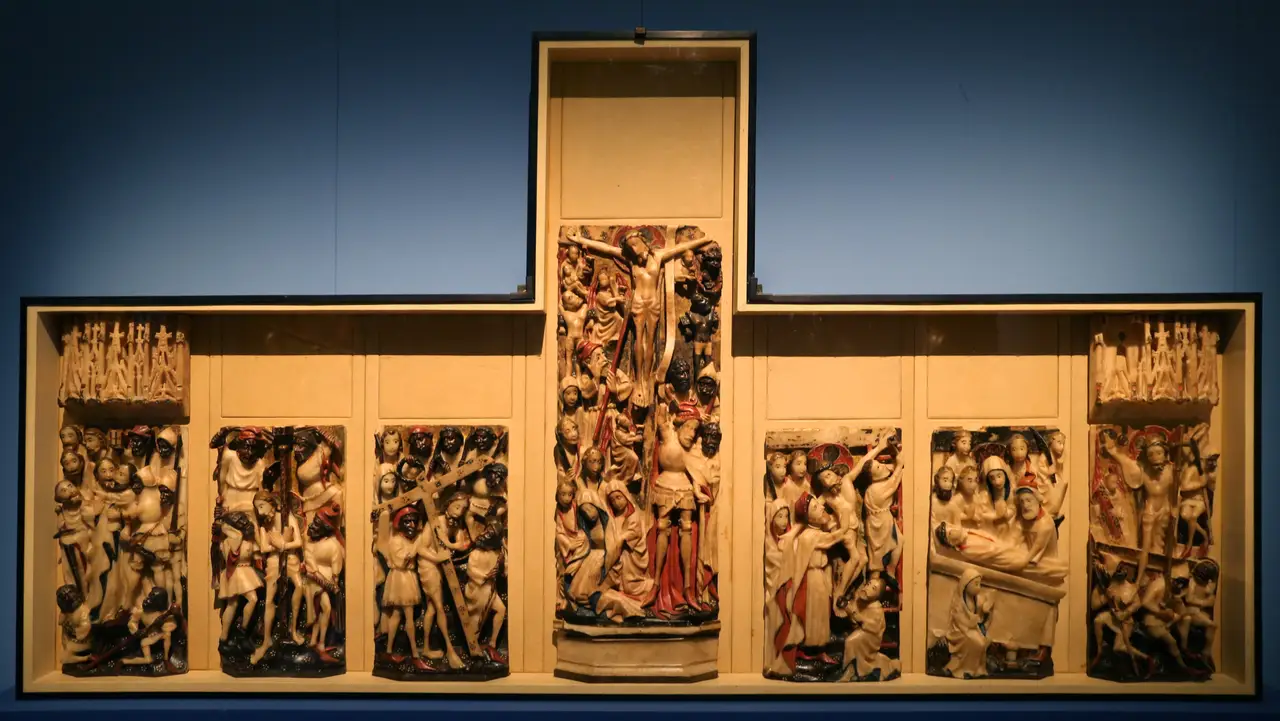 Seven panels of an English Passion altarpiece, about 1450 to 1500, in a modern case at the Museo nazionale di Castello Pandone, Venafro, with the Betrayal at the far left and the Entombment second from the right. Photo: Sailko, CC BY-SA 4.0, via Wikimedia Commons.
About twenty English altarpieces still stand in all or most of their original wooden frames. Five come from Icelandic churches, and others are at Montréal in Burgundy, Naples, Berlin, Compiègne and Santiago. Only one is in Britain, the Swansea altarpiece in the V&A, and Lord Swansea's grandfather bought that in Munich in the 1830s. The V&A's own collection, the largest anywhere, came mostly from W.L. Hildburgh, an American who bought alabasters across the Continent, many of them in Spain, and gave them to the museum in 1946. Most of the rest survive as single panels, because altarpieces were taken apart for sale and a single panel was easier to carry.
How to read a Betrayal and an Entombment
A typical English Passion altarpiece had the Betrayal, the Flagellation, the Entombment and the Resurrection grouped round a taller Crucifixion or Trinity in the middle, with a standing saint at each end. The Betrayal usually came first, after the saint on the left, and the Entombment stood just to the right of the centre. The same sets were made again and again, so these are the scenes that survive and make it to collectors: Cheetham counted 107 Betrayals and 98 Entombments, against seven Last Suppers.
The English Betrayal has a stock cast of soldiers laying hands on Christ, Judas close beside him, Peter drawing his sword, and on the ground the high priest's servant, whose ear Peter cut off. Only John's Gospel (18:10) gives the servant's name, Malchus, and Luke's (22:51) adds that Christ touched the ear and healed it. On lot 341, carved around 1420, two men-at-arms in bascinets and plate armour arrest two robed figures. Behind them a tall figure stretches his hand across the chest of a robed man who is drawing a sword. Below, beneath a ledge, a man lies on his back with a walking staff in his right hand and reaches up with his left towards the central figure, in the place where English Betrayals put Malchus.
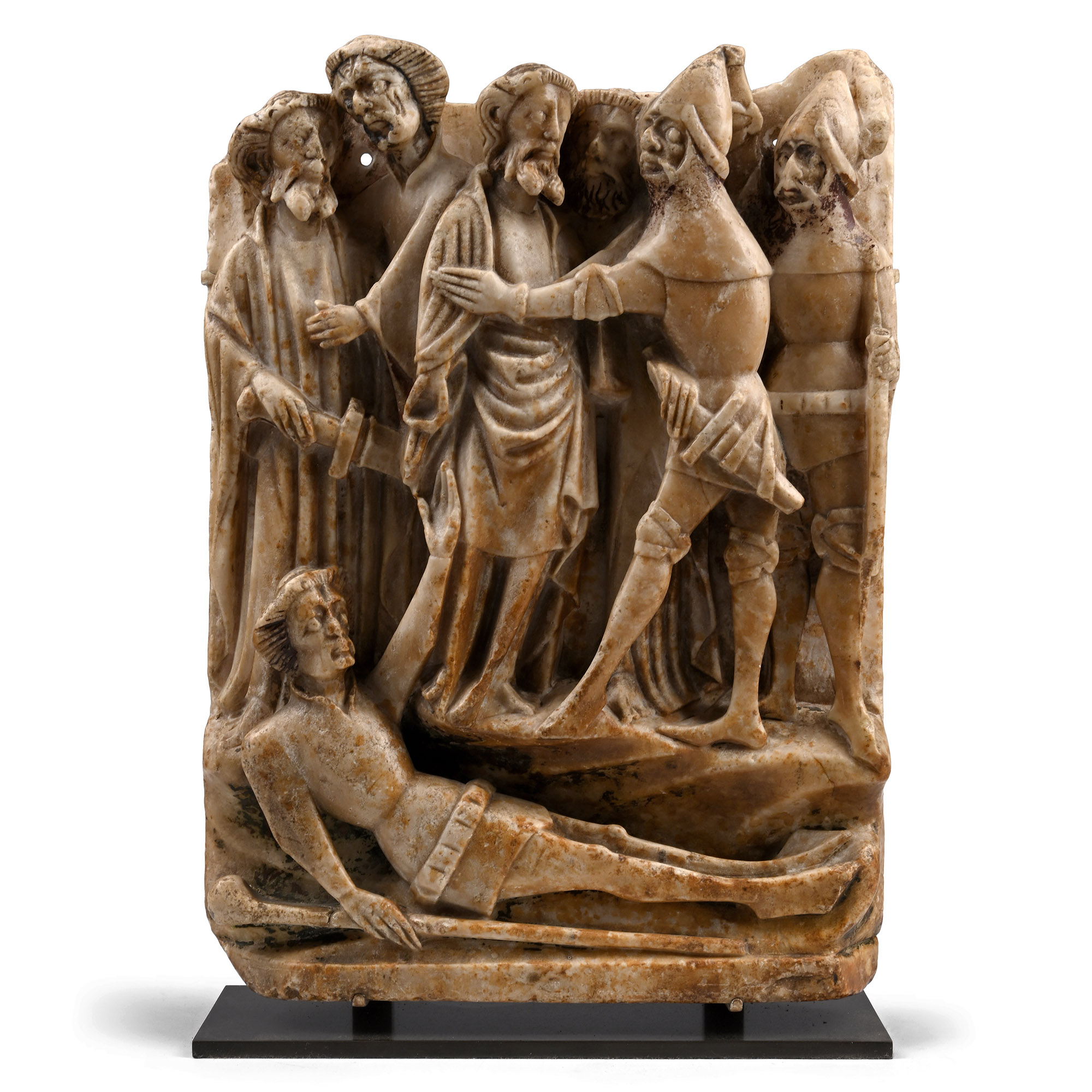
Artists gave the soldiers at the arrest the weapons and armour of their own day, which makes scenes of Gethsemane one of the richest visual sources there is for medieval military equipment. The bascinets and plate armour on lot 341 are what English men-at-arms wore in the years around Agincourt, so the panel shows a soldier of its own time as well as a scene from the Passion. The Betrayal in the Metropolitan Museum, pictured in colour above, is carved to much the same design, with a man lying full length along its base holding a long staff and a swordsman drawing his blade beside Christ.
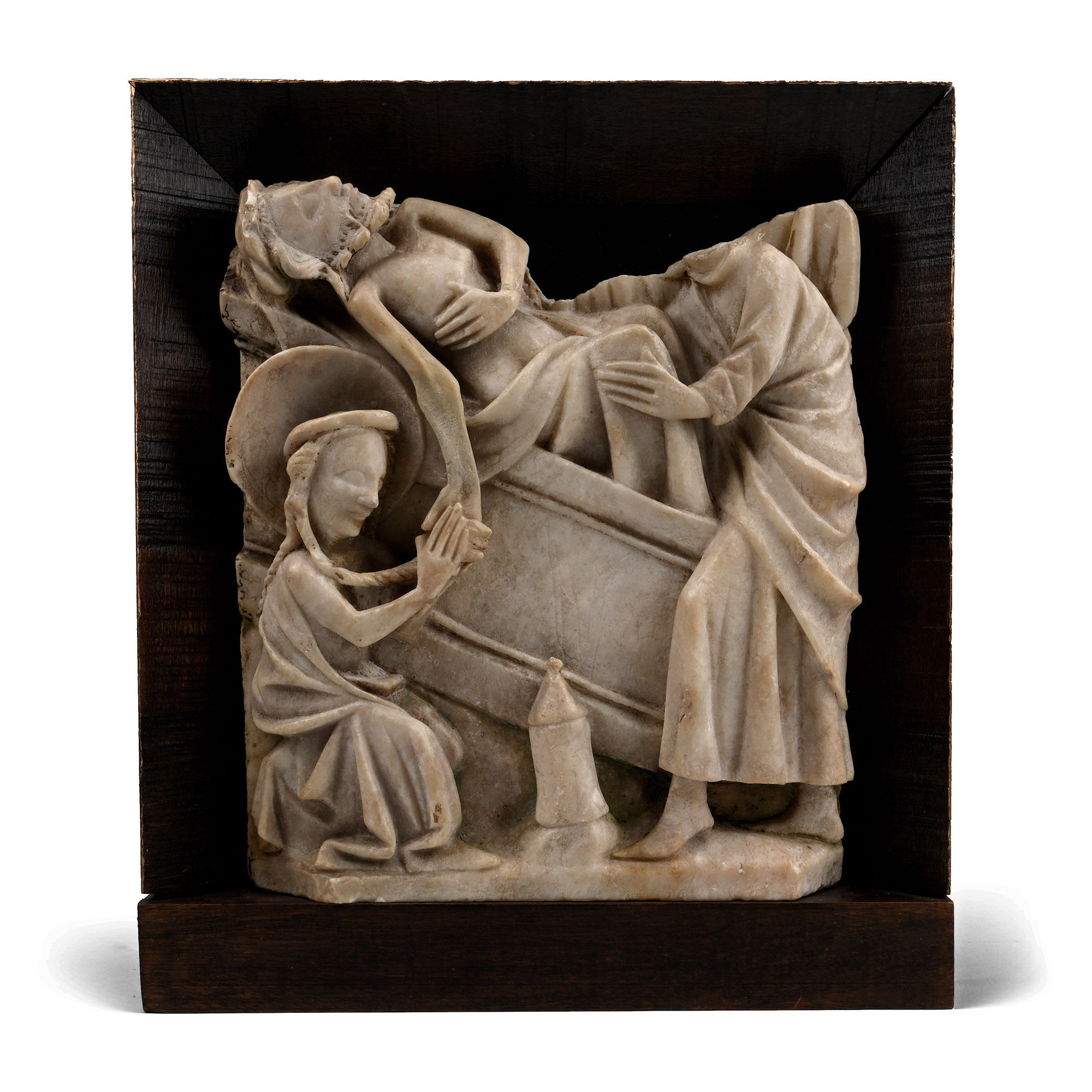
Lot 342 was carved a generation later, around 1440 to 1460, and shows the burial that John's Gospel (19:38-42) gives to Joseph of Arimathea, who laid Jesus in a tomb where no one had yet been laid. Christ lies on a rectangular tomb, and the robed Joseph, at the right, supports his folded knees. Mary Magdalene, with a halo, crouches at the bottom left and reaches with one braid of her hair towards Christ's outstretched right hand, much as she kneels at the tomb on the Metropolitan Museum's painted Entombment. Medieval Entombments always include these two, the Magdalene at Christ's hand and Joseph at the tomb. Her long hair had a meaning of its own, since the medieval Church took her to be the woman who washed Christ's feet with her tears and wiped them with her hair.
Bought back from the Continent
Until late in the nineteenth century English alabasters were taken for Flemish or north Italian work. An article of 1890 established that they were English, and after the Society of Antiquaries' exhibition of 1910 collectors began buying in earnest.
Panels still come up regularly. In London since 2011 single panels have ranged from £2,625, for a Deposition relief, to £44,100 for a part-gilded Betrayal from the Goodison collection in 2022. Another fifteenth-century Betrayal made £16,380 later that year, and an Entombment from a family in Louviers, in Normandy, made £12,800 in 2024.
Some came back to England by way of Amsterdam. Five Passion panels of about 1400 to 1420, a Betrayal among them, had been kept in an oratory in Palma until 1843, were sold at auction in Amsterdam in May 1928, and went from Hildburgh to the V&A. Two years before that sale Aäron Vecht had moved his gallery to the Rokin, the city's art-dealing street. His Kunstzalen A. Vecht, known for glass, maiolica, Asian and medieval art, stayed on the Rokin for some seventy years under him, his son and his grandson, latterly at number 30.
The Betrayal, lot 341, comes from Vecht's collection at Rokin 30. It then passed to Joanna Booth, who began dealing in early carvings and sculpture in Chelsea in 1965, and a London private collector bought it from her in June 2011. The Entombment was with Booth the same year. Both are ready to display, the Betrayal on a custom-made stand and the Entombment on a wooden base.
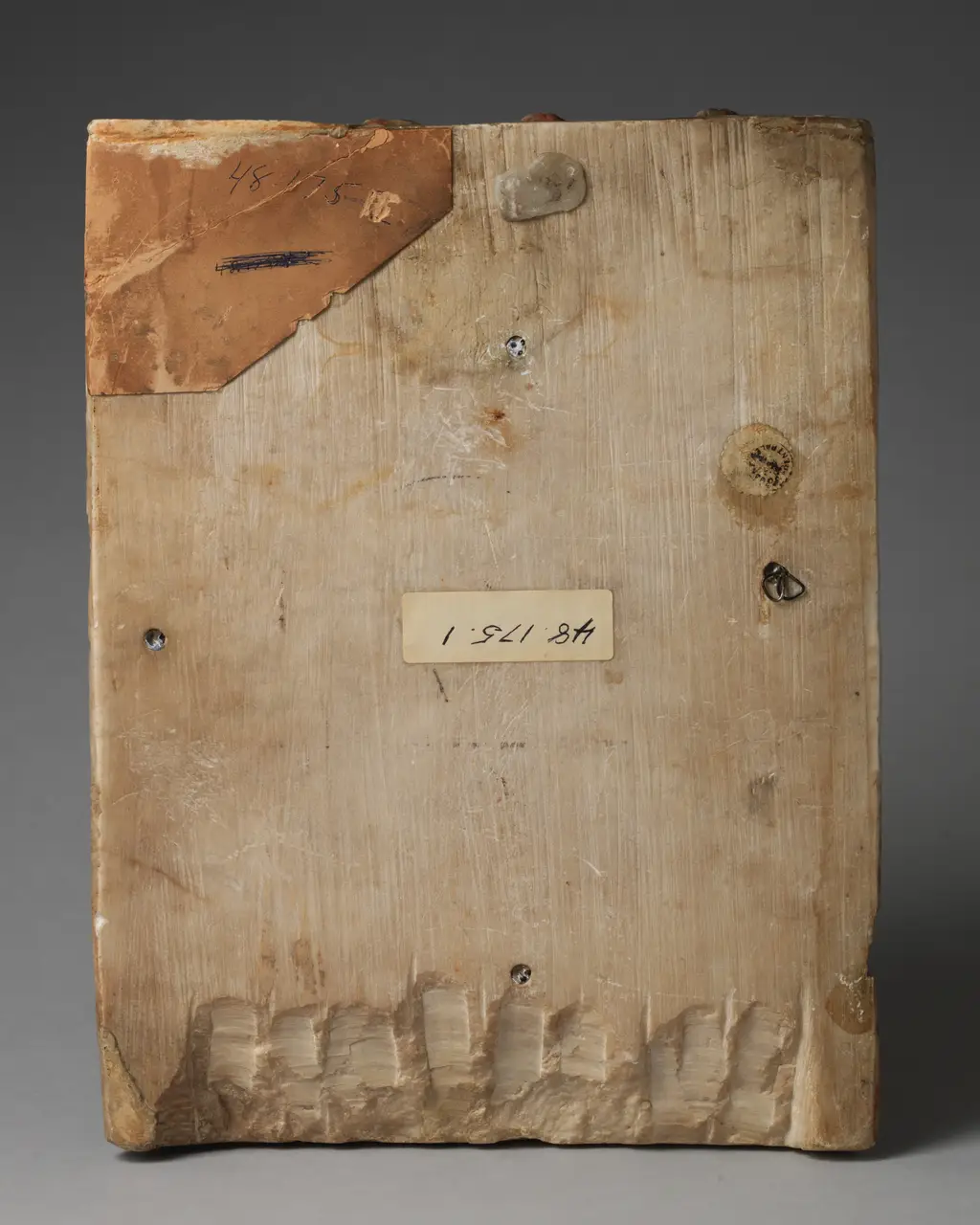 The back of the Betrayal of Christ in the Metropolitan Museum of Art, New York (48.175.1). Public domain (CC0), via The Met Open Access.
The Met's photograph of the back of its Betrayal shows flat stone scored with tool marks, with small lead-plugged holes for the wires that held it in its case, and around them the paper labels and inked numbers of later keepers. The back of lot 341 carries Aäron Vecht's paper collection label, an Amsterdam address stuck to stone that its carvers, around 1420, made to be wired into the wooden case of an English altarpiece.
TimeLine Auctions
