
Loading, please wait...
LOT 0341
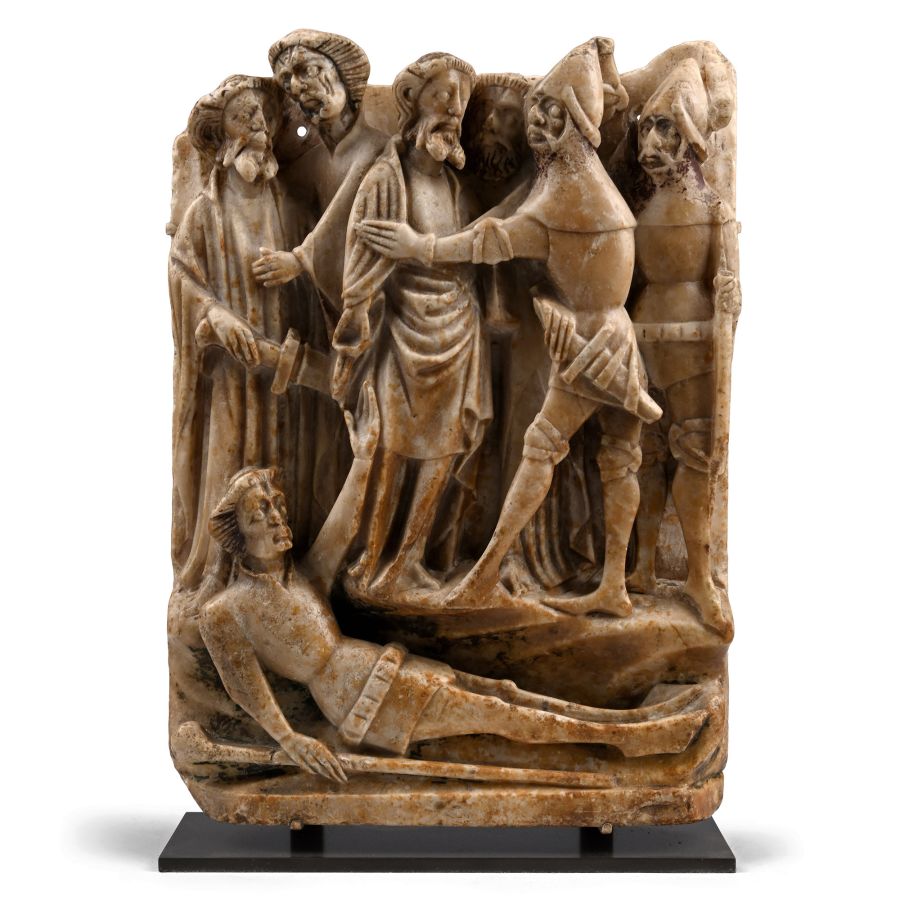
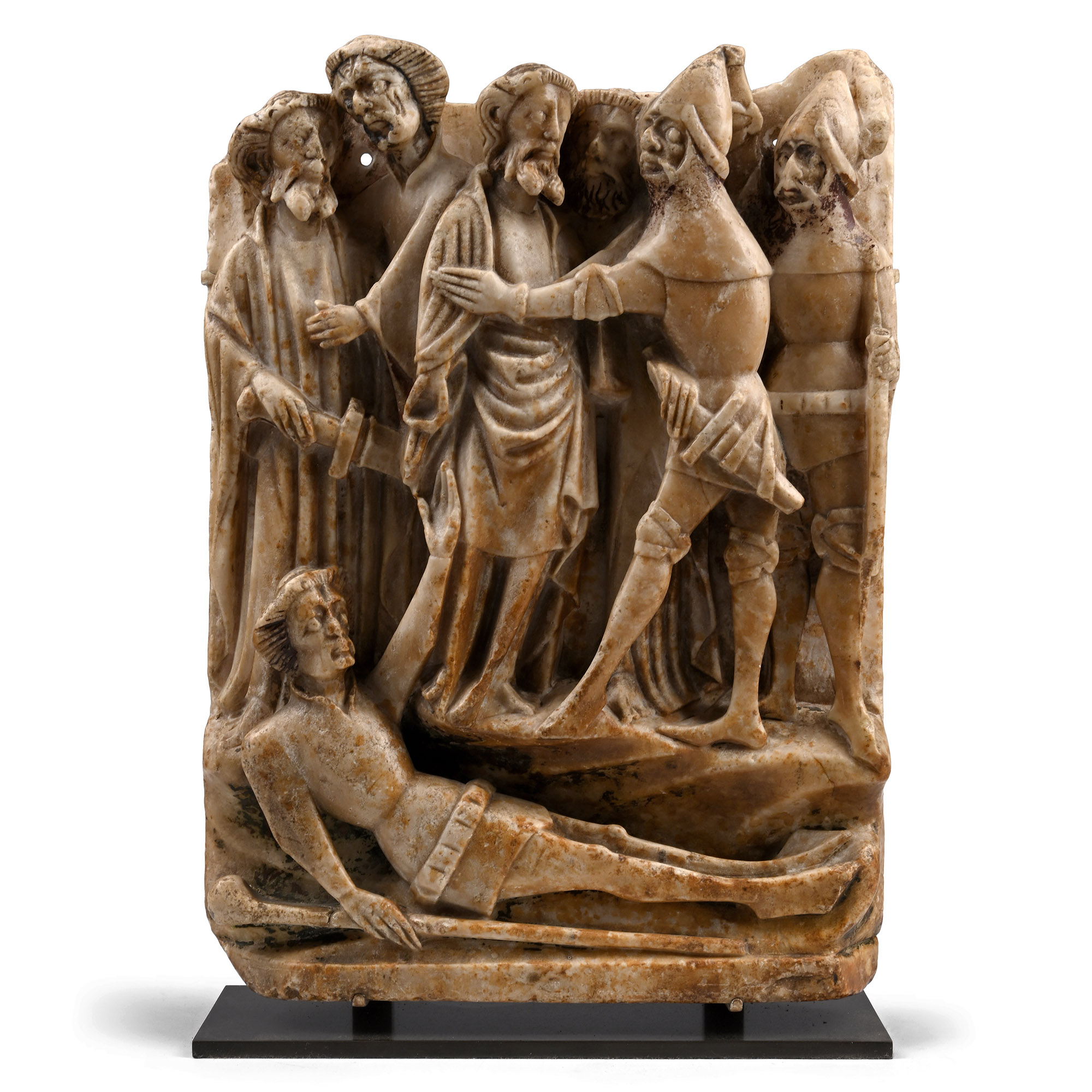
Medieval Alabaster Panel with The Betrayal and Arrest of Christ
ENGLAND, NOTTINGHAM ALABASTER, MIDLANDS, CIRCA 1420 A.D.
14 3/4 in. (10.4 kg total, 37.5 cm high including stand).
Rectangular panel with figural scene in high relief; above, two figures left in bassinets and plate armour arrest two standing figures in loose robes; behind them, a tall figure stretching his hand across the chest of another robed figure drawing a sword; below, beneath a ledge, a supine figure extending his left hand towards the central figure above, his right hand holding a walking staff; mounted on a custom-made stand. [No Reserve]
ProvenanceCollection of Aäron Vecht (1886-1965), Rokin 30, Amsterdam (his paper collection label adhered to the reverse).
with Joanna Booth, London, UK.
Private collection, London, UK, acquired from the above 11th June 2011.
This lot has been checked against the Interpol Database of stolen works of art and is accompanied by search certificate no.13527-262845.
Cf. similar alabaster panel from the Nottingham Workshops (England) dated to the 15th century, on display in the Carmo Archaeological Museum (Museu Arqueológico do Carmo MAC/Esc.30, MAC/Esc.31, MAC/Esc.21 and MAC/Esc.33) in the former Carmo Convent (Convento do Carmo) in Lisbon, Portugal.
FootnotesThe iconography of the betrayal of Christ is ancient, with its earliest roots tracing back to early Christian art. From its inception, the soldiers arresting Jesus in the Garden of Gethsemane were depicted as Roman warriors. It is important to note that artists typically rendered their weapons and armour in the contemporary style of their own eras, rather than using historically accurate Roman attire.
This artistic convention persisted until the fall of the Eastern Roman Empire. As a result, Byzantine depictions of the arrest offer a dynamic chronicle of military evolution, showcasing the changing equipment of the Roman army and local militias throughout the Middle Ages.
Similarly, when this iconography was adopted by other Western and Eastern medieval states, it mirrored the military advancements of nations outside the Byzantine sphere. Consequently, the representation of the arrest at Gethsemane serves as one of the richest visual sources available for studying medieval military equipment.
TimeLine Auctions follows a vetting process to ensure the authenticity and legality of all items, reinforcing our commitment to integrity and responsible trading. Each antiquity, antique, and coin lot undergoes thorough examination by a vetting committee of at least ten external specialists, professional trade association members, scientists, and archaeologists: Our Vetting Process
AUCTIONS:
TimeLine is a leading auction house specialising in antiquities, ancient art, collectables, natural history, coins, medals, and books. Our auctions offer museums, collectors, historians, and enthusiasts the opportunity to acquire unique and historically significant pieces.
LOT 0341
Medieval Alabaster Panel with The Betrayal and Arrest of Christ
Estimate £5,000 - 7,000€5,800 - 8,120 (for guidance only)$6,750 - 9,450 (for guidance only)
-
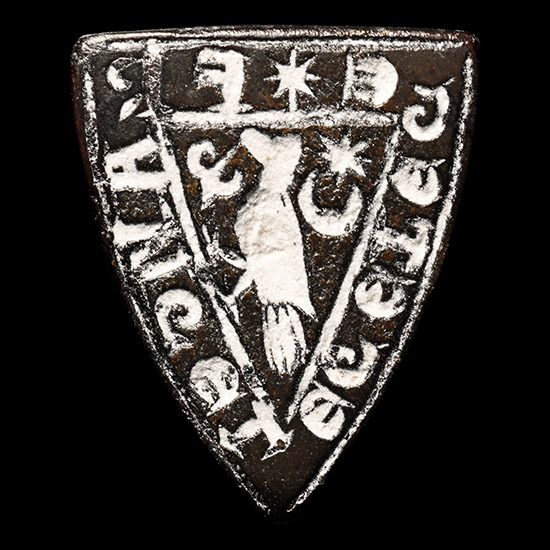
Medieval Bronze 'Break, Read, Conceal' Seal Matrix with Walking Bird
Circa 1300-1400 A.D.Estimate: £200 - 300 (+bp*)
Opening Bid: £100
Shield-shaped seal matrix with a central design of a walking bird in the foreground, and a star, moon and possibly another bird in the back, surrounded by an inscription reading 'FRANGE LEGE TEGE*' for 'break, read, conceal'; suspension loop on the reverse; accompanied by a museum-quality impression. 5.73 grams, 23 mm
Found whilst searching with a metal detector in Hothfield, Kent, UK. Property of a Kent gentleman, a specialist medieval collector. Accompanied by a copy of the British Museum's Portable Antiquities Scheme (PAS) report no.KENT-3A9381. -
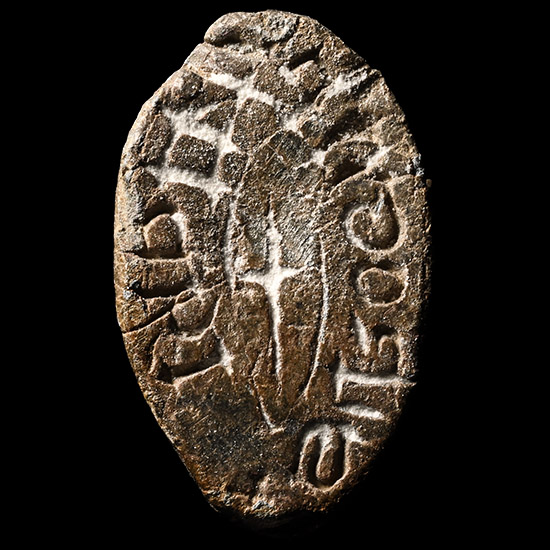
Medieval Lead Seal Matrix of Roger Son of John
Circa 1200-1350 A.D.Estimate: £30 - 40 (+bp*)
Opening Bid: £5
Pointed oval seal matrix with a central alpha(?) motif and a plain line border, surrounded by an inscription reading '+S'ROGAR FI IOHI' for 'seal of Roger son of John', the reverse with a raised rib terminating in a D-shaped lug, on either side of the rib an outward-facing crescent flanked by pellets; accompanied by a museum-quality impression. 14.9 grams, 32 mm
Found whilst searching with a metal detector in Snargate, Kent, UK. Property of a Kent gentleman, a specialist medieval collector. Accompanied by a copy of the British Museum's Portable Antiquities Scheme (PAS) report no.KENT-FB7187. -
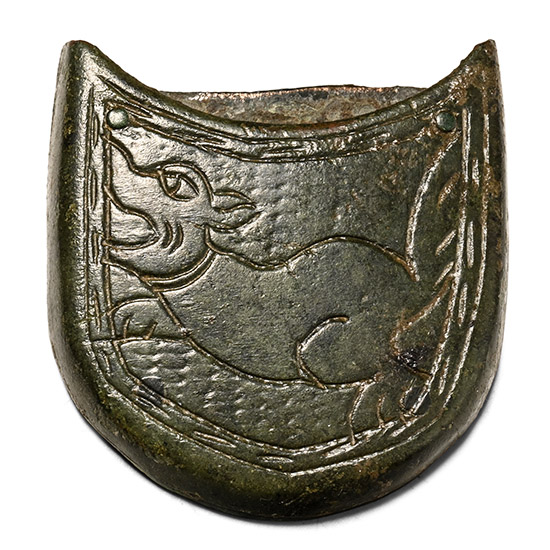
Large Medieval Bronze Dagger Chape with Animal
Circa 13th-14th century A.D.Estimate: £200 - 300 (+bp*)
Opening Bid: £100
Tongue-shaped with an engraved animal, possibly a squirrel. 14.3 grams, 38 mm
Acquired on the UK art market in the 1980s. From an East Anglian private collection.
