
Elephant Bird Egg: The Egg That Named a Giant
On Monday 27 January 1851 Isidore Geoffroy Saint-Hilaire put two elephant bird eggs on the table of the Académie des sciences in Paris. They had reached him only two days earlier from a colonist on Réunion, and he told the members they were of too great an interest to keep back for even a day. A third egg had been shipped from Madagascar with them and had arrived in a multitude of fragments, so he showed a piece of its shell beside the two whole eggs, with a few bones, and named the bird that laid them Æpyornis maximus.
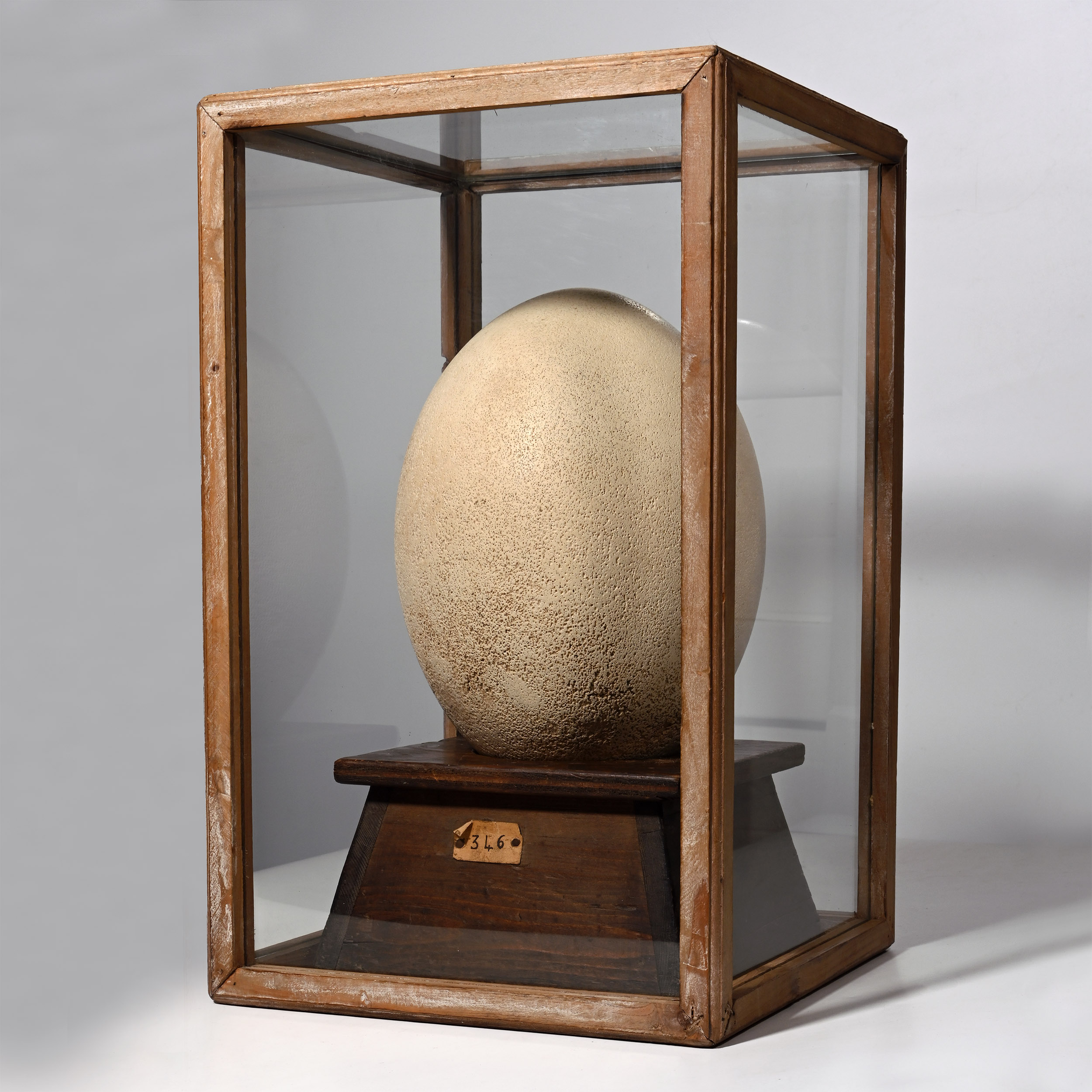
Lot 2998 is an intact elephant bird egg that also came by way of Paris, where a relative of the late Professor Raniero Gnoli bought it in a gallery about a century ago. It comes from the professor's collection at Castel Giuliano, near Bracciano in the province of Rome, and it stands 30 cm tall on a stepped plinth of dark wood, with a paper ticket numbered 346 pinned to the front.
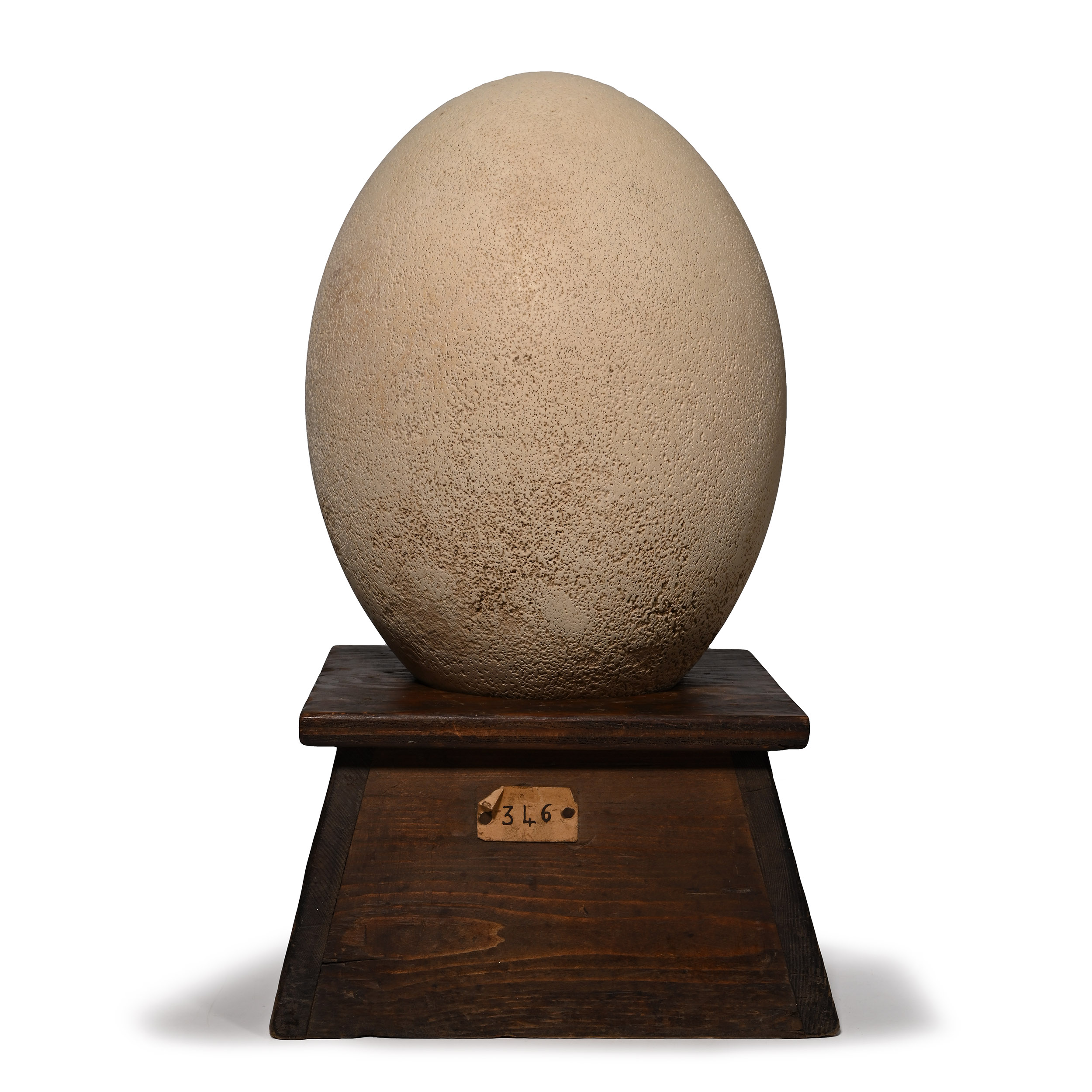
The elephant bird was a flightless giant of Madagascar, nearly ten feet tall and one of the largest birds that ever lived, and it was extinct by the seventeenth century. Its eggs are the largest bird eggs known: each is a foot or so long and holds as much as seven ostrich eggs, or about 160 hen's eggs. Broken shell still lies thick in the dunes of the island's far south, but whole eggs are scarce enough that a count published in 1930 found thirteen in the whole of France. In recent years intact eggs have sold at auction in London for between about £22,000 and £67,000, and once, in 2014, for a reported £122,500.
What is an elephant bird egg?
Geoffroy built the name Æpyornis from the Greek words for "high" and "bird", and added maximus, greatest. The English name answers to the animal's bulk, since a full-grown elephant bird weighed nearly half a ton. It was a ratite, one of the group of flightless birds that includes the ostrich and the emu, though ancient DNA has shown its closest living relative to be the kiwi of New Zealand.
No dinosaur egg yet found holds as much as an elephant bird's, and the fossil Oviraptor egg in the same afternoon's sale, laid in the Late Cretaceous, is 14 cm long against the 30 cm of lot 2998. That dinosaur owes its name to eggs as well: it was called Oviraptor, "egg thief", in 1924, because its skull lay beside a nest of eggs it was taken to be robbing, and it kept the name after an embryo found in 1993 inside an egg of the same kind showed that the eggs were most likely its own.
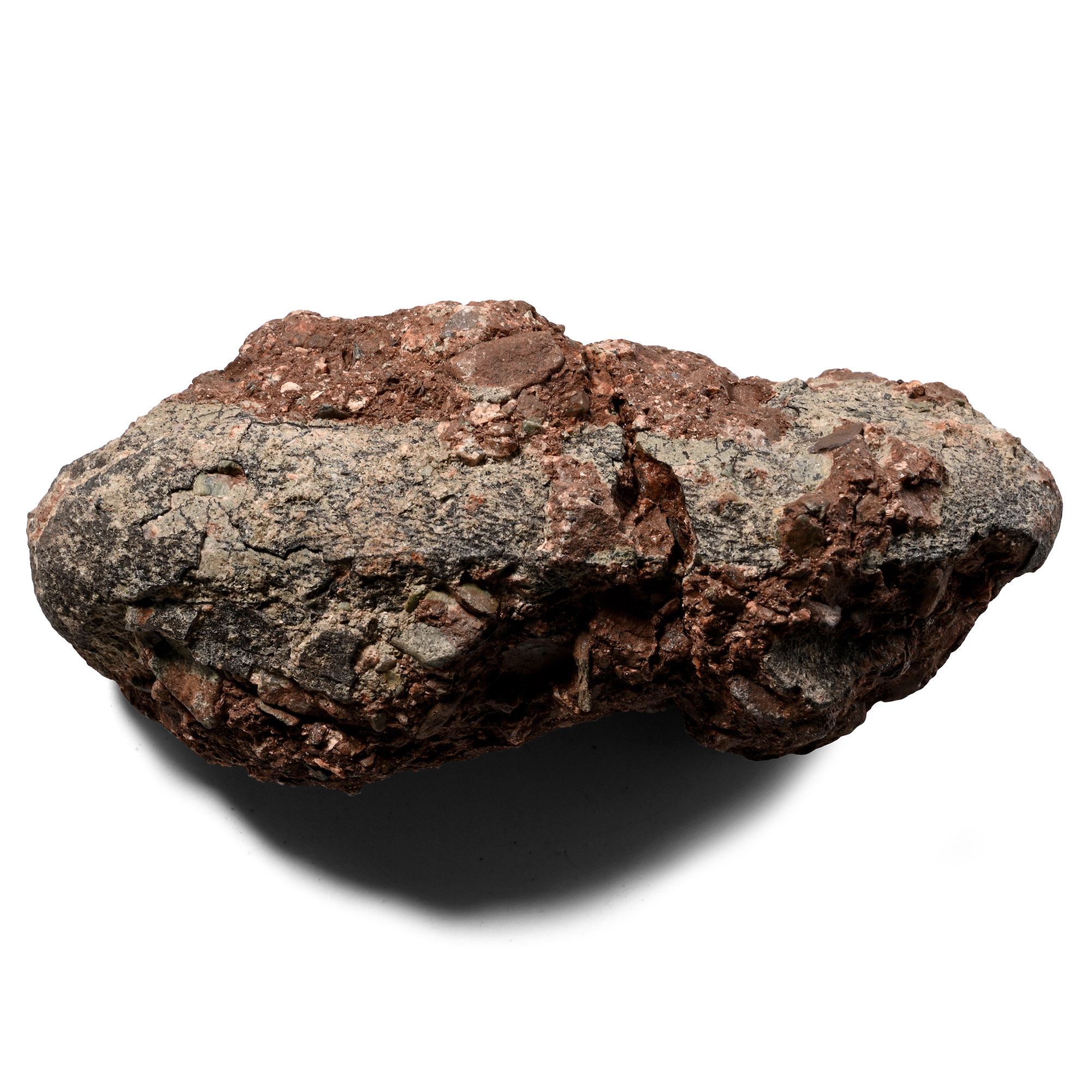
The elephant bird's shell is about three millimetres thick, half as thick again as an ostrich's, and its pores open into narrow slits, a pattern that sets it apart from the eggs of other ratites. On lot 2998 those openings show as the fine dark flecks that cover the shell, denser and browner towards the base, over a beautifully mineralised surface.
Geoffroy called the broken egg and its bones sub-fossils, and the word has stayed with the eggs ever since. The shell keeps enough of its original make-up to be radiocarbon dated, and it still holds ancient DNA: a study published in 2023 recovered the birds' genomes from fragments of shell that ran from about 1,300 to more than 6,000 years old. The precise cause of the bird's extinction is unknown, though the evidence points strongly to human activity, hunting and the destruction of its habitat included, and elephant bird bones have been found with cut marks from butchery.
The elephant bird and the legend of the roc
Marco Polo, around 1298, described a great island off the coast of Africa where at certain seasons a bird appeared that was "so big and so strong that it can take up an elephant in its talons, lift it up into the air to a great height, and then let it fall down to the ground, so that it is dashed to pieces". The islanders, he wrote, called it the ruc. The archaeologist Mike Parker Pearson and his colleagues, who surveyed southern Madagascar, think the elephant bird probably gave rise to this legend of the roc, which Arab and Chinese merchants in the Indian Ocean already knew.
A real bird of Madagascar's south appears in Étienne de Flacourt's history of the island, printed in Paris in 1658 after he had governed the French settlement at Fort-Dauphin. Among the birds that frequent the woods he listed the vouron patra, a great bird of the Ampatres, the far south now called Androy, which laid eggs like the ostrich, kept to the most deserted places and could not be caught by the people there. Flacourt's line is the written evidence usually cited for how late the bird lasted.
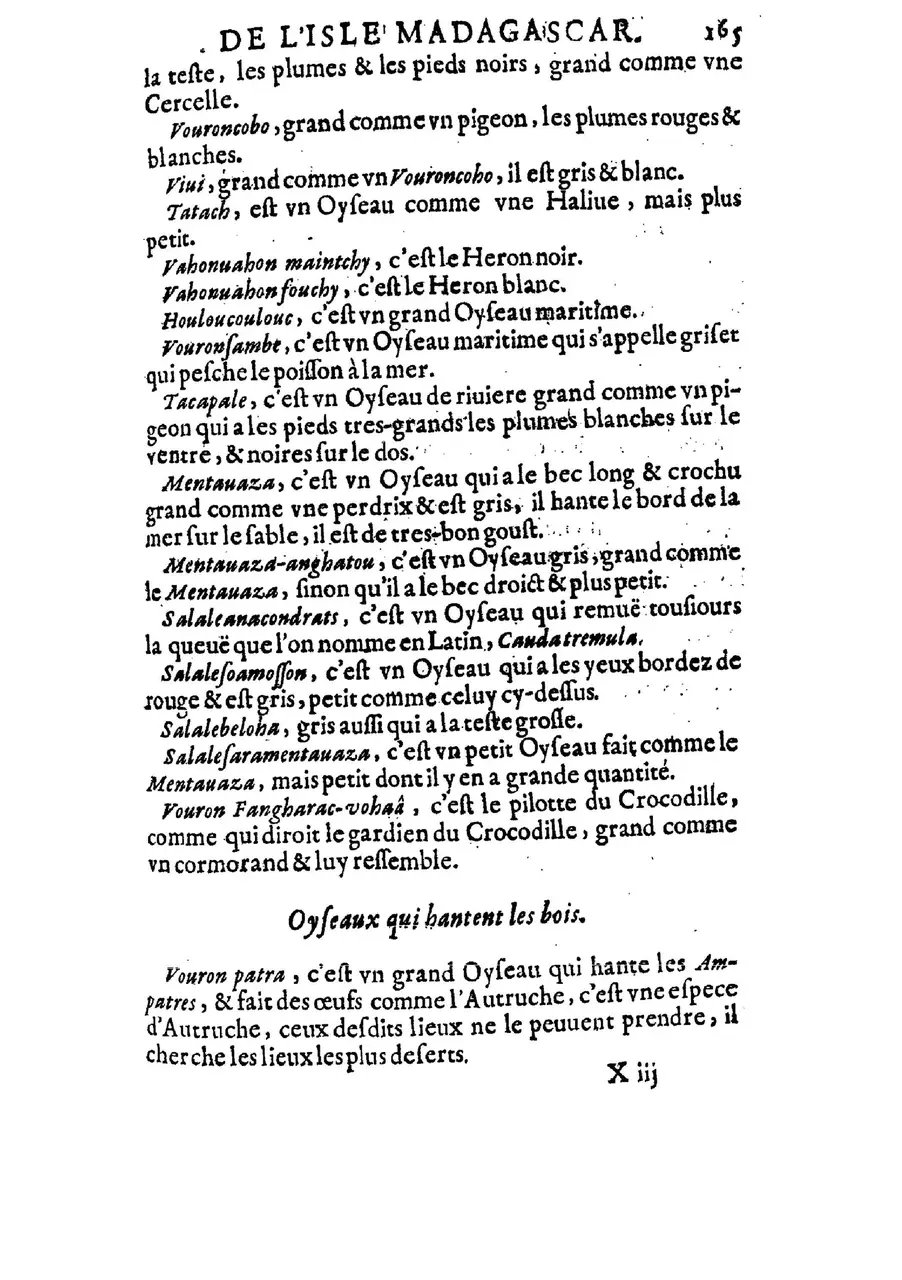 Page 165 of the 1661 edition of Flacourt's Histoire de la grande isle Madagascar, with the vouron patra at the foot, under the heading "Oyseaux qui hantent les bois". Bibliothèque nationale de France, public domain, via Wikimedia Commons.
In 1848 the English naturalist Hugh Strickland reprinted that line in The Dodo and its Kindred and suggested that it "may perhaps guide the future explorer of Madagascar to a discovery of great zoological interest". The next year he printed the story of a French trader named Dumarele, who had seen an egg in the north-west of the island that held "the almost incredible quantity of thirteen wine quart bottles of fluid". Dumarele wanted to buy it and send it to Europe, and its Sakalava owners refused, because it belonged to their chief and such eggs were very rarely met with.
The discovery Strickland hoped for came in 1850, when Abadie, the captain of a merchant ship calling on the south-west coast, saw a giant egg in a Malagasy household, pierced at one end and kept for domestic use. His enquiries turned up a second egg, found perfectly whole in the bed of a torrent, and then a third. All three went by way of Réunion to Geoffroy's table in Paris, and within three months of his paper Scientific American headed its report "The Roc's Eggs".
Why whole elephant bird eggs are rare
The birds probably laid in the warm sand of the coastal dunes, and in the far south, where the eggs were once common, the dunes are still full of their shell. At Faux Cap, near the island's southern tip, Parker Pearson's team found the sand carpeted with fragments, the product of many centuries of laying and erosion, because shell this thick is not easily destroyed.
The eggs themselves are very rarely found whole, and even one of the first three to reach Paris arrived in pieces. The narrator of H. G. Wells's story "Æpyornis Island" (1894), a collector who digs eggs out of a Madagascar swamp, complains of the eggs in the Natural History Museum in London: "all of them were cracked and just stuck together like a mosaic, and bits missing. Mine were perfect." Attenborough's own egg, the subject of a BBC film in 2011, was glued together from pieces he brought back from Madagascar in 1960, and loose shell is common enough that TimeLine has sold groups of fragments in the past. By April 1930 a newspaper on the island, La Tribune de Madagascar, did not think that eggs "without a scratch, so to speak" were still being found.
Elephant bird eggs in Paris, and the Gnoli egg
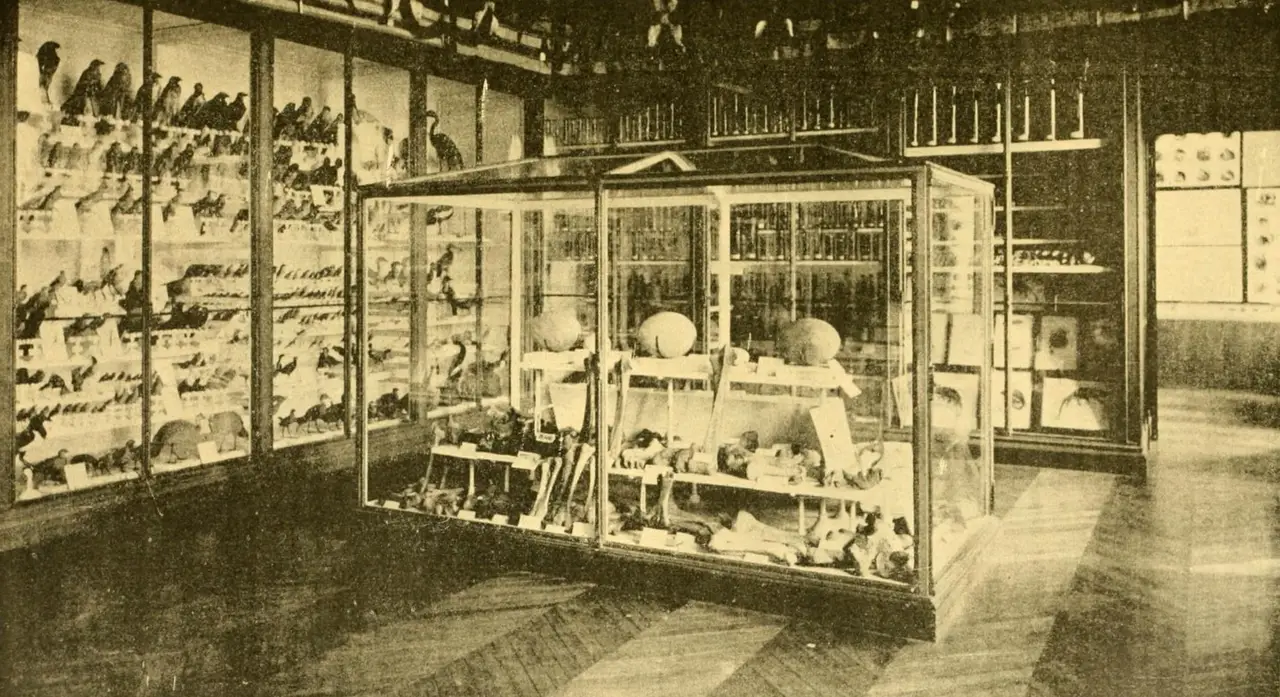 The Madagascar exhibition at the Muséum national d'histoire naturelle, Paris, 1895, from Alphonse Milne-Edwards's "Les animaux de Madagascar" in the Revue générale des sciences pures et appliquées. Public domain, via Wikimedia Commons.
For eighty years after Geoffroy's paper, Paris was where Europe went to see these eggs. In 1895 the Muséum national d'histoire naturelle mounted a Madagascar exhibition that drew more than 120,000 visitors, a year before the island became a French colony. One of its glazed cases, with three elephant bird eggs on the top shelf and bones below, appears in what may be the first photograph of the eggs ever published. Eggs went on show again at the Exposition coloniale of 1931, for which one was bought for 6,000 francs.
The Tribune of April 1930 also carried a count of the known eggs, in which France came first with thirteen, eight of them in Paris, and England had nine. Some were in provincial museums, but the city also had natural-history dealers such as Deyrolle on the rue du Bac, and eggs had reached private houses. One owner the paper named was a Dr Henry Cauderay, who had photographed his egg in a row with an ostrich egg, a hen's egg and a blue tit's.
It was in Paris, in those years, that a relative of Raniero Gnoli bought lot 2998. Gnoli (1930-2025) was an Indologist, professor at Rome's Sapienza University from 1964 to 2000, and the author of Marmora Romana (1971), a standard reference on the coloured stones used in ancient Rome. His relatives include the poet Domenico Gnoli (1838-1915) and the painter of the same name (1933-1970), and he died at his home at Castel Giuliano in May 2025. His egg sits on its plinth inside a pine-framed glass case, much as the Muséum's eggs sat in theirs in 1895.
What is an elephant bird egg worth?
Three intact elephant bird eggs have sold at auction in London in recent years, at prices that include the buyer's premium: £66,675 in April 2013 for a foot-long egg estimated at £20,000 to £30,000, £22,680 in May 2022 for an egg of 27.5 cm, and £44,100 in December 2024 for one of 30.5 cm. The Irish Times reported £122,500 for a 31 cm egg in London in April 2014.
The line between the intact eggs and the reconstructed ones divides those prices as plainly as painting divides a £98 Greek oil flask from a £29,900 one, and it is the difference Wells's collector drew between his perfect eggs and the museum's mosaics. Among intact eggs size seems to count at the margin, since the 27.5 cm egg was the smallest of the four and made the least.
Lot 2998 is intact and 30 cm tall, much the size of the 2013 and 2024 eggs, and has about a century of family ownership behind it. It is estimated at £40,000 to £60,000 and opens the Natural History Sale at 1pm on Sunday 6 December 2026.
The eggs that named the bird
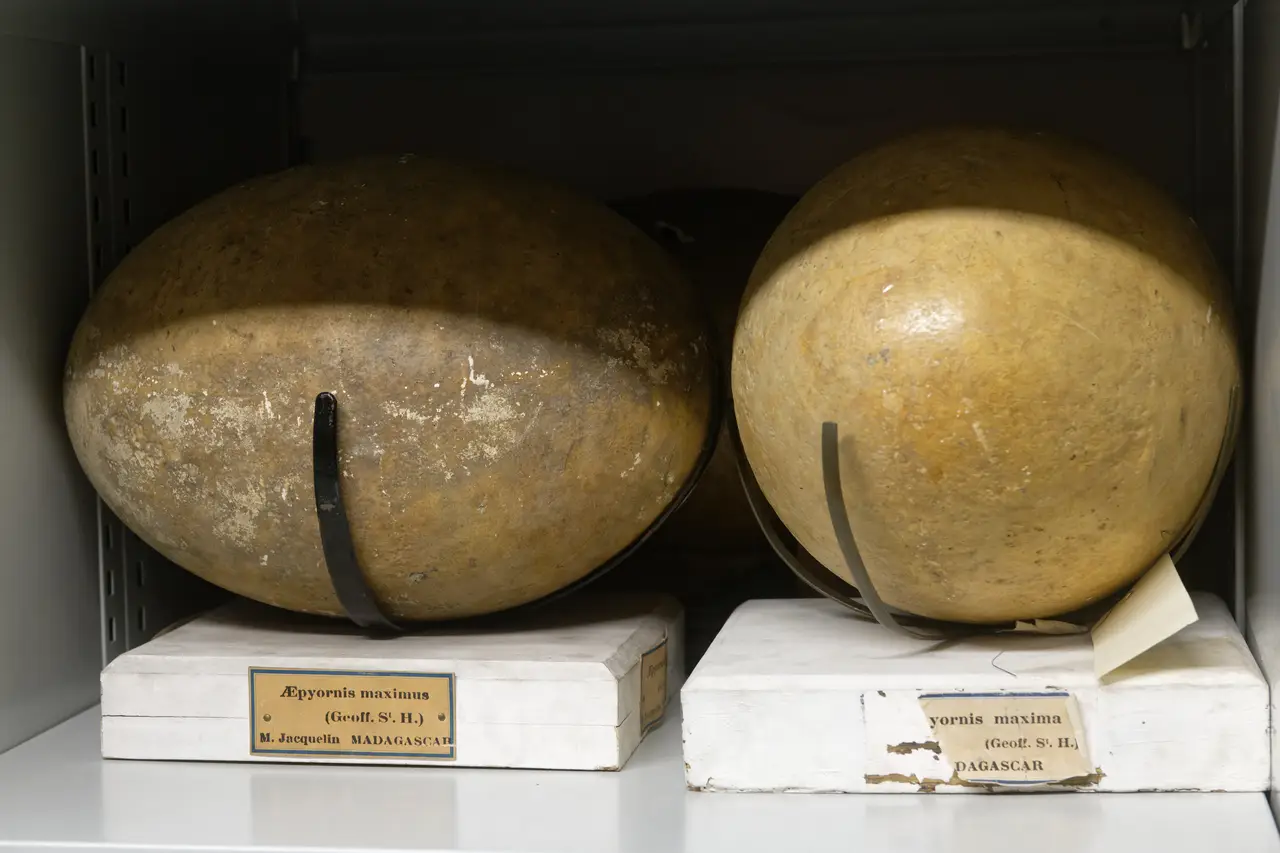 Elephant bird eggs in the Zoothèque of the Muséum national d'histoire naturelle, Paris, in 2020. Photo: Marie-Lan Taÿ Pamart, CC BY 4.0, via Wikimedia Commons.
In the Muséum's underground stores, the Zoothèque, elephant bird eggs rest on old white plinths under printed labels reading "Æpyornis maximus (Geoff. St. H.)", the name and the man who gave it. When researchers went back in 2018 to the specimens Geoffroy had used to name the bird, the bone he described could not be found, and the two eggs from the table in 1851 could no longer be told apart from the Muséum's others. They are somewhere among its eggs, under his name and no longer known to be his, while the egg from Castel Giuliano still carries a number of its own, 346, on a paper ticket pinned to the front of its plinth.
TimeLine Auctions
