
Cuneiform Tablets with a Slander Trial, a Letter to King Shulgi and a Hymn Found Nowhere Else
A woman brings her complaint to her lord and repeats it until it becomes a refrain: "Is my house like her house? Is my spouse like her spouse? Is my mother like her mother? Am I like her? She spread slander, she called me a prostitute, and made my husband divorce me." A herald is sent ("Where are those women? Let them come in!"), and the accused, Ninkuzu, is asked why she slandered the daughter of a man who was her equal. One of the two protests that the other "has bought a witness against me", and the verdict is a sum of silver: "I shall write down a divorce fee of 1/3 of a mina of silver."
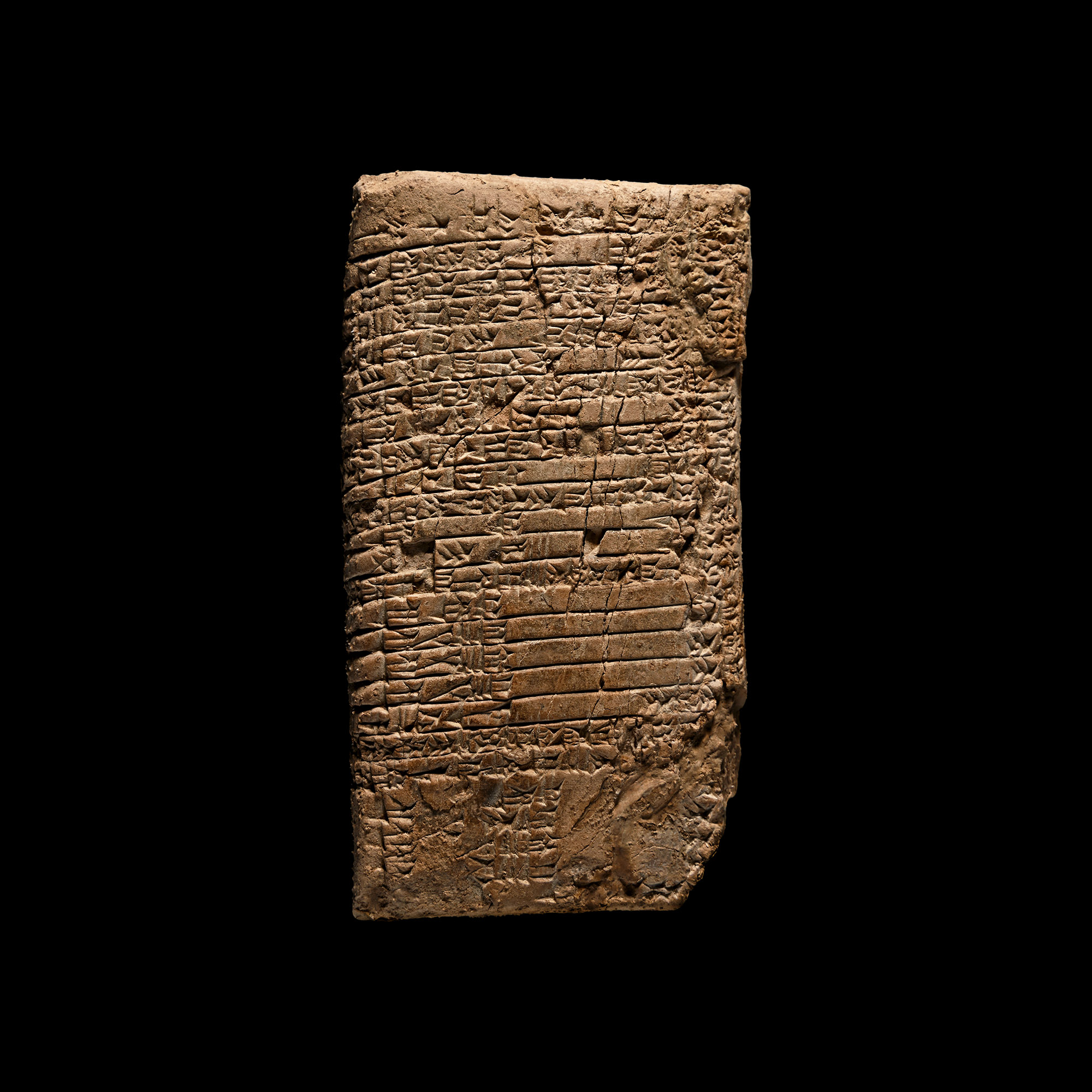
The lines are written in Sumerian on lot 234, a cuneiform tablet in TimeLine's sale of 1 December 2026, and they come from a poem that Babylonian pupils copied out between about 1900 and 1700 BC. Scholars call the poem Two Women B. It runs to some 230 lines, follows a quarrel between two women all the way into court, and was probably written by the teachers of the "tablet house" where scribes were trained.
With 41 lines of the trial scene, the tablet is longer than any one of the published pieces of the poem, and it is in comparatively good condition. It comes from the library of a great-grandson of Charles Darwin, the fourth son of Sir Geoffrey Keynes, most of it assembled in the 1970s and 1980s. Seven more inscribed pieces are offered with it, among them a vizier's letter to King Shulgi, a hymn to the sun god found on no other tablet and a gold-mounted agate cut with the name of a king of Babylon.
Hammurabi's penalties in a Babylonian school poem
A third of a mina is twenty shekels, a large sum at the time, and it is the sum the Laws of Hammurabi set for a divorce of this kind: "If he is a commoner, he shall give her 20 shekels of silver." Real divorce contracts of the period name anything from ten to sixty shekels.
The poem goes on to sentence the slanderer: "after your back and your behind have each been flogged six times, after the half of your head has been marked (for shearing), after your mouth and lips have been rubbed with salt", a herald will announce it in every city square. Hammurabi's law on slander, carved on the stele now in the Louvre, orders much the same, since anyone who accuses a priestess or a man's wife and cannot prove it is to be flogged before the judges and have half his hair shaved off.
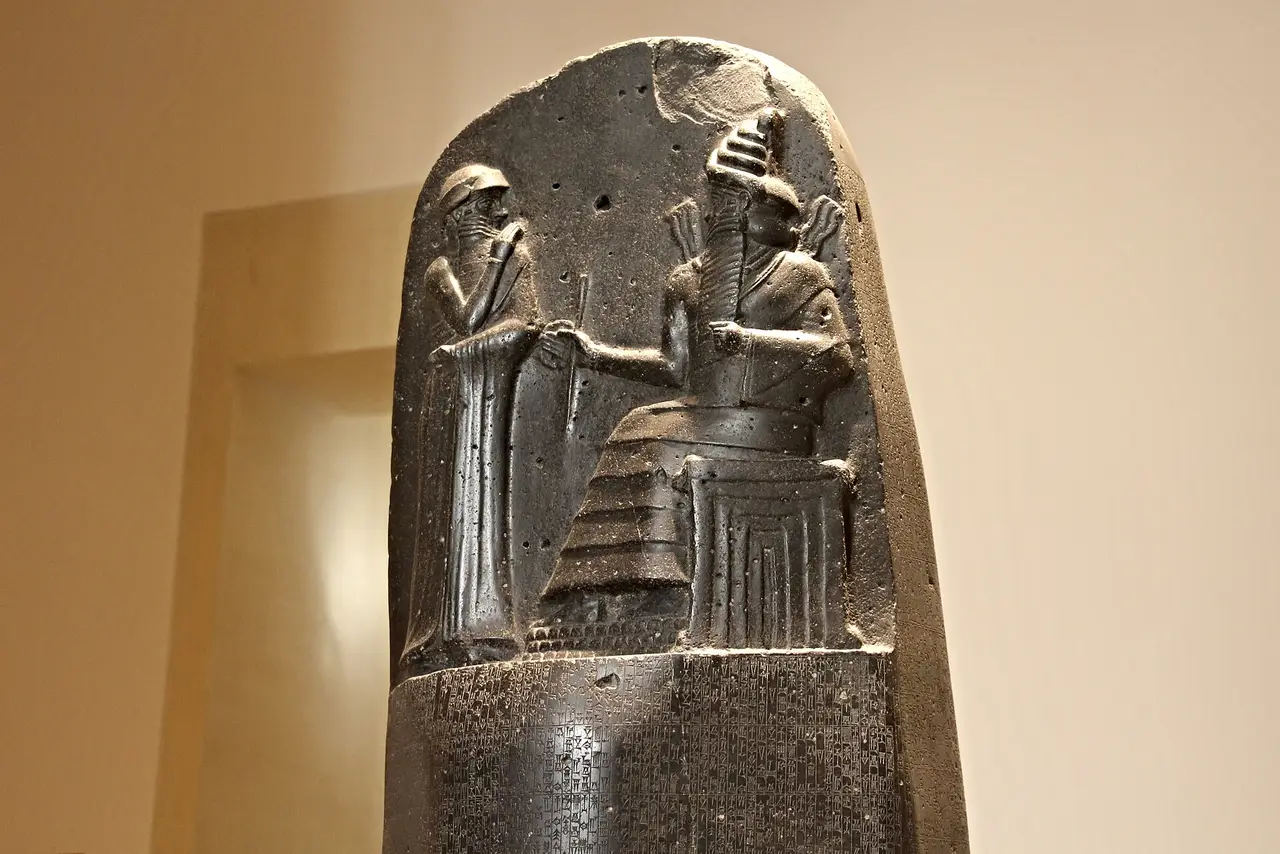 The top of the basalt stele inscribed with the Laws of Hammurabi, who reigned 1792-1750 BC, now in the Louvre, Paris. Photo: Fred Romero, CC BY 2.0, via Wikimedia Commons.
How did scribes learn to write a cuneiform tablet?
By Hammurabi's time Sumerian was a dead language, and scribes kept it alive by speaking it in school, much as medieval scholars spoke Latin. One satire of school life has a pupil recall: "The Sumerian monitor (said): 'You spoke Akkadian!' He beat me."
The fullest picture of such a school comes from House F at Nippur, a small private house excavated in 1951-52. It held 1,400 tablets, just over half of them literary works and most of the rest lists and exercises. School tablets were unbaked and their clay was meant for reuse: some had been built into a bench, the floor and the walls, beside three brick boxes that may have been used to soak old tablets and reshape the clay.
Pupils began with sign drills and lists of personal names, went on to lists of things, places and measures, and finished the elementary stage with model contracts and proverbs. Literature came next, starting with a set of ten works that opens with a hymn of King Shulgi of Ur: "From the time I was born I have been a mighty man." Two Women B belonged to this later stage, and its insults were probably a schoolmaster's lines, since the dialogues between women are thought to have been written by men. Pupils copied letters too, at Nippur anywhere from 14 to 36 lines a day.
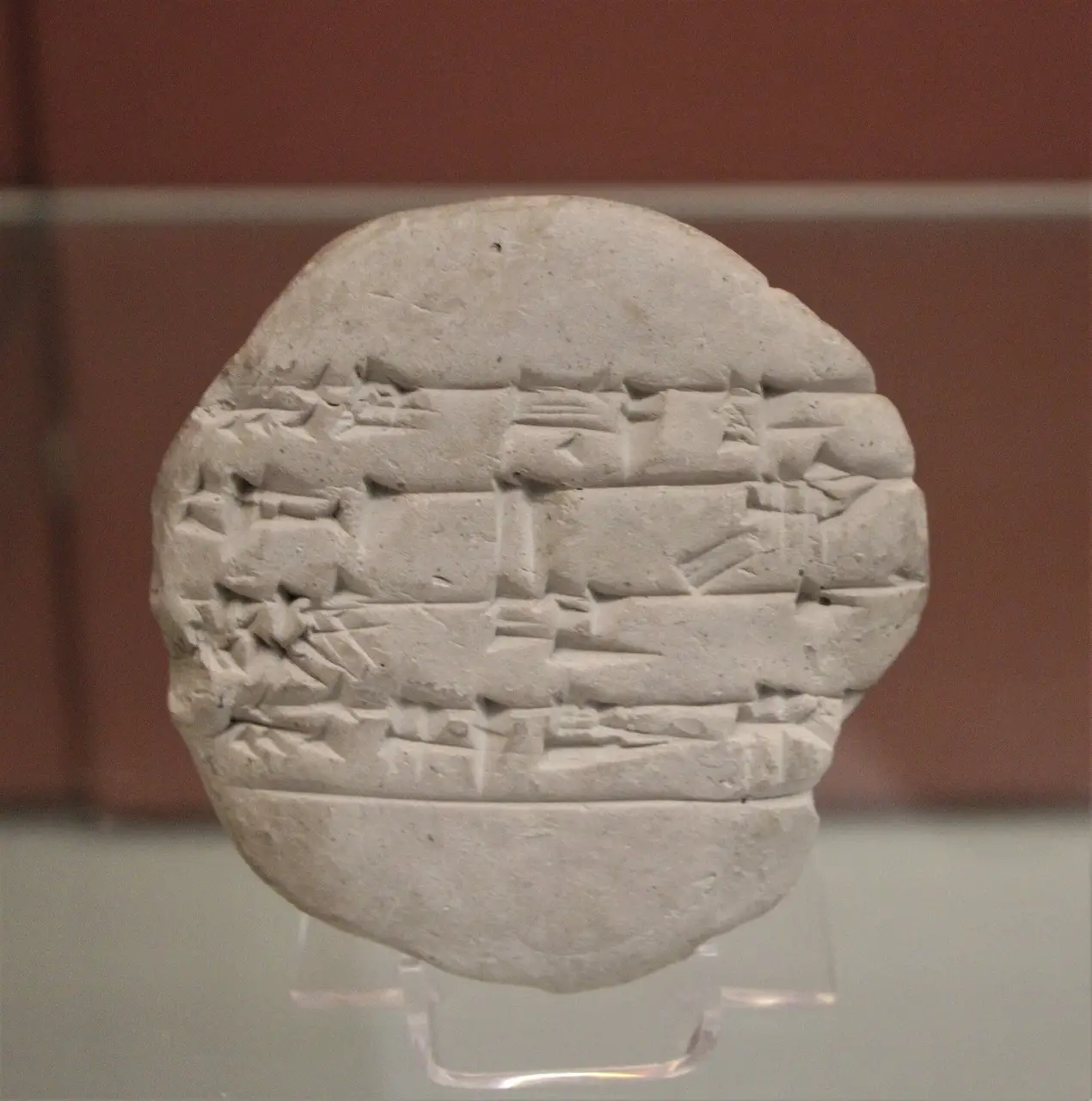 An Old Babylonian school tablet with a proverb, the teacher's version on this face and the pupil's copy on the other, in the British Museum (BM 104096). Photo: Zunkir, CC BY-SA 4.0, via Wikimedia Commons.
A letter to King Shulgi
The letter most often studied in those schools was a complaint from the grand vizier Aradmu to Shulgi himself, king of Ur from about 2095 to 2047 BC. Sent to the frontier to secure the taxes, Aradmu reaches the camp of an officer named Apilaša and reports that "no one inquired about my king's well-being, no one rose from (his) seat for me".
Apilaša sits on a throne with his feet on a golden footstool, in a pavilion of "finely combed fleece" inlaid with gold, silver, carnelian and lapis lazuli, among five thousand of his guards. Offered a chair, Aradmu refuses it ("When I am on my king's orders I stand"), his table is overturned ("I was so frightened that my skin crawled!"), and the letter ends: "It is midday, and war is brewing!"
Aradmu and Apilaša were real officials, the first Shulgi's grand vizier by the 45th year of the reign and the second named in more than sixty administrative documents. In his reply the king takes the side of Apilaša, posted to dangerous country far from Ur, against the most powerful man at his court. He scolds Aradmu for misreading what he saw and tells the two to settle their feud. Most school literature made Shulgi superhuman, and the letters showed pupils a shrewder king who knew the limits of his authority.
Lot 235 carries Aradmu's letter to Shulgi on both faces of a roughly rectangular tablet 89 mm long. It was with Audrey Davies at the Astarte Gallery in London, where it was acquired in 1985, then in a private collection in Montreal, and it comes with a scholarly note by W. G. Lambert, Professor of Assyriology at Birmingham from 1970 to 1993.
A Sumerian hymn to the sun god known from no other tablet
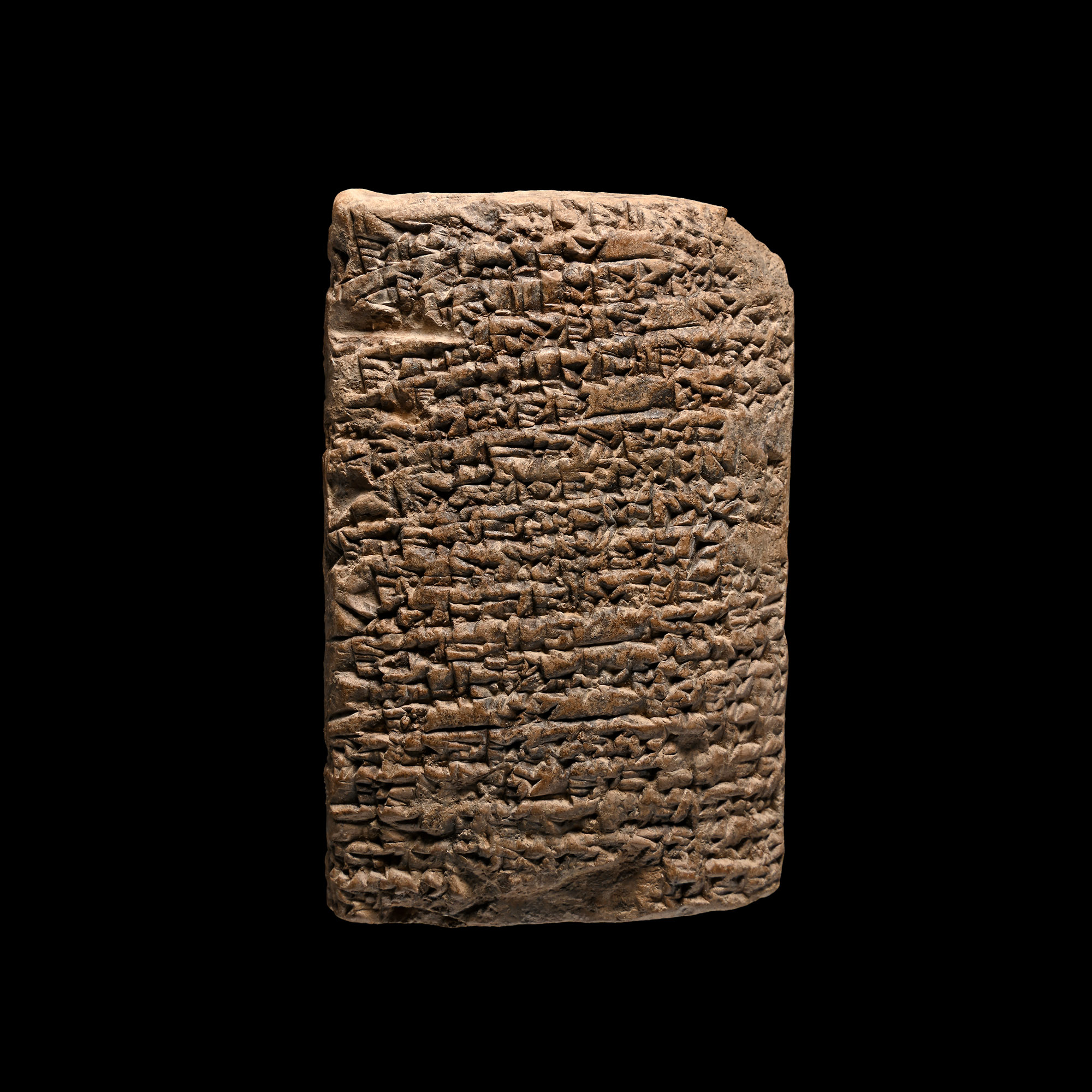
In the late 1980s and early 1990s Lambert examined a London collector's cuneiform texts, a small group exceptional for its variety, and among them was a tablet with 30 lines of Sumerian in two sections, one on each face. He identified the second as "part of a hymn to the Sumerian sun-god Utu, apparently not otherwise known", and thought the first was also a hymn, perhaps to the same god.
The hymns the schools taught survive in multiples, House F alone holding at least nine copies of each of the ten core works, so a hymn that Lambert could match to no other tablet is a much rarer thing. Utu, Shamash in Akkadian, was the god of justice and equity and the judge of gods and men. In legend he gave Hammurabi his laws, and he is usually taken to be the enthroned god at the top of the Louvre stele. The tablet comes in a custom-made case that replicates an old quarter-bound book with marbled boards.
Contracts in clay envelopes, and the seals that closed them
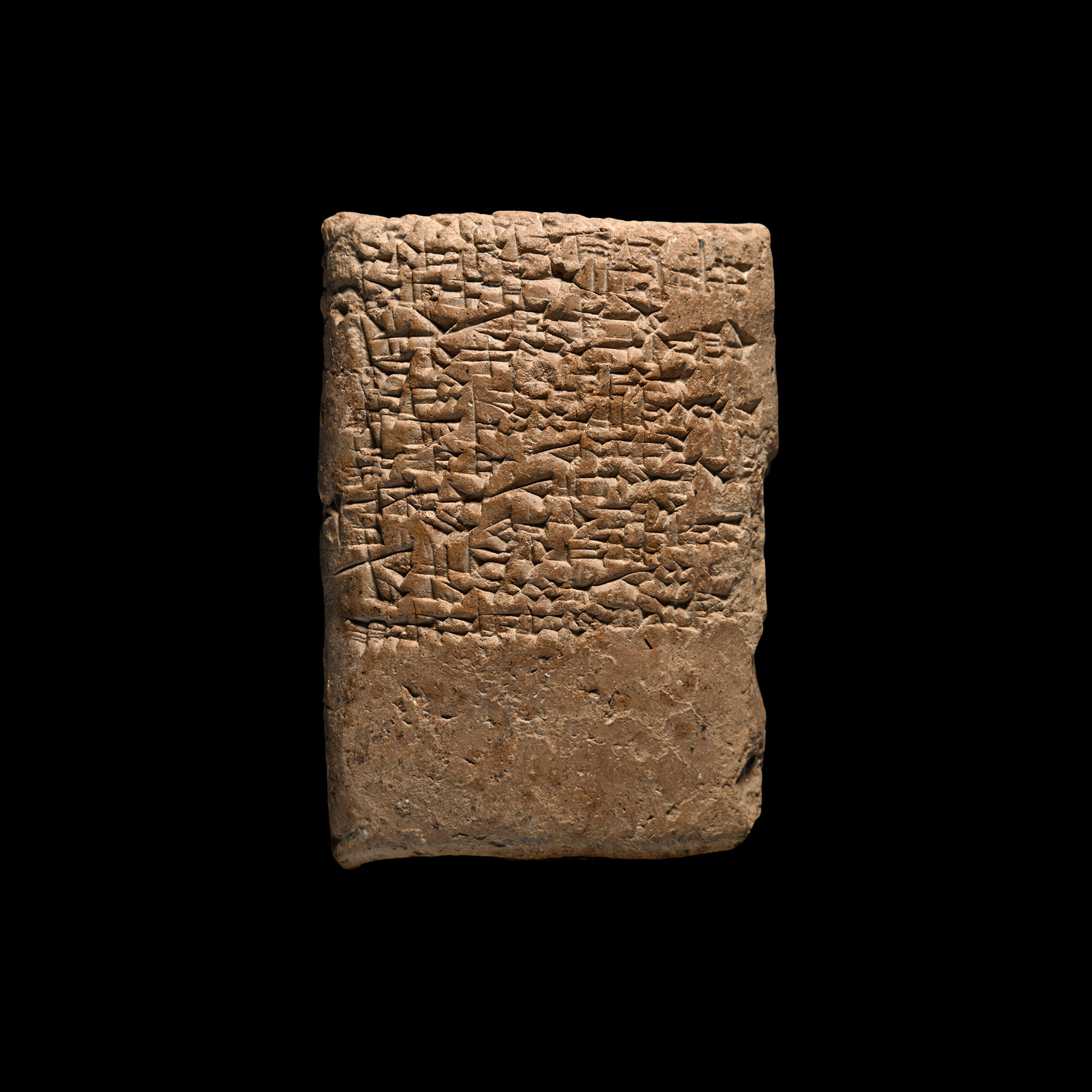
The model contracts of the elementary course prepared a scribe for documents like lot 238, an Old Babylonian legal document of about 2000-1700 BC that is still in its clay envelope. The contract went on the tablet, the tablet was wrapped in a sleeve of clay, and the text was written again on the sleeve, after the witnesses or the party bound by it had rolled their seals along its margins. Signatures were unknown, so the sealing was what guaranteed the document, and in a dispute the tablet in its envelope went before the judges.
In Hammurabi's ninth year a woman at Sippar named Niš-inišu bought a plot of land for ten shekels, and her deed waited fifty-two years for its day in court. In 1732 BC the seller's son sued her heir, and the judges' record reads: "The envelope of the tablet being damaged, they extracted her tablet, and, in accordance with her old tablet, they confirmed her ownership."
Lot 238 shows both layers at once, the envelope's writing above and, lower down, the smaller and closer script of the tablet it was made to protect, and at 12 cm and 437 g it is a large example.
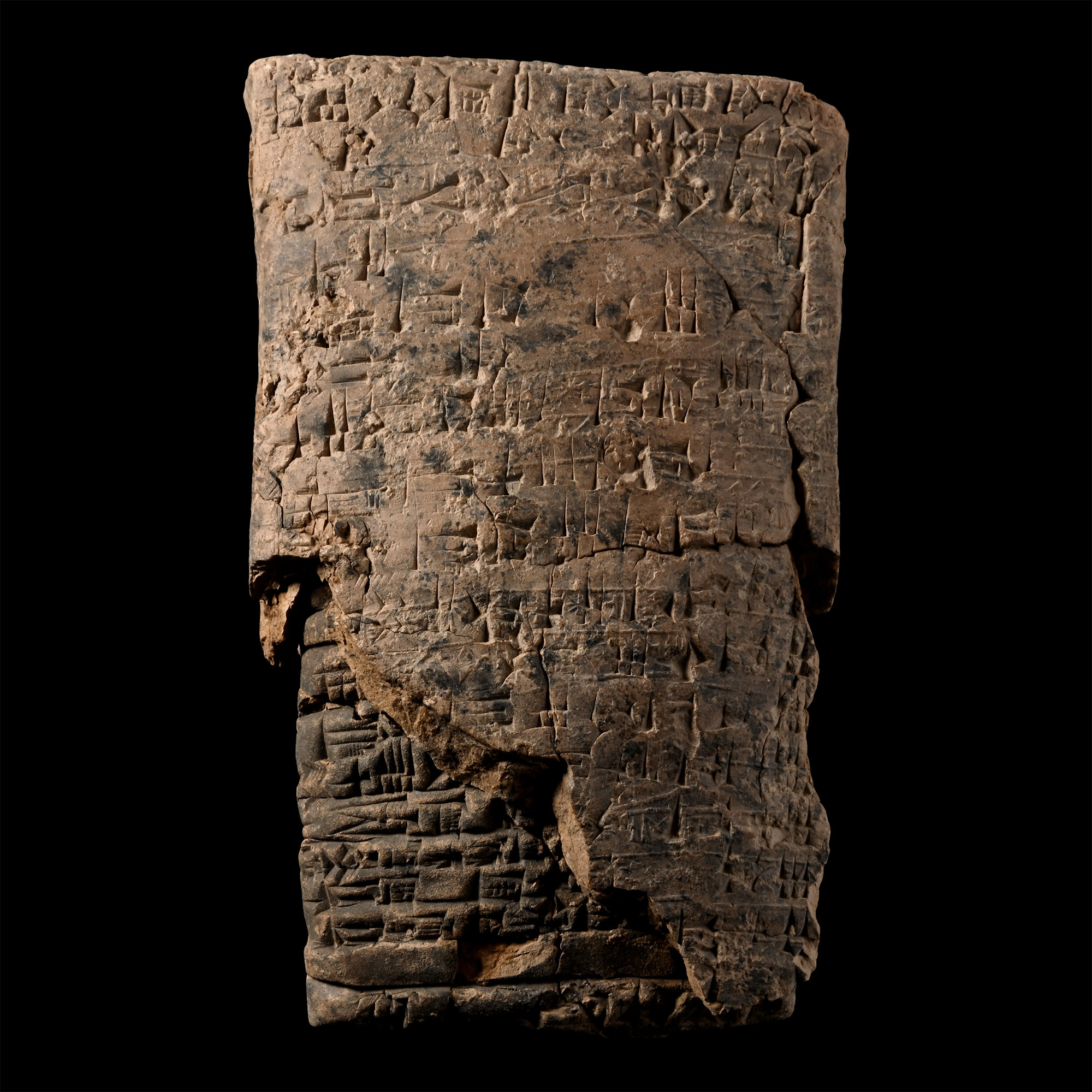
A seal did the work of a signature, and the hematite cylinder seal in lot 246 names its owner in three lines as Lu-Enkika, son of Iddin-Sin, servant of the god Enki, the commonest pattern for a seal inscription of the period. Lambert, in a typed note of 1991, dated it to about 1900-1700 BC and described it as cut in the fine, detailed style that was the best of its time. The original design has a Lamma goddess with both hands raised, facing a god who holds a mace, with a sun disc and crescent between them.
A third figure on the far right, a god holding up a long rod, is cut in a different style, and Lambert judged that it was added with the cutting wheel a century or two later, in all likelihood in Iran. Seal stones were imported and costly, and of a thousand Old Babylonian seals examined in one study a quarter had been recut for a later owner. The seal is sold with a museum-quality impression.
A bronze bowl and an agate bead inscribed for kings
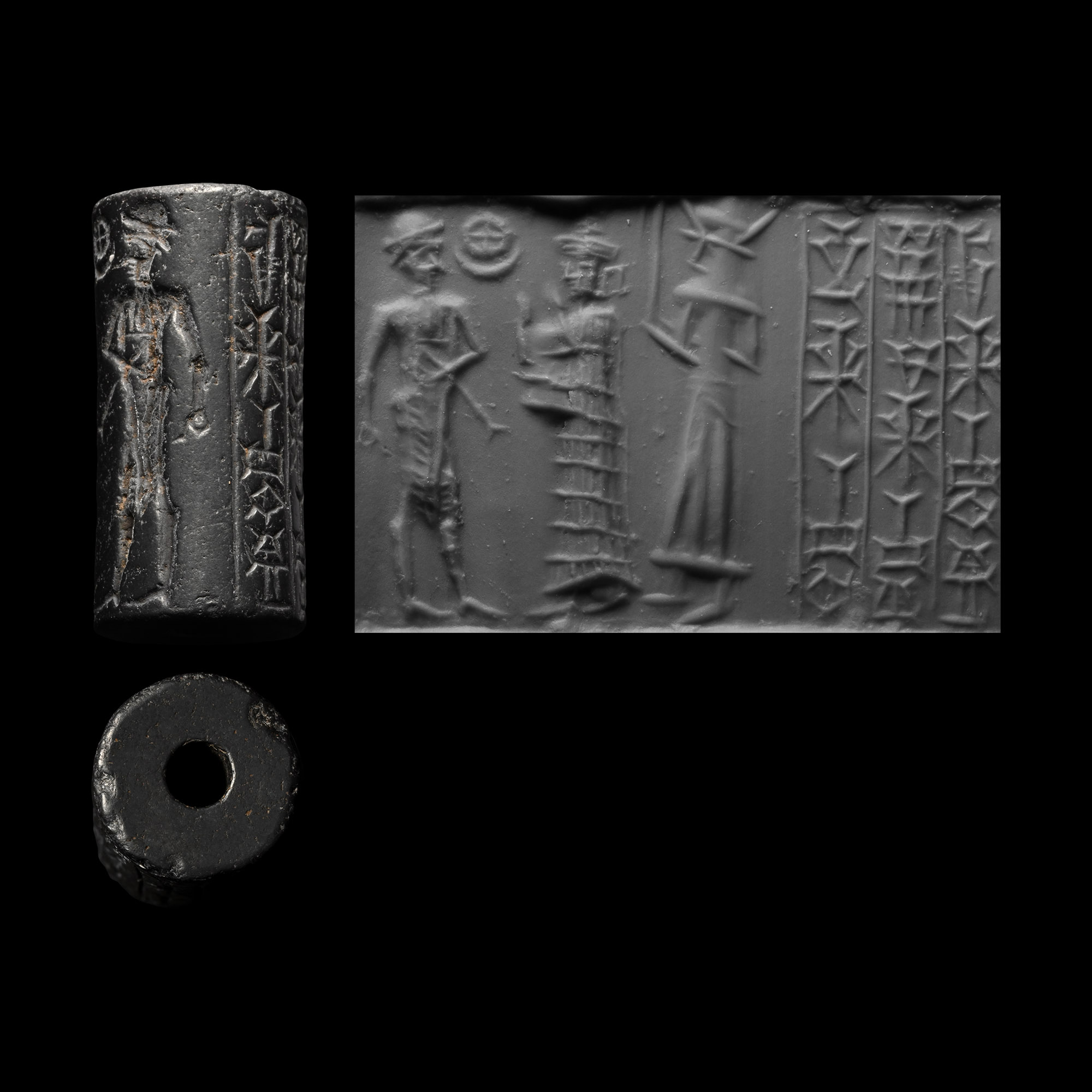
The royal inscriptions of the kings of Akkad survive mostly as copies made by Old Babylonian scribes, and one of those copies follows Sargon's son Manishtushu (c. 2270-2255 BC) on a campaign across the sea in ships. Lot 261 carries Manishtushu's name on an object of his own reign, a hemispherical bronze bowl of 13.5 cm with a thin rim and a rectangular panel incised in three fields. Two fields hold a single tall sign each and the third, on the right, holds five cuneiform characters naming the king, the whole reading "King Manishtushu, King of the World". Royal inscriptions of the third millennium ran in vertical columns read from right to left, so the name, on the right, comes first.
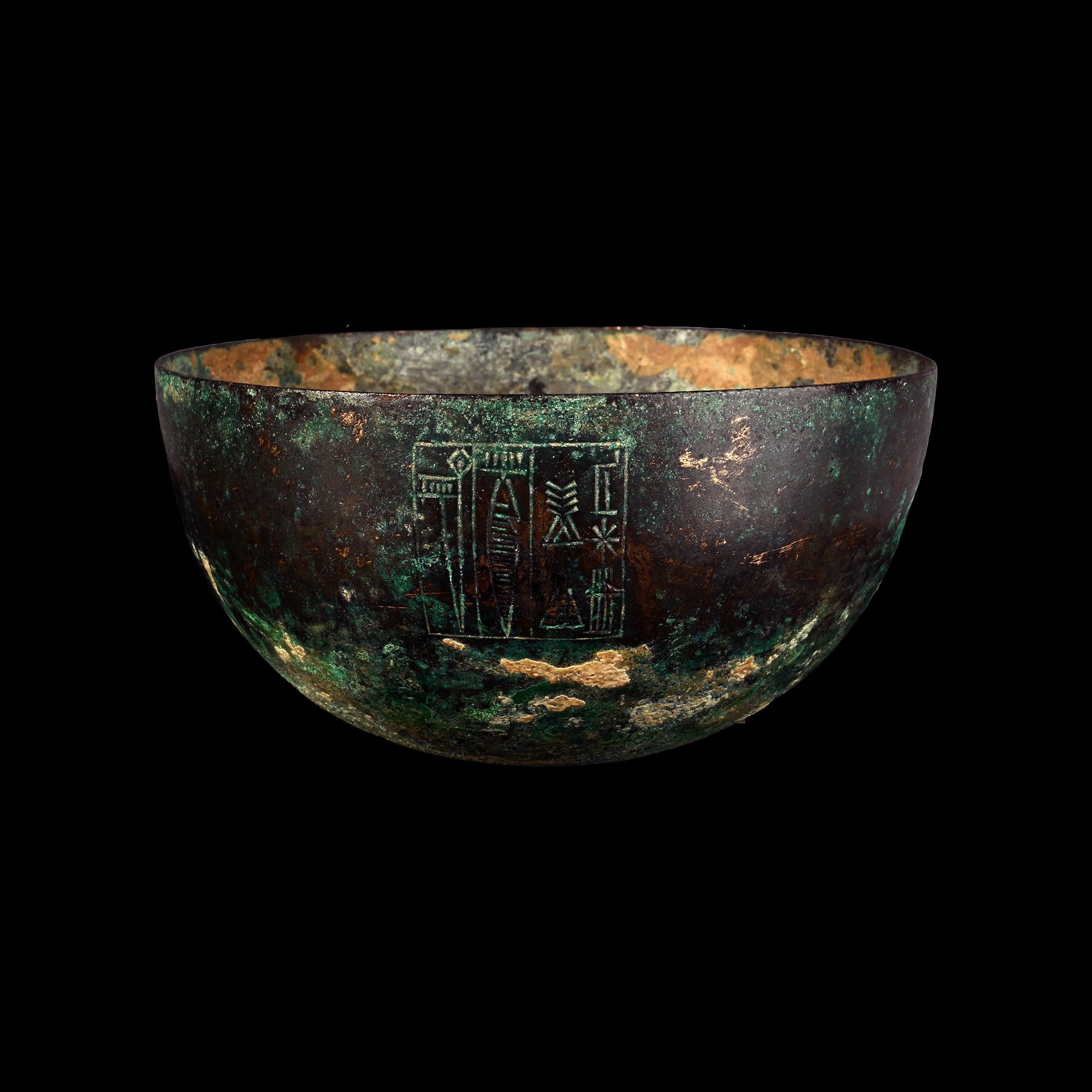
Inscribed metal vessels of the period are very rare, perhaps largely because metal was melted down and reused. Most of the bowls known with Akkadian inscriptions name a king, and one, sold at auction in London on 21 April 1975, is believed to have come from the same ownership as lot 261.
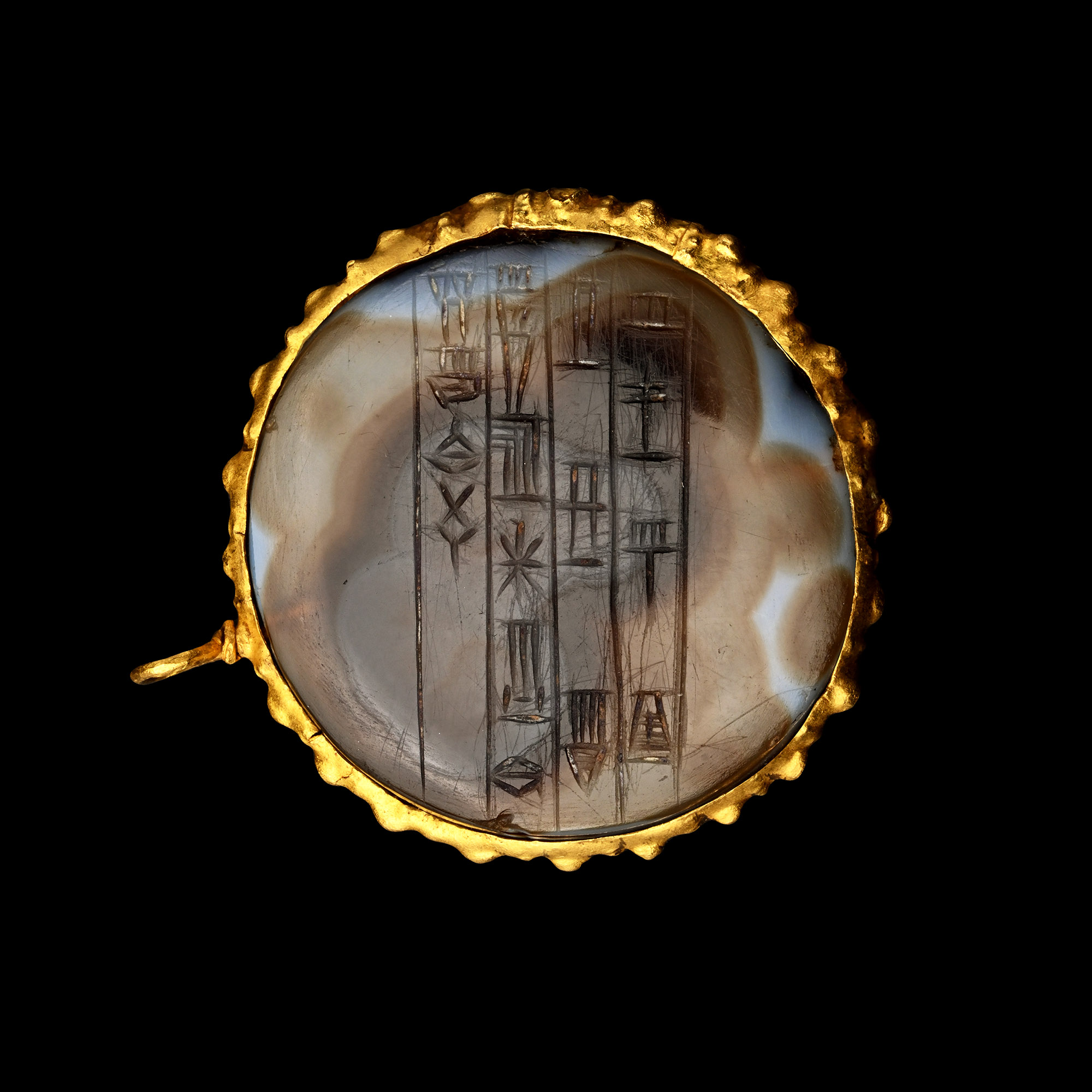
Nearly a thousand years after Manishtushu, the Kassite kings of Babylon were being called "king of the world" on their seals, because they regularly borrowed titles and phrases from the inscriptions of much earlier kings. Lot 241, an agate eye bead, names Kurigalzu II (c. 1332-1308 BC), one of the most powerful of them, as "strong man, King of Babylon, son of Burnaburiaš". "Strong man" is the royal epithet translated "mighty man" in Shulgi's school hymn, seven centuries earlier.
The stone is a polished agate cabochon, 42 mm across, cut so that a dark brown disc sits inside a white ring. It is set in a gold frame with radiating bosses and a loop for hanging, with the inscription in four columns on the back. Inscribed Kassite eye beads are rare, and they are generally understood to have been amulets or offerings to a god. Pliny the Elder still knew the type in the first century AD: "The 'Eye of Baal' has a whitish ground surrounding a dark eye which sends out a golden gleam from its midst. Because of its appearance, the stone is consecrated to the holiest god of the Assyrians."
The oldest tablet in the sale
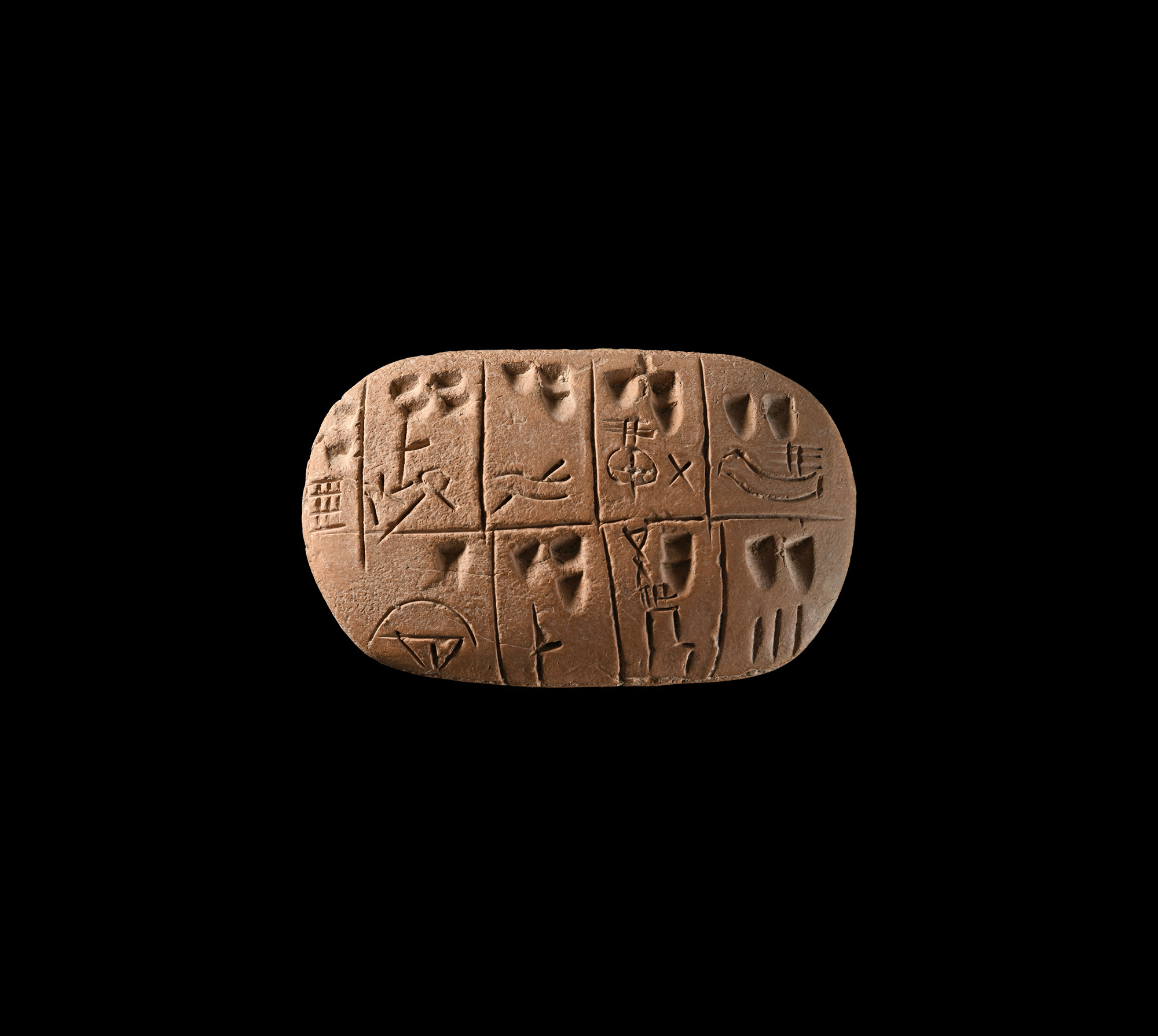
Lot 231 is older than the Nippur schoolroom by more than twelve centuries, a proto-cuneiform tablet of 3200-3000 BC, the Jemdet Nasr period. It is a pillow of clay 63 mm across, its face divided by an incised grid into cases, each holding numerals pressed into the clay with pictographic signs scratched beside them, one of which looks like a boat. About 85 per cent of the tablets of this age are accounts and the rest are lists of words and signs used to train scribes, with no literature, letters or law among them. The tablet belonged to Percy Barnevik in Sweden, then to a private collector in the UK from June 2000, and passed through Sam Fogg in London, and like the letter to Shulgi and the Utu hymn it comes with Lambert's notes.
What is a cuneiform tablet worth?
Most cuneiform texts are receipts, contracts and inventories, and of the 1,150 or so tablets sold at auction with a published price since 2010, half made less than about US$800 at the hammer and one in ten made more than about $5,000. Royal names and literary texts take a piece well past that. A green chalcedony cylinder seal of Kurigalzu II, sold with Lambert's translation of its prayer, made £24,800 at TimeLine in 2017, and the Utu hymn made £6,875 here in February 2020.
Age counts as well, since a Jemdet Nasr pictographic tablet made £20,000 at TimeLine in June 2020 and a proto-cuneiform tablet sold elsewhere for £62,500 in 2019 against an estimate of £20,000-30,000. The eight pieces described here carry estimates from £1,000-1,400 for the contract in its envelope to £60,000-80,000 for Kurigalzu's agate.
TimeLine Auctions
