
Loading, please wait...
LOT 0234
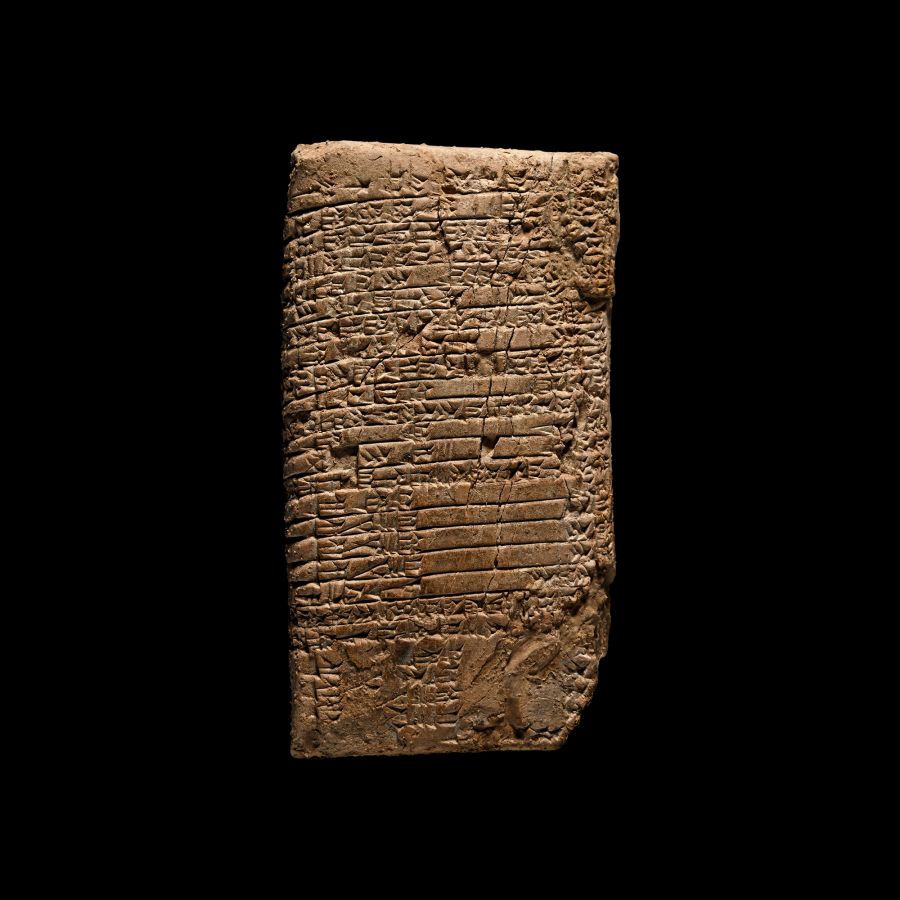
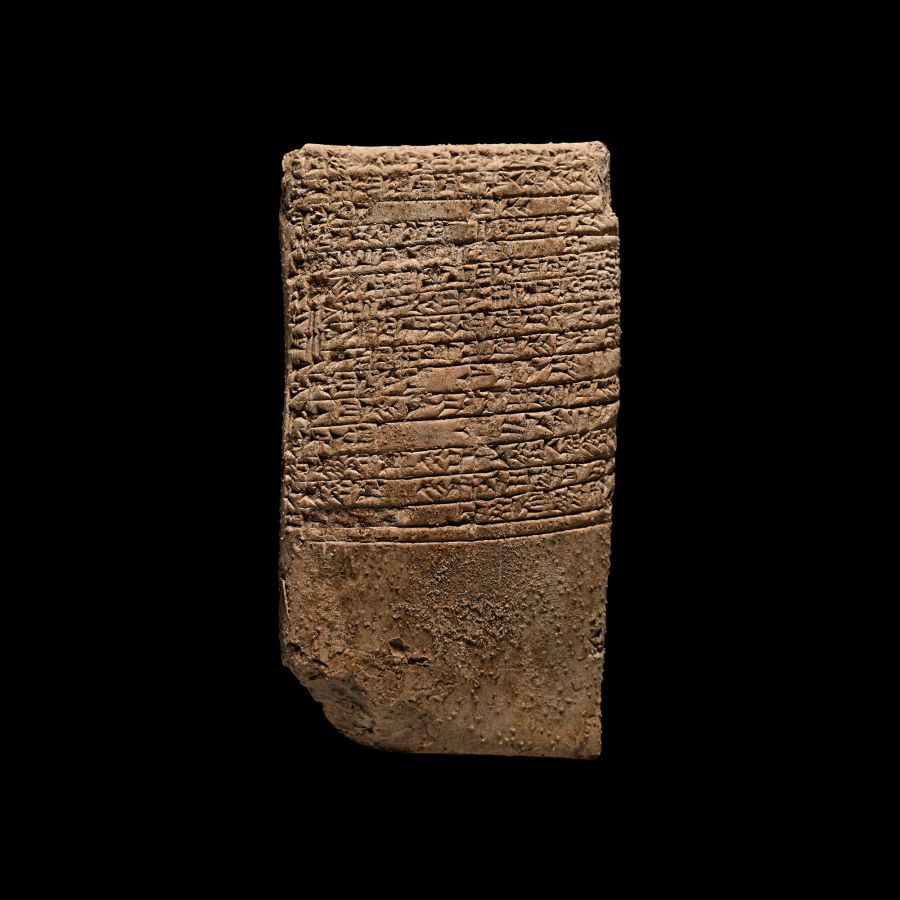
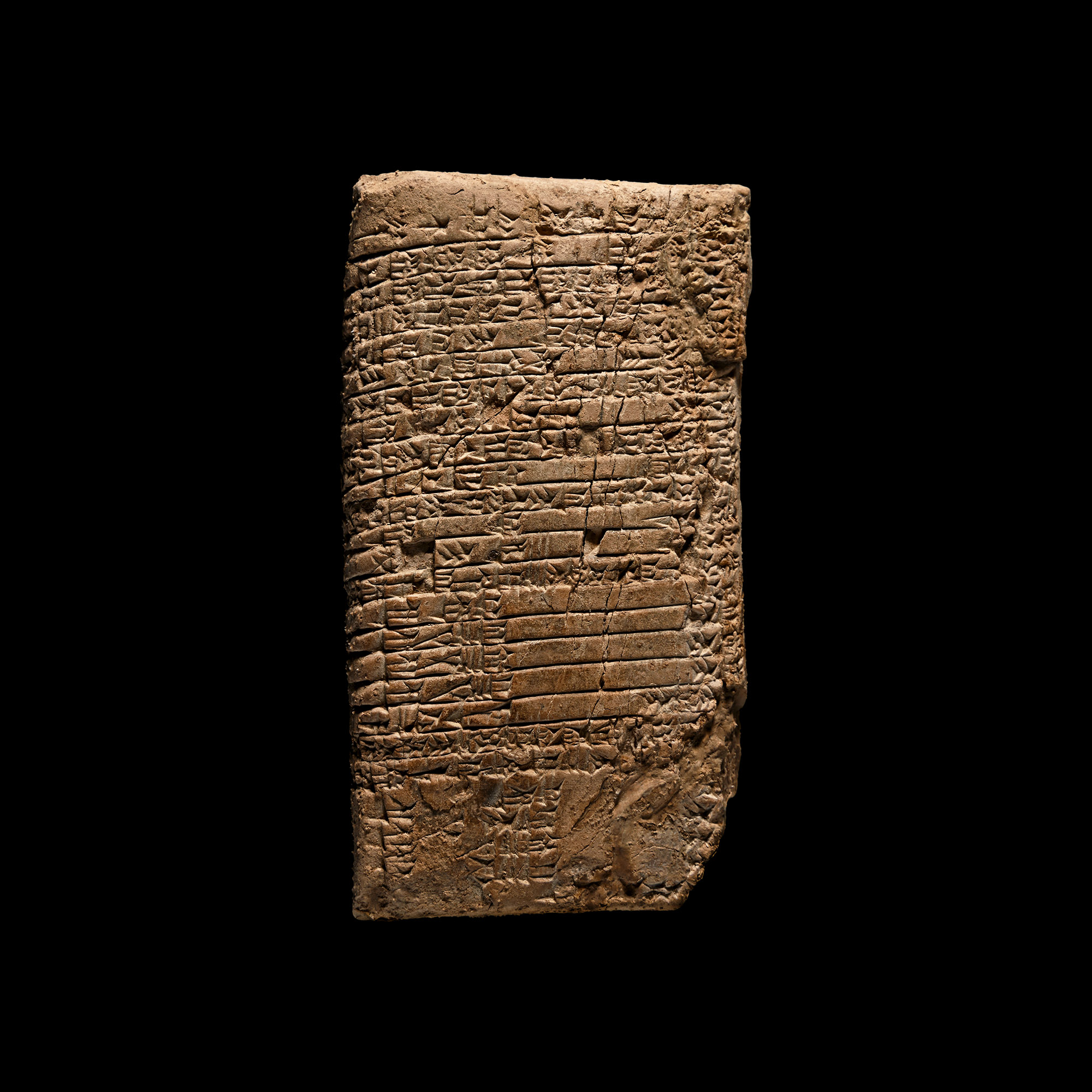
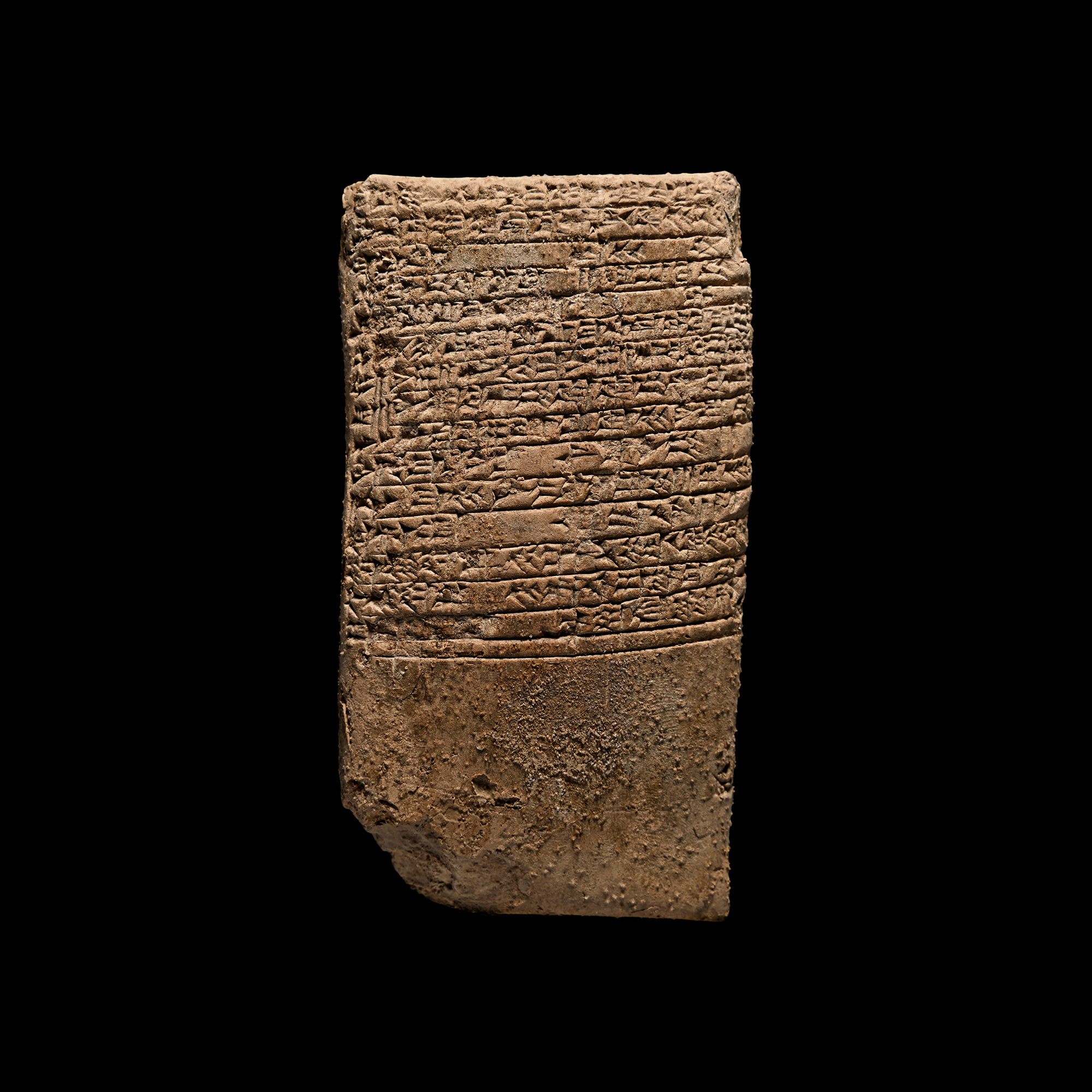
Old Babylonian Cuneiform Tablet with The Dialogue Between Two Women
CIRCA 1900-1700 BC.
5 in. (372 grams, 12.5 cm).
Pillow-shaped ceramic tablet inscribed with 41 lines of a Sumerian cuneiform literary text, comprising a dialogue between two women who insult and abuse each other, and (may) also talk to men about the matter; this tablet is longer than any one of the published pieces of this text and in comparatively good condition; although it does not include a Babylonian translation, part of it overlaps a published copy as an aid to understanding; a provisional partial translation is offered here: 1. "Is my [ ....?] 2. Is my house like her house? 3. Is my spouse like her spouse? 4. Is my mother like her mother? 5. Am I like her? 6. She spread [slander], she called me a prostitute, and made my husband divorce me. 7. ". ... runs around. May my city quarter... you. 8. My lord, what is one man? 9. Is my house like her house? 10. Is my spouse like her spouse? 11. Is my mother like her mother? 12. Am I like her? 13. She spread slander, she called me a prostitute, and made my husband divorce me. 14. Bring on a just lawsuit. 15-16. Who is she? Ninkuzu, daughter of the king. 17. No! Herald, go! 18. Bring me one who can point her out to you while the time is fresh. 19. My lord, bring me….. 20. One who knows her case, one like her. 21. Where are those women? Let them come in! 22. You (sing.), whose name is Ninkuzu, 23. Why (did you slander) the daughter of a man, your equal, (and call her) a prostitute? (Four untranslated lines) 28. She has bought a witness against me. [….] 29. Bring a just law-suit. 30. "If I should bring on a just law-suit for you. 31. I shall write down a divorce fee of 1/3 of a mina of silver as it is. 32. Then I shall increase the divorce fee of 1/3 of a mina of silver."; in a custom-made presentation case replicating an old quarter-bound book with cloth-covered boards.
ProvenanceThe Library of Simon Keynes (1927–2017), great-grandson of Charles Darwin and fourth son of Sir Geoffrey Keynes, with the bulk assembled in the 1970s and 1980s.
Ex Sam Fogg, London, 2019.
Private collection, Europe.
Acquired by the present owner from the above.
Accompanied by a five-page cataloguing report.
This lot has been checked against the Interpol Database of stolen works of art and is accompanied by search certificate no.13426-259927.
Cf. similar tablets in Goetze, A., Old Babylonian omen texts, Yale, 1966, pls.1ff.
FootnotesThe existence of the (source) text has been known for some decades, and ten pieces have been published, all from the Old Babylonian period (c. 1900 - 1600 BC), the period from which this tablet also originates. A few of the ten known tablets are bilingual - that is, the Sumerian is also given in Babylonian translation - which has assisted in the translation of the text by modern scholars.
While a text reconstructed from the ten published pieces and other unpublished tablets has existed for some decades now, no one has so far published it in its entirety or offered a fully convincing translation, because of the difficulties of the text. Sumerian had a woman's dialect, called 'Emesal, 1', and this text often uses Emesal forms, which are more problematic than the ordinary Sumerian dialect. There are also no indications of speaker given in the text - the reader has to deduce when another speaker takes over. Thus there is considerable uncertainty about the punctuation. It is clear that when the whole text is edited properly for all duplicates and a reliable translation can be made, this will be an enlivening commentary on human nature in Babylonia of the early second millennium BC. A beautiful and important piece of Sumerian literature. The sum of 1/3 of a mina of silver - 20 shekels - was a large sum of money at the time.
TimeLine Auctions follows a vetting process to ensure the authenticity and legality of all items, reinforcing our commitment to integrity and responsible trading. Each antiquity, antique, and coin lot undergoes thorough examination by a vetting committee of at least ten external specialists, professional trade association members, scientists, and archaeologists: Our Vetting Process
AUCTIONS:
TimeLine is a leading auction house specialising in antiquities, ancient art, collectables, natural history, coins, medals, and books. Our auctions offer museums, collectors, historians, and enthusiasts the opportunity to acquire unique and historically significant pieces.
LOT 0234
Old Babylonian Cuneiform Tablet with The Dialogue Between Two Women
Estimate £3,000 - 4,000€3,480 - 4,640 (for guidance only)$4,050 - 5,400 (for guidance only)
Opening Bid
£1,500 (EUR 1,740; USD 2,025) +BP*
-
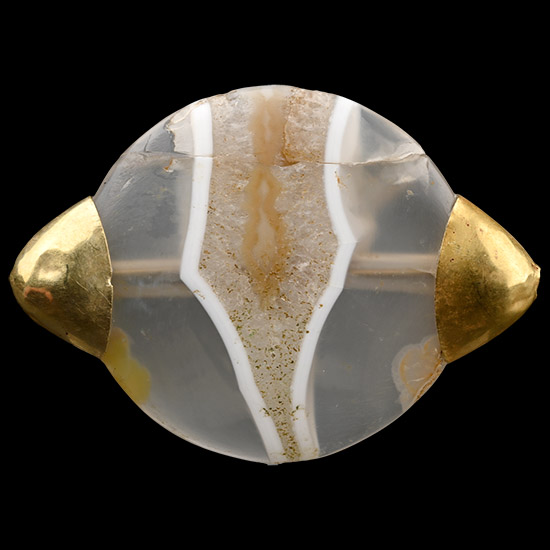
Exceptional Western Asiatic Banded Agate Bead with Gold Caps
2nd-1st millennium B.C.Estimate: £1,800 - 2,400 (‡+bp*)
Opening Bid: £1,000
Discoid in plan and pierced transversely with D-shaped gold caps at each end; mounted on a custom-made stand. 88 grams total, 84 mm wide including stand
Private collection, acquired on the UK art market, 2000. Private collection, Switzerland. This lot has been checked against the Interpol Database of stolen works of art and is accompanied by a search certificate number no.12877-241681.
The Sumerians used agate for beads and even for making ceremonial axe-heads. The engraving of agate, especially to produce cameos and intaglios, is an art which was principally cultivated by the Greeks and the Romans. In addition to the artistic excellence of the engravings, many of the early works show great skill in using the different colourings of the agate for decorating the figures. -
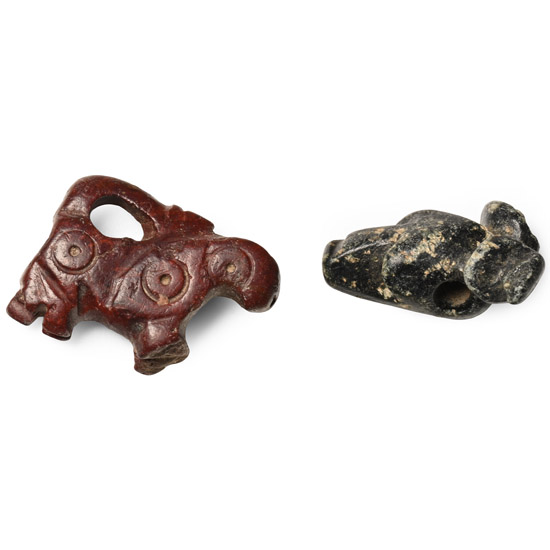
Sumerian Stone Animal Amulet Group
Circa 2500-2000 B.C.Estimate: £50 - 70 (+bp*)
Opening Bid: £5
Comprising a perching bird and a lion with gaping mouth. 5 grams total, 19-20 mm
From the private collection of a European gentleman (1942-2024), formed since the 1970s. -
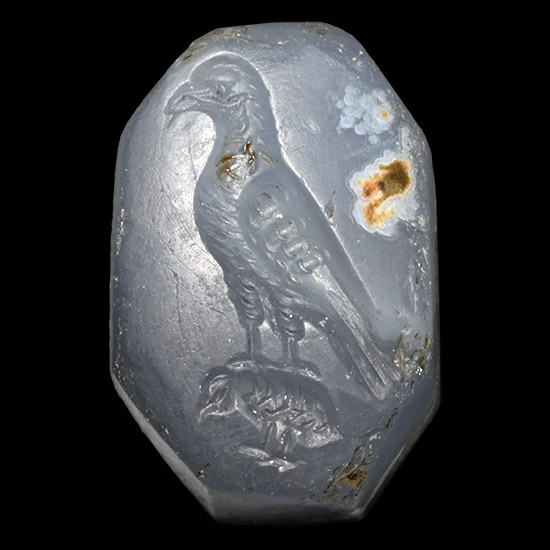
Neo-Babylonian Chalcedony Stamp Seal with Eagle
Circa 7th-6th century B.C.Estimate: £120 - 170 (+bp*)
Opening Bid: £5
Octagonal in plan with tongue-shaped body, incuse perching eagle motif. 5.2 grams, 19 mm
From the private collection of a European gentleman (1942-2024), formed since the 1970s.
