
Loading, please wait...
_900x900.jpg "WWII 'RAF' Bomber (Mosquito) Helmet, Map and Whistle Group")
_200x200.jpg "WWII 'RAF' Bomber (Mosquito) Helmet, Map and Whistle Group")
.jpg "WWII 'RAF' Bomber (Mosquito) Helmet, Map and Whistle Group")
LOT 0287
WWII 'RAF' Bomber (Mosquito) Helmet, Map and Whistle Group
1941 A.D. OR LATER
12 1/4 in. (6.1 kg, 31 cm).
Comprising: a type C leather open face helmet wired for type B communication, oxygen mask with hose and alloy-framed flying goggles with padded leather and rubber band, the frames stamped 'Stadium Made in England Patent Reg Design'; the helmet with webbing chin strap, buckles and stud fasteners, chamois leather lining bearing ink stamp and handwritten 'Adams Progressive' 'No.75-78', plug holder with paper label, tubular oxygen mask inlet marked 'MLD 18' 'MC253D', microphone plug and hose with brass connector stamped 'D/156'; together with an RAF flight map and an RAF 'ditching' whistle of classic snail type with Air Ministry's crown markings and reference numbers '23/230' and '293/14/L1795'; the helmet mounted on a wooden 'mannequin' head. [3]
ProvenanceAcquired from J C Militaria and Historic Flying Clothing Company.
The Kusmirek Collection, UK.
Accompanied by copies of listings for each item.
This type of helmet and system was introduced in 1941 A.D.
CONDITIONTimeLine Auctions follows a vetting process to ensure the authenticity and legality of all items, reinforcing our commitment to integrity and responsible trading. Each antiquity, antique, and coin lot undergoes thorough examination by a vetting committee of at least ten external specialists, professional trade association members, scientists, and archaeologists: Our Vetting Process
AUCTIONS:
TimeLine is a leading auction house specialising in antiquities, ancient art, collectables, natural history, coins, medals, and books. Our auctions offer museums, collectors, historians, and enthusiasts the opportunity to acquire unique and historically significant pieces.
LOT 0287
WWII 'RAF' Bomber (Mosquito) Helmet, Map and Whistle Group
Sold for (Inc. bp): £1,170
-
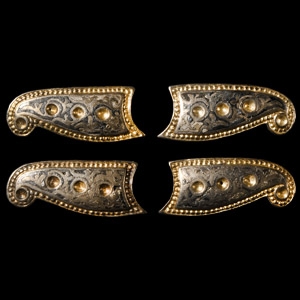
Mongol Silver Belt Mount Group
13th century A.D.Estimate: £200 - 300 (+bp*)
Opening Bid: £89
Each with a broader scooped edge tapering to a volute flourish, pellets adorning the perimeter, three medial circular dimples, fourth dimple to the scrolled end, against a field of foliate scrolls and niello fill; each with a set of mounting lugs to the reverse. 25.7 grams total, 40-41 mm
Fine condition.
Acquired in the 1980s-1990s. Ex an important central London gallery, London W1.
Similar plaques have been found in the burial graves of Mongol commanders and their wives, probably once part of a waist belt from which the sabre and other weapons were hanging. They were found together with arms, unique elements of the costume of fabric and leather, and splendid jewellery of gold and silver. -
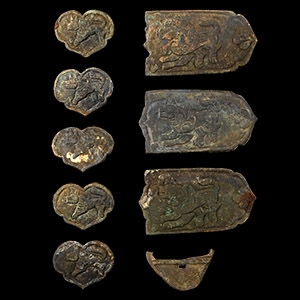
Volga Bulgar Bronze Lion Belt Mount Group
10th-12th century A.D.Sold for (Inc. bp): £195
Comprising three mounts with bounding lion motifs, five heart-shaped mounts also showing leaping lions and a plain semi-circular mount; all with mounting lugs to reverse. 67 grams total, 27-52 mm
From the collection of a North American gentleman, formed in the 1990s. -
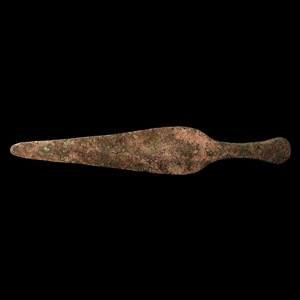
Western Asiatic Bronze Dagger with Integral Hilt
3rd-2nd millennium B.C.Estimate: £100 - 140 (+bp*)
Opening Bid: £50
Composed of a leaf-shaped blade, round-section grip with wide flat tang and lobe pommel. 740 grams, 40 cm
Fine condition.
Abelita family collection, 1980-2015.
