
Auction Highlights
-
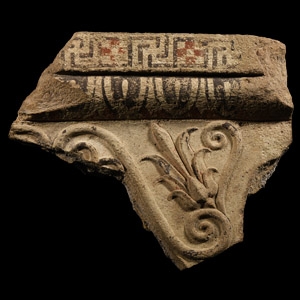
Etruscan Painted Terracotta Architectural Cornice
Sold for (Inc. bp): £3,900
A fragment of amorphous form, decorated in relief with scrolling tendrils and anthemion, painted egg-and-dart ornament above, surmounted by moulded bands and a frieze of meander and chequerboard panels; remains of red and black painted pigment. -
.jpg)
Roman Bronze Eros Cradling Goose Applique
Sold for (Inc. bp): £1,950
Formed as the bust of Eros looking upwards, stub wings to his shoulders, holding a goose to his chest; conical socket above each wing; eyes with silver inserts; old collector's label '1994 51.75' to the reverse; mounted on a custom-made stand; likely a socket base. -
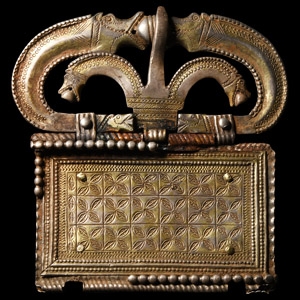
Roman Silver-Gilt Military Buckle for an Elite Imperial Officer
Sold for (Inc. bp): £7,800
Comprising a rectangular plate, richly decorated with embossed laurel leaves in a grid, framed with raised bosses, the buckle loop comprising opposing dragons with open mouths, holding a spherical tongue-rest, another pair of smaller dragon heads to base, the tongue with a smaller pair of punch-decorated dragon heads. -
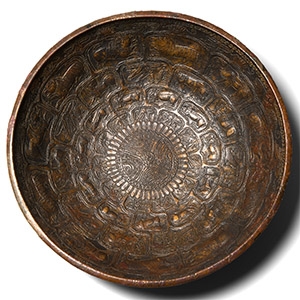
South Arabian Bronze Bowl with Mythical Animals
Sold for (Inc. bp): £5,850
Hemispherical in form, repoussé interior displaying graduated concentric registers of stylised and mythical animals within tessellating cartouches; a low relief mesomphalos decorated with rosette at centre; geometric ornament around the rim. -
.jpg)
Assyrian Bronze Relief Fragment
Sold for (Inc. bp): £16,900
Displaying a corrugated rim above and below; two advancing soldiers, each striding forwards over the headless body of a dead enemy, carrying a severed head in each hand; the soldiers shown bearded and each wearing a pointed and segmented helmet with a recess to accommodate the ears, a cuirass and thigh-length tunic, with a bow over one shoulder and a sword slung from a waist belt; mounted on a custom-made display stand. -
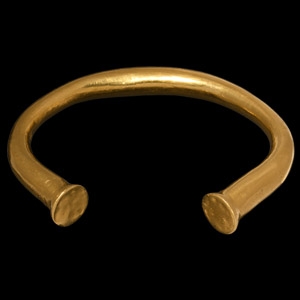
Bronze Age Gold Bracelet with Torc-Shaped Terminals
Sold for (Inc. bp): £11,440
Of penannular form with expanded sections at the centre and to both shoulders. -
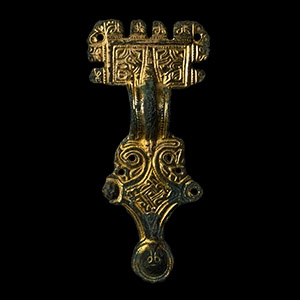
'The Oving' Anglo-Saxon Gilt Bronze Great Square-Headed Brooch
Sold for (Inc. bp): £4,160
Comprising a rectangular headplate with two panels of chip-carved Style I ornament, flanking a beast-head with triangular muzzle and two pellet eyes, raised three-sided frame and outer band of pellets above beast-heads with lentoid eyes; the shallow bow with raised median rib, flanges to the edges and punched pellet detailing; footplate with beast-head between curved pellet lines, pierced horse-head lappets, lozengiform central panel with knot of Style I limbs; two lateral discs, one pierced to accept a stud and the other with a domed stud in place; the finial a disc with human mask inverted; pin-lug and part of catch to the reverse. -
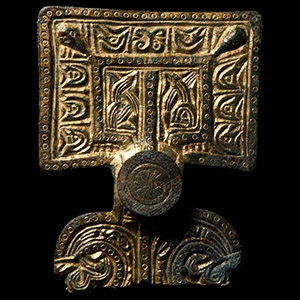
Anglo-Saxon Gilt Bronze Great Square-Headed Brooch
Sold for (Inc. bp): £3,900
Displaying chased panels populated with Style I zoomorphs and geometric forms, borders of annulets, raised masks to the upper corners of the headplate; applied discoid boss to bow decorated with a rosette, addorsed beast heads below; extensive remains of gilding; pin lug and catchplate to reverse and remains of ancient repair, lower part absent. -
.jpg)
'The Tenby' Hiberno-Norse Viking Penannular Brooch
Sold for (Inc. bp): £3,640
Comprising a round-section crescent with flared ends terminating in two curved spatulate flat panels, each with a ropework border surrounding a two-band knotwork motif; cleaned and conserved. -
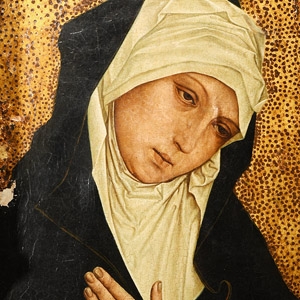
Medieval Oil Painting of Sorrowful Virgin
Sold for (Inc. bp): £9,100
The weeping Virgin with her head bowed to the left and hands raised to her chest on a dotted gilt background, an expression of pain on her delicately formed face; wearing a white veil and a black long-sleeved robe, the veil arranged as a headdress and covering her hair; on wood and mounted in a later carved wooden architectural frame. -
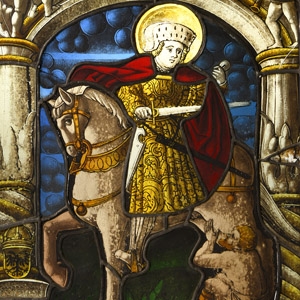
Medieval Stained Glass Panel With Saint Martin on Horseback
Sold for (Inc. bp): £2,080
Shown beneath an arcade, offering his cloak on the end of his sword to the beggar at his feet; polychrome detailing; repaired with lead cames and held in a wooden frame. -
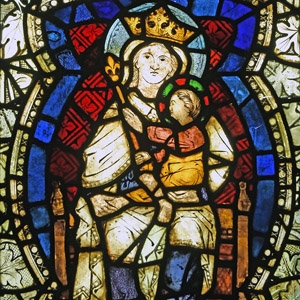
Medieval Stained Glass Panel with The Virgin and Child
Sold for (Inc. bp): £2,860
Composed from irregular painted panels bearing mainly foliage designs and figural elements; Mary crowned and enthroned with infant Jesus on her knee, in a lobed vesica-shaped panel held with lead cames; mounted in a wooden frame with modern replacements. -
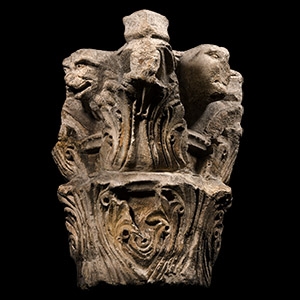
Medieval Stone Column Capital with Lion and Human Face
Sold for (Inc. bp): £1,950
Carved in the half-round with a frieze composed of interlaced foliage with two rows of acanthus leaves and foliage scrolls, framing a lion's head on one side and a human head on the other, remains of lion's mane to the third; drilled holes to the raised surfaces and sockets for the insertion of decorative stones. -
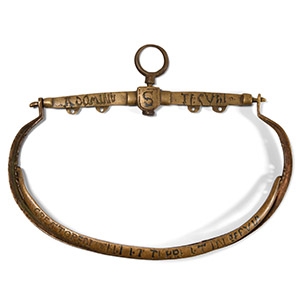
'The Kirkleavington' Medieval Bronze Inscribed Purse Frame
Sold for (Inc. bp): £3,640
The bar with central D-shaped block pierced vertically by a stud surmounted by the suspension loop, with four pierced flanges to the underside; the frame in two sections, the larger a U-shaped rod with pivot for the bar, the smaller pivoting within the inner face, both pierced on the inner face; the block inscribed to one face with capital S and to the other with intersecting Vs; the bar inscribed to one face in capitals 'A DOMINI TECVM' and to the other in coarsely incised capitals 'AVEMARIA G[R]ACIAPLE[NA]'; the smaller rod inscribed in capitals 'CREATOREN CELI ET TERRE ET IN [IES]VN'; the larger inscribed with a band of scrolled decoration and the text in Lombardic capitals 'SOLI DEO HONOR ET GLORIA'; the accompanying letter discusses the texts (1) Ave Maria G[r]acia ple[n]a Dominus Tecum 'Hail Mary full of grace, the Lord [is] with thee'; (2) Soli Deo Honor et Gloria 'Honour and glory to God alone'; (3) Creatorem celi et terrae et inferum 'creator of heaven and earth and in Jesus'. The intersecting Vs may form a monogram for A[ve] M[aria]; the 1847 letter describes the findspot as 'found at Kirkleavington near Yarm in the sill of a brook' in the North Riding of Yorkshire. -
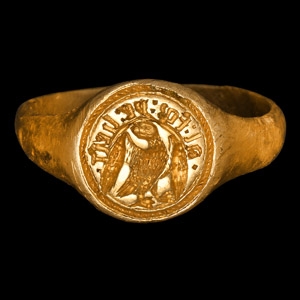
'The Roxwell' Medieval Gold Signet Ring of 'King's Serjeant William Skrene'
Sold for (Inc. bp): £23,400
Gold hoop and discoid bezel with incuse ropework border; incuse image of a bird of prey perching with wings spread and head turned; blackletter incuse and reversed inscription in an arc above the bird's head and pinions '·al : for : ye : best ·' (all for the best); repair to hoop. -
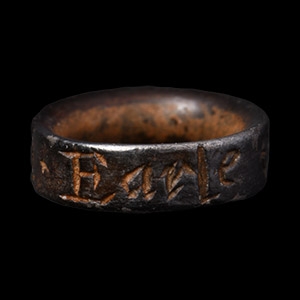
Medieval Silver 'Edmund Plantagenet, Earl of Rutland' Royal Hawking Vervel
Sold for (Inc. bp): £9,750
Or a leg ring inscribed '+Earle of Rutland' in derivative black letter script, for a female merlin or sparrow hawk (due to the youth of Edmund Plantagenet who died aged 17); the ring with a convex interior face. -
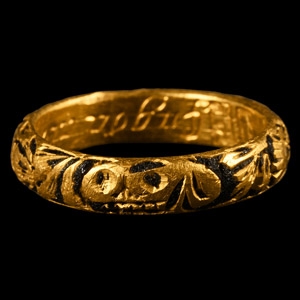
Post Medieval Gold Memento Mori Ring with Inscribed Posy 'In God Alone Wee Two Are One'
Sold for (Inc. bp): £4,680
Displaying large flower heads, foliage and a skull to the outer face, enhanced with black enamelling; interior inscribed in a cursive script 'In god alone wee two are one', together with possible maker's stamps 'D' and 'F' in two rectangular cartouches. -
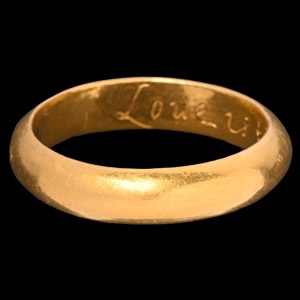
Heavy Post Medieval Gold 'Love Is The Bond Of Pease' Posy Ring
Sold for (Inc. bp): £2,860
Composed of a gently carinated hoop, the interior inscribed in cursive script 'Love is the bond of pease'. -
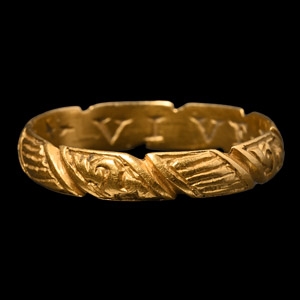
Post Medieval Gold 'Live Life to the Full' Decorated Posy Ring
Sold for (Inc. bp): £3,380
Composed of a decoratively notched hoop divided into chased rhomboidal panels displaying foliate tendrils and horizontal hatching alternately; the interior inscribed in Roman capitals with the Latin phrase: 'x x x x VIVE x VT x VIVAS'. -
![English Milled Coins - George VI - 1937 - Cased RM Proof Coronation Gold Set [4]](https://timelineauctions.com/upload/images/items/small/203351-s(2).jpg)
English Milled Coins - George VI - 1937 - Cased RM Proof Coronation Gold Set [4]
Sold for (Inc. bp): £11,700
Set comprising gold five pounds, two pounds, sovereign and half sovereign. Obvs: profile bust with GEORGIVS VI D G BR OMN REX F D IND IMP legends. Revs: St George and dragon; date in exergue; with original Royal Mint hinged red leatherette case of issue.
-
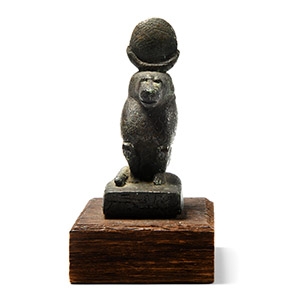
Egyptian Bronze Statuette of Thoth with Hieroglyphs to the Base
Late Period, 664-525 B.C.Sold for (Inc. bp): £2,210
In baboon form, modelled in the round wearing a lunar disc and seated on a semi-circular base with attachment lug; accompanied by a wooden display base; traces of hieroglyphic inscription around the edge of the base; repaired. 157 grams total, 10.1 cm high including stand
Gifted by Herbert Parsons (1870-1940) to his grandson, James Gibson (1926-2013). Inherited by the vendor and her brother, from their grandfather James Gibson. This lot has been checked against the Interpol Database of stolen works of art and is accompanied by search certificate no.200862.
God of the moon, magic and writing, Thoth could take the form of a baboon or an ibis. In baboon form, he was associated with the animals who rise early in the day, and was thus linked to the sun god, Ra. The dedicatory hieroglyphic inscription on the base of this example includes the di and ankh signs meaning 'give life'. -
.jpg)
Egyptian Bronze Amun-Min-Kamutef Statuette
Late Period, 664-332 B.C.Sold for (Inc. bp): £1,755
Modelled in the round as a votive ithyphallic figure wearing a double-plumed crown with a sun disc, holding a flail in his outstretched right hand and his erect phallus in the left; mounted on a custom-made display base. 538 grams total, 21 cm high including stand
Acquired on the London art market. Ex 'K' collection, 1990-2020s.
Amun-Min-Kamutef was a syncretic deity combining the attributes of Amun, the supreme god of the Egyptian pantheon, and Min who represents sexual procreativity. The iconography of Amun's ithyphallic form Kamutef is essentially that of Min, and serves to emphasise the sexual prowess of the god. Kamutef means 'bull of his mother' and appears to refer both to Amun's sky-goddess mother in her cow form and to the bull's sexual prowess and strength. -
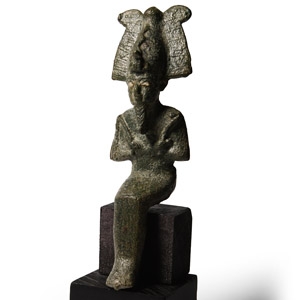
Egyptian Bronze Seated Osiris with Inlaid Eyes
Circa 26th-30th Dynasty, 664-342 B.C.Sold for (Inc. bp): £1,755
Modelled mummiform and seated with arms crossed at chest, holding crook and flail, wearing a false beard and plumed Atef crown with uraeus, cream-coloured inlay to eyes; mounted on a custom-made display base. 160 grams total, 15.3 cm including stand
large chip to outer surface layer to reverse.
Ex old English collection. Spanish collection, 1980s. Accompanied by a previous dealer's catalogue and price card (£2,500.00).
Osiris was the foremost of ancient Egyptian funerary deities and lord of the underworld. Many statuettes of the god were offered in temples dedicated in his name, but have also been discovered in other contexts including animal necropoleis and temples dedicated to other gods. -
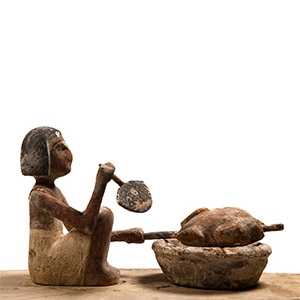
Egyptian Wooden Fowl-Roasting Scene
11th-12th Dynasty, 2010-1960 B.C.Sold for (Inc. bp): £5,200
The scene comprising: a thick rectangular base with gessoed surface; squatting male figure in a white kilt with modelled hair and painted facial details, the hands drilled to accept the handles of tools; a wooden spit with impaled carcass of a roasting fowl in the left hand; a small fan in the right hand; a squat fire-bowl with rounded rim and recess to the upper edge. 980 grams total, 31 cm wide
Acquired in the 1960s. From the collection of the late Egyptologist Surgeon Commander PHK Gray RN. From a Surrey, UK, collection. Accompanied by a scholarly note from Egyptologist Paul Whelan. This lot has been checked against the Interpol Database of stolen works of art and is accompanied by search certificate number no.202932.
Crafted for the tomb to accompany the deceased and provide for him in the afterlife. -
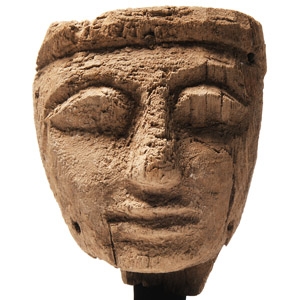
Egyptian Wooden Mask
Late Dynastic Period, after 500 B.C.Sold for (Inc. bp): £1,300
Wooden face from a coffin lid, D-shaped in plan with large almond-shaped eyes, holes for mounting pegs; accompanied by the original dealer's ticket from Phocion J. Tano of Cairo with handwritten description and signature 'Small masque of wood of the end of the Saïtic Period some four hundred years B.C. It is found close to the pyramid of Meïdun and it is genuine guaranteed and nothing ticked. It is as is found. Cairo the 14/4/65.'; mounted on a custom-made stand. 357 grams total, 20.8 cm high including stand
Ex Phocion J. Tano, Cairo, Egypt, 1965. Phocion Jean Tano (1898-1972) belonged to a family dynasty who founded and ran one of the oldest antiquities shops in Egypt, located in front of the old Shepheard's Hotel in Cairo. From a private UK family collection. Accompanied by an original handwritten and signed card receipt dated 14 April 1965 from Phocion J. Tano Antiquities Gallery, Cairo, Egypt. -
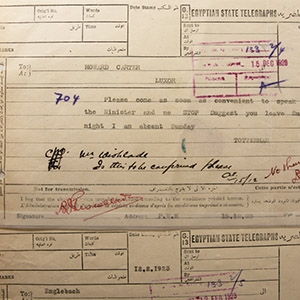
Collection of Egyptology Letters, Documents and Photographs
Early 20th century A.D.Sold for (Inc. bp): £845
Comprising: original typescript (some carbon copies) and manuscript documents in Arabic, French and English relating to Egyptian archaeological sites and matters, including requests for permits to visit sites, together with several telegraph forms including a permission for a visit to the tomb of Tutankhamen on 13 February 1923 and requests for similar permission; together with seven monochrome photographic prints depicting Egyptian sites. 245 grams total, 9.5-30 cm
Ex Hans Nilson collection.
The names of numerous luminaries of Egyptology of the late 19th and early 20th century found in these documents, besides their significant contributions to our knowledge of ancient Egypt, also held important administrative roles in Egypt's Antiquities Service and the Cairo Museum. They include: Victor Loret (1859-1946), who served as Director General of the Egyptian Antiquities Service from 1897-1899; Émile Brugsch (1842-1930) served as Keeper in the Cairo Museum from 1883-1914; Reginald Engelbach (1888-1946) served as Chief Inspector of Upper Egypt for the Antiquities Service in 1920 and Keeper in the Cairo Museum from 1931-1941; Gustave Lefebvre (1879-1957) served as Inspector of Middle Egypt for the Antiquities Service from 1905-1914 and Keeper in the Cairo Museum from 1926-1928; James Quibell (1867-1935) served as Inspector of the Delta and Middle Egypt for the Antiquities Service from 1899-1904, Luxor 1904-1905, and Saqqara also in 1905. He was Keeper in the Cairo Museum from 1914-1923 and Secretary-General of the Antiquities Department from 1923-1925; Pierre Lacau (1873-1963) served as Director of the Antiquities Service from 1914-1936. When the tomb of Tutankhamun was discovered in 1922, Lacau ensured that its entire contents were secured for the Cairo Museum (much to the chagrin of Howard Carter and the Earl of Carnarvon); Howard Carter (1874-1939), although famous for discovering the tomb of Tutankhamun in 1922, earlier served as Chief Inspector of Antiquities of Upper Egypt from 1899-1905. The name most frequently occurring in the documents is that of Paul Tottenham who served as Advisor to the Ministry of Public Works in Egypt, including a telegram he sent to Howard Carter on 15th February 1923 requesting that he attend a meeting with the Minister (of Public Works), presumably on matters concerning the tomb of Tutankhamun. -
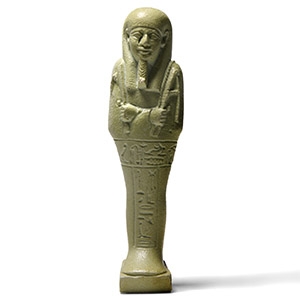
Egyptian Glazed Composition Shabti for Ka-Nefer
30th Dynasty, 380-343 B.C.Sold for (Inc. bp): £975
Modelled mummiform, hands crossed in front of chest holding pick and hoe, seed bag over shoulder, wearing tripartite wig and false beard, T-shaped arrangement of hieroglyphic inscription to the midriff and lower body; plinth base and plain back pillar to reverse. 78 grams, 12.2 cm high
Private collection, New York, USA, early 1980s.
The inscription informs us that Ka-nefer was a wener- priest and scribe of Ptah. His mother's name was Isit-reshuty. He was buried at Saqqara. -
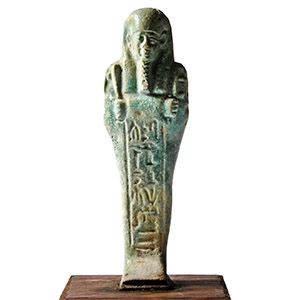
Egyptian Green Glazed Hieroglyphic Shabti
Late Period, 664-323 B.C.Sold for (Inc. bp): £1,170
Modelled mummiform with arms crossed over the chest, holding pick and hoe, a column of hieroglyphs with owner and mother's names running vertically down the front of the body, standing on a plinth with blank pillar to reverse; mounted on a wooden display base. 123 grams total, 13 cm high including stand
Gifted by Herbert Parsons (1870-1940) to his grandson, James Gibson (1926-2013). Inherited by the vendor and her brother, from their grandfather James Gibson.
The owner of this shabti (name unclear) was a Hem-Ka priest of Osiris. -
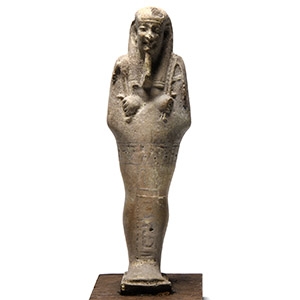
Large Egyptian Glazed Hieroglyphic Shabti
Late Period, 30th Dynasty, 380-343 B.C.Sold for (Inc. bp): £845
Modelled mummiform, arms crossed over the chest holding crook and flail, with a blank pillar to reverse; hieroglyphs to the front of the body; remains of glaze; mounted on a wooden display base; repaired. 191 grams total, 17 cm high including stand
Gifted by Herbert Parsons (1870-1940) to his grandson, James Gibson (1926-2013). Inherited by the vendor and her brother, from their grandfather James Gibson. -
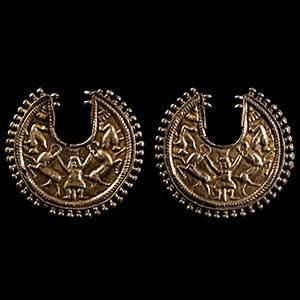
Egypto-Persian Silver-Gilt Earring Pair with Bes Holding Two Ibexes
Circa 530-330 B.C.Sold for (Inc. bp): £2,340
Each with bifacial repoussé decoration depicting the Egyptian god Bes controlling two ibexes, above them two geese or storks facing stylised lotus flowers, projecting knops to the perimeter, four loops to the inner edge. 26.73 grams total, 4.7 cm each
with Riyahi Gallery, London, prior to 1996. Private collection, Switzerland, acquired from the above, 1 July 1996. Acquired from the above, 23 December 2010. Accompanied by a copy of an Art Loss Register certificate, no 5068.C.V. -
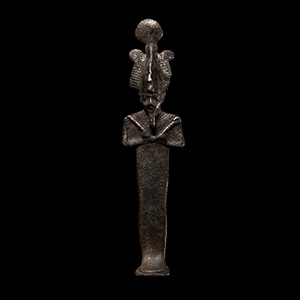
Egyptian Silver Osiris Amulet
Late New Kingdom, circa 1000 B.C.Sold for (Inc. bp): £2,210
Suspension loop to the reverse; Osiris standing wearing the Atef crown, arms folded across the chest holding the crook and flail, regalia of kingship. 8.7 grams, 64 mm
From an early 20th century collection, Home Counties, UK, 1930-1940s. -
.jpg)
Large Egyptian Bronze Statue of Khonsu
Late Period, 26th Dynasty, 664-525 B.C.Sold for (Inc. bp): £33,800
Standing in advancing pose on a rectangular base; the god modelled with a disk representing the full-moon surmounting a crescent new moon atop his head and fronted by a uraeus, the falcon-head sports a finely striated tripartite wig and with beaded silver wire frames to the (once inlaid) eyes; wearing a broad wesekh collar; the left arm bent and fist drilled to grip a staff, right arm straight to the side with similar drilled fist; pleated shendyt kilt and belt to the hips; mounted on a tiered socle base. 896 grams total, 27 cm including stand
Very fine condition.
Smith family collection, Cambridge, UK since 1949. Private UK collection since 1978. Accompanied by a scholarly note by Egyptologist Paul Whelan. This lot has been checked against the Interpol Database of stolen works of art and is accompanied by search certificate number no.11033-183985.
The moon god Khonsu (whose name means 'wanderer', referring to the passage of the moon across the sky) is known as a blood-thirsty sky-deity in the Pyramid Texts. In New Kingdom Thebes, however, he was regarded as a far more benevolent deity, being the child of Amun and Mut, and provided with his own temple at Karnak. There, he was considered to control destiny. Khonsu can appear in human form with a side-lock of youth, wearing an enveloping garment, and holding royal regalia, and also as a falcon-headed man with the full moon and crescent new moon headdress, as with this fine example. In his falcon-headed form he frequently holds an ankh symbol and a was-sceptre, for which the hands of this piece were drilled to accept the god's well-known attributes.
