
Loading, please wait...
LOT 1198
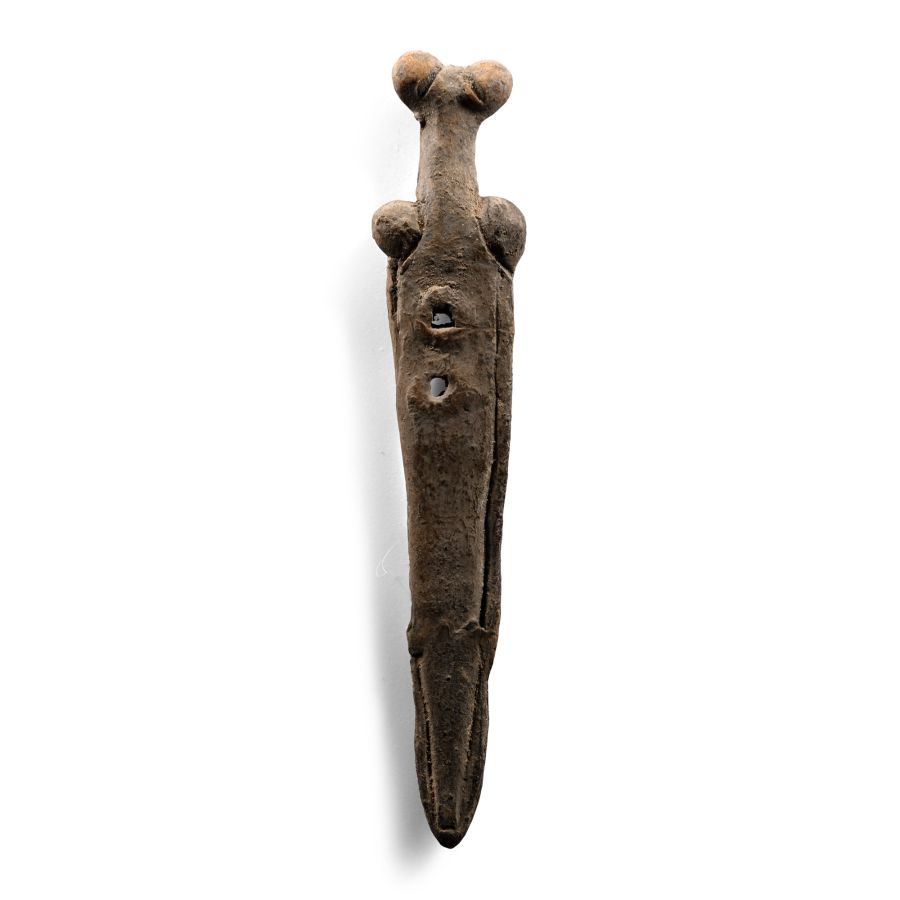
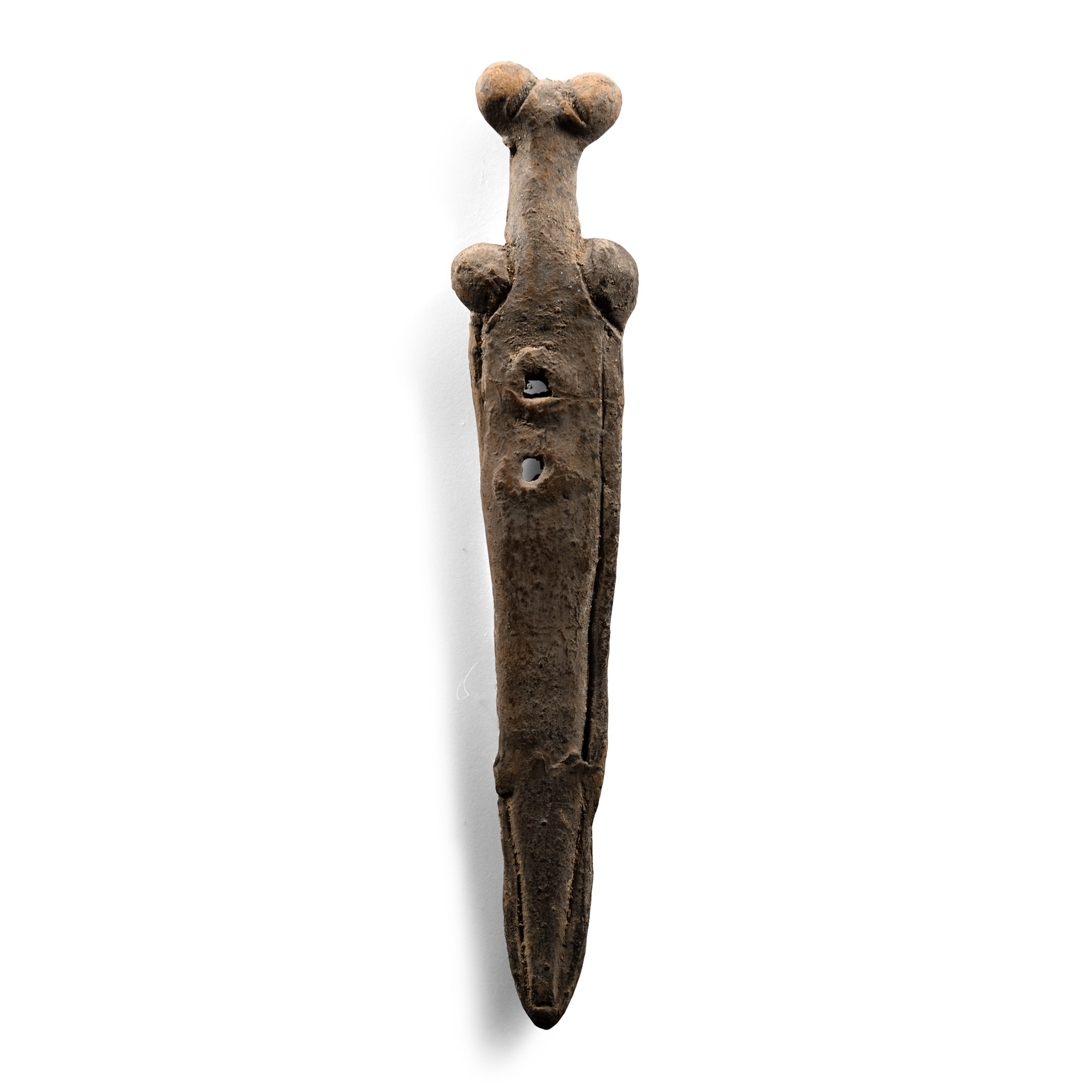
Western Asiatic Votive Terracotta Dagger
1ST CENTURY B.C.
3 3/8 in. (5.83 grams, 88 mm).
Model dagger with two-lobed pommel and similar guard, applied bands to the scabbard, two attachment points.
ProvenanceJapanese private collection, assembled in the 1990s.
Acquired from the above in 2010.
European private collection.
TimeLine Auctions follows a vetting process to ensure the authenticity and legality of all items, reinforcing our commitment to integrity and responsible trading. Each antiquity, antique, and coin lot undergoes thorough examination by a vetting committee of at least ten external specialists, professional trade association members, scientists, and archaeologists: Our Vetting Process
AUCTIONS:
TimeLine is a leading auction house specialising in antiquities, ancient art, collectables, natural history, coins, medals, and books. Our auctions offer museums, collectors, historians, and enthusiasts the opportunity to acquire unique and historically significant pieces.
LOT 1198
Western Asiatic Votive Terracotta Dagger
Estimate £300 - 400€350 - 460 (for guidance only)$410 - 540 (for guidance only)
-

Mitanni Faience Cylinder Seal with Worship Scenes
Circa 1500-1200 B.C.Sold for (Inc. bp): £546
Accompanied by a copy of an old scholarly note, typed and signed by W.G. Lambert, late Professor of Assyriology, University of Birmingham, 1970-1993, which states: 'Cylinder Seal of Faience with Green Glaze 43 x 17 mm. The design, which is contained within a line above and another beneath, consists of two scenes of worship. The one shows a stylized sacred tree with a central trunk and five branches each side, all ending in buds, then a pendant hanging from each lowest branch on either side. On left and right and facing the tree are worshippers, both with hands raised. The other scene has two similar worshipers, facing each other with hands raised. Between them the area is divided in the middle by a guilloche. Above it is a stag falling onto its neck, below it is another kind of horned animal, but recumbent and turning its head. This seal is Mitanni, c. 1500-1200 B.C and from anywhere in the area between Syria and Western Kurdistan. It is a product of the Hurrian civilization and the stylized tree is a symbol of the Storm God, Hurrian Teshub, Babylonian Adad, Hebrew Hadad or Baal. The horned animals occur commonly on Mitanni seals, and this seal proves that they are symbolic of some god, but it is not known which one. The guilloche is a standard decorative filler of the period. Faience is a manufactures substance, comparable with the modern porcelain. In the ground it often deteriorates over the centuries and has a powdery surface. This one, however, is in good condition, the only mark of its age being that the glaze has lost something of its original colour, which was turquoise This is an unusually large seal and important since seals of this size and quality are extremely rare.'; supplied with a museum-quality impression. 11.3 grams, 42 mm
From the private collection of a North American lady, formed 1970s-early 1990s, with collection reference no.P31. Accompanied by a copy of a scholarly note, typed and signed by Professor Wilfrid George Lambert dated September 1990. -

Bactrian Gold Coiled Wire Necklace with Pendant
3rd-2nd millennium B.C.Sold for (Inc. bp): £3,120
Tightly-coiled wire band with graduated profile, domed disc closure with repoussé central boss and pellets to the rim, pendant formed as a rectangular frame enclosing two fusiform banded agate and another fusiform bead, barrel-shaped gold collars and coiled wire finials. 37.20 grams, 66 cm
with Ancient and Islamic Art Ltd, 1993. Private European collection, early 1990s. This lot has been checked against the Interpol Database of stolen works of art and is accompanied by a search certificate no.12597-232360.
In Old Bactria there are a number of necklaces with compartmented chlorite rosettes containing settings in lapis lazuli, cornelian, and turquoise, which seem to indicate a tradition of purely local taste; together with these should be considered other examples in twisted gold lamina, like our example, with pendants in gold or in semi-precious stones such as rock crystal. -

Sabaean Alabaster Bull
3rd-1st century B.C.Estimate: £3,500 - 4,500 (+bp*)
Opening Bid: £1,750
Carved in the round with integral rectangular base; of sturdy build with thick shoulders, rump and legs; latticed hair texture to the brow. 1.14 kg, 14 cm wide
Mrs Janssens, Belgium, 1970s. Private collection, London, UK. Accompanied by a copy of an Art Loss Register certificate, no.S000119291. This lot has been checked against the Interpol Database of stolen works of art and is accompanied by search certificate number no.12980-245246.
In Sabaean religion, the bull signalled strength, fertility, and divine protection, and is often linked by scholarship with the moon-god Almaqah, the principal deity of the kingdom. Small alabaster figures of this type were likely set up as temple offerings or served as fittings within cultic furnishings; flat undersides or discreet mounting points on some examples suggest attachment to a larger ensemble.
