-
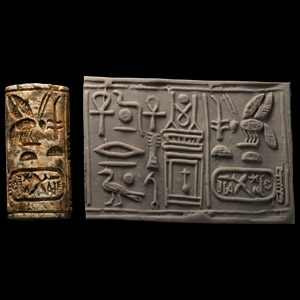
Egyptian Stone Cylinder Seal with Cartouche of Psusennes
Third Intermediate Period, circa 1055-950 B.C.Sold for (Inc. bp): £1,950
Large cylinder with deeply incised hieroglyphs, including the royal titulary above a cartouche of Psusennes I or II. 31.7 grams, 44 mm
From the collection of a gentleman, acquired on the London art market in the 1990s. -
.jpg)
Egyptian Faience Fish Plaque Amulet
New Kingdom, 1550-1070 B.C.Sold for (Inc. bp): £416
Rectangular plaque with raised Tilapia fish motif on the top and six ring-and-dot motifs on the underside. 2.12 grams, 17 mm
Mrs Allinson to Mrs Foster, 1867 and thence by descent to the current owner, Stanley Crescent, London, UK.
Amulets depicting the Tilapia fish served as symbols of regeneration. -
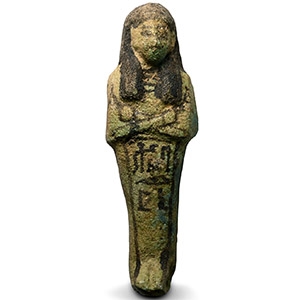
Egyptian Faience Hieroglyphic Shabti
Late New Kingdom-early Third Intermediate Period, circa 1200-1000 B.C.Sold for (Inc. bp): £468
Mummiform figure wearing a lappet wig, with arms crossed and holding a pick and hoe outlined in black; the wig, facial features, necklace, and seed bag painted black; hieroglyphic text to lower body: sḥḏ wsỉr "The illuminated, the Osiris". 87 grams, 11.3 cm
From the collection of a gentleman, acquired on the London art market in the 1990s.
The shabti was a stock product included with an opening dedication, awaiting the addition of the prospective purchaser's name. However, many examples of shabtis with only partial dedications are known to have been buried with the deceased. -
.jpg)
Egyptian Carnelian Scarab
Late Period, 664-332 B.C.Sold for (Inc. bp): £2,600
Modelled in the round with detailed head and legs, ellipsoid plaque, longitudinal piercing. 3.3 grams, 18 mm
Ex Belinda Elliston collection, a member of the Egyptian Exploration Society, 1940s onwards. -
.jpg)
Large Egyptian Red Stone Scarab
Late Period, 664-332 B.C.Sold for (Inc. bp): £468
Plano-convex in section, carved in the half-round scarab with segmented carapace; underside plain. 56.6 grams, 42 mm
with Archaeologia, Switzerland, before 1983. Ex private North American collection. London private collection, 2016. -
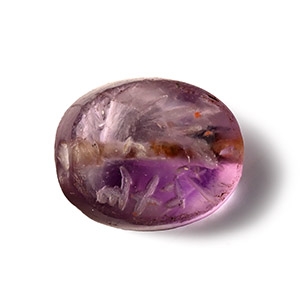
Phoenician Amethyst Scarab with Horse’s Head and Later Aramaic Inscription
Late 1st millennium B.C.Sold for (Inc. bp): £572
Scaraboid in form with transverse piercing, four later engraved Aramaic characters engraved to the flat face above a horse-head motif; supplied with a museum-quality impression. 1.59 grams, 13 mm
From the private collection of the late Mr S.M., London, UK, 1969-1999; thence by descent. Accompanied by a copy of a previous cataloguing slip. -
.jpg)
Egyptian Hardstone Scarab
26th-30th Dynasty, 664-343 B.C.Sold for (Inc. bp): £3,120
Carved in the half-round with detailed mouth, legs and carapace. 70.2 grams, 49 mm
with Galerie Gunter Phuze, Kunst der Antike, Freiburg, 2000, no.352. Ex George Broomis. Private collection, London, UK. This lot has been checked against the Interpol Database of stolen works of art and is accompanied by search certificate number no.12936-245209.
Scarabs were among the most popular amulets of ancient Egypt. Modelled on the dung beetle, they symbolised rebirth, transformation, and the daily journey of the sun god across the sky. From the Middle Kingdom onwards, they were widely used as personal seals, jewellery, and offerings in tombs. The flat underside was often carved with names, prayers, or symbols, while the beetle form on top carried protective power. Scarabs were believed to safeguard the wearer in life and assist the dead in the afterlife, making them both practical objects and deeply spiritual charms. -
.jpg)
Egyptian Rock Crystal Scarab
Late Period, 664-332 B.C.Sold for (Inc. bp): £650
Carved scarab with segmented carapace and legs. 6.45 grams, 23 mm
Ex Belinda Elliston collection, a member of the Egyptian Exploration Society, 1940s onwards. -
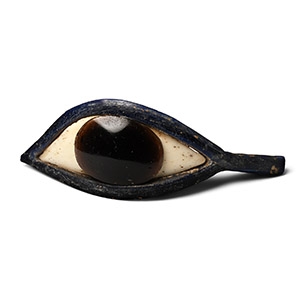
Egyptian Mummy Glass Eye
1st millennium B.C.Sold for (Inc. bp): £1,300
Comprising a blue glass frame with extended tear duct, inset with a white sclera and a large black pupil. 8.02 grams, 62 mm
Acquired in London or Japan, early 1980s. Property of a London, UK, gentleman. -
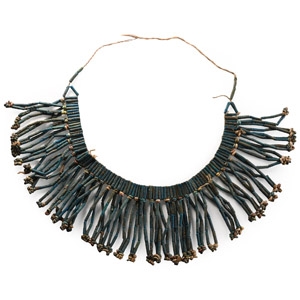
Egyptian Faience Bead Broad Collar Necklace
Late Period, 664-332 B.C.Sold for (Inc. bp): £468
Comprising: band of vertically strung faience tubular beads with integral tie at each end; below, a fringe of vertically strung groups of eight similar beads on a loop of thread with annular beads at the junction with the band and more similar at the outer end of the fringe; ancient cord. 50 grams, 33.5 cm
Ex William Ohly, 1883-1955. Ex Abbey Museum, Barnet, by descent. -
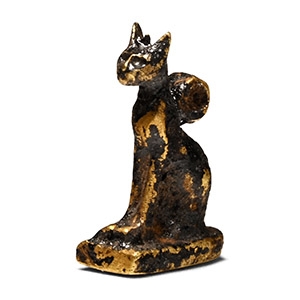
Egyptian Gold Bastet Seated Cat Amulet
Late New Kingdom-Third Intermediate Period, circa 1069-900 B.C.Sold for (Inc. bp): £715
Modelled seated on a tongue-shaped base, with simple facial detailing and suspension loop to the back. 0.51 grams, 8 mm
Ex French collection, early 20th century. From the collection of a late Japanese gentleman, 1970s onwards.
The goddess Bastet was believed to be the daughter of the sun god and was shown with the features of a lion up until about 1000 B.C. when she was first portrayed as a cat or human with a cat head. As the daughter of Ra she was associated with the rage inherent in the sun god's eye which was considered to be his instrument of vengeance. Her development into a cat goddess occurred during the New Kingdom but did not fully develop until the Late Period. She was still associated with the destructive power of the sun and was shown on the prow of the solar boat, decapitating the evil serpent Apophis in the Book of the Dead. The maternal, protective and hunting characteristics of the cat are obvious in Bastet and she was seen as a protector of pregnant women and young children. In the Pyramid Texts she is invoked by the deceased king to act as his protector and to help him reach the sky to join the sun god; the king proclaims that Bastet is his mother and nurse. Like her counterpart, Sekhmet, Bastet has an aggressive side and, in a text from Karnak, Amenhotep II described his enemies being slaughtered like the victims of Bastet. The goddess had a shrine at Karnak, where she is known as the 'Lady of Asheru' which aligns her closely with the goddess Mut, the consort of Amun-Ra. Her most famous shrine was in the north-east Delta region, at Bubastis, and was known as Per-Bastet or 'the House of Bastet.' Herodotus describes the festival of Bastet as one of the most elaborate in all of Egypt and identifies her with the Greek Artemis. Cemeteries of cats have been excavated at Bubastis and at Saqqara and Memphis. -
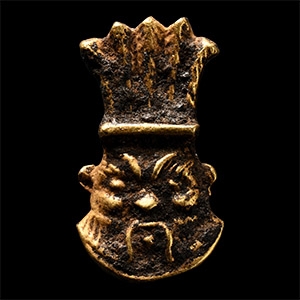
Egyptian Gold Bes Amulet
New Kingdom, circa 1550-1070 B.C.Sold for (Inc. bp): £1,235
Mask of Bes with feathered crown; attachment bar to reverse. 3.57 grams, 18 mm
Ex French collection, early 20th century. From the collection of a late Japanese gentleman, 1970s onwards.
From the New Kingdom onwards, Bes became one of ancient Egypt's most popular apotropaic deities. Despite his somewhat fearsome appearance, Bes served as the patron and protector of pregnant women and children, and was also believed to shield them from snakes.

