
Loading, please wait...
LOT 1404
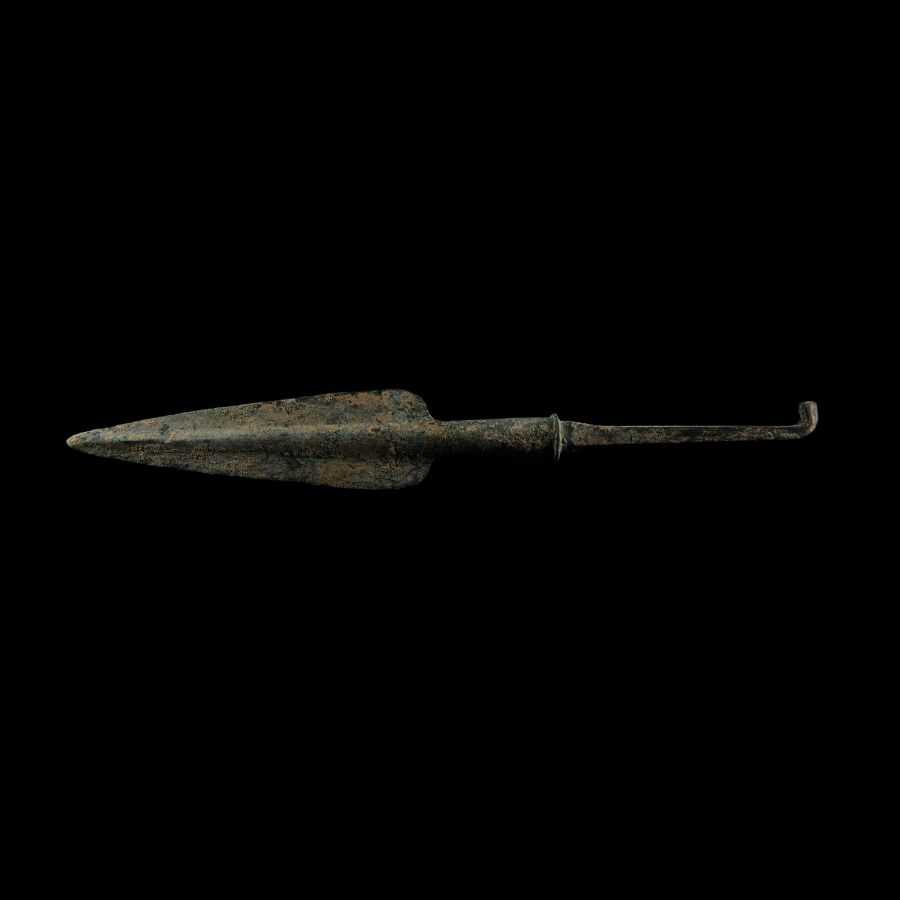
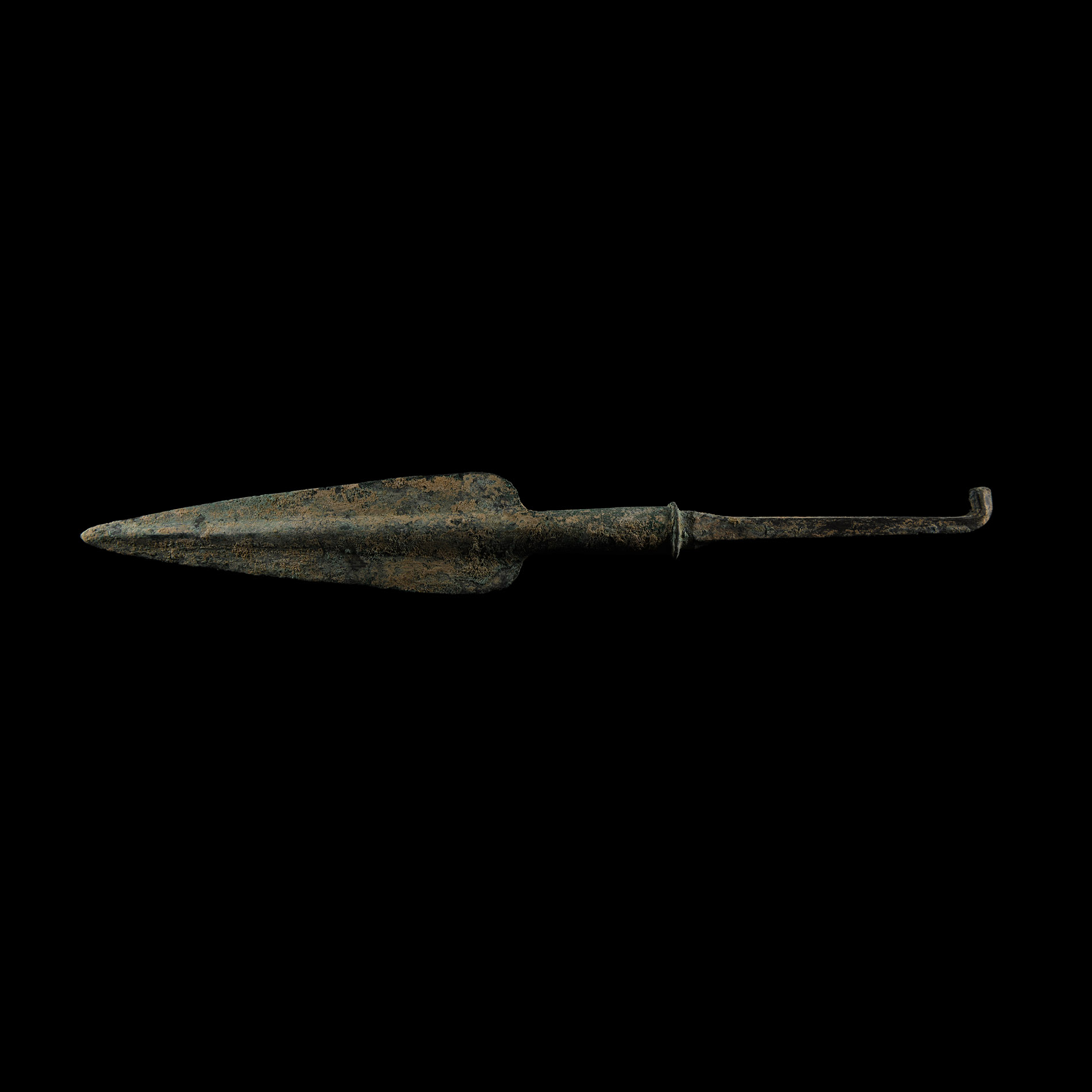
Western Asiatic Tanged Bronze Spearhead
LATE 3RD-EARLY 2ND MILLENNIUM B.C.
10 1/2 in. (151 grams, 26.5 cm).
Having foliate blade with central rib and slender shoulders, cylindrical short shaft encasing a rectangular tang with a bent end.
ProvenanceAcquired 1980-2015.
Ex Abelita family collection.
Cf. Gernez, G., L’armament en métal au Proche et Moyen-Orient: des origines a 1750 av. J.C., Paris, 2007, fig.2.88, subtypes L2 B.c.
FootnotesThis variant is characterised by a blade of rhomboidal or swollen section, an intermediate part often short widened so as to form a clear stop and a curved bristle at its end, sometimes finished in a button. Most lances are of medium dimensions (23 cm to 36 cm), others are very elongated (more than 50 cm). The best parallels come from Tepe Hissar. Elements of handles found nearby the spearheads in the excavations have made it possible to reconstruct the total length of the weapon (1.40 m).
CONDITIONTimeLine Auctions follows a vetting process to ensure the authenticity and legality of all items, reinforcing our commitment to integrity and responsible trading. Each antiquity, antique, and coin lot undergoes thorough examination by a vetting committee of at least ten external specialists, professional trade association members, scientists, and archaeologists: Our Vetting Process
AUCTIONS:
TimeLine is a leading auction house specialising in antiquities, ancient art, collectables, natural history, coins, medals, and books. Our auctions offer museums, collectors, historians, and enthusiasts the opportunity to acquire unique and historically significant pieces.
LOT 1404
Western Asiatic Tanged Bronze Spearhead
Estimate £100 - 140€120 - 160 (for guidance only)$140 - 190 (for guidance only)
-
Roman Iron Gladius Sword with Bird Triskeles
Circa 1st-2nd century A.D.Sold for (Inc. bp): £2,600
With fish-shaped blade of piled iron construction with square shoulder and flat-section tang; incised triskele motif to one face, each arm terminating in a bird's head with curved beak and lentoid eye; accompanied by a custom-made display stand. 870 grams total, 67 cm high including stand
Acquired in the 2000s. From the private collection of John Lawton, Surrey, UK. -
.jpg)
Western Asiatic Bronze Arrowheads, Javelin Heads and Daggers
3rd millennium-7th century B.C.Sold for (Inc. bp): £195
Comprising ten slender tanged arrowheads, javelin heads and daggers, some lozenge-section and some with raised midribs. 329 grams total, 14-21.5 cm
Acquired 1980-2015. Ex Abelita family collection.
Most of these blades are bipartite, but the definition of the bipartite type is not absolute as it brings together weapons of very different and unrelated designs. In fact, some weapons do not have a sufficiently characteristic shape to be interpreted as a spear, dagger, or long arrowhead. The javelin heads classified by Gernez as type Type L 3 are characterized by the simplicity of their design. They have a sharp and/or pointed active part, a flat, elliptical or rhomboidal cross-section and an elongated tang with a rectangular, square or circular section, ending in a pointed, widened, curved or folded blade. -
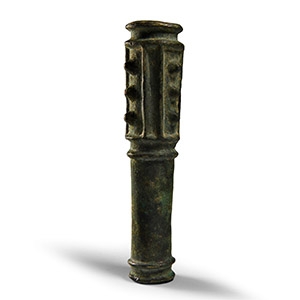
Luristan Bronze Macehead
Late 2nd millennium B.C.Sold for (Inc. bp): £286
Of cylindrical shape, the upper section with alternating rectangular panels and vertical rows of three prominent spikes, short cylindrical shaft edged at top and bottom. 244 grams, 13.5 cm
Ex London, UK, collection, before 1988.
The mace was probably the oldest weapon used by humans. This weapon has been used in different ways and it was probably considered the main tool in the civilisation of the Kassites because of the high number of maces found in this area. Bronze maces in Luristan probably had wooden handles, although most of them unfortunately have been eroded and severely deteriorated. According to Khorasani, such maces were realised with lost-wax process.
