Loading, please wait...
LOT 2050
Western Asiatic Style Banded Agate Fertility Idol
20TH CENTURY A.D.
3 1/8 in. (69 grams, 79 mm).
Carved in the round pregnant female amulet with ursine head; attachment point at rear of neck. [No Reserve]
ProvenanceFrom the family collection of a Hampstead gentleman; formerly acquired in the 1980s.
CONDITIONTimeLine Auctions follows a vetting process to ensure the authenticity and legality of all items, reinforcing our commitment to integrity and responsible trading. Each antiquity, antique, and coin lot undergoes thorough examination by a vetting committee of at least ten external specialists, professional trade association members, scientists, and archaeologists: Our Vetting Process
AUCTIONS:
TimeLine is a leading auction house specialising in antiquities, ancient art, collectables, natural history, coins, medals, and books. Our auctions offer museums, collectors, historians, and enthusiasts the opportunity to acquire unique and historically significant pieces.
-
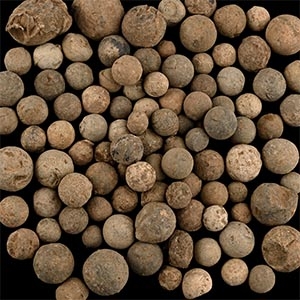
Lapis Lazuli Bead Necklace String
20th century A.D.Sold for (Inc. bp): £33
Restrung group of square-section tubular beads with interstitial seed beads. 29.96 grams, 38.2 cm
London, UK, collection, 2000s. -
Spanish Gold Ring with a Table-Cut Red Spinel
16th-17th century A.D.Sold for (Inc. bp): £11,700
A substantial ring with a box-shaped bezel set with a table-cut red spinel of deep purplish-red hue, the reverse of the bezel convex with chamfered ends. 6.93 grams, 24.30 mm overall, 17.05 mm internal diameter (approximate size British M 1/2 , USA 6 1/4, Europe 13.09, Japan 12)
Private English collection, formed between the late 1970s and early 1990s. Private collection, UK. This lot has been checked against the Interpol Database of stolen works of art and is accompanied by search certificate number no.12996-245986.
The box bezel is typical of both Spanish and Islamic goldsmithing traditions. The small pointed projection at the rear of the hoop, however, is not a common feature in Spanish rings but is a distinctive hallmark of Islamic goldwork — a form ultimately rooted in Middle Eastern traditions of the Sasanian, Fatimid, and Mamluk periods. This detail likely reached Spain through the transmission of techniques from the Middle East into Islamic North Africa, and subsequently into the goldsmithing repertoire of al-Andalus. These forms were adapted by Spanish goldsmiths to accommodate the tastes of a Christian clientele, reflecting the deep and enduring influence of Islamic craftsmanship in post-Reconquista Spain. -
Museum Reproduction of Tudor Silver Henry Darnley Ring
20th century A.D.Sold for (Inc. bp): £13
With roundels to the shoulders, broad plaque with 'MH' monogram in a ring of billets; inner face with heater shield bearing a lion rampant over '1565' and 'HENRI DARNLEY' legend. 5.48 grams, 21.20 mm overall, 17.66 mm internal diameter (approximate size British O 1/2, USA 7 1/4, Europe 15.61, Japan 15)
Acquired on the UK art market. Property of a Suffolk, UK, gentleman.
The tale of Mary Queen of Scots is a fascinating story of the Queen of Scotland which began when Mary was born on the 8th of December 1542. The only legitimate surviving child of King James V of Scotland, Mary ascended to the throne when she was only six days old upon her father’s death. Most of Mary’s childhood was spent in France, whilst Scotland was ruled by regents, due to an agreement proposed by King Henry II of France that Mary would eventually marry his son, Dauphin Francis. On 4 April 1558, Mary signed a secret agreement bequeathing Scotland and her claim to England to the French crown if she died, and twenty days later, she married the Dauphin at Notre Dame de Paris. When Henry II died in 1559, fifteen-year-old Francis and sixteen-year-old Mary became King and Queen of France. Upon her husband’s death in 1560 and now a widow, Mary returned to Scotland the following year. As a devout Catholic, she was regarded with suspicion by many of her subjects, as well as by her cousin Elizabeth I, the Queen of England. Mary then turned her attention to finding a new husband and in 1565, she married her half cousin, Henry Stewart, known as Lord Darnley, and they went on to have a son, James VI and I. In 1567, an explosion occurred at Darnley’s residence and he was found murdered, thought to have been smothered, in the garden. Lord Bothwell was believed to have orchestrated his murder; however was later acquitted and after abducting her, married Mary a month later. Following an uprising against the couple, Mary was forced to abdicate the throne in favour of her son and fled to England to seek protection from the Queen. This began the journey of Mary’s well known imprisonment and eventual execution by her cousin, Queen Elizabeth at Fotheringhay Castle. In 1820, a gold ring was found within the ruins of Fotheringhay Castle and was said to be the wedding ring of Mary, Queen of Scots and Lord Darnley. The bezel engraved with initials ‘M’ and ‘H’ and a true lover’s knot. The reverse engraved with the Royal Arms of Scotland, the lion rampant beneath a crown and the inscription ‘Henry. L’ Darnley’.