
Loading, please wait...
_900x900.jpg "Western Asiatic Stone Stamp Seal and Amulet Collection")
_200x200.jpg "Western Asiatic Stone Stamp Seal and Amulet Collection")
.jpg "Western Asiatic Stone Stamp Seal and Amulet Collection")
LOT 1151
Western Asiatic Stone Stamp Seal and Amulet Collection
1ST MILLENNIUM B.C.
1/2 - 1 in. (19.4 grams total, 12-24 mm).
Comprising: a pillow-shaped carnelian amulet pierced through the notched upper edge, hatched panels to both faces; a triangular-section stamp seal displaying ring-and-dot motifs and a possible animal figure; a plano-convex stamp seal bearing a geometric motif; a square-shaped lapis lazuli amulet engraved with a horned quadruped standing right. [4, No Reserve]
ProvenanceCollected since the 1970s.
Ex Everitt collection, acquired by descent 2017.
TimeLine Auctions follows a vetting process to ensure the authenticity and legality of all items, reinforcing our commitment to integrity and responsible trading. Each antiquity, antique, and coin lot undergoes thorough examination by a vetting committee of at least ten external specialists, professional trade association members, scientists, and archaeologists: Our Vetting Process
AUCTIONS:
TimeLine is a leading auction house specialising in antiquities, ancient art, collectables, natural history, coins, medals, and books. Our auctions offer museums, collectors, historians, and enthusiasts the opportunity to acquire unique and historically significant pieces.
-
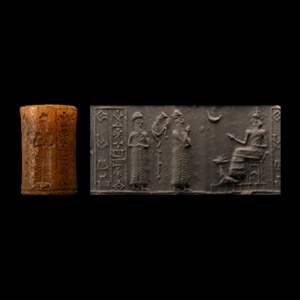
Akkadian Alabaster Cylinder Seal of Kiruzum (or Hurruzum), Servant of (the Goddess) Ninsianna
Late 3rd-early 2nd millennium B.C.Sold for (Inc. bp): £2,340
With frieze depicting a throne-room scene, seated king in tiered robe confronted by two robed supplicants with an altar and idol, two columns of cuneiform text; supplied with a museum-quality impression. 42 grams, 38 mm
From the 'S' collection, acquired 1970-1990s. The collection was seen and studied by W.G. Lambert, late Professor of Assyriology at the University of Birmingham, 1970-1993. This lot has been checked against the Interpol Database of stolen works of art and is accompanied by search certificate number no.12245-222160. -
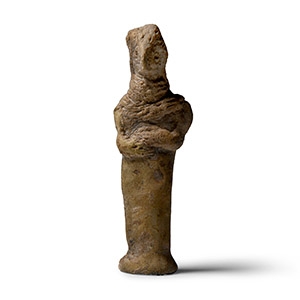
Western Asiatic Terracotta Idol
3rd-2nd millennium B.C.Estimate: £400 - 600 (‡+bp*)
Opening Bid: £222
Free-standing; formed with a pinched face, hair held in a bun at the back of the head, arms folded across the waist, wearing a neck collar and possibly a headdress; splayed foot. 33 grams, 10.1 cm high
Acquired in the 1970s. Ex European private collection. -
.jpg)
Jordanian Terracotta Jar with Ledge Handles
Early Bronze Age, 3rd millennium B.C.Sold for (Inc. bp): £156
Biconvex globular body with broad neck, everted rim, two ledge handles below the equator, band of pointillé to the neck and shoulder. 785 grams, 18 cm high
From a family collection pre 1988.
