
Auction Highlights
-
.jpg)
Egyptian Granite Head of a Dignitary
Sold for (Inc. bp): £28,600
Carved with soft facial features and carefully executed cosmetic lines around the eye, earring, and carefully detailed duplex wig with gently wavy curls; likely from the Ramesside Period; mounted on a custom-made stand. -
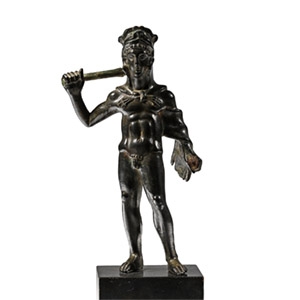
Etruscan Bronze Statuette of Herakles
Sold for (Inc. bp): £18,200
Modelled in the round with a muscular nude body, his club resting on his shoulder and the hair dressed in rows of tight, close-set curls underneath the Nemean lionskin hood with cloak billowing over his left arm, the paws tied across his chest; mounted on a custom-made display stand. -
.jpg)
Roman Marble Portrait of a Boy as Worshipper of Isis
Sold for (Inc. bp): £17,550
Carved head of a prepubescent worshipper of Isis, with soft facial features, long nose, small downturned mouth, heavy-lidded eyes, the whole giving the face a sombre or mournful appearance; the hair textured to indicate a short cut and combed forward across the scalp, sidelock above the right ear; mounted on a 16th century carved breccia upper body with leather cuirass and pteruges to right shoulder, cloak draped across the shoulders and fastened at the clavicle on the right side with a disc-brooch; socle base; some restoration. -
.jpg)
Larger Than Life-Size Roman Bronze Sandaled Foot
Sold for (Inc. bp): £39,000
Modelled in the round and originally part of a monumental statue, the naturalistic right foot encased in a trochades leather sandal with median reversed tongue secured with side straps and thick looped laces; the thick platform sole slightly curved, toes and nails well defined; mounted on a substantial custom-made display stand. -
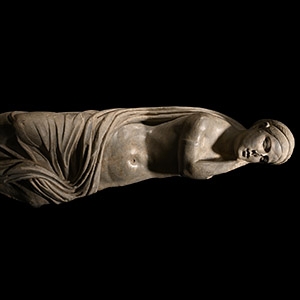
Life-Size Roman Marble Sleeping Girl from a Sarcophagus Lid
Sold for (Inc. bp): £20,800
Modelled in the half-round, nude with eyelids half-closed in sleep; a drapery partly covering the head and wrapping around the lower body under the hips; the hairstyle similar to those of the Antonine Dynasty, the peaceful face supported by the hands and the ear pierced to accept an earring; iron reinforcing rod to the feet and the right arm's armilla a later replacement; upper head restored in Parian marble. -
.jpg)
Byzantine Porphyry Relief with Cross Surrounded by Two Birds
Sold for (Inc. bp): £28,600
An imposing panel divided to four sections by a central cross on a stepped pedestal, the lower and upper arm with branch-like extensions; the upper quadrants with a circlet surrounding a palm tree-shaped motif; each lower quadrant with a bird in profile facing back; mounted on a custom-made display stand. -
.jpg)
Carved Marble Memento Mori Skull
Sold for (Inc. bp): £16,900
Carved skull on a short neck with musculature and blood vessels; mandible in place with some teeth in sockets, wisps of hair adhering to the dome of the skull; one zygomatic bone partly absent; square-section socle base. -
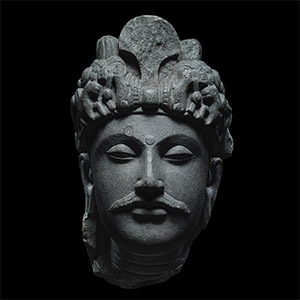
'The Kelton' Gandharan Head of a Bodhisattva
Sold for (Inc. bp): £24,700
Carved in the half-round head of a Bodhisattva (probably Maitreya) with fine detailing to the arched brow, aquiline nose, neat moustache and full lips; the eyes heavily lidded, urna to the forehead, long open lobes to the ears; the hair in multi-stranded curling locks gathered into an ushnisha with brow-band below; heavily cleaned, conserved, and mounted on a custom-made stand; supplied with original old wooden base with collector's label: 'Head of Bodhisattva / Fine grain schist / Gandhara, Northwest Pakistan / 4th century'.
-
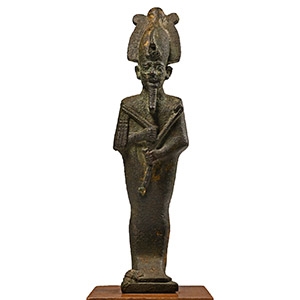
Egyptian Bronze Figure of Osiris
Late Period, 664-332 B.C.Sold for (Inc. bp): £5,980
Solid cast mummiform figure standing on an integral plinth; the god cloaked in a tight-fitting shroud, sporting the ostrich-plumed atef crown with uraeus, divine beard, and holding the characteristic crook and flail regalia; traces of gilding remain; mounted on a custom-made display stand. 811 grams total, 21 cm including stand
Private collection, 19th century, thence by descent. Private collection, Neuchâtel. This lot has been checked against the Interpol Database of stolen works of art and is accompanied by search certificate number no.12195-222135.
Osiris is a deity who represents death and fertility and is commonly regarded as the quintessential god of rebirth. Though he was once a mortal ruler, as a deceased entity, his domain was the Underworld. Abydos was the primary centre of Osiris’s cult, where a renowned yearly celebration of the god was held. -
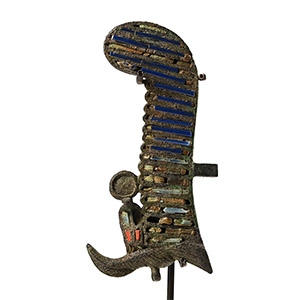
Egyptian Bronze and Glass Inlaid Ostrich Feather from an Atef Crown
Late Period-Ptolemaic Period, circa 664-30 B.C.Sold for (Inc. bp): £650
Stylised ostrich plume surmounting a ram's horn, uraeus with sun disk to one side; side tang and loop on the underside for attachment; the plume decorated with a series of narrow horizontal recesses to accept inlays, with some original remaining as well as later replacements in blue glass. 244 grams total, 18.5 cm
UK private collection of Werner Forman (1921-2010), formed between 1950-1980.
The atef crown consists of a central element similar to the hedjet or White Crown, flanked by two ostrich feathers, often with a pair of ram's horns beneath and uraei on either side. The meaning of atef is uncertain, but it may mean either 'his might' or 'his terror'. The crown first appeared in the 5th Dynasty and is particularly associated with the underworld god Osiris. -
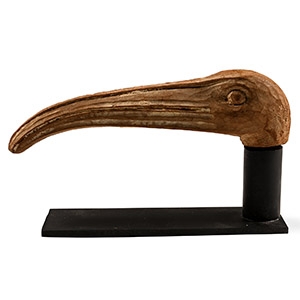
Egyptian Wooden Head of an Ibis
Late Period-Ptolemaic Period, circa 664-30 B.C.Sold for (Inc. bp): £1,300
Naturalistically carved ibis head from a composite statuette, with carefully detailed beak and eyes; traces of gesso and gilding remain; mounted on a custom-made display stand. 116 grams total, 18.5 cm wide
American private collection, New York, acquired in London before 2000.
The ibis was sacred to the god Thoth, who was revered for his association with knowledge, writing, and healing. The god also acted as the recorder of the final judgment, which determined whether the deceased had lived a life of virtue. Vast numbers of ibises were mummified in religious centres such as Saqqara and Tuna el-Gebel, where they were offerings to the god and interred in extensive catacombs. -
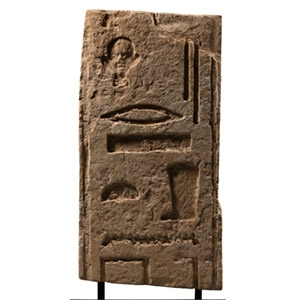
Egyptian Limestone Relief Fragment
Old Kingdom, 2686-2181 B.C.Sold for (Inc. bp): £3,380
Rectangular panel carved in sunk relief with vertical borders framing a portion of hieroglyphic inscription ...ḥry sštꜢ n..., '...keeper of secrets of...'. 6.79 kg total, 50.5 cm high including stand
Reputedly acquired by a private collector in 1936. Ex Ian Colverson Collection, UK (1940-2022). This lot has been checked against the Interpol Database of stolen works of art and is accompanied by search certificate number no.12196-222436.
The relief is most likely a fragment of a vertical inscription from a false door of an Old Kingdom tomb chapel. The complete inscription was probably an offering formula followed by a list of the tomb owner's titles. The 'keeper of secrets' is a priestly title indicating that one of his roles was as an embalmer. -
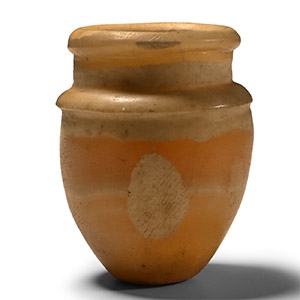
Egyptian Alabaster Vase with Carinated Shoulders
Later Period, circa 664-332 B.C.Sold for (Inc. bp): £910
With rounded rim, short neck, a raised carination to the shoulder, the body tapering to a flat base; usage wear. 172 grams, 69 mm high
Mary Stout Shaw (1880-1962); thence by direct descent to the present owner. Accompanied by a copy of a 1976 family photo featuring some of the collection on display,
Mary Kilgour Stone was born in 1880 in Cincinnati, Ohio. On 25 November 1903, she married Percy Wyfold Stout from Gloucester (DSO, OBE, 1875-1937), who had moved to Cairo after an international rugby career. After fighting in the First World War, Percy became the Director of the Egyptian Delta Land Company and the Anglo-American Nile Tourist Company. He and Mary were friends with the famous Major Gayer-Anderson, who worked as a doctor on the company’s cruise boats between 1930 and 1939. Gayer-Anderson tells in his memoir how this allowed him to make frequent trips to Upper Egypt and fulfil his passion for collecting (and dealing in) ancient Egyptian art. In his company, Mary became an enthusiast about all things Egypt and formed an elegant collection of ancient Egyptian alabaster vessels, including the following lots. She was particularly fascinated with the ancient cat goddess Bastet. Therefore, when Gayer-Anderson decided to give his famous ancient bronze cat to the British Museum in 1939, he made sure the donation was in both his name and Mary Stout Shaw’s, as a tribute to their friendship. -
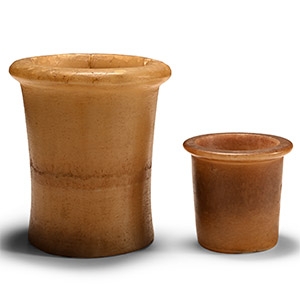
Two Egyptian Cylindrical Alabaster Jars
Early Dynastic Period, circa 3100-2900 B.C.Sold for (Inc. bp): £2,340
The larger with rounded rim, concave body and flat base, the smaller with cylindrical body and flat disc rim. 1 kg total, 6.4-11.5 cm high
Mary Stout Shaw (1880-1962); thence by direct descent to the present owner. Accompanied by a copy of a 1976 family photo featuring some of the collection on display, the larger kohl jar is clearly visible on a 1976 family photo. This lot has been checked against the Interpol Database of stolen works of art and is accompanied by search certificate number no.12198-220885.
Mary Kilgour Stone was born in 1880 in Cincinnati, Ohio. On 25 November 1903, she married Percy Wyfold Stout from Gloucester (DSO, OBE, 1875-1937), who had moved to Cairo after an international rugby career. After fighting in the First World War, Percy became the Director of the Egyptian Delta Land Company and the Anglo-American Nile Tourist Company. He and Mary were friends with the famous Major Gayer-Anderson, who worked as a doctor on the company’s cruise boats between 1930 and 1939. Gayer-Anderson tells in his memoir how this allowed him to make frequent trips to Upper Egypt and fulfil his passion for collecting (and dealing in) ancient Egyptian art. In his company, Mary became an enthusiast about all things Egypt and formed an elegant collection of ancient Egyptian alabaster vessels, including the following lots. She was particularly fascinated with the ancient cat goddess Bastet. Therefore, when Gayer-Anderson decided to give his famous ancient bronze cat to the British Museum in 1939, he made sure the donation was in both his name and Mary Stout Shaw’s, as a tribute to their friendship. -
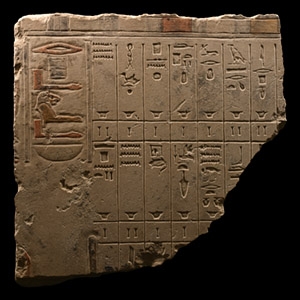
Egyptian Limestone Relief with Hieroglyphic List of Funerary Offerings
Old Kingdom, circa 2513-2190 B.C.Sold for (Inc. bp): £14,950
Dressed panel with reserved rectangular border to upper edge with ochre and terracotta pigment; left edge with reserved rectangle and column of hieroglyphs picked out with pigment; the left edge with a reserved rectangle and column of hieroglyphs picked out with pigment giving the titles of the deceased: ı͗ry-pꜤt ḥꜢty-Ꜥ nb, 'member of the elite, foremost of action, and lord'; to the right, a tabulated list of offerings with the quantities for each indicated beneath. 10.85 kg, 37 cm high
Acquired in the mid-1980s-1990s. Private collection, Switzerland, thence by descent. Private collection, since the late 1990s. Accompanied by an academic report by Egyptologist Paul Whelan. This lot has been checked against the Interpol Database of stolen works of art and is accompanied by search certificate number no.12199-222171.
The majority of preserved Old Kingdom offerings lists come from tombs at Saqqara or other parts of the Memphite necropolis and were intended to ensure that the deceased would be sustainably provided for eternally. During the 4th Dynasty, around 165 different offerings could be listed for the deceased, but by the 5th Dynasty, almost half of these had disappeared while some new ones were added. Even then, these lists could include around a hundred offerings. Although non-consumable items such as eye paint and cloth are sometimes listed, most offerings are different kinds of food, such as bread, wine, grain, and fruit. -
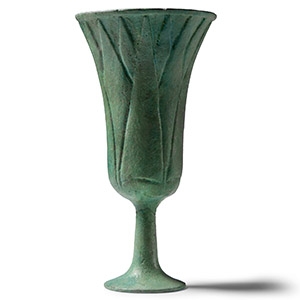
Egyptian Blue-Glazed Faience Blue Lotus Chalice
New Kingdom-Third Intermediate Period, circa 1504-935 B.C.Sold for (Inc. bp): £9,360
With a tall, flaring cup rounded at the base, attached to a short stem supported on a flared foot; the outside of the cup decorated with petals modelled in relief and a ribbed rim; the stem and foot plain; some restoration. 126 grams, 16 cm
Acquired 1970s-1996. Property of a North American collector. London collection, 2016. This lot has been checked against the Interpol Database of stolen works of art and is accompanied by search certificate no.12099-214088.
Faience chalices shaped like the flowers of the blue lotus (Nymphaea caerulea) first appeared in the 18th Dynasty. The blue lotus chalices were believed to have been used for cultic or votive purposes in temples or in rituals offered to the dead. Known as 'Seshen' by the ancient Egyptians, the blue lotus was a symbol of solar concepts associated with rebirth, probably because its flowers opened in the morning and closed at night. Hence, it is not surprising to find that the lotus was prominently featured in ancient Egyptian funerary art, particularly in banqueting scenes honouring the deceased, and in bouquets that adorned the coffin and bier of the deceased. It is also believed that the flower petals were used to make perfume, and that the ancient Egyptians took advantage of the lotus's narcotic properties. The extracted essence was added to wine to enhance its pleasurable effects, as depicted in banqueting scenes with intoxicated guests. -
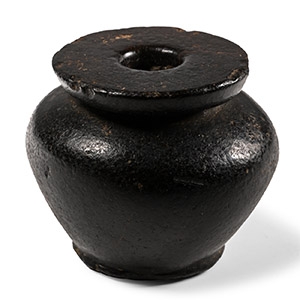
Egyptian Black Stone Kohl Vessel
Middle Kingdom, circa 1991-1665 B.C.Sold for (Inc. bp): £572
Squat in profile with integral discoid base, broad discoid rim to the mouth. 190 grams, 53 mm wide
Swiss collection, acquired in 1998.
Such vessels contained kohl, an eyepaint either green or black. Kohl was used as a cosmetic in daily life, mentioned in funerary texts as necessary make-up in the presentation of the deceased before Osiris, and served as a medical treatment for eye ailments. The small size of kohl jars and their tiny capacity indicate the preciousness and costliness of the contents. -
Egyptian Granite Head of a Dignitary
New Kingdom, 1552-1069 B.C.Sold for (Inc. bp): £28,600
Carved with soft facial features and carefully executed cosmetic lines around the eye, earring, and carefully detailed duplex wig with gently wavy curls; likely from the Ramesside Period; mounted on a custom-made stand. 4.23 kg total, 20 cm including stand
Private collection, France. with Christie’s, New York, 18 December 1996, no.60. Acquired by the present owner from the above. Accompanied by an academic report by Egyptologist Paul Whelan. This lot has been checked against the Interpol Database of stolen works of art and is accompanied by search certificate number no.12202-222169.
The shape of the eyes, raised upper and lower cosmetic lines, brows, and mouth on the TimeLine head present a similar countenance to that of the cube statue of Hori, dated to the reign of Ramesses II, now in the Musée du Louvre (inv. no. Louvre E11275). An even closer parallel can be seen in another non-royal statue of Paaha in the British Museum (inv. no. EA 501). -
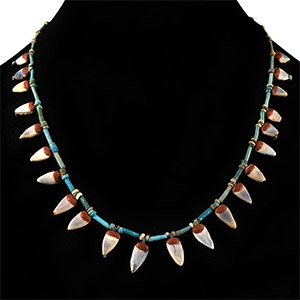
Egyptian Amarna Period Beaded Fruit Necklace
18th Dynasty, 1332-1346 B.C.Sold for (Inc. bp): £598
Restrung necklace of annular and tabular beads with fructiform amulets. 13.1 grams, 44 cm
Ex London, UK, collection, 1990s.
Petal-shaped beads of faience and glass were widely used in jewellery during the Amarna Period. During this era, advanced production methods enabled the creation of bi-chrome and polychrome designs, which often included newly developed colours. This resulted in vibrant necklaces that resembled festive collars made of natural floral elements. -
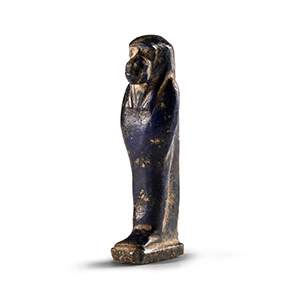
Egyptian Lapis Lazuli Son of Horus Amulet
Late Period, 664-332 B.C.Sold for (Inc. bp): £715
Carved amulet of the baboon-headed mummiform figure of Hapy shown standing with dorsal pillar, pierced for suspension. 2.52 grams, 28 mm
Private collection of Mr S.A., Switzerland, 1990s, thence by descent.
The Four Sons of Horus were deities responsible for protecting the internal organs of the deceased. The baboon-headed Hapy protected the lungs.
