
Loading, please wait...
_900x900.jpg "Western Asiatic Stone Beads with Engraved Animals")
_200x200.jpg "Western Asiatic Stone Beads with Engraved Animals")
.jpg "Western Asiatic Stone Beads with Engraved Animals")
LOT 1055
Western Asiatic Stone Beads with Engraved Animals
20TH CENTURY OR EARLIER
3/4 in. (22.1 grams total, 20-22 mm).
Two roughly spherical beads carved from a milky stone, both possibly engraved later, a frieze of animal and mythical figures, together with a single, apparently human, figure. [2, No Reserve]
ProvenanceCollected since the 1970s.
Ex Everitt collection, acquired by descent 2017.
TimeLine Auctions follows a vetting process to ensure the authenticity and legality of all items, reinforcing our commitment to integrity and responsible trading. Each antiquity, antique, and coin lot undergoes thorough examination by a vetting committee of at least ten external specialists, professional trade association members, scientists, and archaeologists: Our Vetting Process
AUCTIONS:
TimeLine is a leading auction house specialising in antiquities, ancient art, collectables, natural history, coins, medals, and books. Our auctions offer museums, collectors, historians, and enthusiasts the opportunity to acquire unique and historically significant pieces.
-
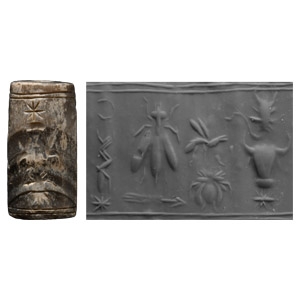
Mesopotamian Agate Cylinder Seal with Bull's Head
1st millennium B.C.Sold for (Inc. bp): £312
Carved with zoomorphic figures, astrological symbols and geometric decoration, central bull's head with a star below and two large insects on the field. 6.78 grams, 24 mm
From the property of late Mr SM, London, UK, 1969-1999. Accompanied by an old collection ticket. -
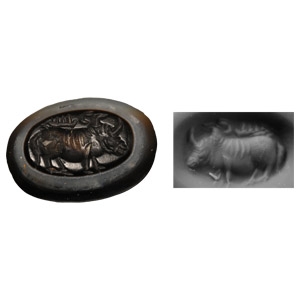
Sassanian Gemstone with Standing Bull
Circa 400-600 A.D.Sold for (Inc. bp): £85
Ellipsoid banded agate gemstone with intaglio standing bull, crescent above the shoulders; supplied with a museum-quality impression. 1.25 grams, 17 mm
UK private collection before 2000. On the UK art market. Property of a London gentleman. -
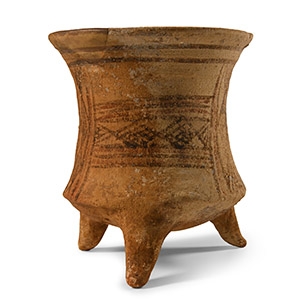
Western Asiatic Painted Terracotta Tripod Vessel
Middle Bronze Age, 2nd millennium B.C.Estimate: £300 - 400 (+bp*)
Opening Bid: £150
Tubular with waisted profile, domed underside with three splayed legs; horizontal and vertical bands of painted geometric detailing. 508 grams, 14.5 cm
Ex London, UK, gallery, 1971-early 2000s.
