
Loading, please wait...
_900x900.jpg "Western Asiatic Spiked Bronze Macehead Group")
_200x200.jpg "Western Asiatic Spiked Bronze Macehead Group")
.jpg "Western Asiatic Spiked Bronze Macehead Group")
LOT 0300
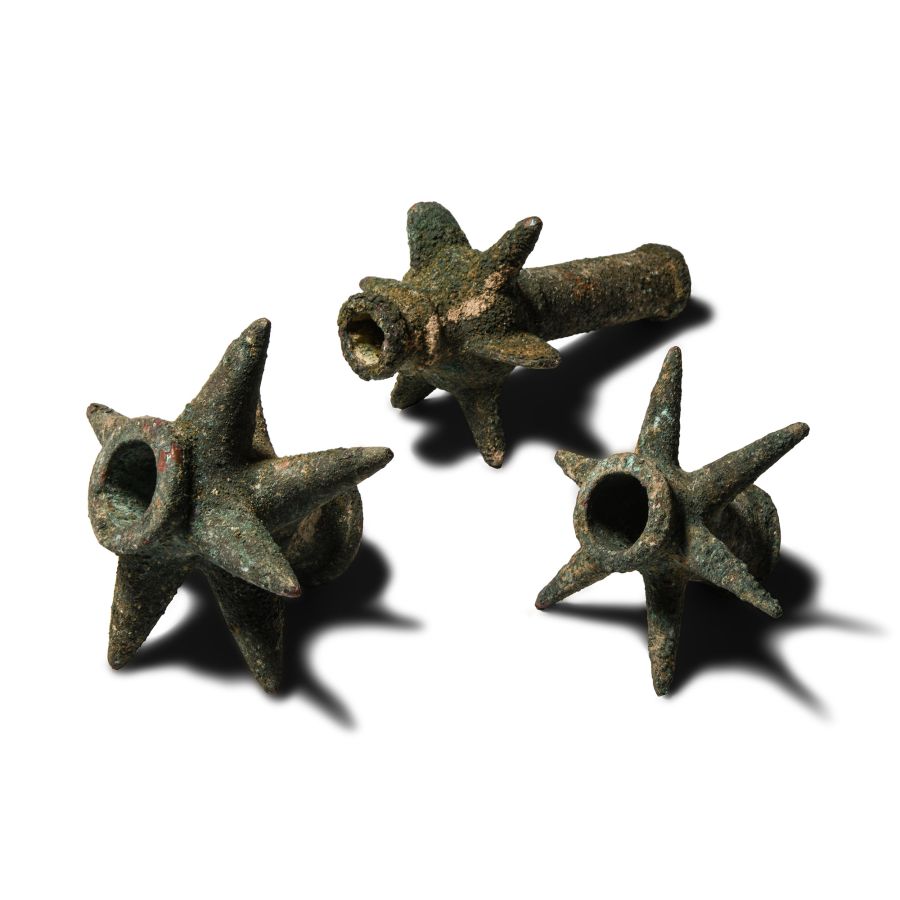
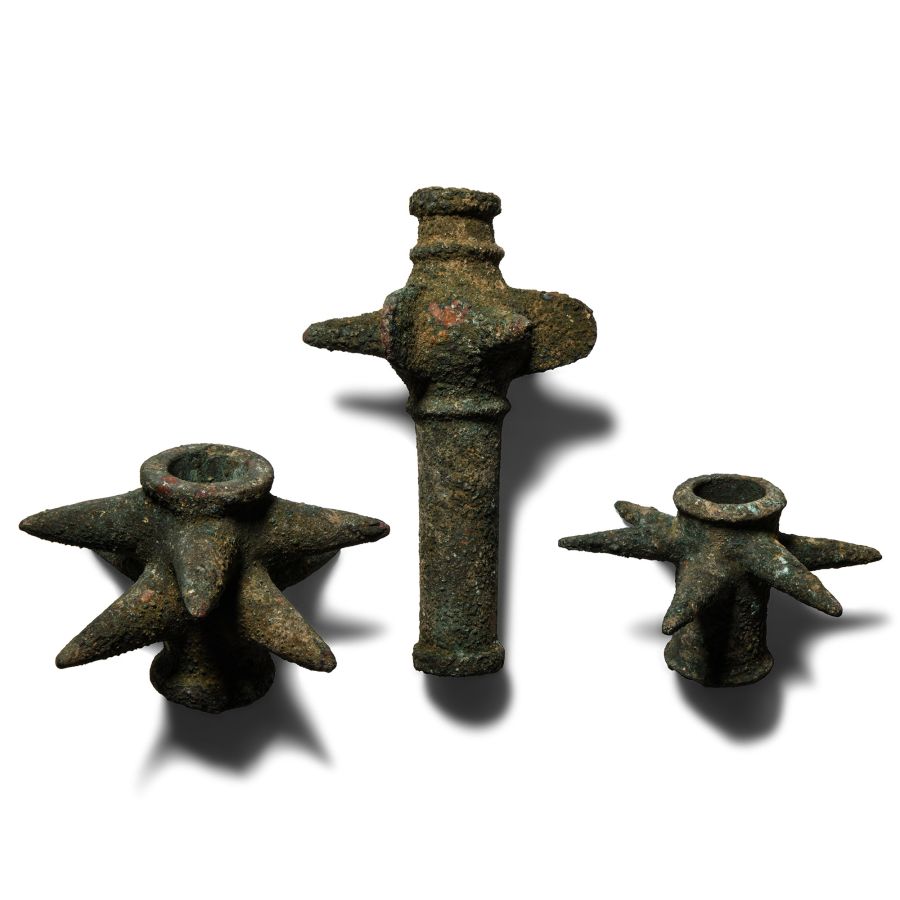
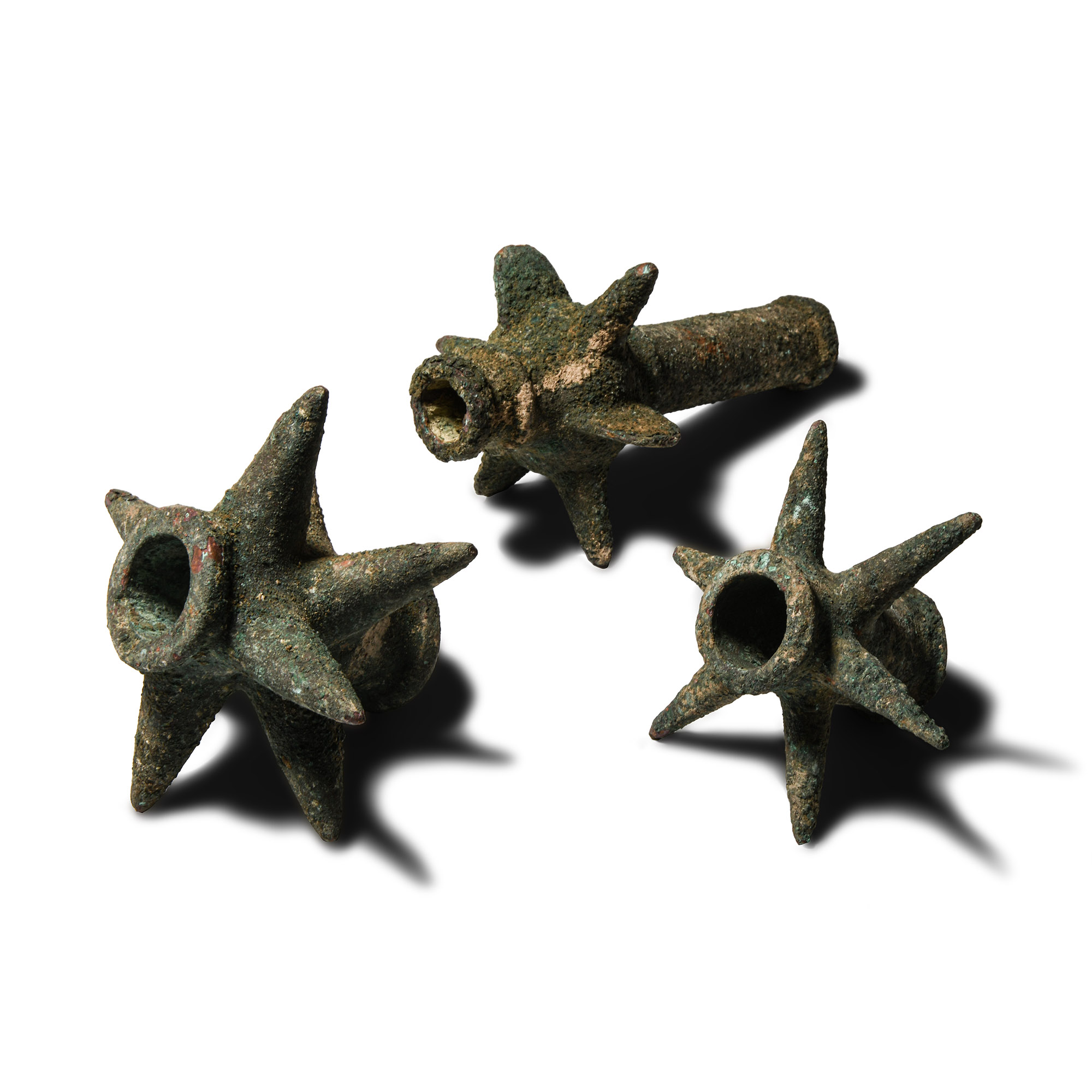
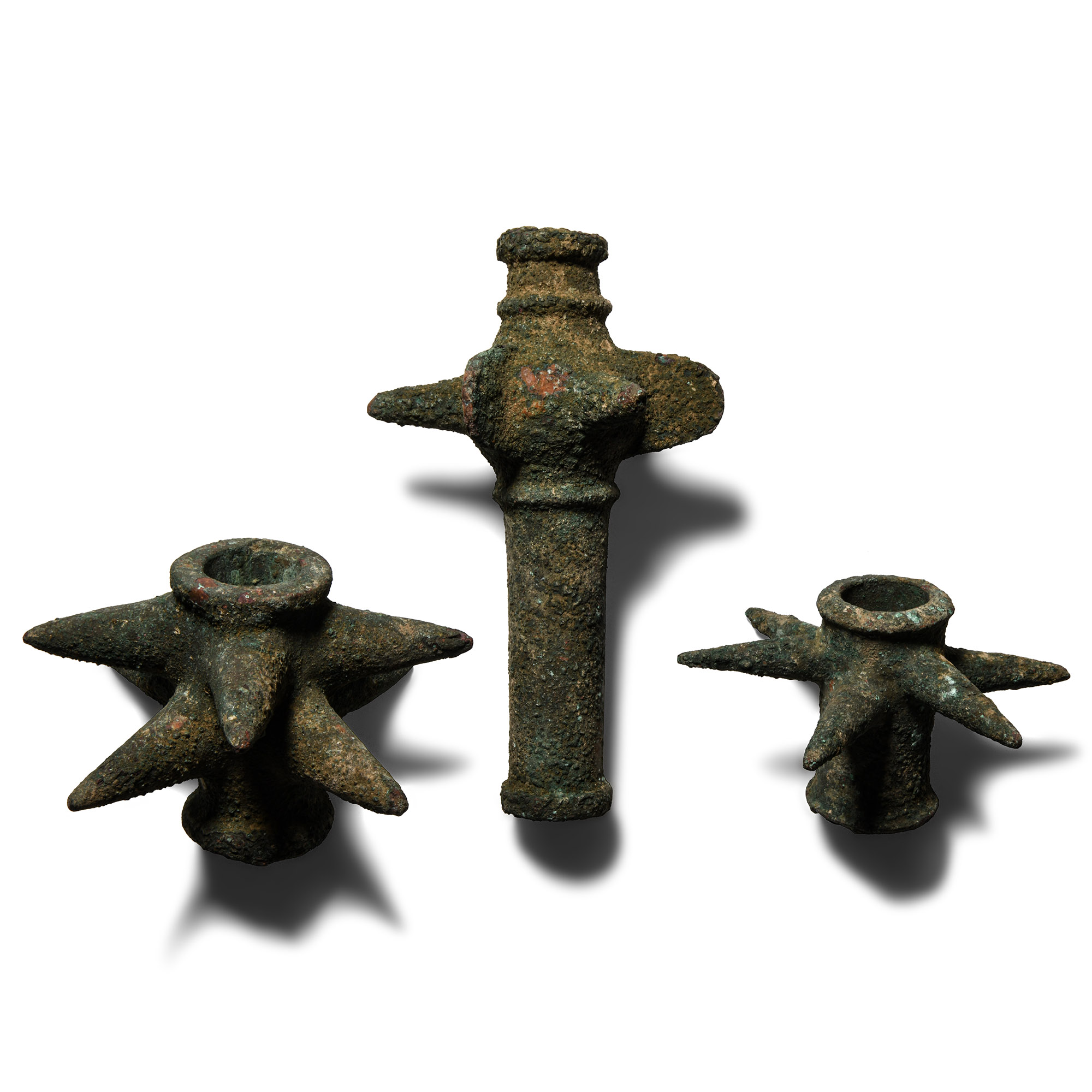
Western Asiatic Spiked Bronze Macehead Group
2ND-1ST MILLENNIUM B.C.
4 - 5 7/8 in. (1.35 kg total, 10-15 cm).
Comprising: one with two unaligned rows, each with four horizontal spikes, topped by a tooth helping to secure the mace to a wooden shaft; the second with a long socket and a row of six spikes, three pointed and three rounded, double tipped edge for securing the shaft; the third with six horizontal spikes; all with solid heads and hollow tubular sockets; of North-West Iranian typology. [3]
ProvenanceAcquired from Artemis Gallery, Munich in 1995.
European private collection.
Accompanied by an academic report by Dr Raffaele D’Amato.
This lot has been checked against the Interpol Database of stolen works of art and is accompanied by search certificate number no.11997-211853.
Cf. Dyson, R.H., ‘Hasanlu and Early Iran’, in Archaeology, vol. 13, no.2, June 1960, pp.118-129, fig.p.128; Muscarella, O.W., Bronze and Iron, Ancient Near Eastern Artifacts in the Metropolitan Museum of Art, New York, 1988, nos.68-71, for very similar types; Gorelik, M., Weapons of Ancient East, IV millennium BC-IV century BC, Saint Petersburg, 2003, in Russian, see pl.XXXI, nos.82,83, from Luristan and Fargana, for very similar types.
FootnotesA variety of similar bronze mace heads have been recovered in Hasanlu and Marlik, mainly of spiked variety. Excavations at 8th-7th century B.C. War Kabud and Chamzhi-Mumah in Luristan have produced related types, with smaller spikes or knobs and with an elongated socket, like one of our examples. These spiked maces are a specifically Iranian type. In general, they were used from the 9th century B.C. although some scholars support the thesis of their use in the late 2nd-early 1st millennium based on finds from Marlik.
CONDITIONTimeLine Auctions follows a vetting process to ensure the authenticity and legality of all items, reinforcing our commitment to integrity and responsible trading. Each antiquity, antique, and coin lot undergoes thorough examination by a vetting committee of at least ten external specialists, professional trade association members, scientists, and archaeologists: Our Vetting Process
AUCTIONS:
TimeLine is a leading auction house specialising in antiquities, ancient art, collectables, natural history, coins, medals, and books. Our auctions offer museums, collectors, historians, and enthusiasts the opportunity to acquire unique and historically significant pieces.
LOT 0300
Western Asiatic Spiked Bronze Macehead Group
Estimate £3,000 - 4,000€3,480 - 4,640 (for guidance only)$4,050 - 5,400 (for guidance only)
-
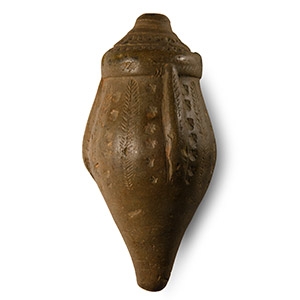
Turco-Mongol Ceramic Fire Bomb or Hand Grenade
13th-15th century A.D.Sold for (Inc. bp): £182
A hollow ceramic vessel with cylindrical body, carinated shoulder, short neck and domed mouth, bands of impressed herringbone patterns to the shoulder, waist and body, alternated with floral pattern around a groove; intended to be filled with explosive liquid and a wick, and used as a hand grenade. 520 grams, 17 cm
Acquired 1980-2015. Ex Abelita family collection. Accompanied by an academic paper by military specialist Dr Raffaele D'Amato, dated 15 July 2019 and titled 'Eastern Roman Empire - Greek Fire Bomb or Hand Grenade (μεσαίον kακάβιον) 9th-11th century AD'.
This piece was a sort of ceramic fire grenade, similar to the ones used by the Eastern Romans but of Turco-Mongol type. Apart from the use of manual flame-throwers, special corps of soldiers employed terracotta grenades, in the form of small jars, abundantly evidenced in archaeological excavations. -

Luristan Socketted Bronze Cudgel
13th-7th century B.C.Sold for (Inc. bp): £260
A cudgel or handle of an axe or mace reinforced at both ends by raised moulding, the handle adorned with a double spiral in relief. 473 grams, 15.5 cm wide
Fine condition.
Private family collection formed in London, mid 1980s to early 1990s. -
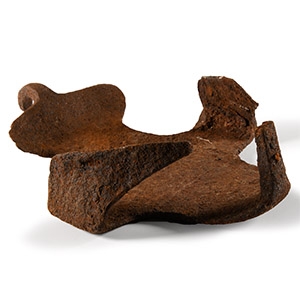
Roman Iron 'Hipposandalus' Military Horseshoe
1st-4th century A.D.Sold for (Inc. bp): £494
Iron shoe with lateral curved plates and vertical bar to the front, rear panel with hooked spur for attachment. 350 grams, 16.5 cm
From a collection acquired on the UK art market from various auction houses and collections mostly before 2000. From an important Cambridgeshire estate; thence by descent.
Hipposandals (soleae ferreae) were used on horses with injured hooves, a sort of equine orthopaedic shoe used by the mulomedicus, i.e. a Roman military veterinarian. Another important function was that to protect the hooves of the horse from injuries and damages from hard objects. The hipposandal of type 1 was formed from a sub-oval plate which tapered towards the front and rear with projections at the front, back and on either side. The heel was upturned at about 45 degrees and flared outwards. It would have terminated with a downward facing hook, now missing. The base of the sole was flat.
