Loading, please wait...

Western Asiatic Silver Inlay Pair with Human Heads and Animals Western Asiatic Silver Inlay Pair with Human Heads and Animals Western Asiatic Silver Inlay Pair with Human Heads and Animals
Use mousewheel to zoom in and out, click to enlarge
Details

LOT 1039

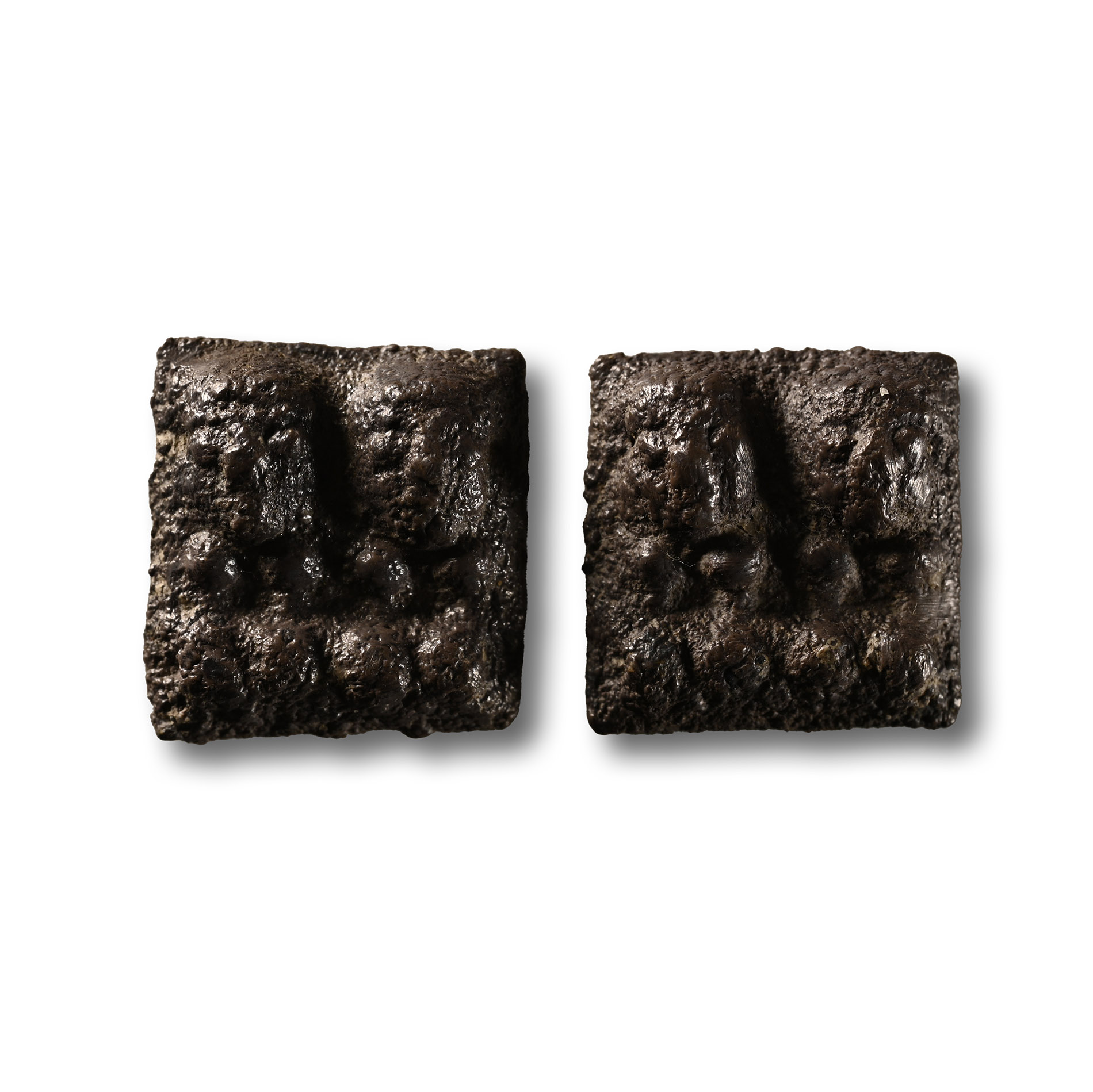
Western Asiatic Silver Inlay Pair with Human Heads and Animals

1ST MILLENNIUM B.C.

5/8 in. (2.6 grams total, 16 mm each).

Comprising two matched inlays, each with a pair of facing heads, zoomorphic motifs below. [2]

Provenance

Collected from 1970-1999.
From the collection of the late Mr S.M., London, UK.
This lot has been cleared against the Art Loss Register database, and is accompanied by an illustrated lot declaration signed by the Head of the Antiquities Department, Dr Raffaele D'Amato.

CONDITION
VETTING:

TimeLine Auctions follows a vetting process to ensure the authenticity and legality of all items, reinforcing our commitment to integrity and responsible trading. Each antiquity, antique, and coin lot undergoes thorough examination by a vetting committee of at least ten external specialists, professional trade association members, scientists, and archaeologists: Our Vetting Process


AUCTIONS:

TimeLine is a leading auction house specialising in antiquities, ancient art, collectables, natural history, coins, medals, and books. Our auctions offer museums, collectors, historians, and enthusiasts the opportunity to acquire unique and historically significant pieces.

Live Bidding

LOT 1039

Western Asiatic Silver Inlay Pair with Human Heads and Animals

Sold for (Inc. bp): £91

Print page

RELATED LOTS
  • Western Asiatic Mixed Bead Group
    Western Asiatic Mixed Bead Group
    1st millennium B.C. and later

    Sold for (Inc. bp): £52

    Including melon, tabular, annular, fusiform and other beads. 68 grams total, 2-18 mm


    Ex London, UK, collection, 1990s. This lot has been cleared against the Art Loss Register database, and is accompanied by an illustrated lot declaration signed by the Head of the Antiquities Department, Dr Raffaele D'Amato.

    Lot Details

  • Large Western Asiatic Bronze Figure of a Bull
    Large Western Asiatic Bronze Figure of a Bull
    Circa 10th century B.C.

    Estimate: £10,000 - 14,000 (‡+bp*)

    Opening Bid: £5,000

    A heavy example modelled in the round with slender elongated trunk, thick neck and prominent horns, vestigial ears below; Anatolian workmanship. 1.32 kg, 19.2 cm


    with Christie's, New York, 8 June 2001, no.363. Private collection, Europe. Accompanied by copies of the relevant Christie's catalogue pages. Accompanied by an academic report by Dr Raffaele D’Amato. This lot has been checked against the Interpol Database of stolen works of art and is accompanied by a search certificate number no.12414-226675. This lot has been cleared against the Art Loss Register database, and is accompanied by an illustrated lot declaration signed by the Head of the Antiquities Department, Dr Raffaele D'Amato.

    Bulls with raised horns have been found in central Anatolian royal burials. Among the sacred animals found in the royal graves of Alacahöyük, the bull and the deer are always present. This simplified figure of a young and spritely standing bull recalls the Baltimore bull and other two examples in the Cleveland Museum of Art. Images of bulls were mounted on standards, used in battlefields or in religious processions, or like in the royal graves of Alacahöyük, they were used to decorate cult furniture or shrines.

    Lot Details

  • Old Babylonian Hematite Cylinder Seal with Figures
    Old Babylonian Hematite Cylinder Seal with Figures
    Circa 1900-1700 B.C.

    Sold for (Inc. bp): £364

    Cylinder with cord and bead handles; accompanied by a copy of an old scholarly note, typed and signed by W.G. Lambert, late Professor of Assyriology, University of Birmingham, 1970-1993, which states: 'Cylinder Seal of Hematite, 26.5 x 15 mm. The design consists of two pairs of figures. The one consists of two standing figures: the one on the right is a deity, whether male or female is not clear, wearing a smooth hat and a long robe open at the front from which one leg projects. One hand is held at the waist, the other grasps a scimitar. Facing is a nude male figure holding a small bucket in one hand and a small vessel in the other, apparently to sprinkle water from the bucket. It is not known if this figures is meant as a human priest or a minor god. Between this pair in the sky are three dots. The other pair consists of a victor wearing dress that only reaches the knees. His feet are apart, and his one raised hand holds a weapon, while in the other is a seven-fold item, either meant as a revolving weapon, or as a 'multiple club'. (Some have suggested that it is a sling.) The victor's victim is kneeling, and turns back to face his oppressor and plead with raised arm. The victor's one foot rests on the leg of the victim so that he cannot escape. The identity of this victor is so far unknown. This seal is Old Babylonian, from southern Iraq or a neighbouring area, and dates from c. 1900 - 1700 B.C. Though there is some wear and corrosion, the whole design is clear.'; supplied with a museum-quality impression. 15.9 grams, 26 mm


    UK private collection, acquired 1980-1983. Accompanied by a copy of a scholarly note, typed and signed by Professor Wilfrid George Lambert in July 1990. This lot has been cleared against the Art Loss Register database, and is accompanied by an illustrated lot declaration signed by the Head of the Antiquities Department, Dr Raffaele D'Amato.

    Lot Details

Stay up-to-date with the latest from TimeLine Auctions by joining our mailing list