-
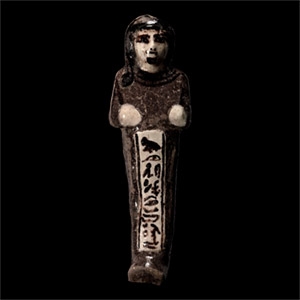
Egyptian Faience Shabti for the Fourth Son of Ramesses II, Prince Khaemwaset
New Kingdom, 19th Dynasty, 1279-1213 B.C.Sold for (Inc. bp): £2,015
The mummiform figure in brownish-black and white faience with black detailing, wearing a round wig featuring a side-lock and a broad collar, the white face displaying eyes, eyebrows, nostrils, and a short beard in black; the arms crossed, and the white-glazed hands holding hoes; a slightly raised white-glazed frontal panel containing a column of hieroglyphic text reads: 'The Osiris, the Sem-Priest, the King's Son, Khaemwaset, True of Voice'. 82.4 grams, 11.8 cm
From the private collection of George Ortiz, Geneva, Switzerland, since before 1981. Received by gift from George Ortiz to the current owner at Mr Ortiz's Geneva home in the summer of 1981. From the private collection of a UK gentleman since the early 1980s. Identified by Professor A.M. Dodson BA, MPhil, PhD, FSA, Department of Anthropology & Archaeology, University of Bristol. This lot has been cleared against the Art Loss Register database, and is accompanied by an illustrated lot declaration signed by the Head of the Antiquities Department, Dr Raffaele D'Amato.
Khaemwaset was the fourth son of Ramesses II, born to Queen Iset-Nofret. In addition to serving as the Sem-priest of Ptah at Memphis from an early age, he held various titles related to the Memphite cult, including High Priest of Ptah. The side-lock featured on all of Khaemwaset's shabtis is associated with his priestly role. Many shabtis of the prince are known, with the largest single group coming from the Serapeum at Saqqara; however, others have been found in numerous other locations. Since Khaemwaset's tomb has yet to be discovered, it appears that most of the known shabtis may have served as votive offerings in the sacred areas of the Memphite necropolis. His faience shabtis come in various colours, including green, blue, white, and black, and range in size from just under 10 cm to 15 cm in height. The distinctive glaze combination of this example, featuring a raised white-glazed panel contrasting with the darker body colour, is also found on some other 19th Dynasty shabtis (Cf. Janes, G., The Shabti Collections 3: Rochdale Arts & Heritage Service, Cheshire, 2011, pp.1-5 for those of Userhat from Sedment). -
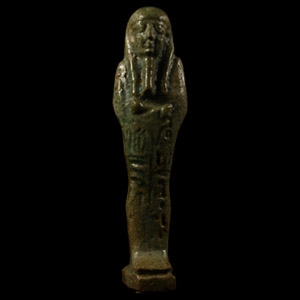
Egyptian Faience Shabti for Hor-sa-Iset
Late Period, circa 4th century B.C.Sold for (Inc. bp): £975
Of mummiform type, wearing a tripartite wig and long plaited divine beard; holding a pick in the left hand, a hoe in the right, and the cord of a seed bag hanging over his left shoulder; standing on an integral plinth, a plain back pillar terminating at the base of the wig; two vertical panels of hieroglyphic inscription to the front, including dedication: sḥḏ wsỉr ḥr sꜢ Ꜣst, ‘The illuminated, the Osiris, Hor-sa-Iset’; mounted on a custom-made display stand. 124 grams, 15.2 cm
Jacques René Fiechter, Switzerland (1920-1950). with Auction Martin, Egyptian collection of André Bircher, 1949. with Cahn Auktionen AG, Basel, 5 November 2011, no.20. Private collection, Europe. Accompanied by copies of the relevant Cahn catalogue pages. This lot is accompanied by an illustrated lot declaration signed by the Head of the Antiquities Department, Dr Raffaele D'Amato. -
.jpg)
Egyptian Bronze Offering Table with Ramesses II Cartouche
New Kingdom, circa 13th century B.C.Sold for (Inc. bp): £1,755
Hollow-formed representation of a cartouche featuring a figure of a kneeling offerant at one end; the cartouche inlaid with a panel incised with Setepenre Usermaatre and hieroglyphic text, along with two attachment holes on the underside. 118 grams, 78 mm
Acquired on the German art market, 1989-1995. with The Museum Gallery, 19 Bury Place, London, WC1, UK, 1998-2003. Property of a London based academic, 2003 to present. This lot has been cleared against the Art Loss Register database, and is accompanied by an illustrated lot declaration signed by the Head of the Antiquities Department, Dr Raffaele D'Amato.
This type of object seems to have served as a symbolic offering. Its resemblance to the primary element of an incense burner may imply a ritual connection. -
.jpg)
Egyptian Limestone Relief
Late Period, 664-332 B.C.Sold for (Inc. bp): £2,080
A fragment featuring a low-relief depiction of a male head in profile with a shoulder-length duplex wig, the upper part intricately detailed with herringbone stripes and a fringed edge, transitioning into heavy curls at the lower part, sporting a short beard and a boldly carved ear with an indented lobe, drilled for a mounting peg. 1.95 kg, 26.5 cm
Acquired in the mid 1980s-1990s. Private collection, Switzerland, thence by descent. Private collection, since the late 1990s. This lot has been checked against the Interpol Database of stolen works of art and is accompanied by a search certificate number no.12626-234637. This lot has been cleared against the Art Loss Register database, and is accompanied by an illustrated lot declaration signed by the Head of the Antiquities Department, Dr Raffaele D'Amato. -
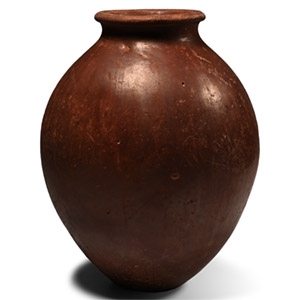
Egyptian Predynastic Globular Flask
Naqada II, 3500-3150 B.C.Sold for (Inc. bp): £1,040
A globular-shaped body with a disc base, short neck, and everted rim at the mouth; featuring a burnished red wash surface. 925 grams, 21 cm
Private collection. with Bonhams, London, 22 September 1998, no.130. European private collection. This lot is accompanied by an illustrated lot declaration signed by the Head of the Antiquities Department, Dr Raffaele D'Amato. -
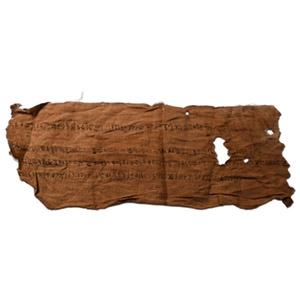
Egyptian Mummy Shroud Section with Hieratic Text
Late-Ptolemaic Period, circa 480-30 B.C.Sold for (Inc. bp): £910
A rectangular section of woven linen textile featuring four lines of neat hieratic text in black. 8 grams, 32 cm
From the collection of a gentleman, acquired on the London art market in the 1990s. This lot is accompanied by an illustrated lot declaration signed by the Head of the Antiquities Department, Dr Raffaele D'Amato.
From the fifth century B.C., mummy wrappings for the affluent frequently display lines of hieratic script—a cursive variant of Egyptian hieroglyphs used for both daily and religious writings. These often include excerpts from funerary texts like the Book of the Dead, along with prayers and invocations designed to safeguard and guide the deceased in the afterlife. These texts, sometimes accompanied by vignettes, were inscribed directly on the linen strips before or during the mummification process. Some of these bandages could be remarkably long; one example from Brussels, measuring only 6.2 cm in width, spans an incredible 26 metres. -
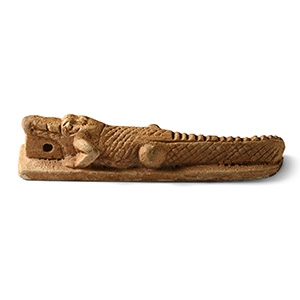
Egyptian Faience Crocodile Amulet
Late-Ptolemaic Period, 664-30 B.C.Sold for (Inc. bp): £2,600
Representing the god Sobek; detailed face and scales; standing on a rectangular plinth; pierced to the front for suspension. 13.4 grams, 74 mm
From the estate of the late Professor Dr E. Bernardo Streiff, Geneva; a distinguished collection of antiquities formed during the 1950s-1970s. with Galerie Rhéa, Zurich, Switzerland. This lot has been checked against the Interpol Database of stolen works of art and is accompanied by a search certificate number no.12629-236404. This lot has been cleared against the Art Loss Register database, and is accompanied by an illustrated lot declaration signed by the Head of the Antiquities Department, Dr Raffaele D'Amato.
Sobek is one of the most ancient and fascinating deities in the Egyptian pantheon. He is typically depicted as a crocodile or a man with the head of a crocodile, embodying various attributes related to the natural world, power, and protection. Sobek was mainly associated with water, fertility, and the Nile, along with strength and military prowess. His worship extends throughout much of ancient Egyptian history, and he was venerated not only as a force of nature but also as a god of healing, protection, and royal authority. His principal cult centres were situated in the Faiyum region, particularly the city of Crocodilopolis, and also at Kom Ombo in Upper Egypt. -
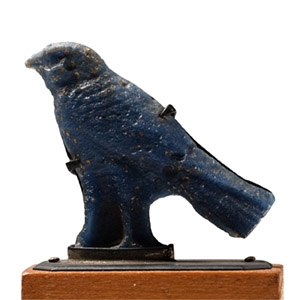
Egyptian Blue Glass Bird Inlay
Ptolemaic Period, circa 332-30 B.C.Sold for (Inc. bp): £624
Modelled in the half-round with low-relief hatched detailing; perching on a D-section base; mounted on a silver support and a wooden display stand. 18 grams total, 55 mm including stand
with Jean-Phillipe Mariaud de Serres, Paris, France. Private collection, London, UK, acquired from the above in 1992. This lot is accompanied by an illustrated lot declaration signed by the Head of the Antiquities Department, Dr Raffaele D'Amato.
The falcon inlay possibly symbolises Horus, the god of the sky, war, and protection. Horus was one of the most significant and widely worshipped gods in ancient Egyptian mythology. His importance spans multiple facets of Egyptian religion, including kingship, protection, the sky, and the sun. Depicted in various human and animal forms, Horus played a vital role in Egyptian cosmology, especially as the protector of the Pharaoh and as a representation of divine authority. -
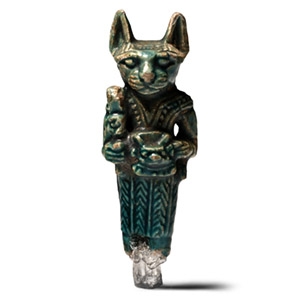
Egyptian Glazed Steatite Amulet of Bastet
Late Period, circa 664-332 B.C.Sold for (Inc. bp): £1,820
Modelled in advancing pose wearing a tight-fitting robe, cat-headed, with a sistrum in one hand and a Bes head emblem in the other; suspension loop between shoulders. 3.75 grams, 38 mm
François de Ricqlès, Paris, Archéologie, 30 September-1 October 1996, no.332. Private collection, London, UK, acquired from the above sale. Accompanied by a copy of a French cultural passport, dated 2 October 1996. This lot is accompanied by an illustrated lot declaration signed by the Head of the Antiquities Department, Dr Raffaele D'Amato.
Bastet is typically depicted with the head of a lioness or domestic cat. The cat symbolises protection, motherhood, and, later, gentleness and domesticity, qualities associated with Bastet, especially in her later evolution from a fierce lioness to a more benevolent feline goddess. The sistrum she holds is a ritual musical instrument associated with Hathor and other birth goddesses and is linked to joy, music, and divine protection. Bastet was often invoked during music and dance ceremonies, and the sistrum reinforces her role in celebration and protection. Bes was a dwarf god known for guarding households, particularly mothers and children. His image on Bastet’s amulet emphasises her protective role, especially at home and during childbirth. -
.jpg)
Egyptian Green Glazed Faience Openwork Ring
Third Intermediate Period, circa 1069-735 B.C.Sold for (Inc. bp): £1,430
With the reserved figure of a seated falcon-headed deity holding the Maat feather, a stylised lotus bloom above and below. 3.53 grams, 24.05 mm overall, 19.40 mm internal diameter (approximate size British S, USA 9, Europe 20, Japan 19)
with Christie's, London, 19 October 1994, no.133 (part). Private collection, London, UK, acquired from the above sale. This lot is accompanied by an illustrated lot declaration signed by the Head of the Antiquities Department, Dr Raffaele D'Amato. -
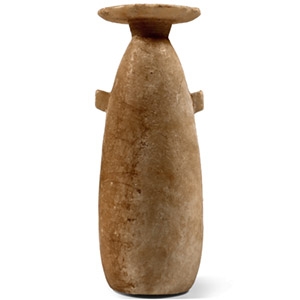
Phoenician Alabastron with Handles
6th-5th century B.C.Sold for (Inc. bp): £1,053
Comprising a slender alabaster piriform body and two lateral lug handles, conical neck with broad everted rim. 650 grams, 19.7 cm high
Giusfredi collection, 1980s. Swiss private collection, acquired May 1999. This lot is accompanied by an illustrated lot declaration signed by the Head of the Antiquities Department, Dr Raffaele D'Amato. -
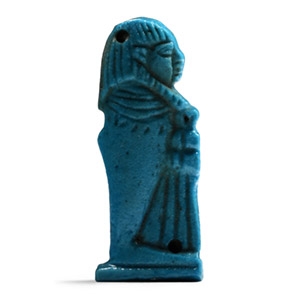
Egyptian Turquoise Glazed Faience Amulet of Imsety
Late Period, circa 664-332 B.C.Sold for (Inc. bp): £468
Flat-backed depiction of Imsety, one of the four sons of Horus, wearing a finely detailed tripartite wig, a broad collar, and holding a length of folded cloth. 3.66 grams, 36 mm
with Ancient World Arts, New York, USA. Private collection, London, UK, acquired from the above in 1994. This lot is accompanied by an illustrated lot declaration signed by the Head of the Antiquities Department, Dr Raffaele D'Amato.
The Four Sons of Horus were deities responsible for protecting the deceased's internal organs. The human-headed Imsety protected the liver, the baboon-headed Hapy protected the lungs, the jackal-headed Duamutef protected the stomach, and the falcon-headed Qebehsenuef protected the intestines. Amulets depicting these deities were placed within the mummy wrappings.

