
Loading, please wait...
LOT 1211
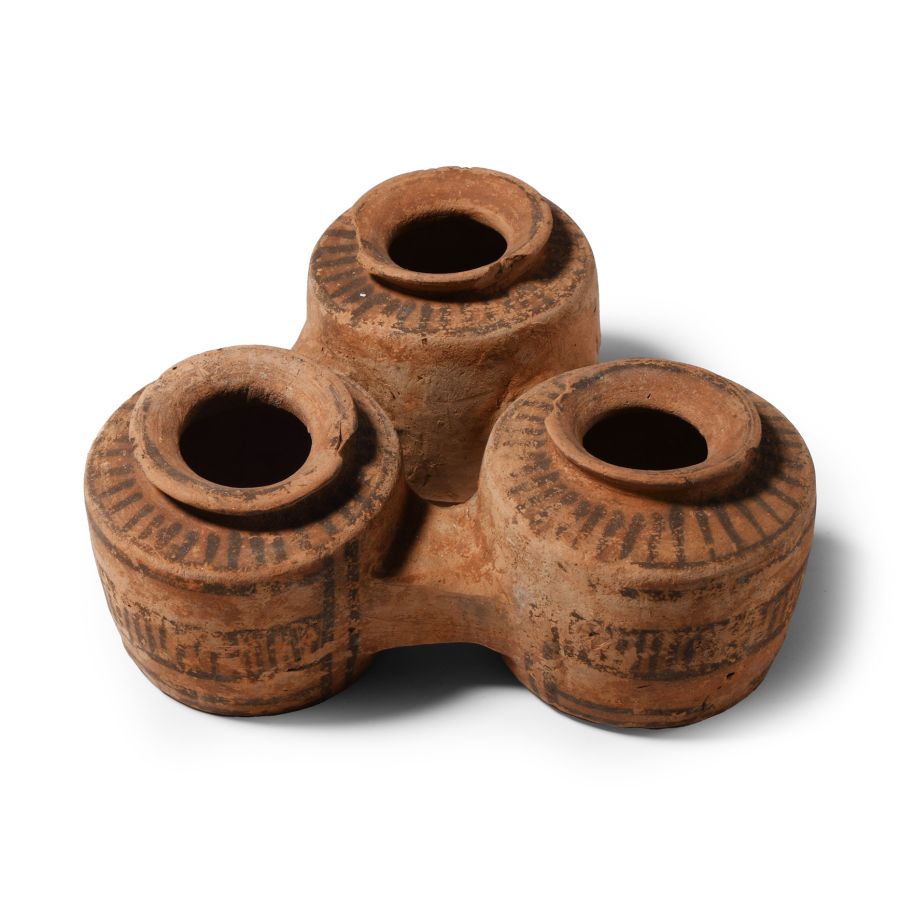
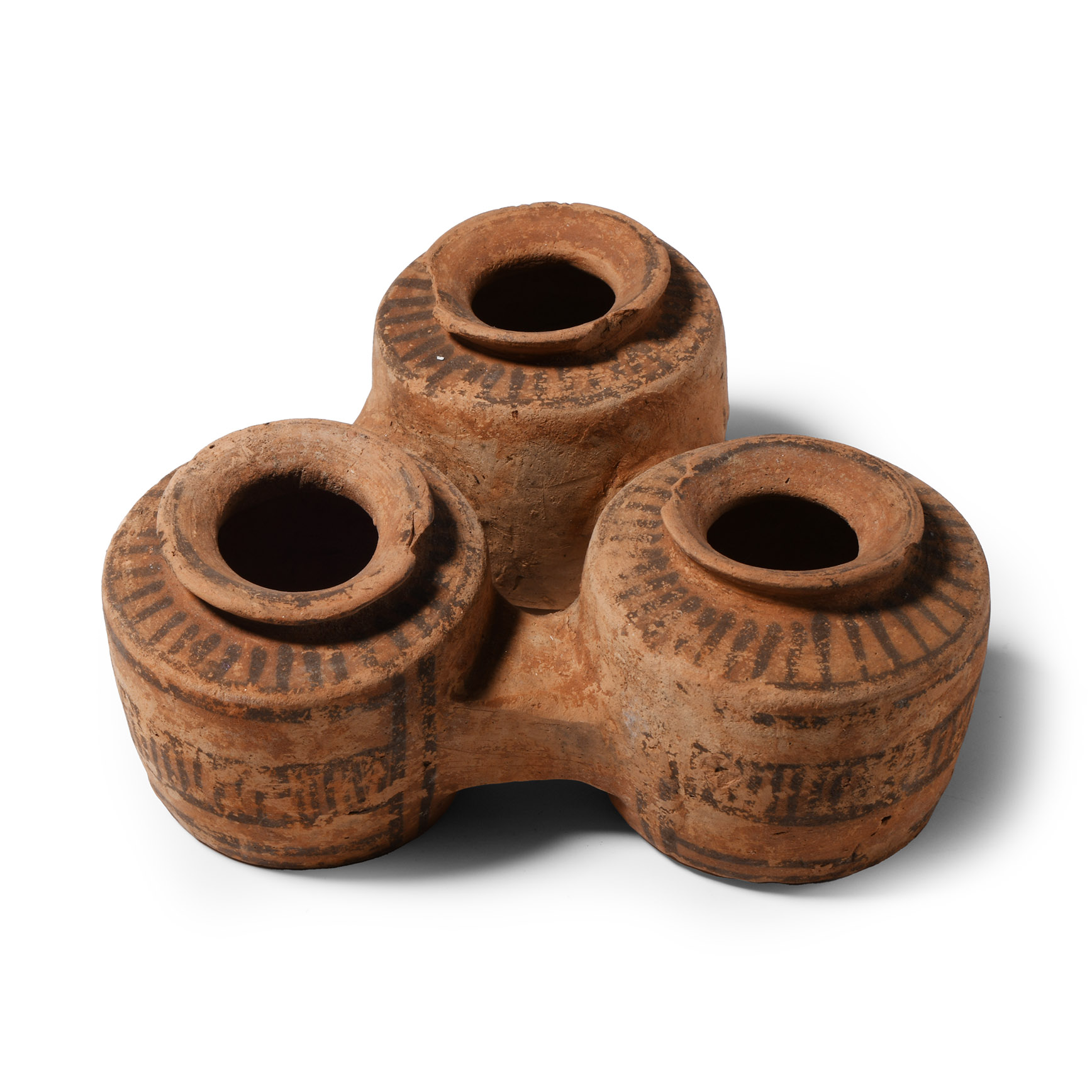
Western Asiatic Painted Terracotta Kernos
1ST MILLENNIUM B.C.
5 1/8 in. (350 grams, 13 cm).
Three drum-shaped ceramic vessels each with a flared rim and flat underside, connected by spurs at the equator; painted linear motifs to the mouths, shoulders and sidewalls. [No Reserve]
ProvenanceFrom a collection acquired on the UK art market from various auction houses and collections mostly before 2000.
From an important Cambridgeshire estate; thence by descent.
Cf. similar if more elaborate item in the Metropolitan Museum of Art under accession no.74.51.661.
FootnotesIn the typology of ancient Greek pottery, the kernos (κέρνος or κέρχνος, plural kernoi) was a stone tray to which were attached several small vessels for holding offerings. Its unusual design is described in literary sources, which also list the ritual ingredients it might contain. The kernos was used primarily in the cults of Demeter and Kore, and of Cybele and Attis.
CONDITIONTimeLine Auctions follows a vetting process to ensure the authenticity and legality of all items, reinforcing our commitment to integrity and responsible trading. Each antiquity, antique, and coin lot undergoes thorough examination by a vetting committee of at least ten external specialists, professional trade association members, scientists, and archaeologists: Our Vetting Process
AUCTIONS:
TimeLine is a leading auction house specialising in antiquities, ancient art, collectables, natural history, coins, medals, and books. Our auctions offer museums, collectors, historians, and enthusiasts the opportunity to acquire unique and historically significant pieces.
-
.jpg)
Sassanian Carnelian Stamp Seal
3rd-7th century A.D.Sold for (Inc. bp): £26
Composed of a small plano-convex body engraved with a ritualistic figure or symbol to the base; drilled for suspension. 1.19 grams, 10 mm
UK gallery, early 2000s.
According to some scholars, these seals originated as brands for cattle and contain elaborated hereditary notes. According to others they could represent monograms or Neshan (rank badges) or rank insignia. The crescent can be also associated with Zoroastrian shrines. -
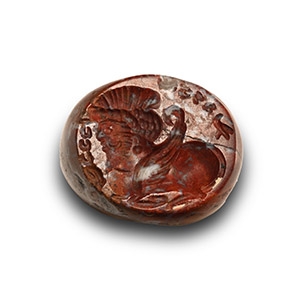
Sassanian Red Jasper Stamp Seal with Human-Headed Bull
4th-5th century A.D.Estimate: £2,000 - 3,000 (+bp*)
Opening Bid: £1,111
Plano-convex seal with intaglio crouching Gopatshah bull with a man's head, crowned, and small wing to his shoulder; Pahlavi inscription 'pst'n 'L yzd' (reliance on god); supplied with a museum-quality impression. 5.96 grams, 18 mm
Acquired between 1980-1983. From the 'Empire' collection, an important UK private collection of seals, no.13. Accompanied by a copy of an old typed cataloguing page signed by A D H Bivar. This lot has been checked against the Interpol Database of stolen works of art and is accompanied by a search certificate number no.12128-217083. -
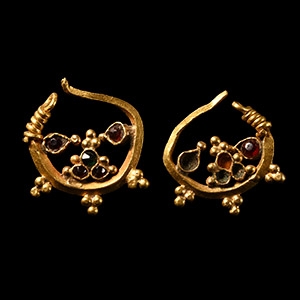
Western Asiatic Gold Gem-Set Earrings
2nd-4th century A.D.Estimate: £400 - 600 (+bp*)
Opening Bid: £200
Comprising two diamond-section penannular hoops with loops; each with three granulated pyramids to the lower edge; the centre of the hoop with a triple-cell set with one green and two red glass (?) gems with granulated outer edges, flanked by two teardrop-shaped cells set with a red glass (?) gem. 2.76 grams total, 19-21 mm
From a late Japanese specialist collector, 1970-2000s.
