
Loading, please wait...
_900x900.jpg "Western Asiatic Orange Jasper Cylinder Seal with Animals")
_200x200.jpg "Western Asiatic Orange Jasper Cylinder Seal with Animals")
.jpg "Western Asiatic Orange Jasper Cylinder Seal with Animals")
LOT 1274
Western Asiatic Orange Jasper Cylinder Seal with Animals
2ND-1ST MILLENNIUM B.C.
1 in. (4.6 grams, 24 mm).
With incised frieze of birds and animals in a landscape, guilloche borders above and below. [No Reserve]
ProvenanceAcquired 1970s-1996.
Property of a North American collector; collection no.015.
London collection, 2016.
Cf. Teissier, B., Ancient Near Eastern Cylinder Seals in the Marcopoli Collection, Berkeley, 1984, item 607, for type.
CONDITIONTimeLine Auctions follows a vetting process to ensure the authenticity and legality of all items, reinforcing our commitment to integrity and responsible trading. Each antiquity, antique, and coin lot undergoes thorough examination by a vetting committee of at least ten external specialists, professional trade association members, scientists, and archaeologists: Our Vetting Process
AUCTIONS:
TimeLine is a leading auction house specialising in antiquities, ancient art, collectables, natural history, coins, medals, and books. Our auctions offer museums, collectors, historians, and enthusiasts the opportunity to acquire unique and historically significant pieces.
LOT 1274
Western Asiatic Orange Jasper Cylinder Seal with Animals
Sold for (Inc. bp): £260
-
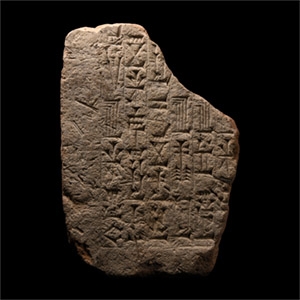
Temple Brick Section of Nebuchadnezzar II, King of Babylon
Circa 604-562 B.C.Sold for (Inc. bp): £3,250
Fragment of a rectangular ceramic brick with remains of six columns of cuneiform text with broad margins. 1 kg, 18 cm
From the K.H. Wilson collection, Basildon, UK, before 1991. Property of a Cambridgeshire, UK, gentleman. Accompanied by an information sheet, translation, and original signed letter from Dr I L Finkel at the British Museum dated 18 March 1991.
The construction of the Hanging Gardens of Babylon and the destruction of Jerusalem's temple are ascribed to Nebuchadnezzar II. He is featured in the Book of Daniel and is mentioned in several other books of the Bible. -
.jpg)
Babylonian Cuneiform Clay Tablet
Circa 2000 B.C.Sold for (Inc. bp): £468
Pillow-shaped and bearing ten horizontal lines of cuneiform text to the principal face with one vertical line to the side. 60 grams, 58 mm
Acquired before 1990s/early 2000s. From the family collection of Jack Lyttle (1944-2023), Kilmacolm, Scotland; thence by descent to his granddaughter. Property of an East Sussex, UK, gentleman. -
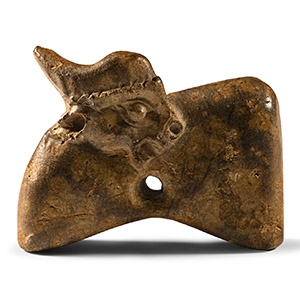
Elamite Recumbent Bull Pendant
1st millennium B.C.Estimate: £400 - 600 (+bp*)
Opening Bid: £180
Carved in the round with D-shaped body, head reversed with open mouth and domed eye, pierced at the chest. 38 grams, 50 mm
with a London, UK gallery, 1971-early 2000s.
