
Loading, please wait...
_900x900.jpg "Western Asiatic Mixed Bead Necklace String")
_200x200.jpg "Western Asiatic Mixed Bead Necklace String")
.jpg "Western Asiatic Mixed Bead Necklace String")
LOT 1336
Western Asiatic Mixed Bead Necklace String
1ST MILLENNIUM B.C. AND LATER
11 7/8 in. (27.7 grams, 30 cm).
Restrung designer necklace string of ceramic and stone beads of mainly oblate form, central feature a large cylindrical and annular bead; restrung. [No Reserve]
ProvenanceAcquired 1980-2015.
Ex Abelita family collection.
TimeLine Auctions follows a vetting process to ensure the authenticity and legality of all items, reinforcing our commitment to integrity and responsible trading. Each antiquity, antique, and coin lot undergoes thorough examination by a vetting committee of at least ten external specialists, professional trade association members, scientists, and archaeologists: Our Vetting Process
AUCTIONS:
TimeLine is a leading auction house specialising in antiquities, ancient art, collectables, natural history, coins, medals, and books. Our auctions offer museums, collectors, historians, and enthusiasts the opportunity to acquire unique and historically significant pieces.
-
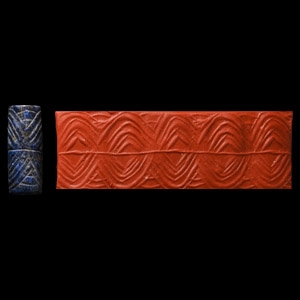
Western Asiatic Lapis Lazuli Cylinder Seal
3rd-2nd millennium B.C.Sold for (Inc. bp): £130
With incuse design of concentric lozenges and median line. 1.93 grams, 18 mm
Acquired in the 1980s-2000s. From an important London, UK, collection. -
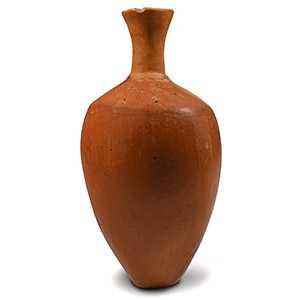
Amlash Terracotta Vessel
1st millennium B.C.Sold for (Inc. bp): £65
Comprising a piriform body and trumpet-shaped narrow neck, flat base. 398 grams, 21.8 cm
From a Mayfair gallery 1990s. Ex London, UK, collection. This lot has been cleared against the Art Loss Register database, and is accompanied by an illustrated lot declaration signed by the Head of the Antiquities Department, Dr Raffaele D'Amato. -
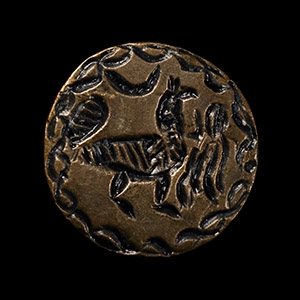
Central Asian Bronze Stamp Seal Matrix with Standing Bird
Circa 500-100 B.C.Sold for (Inc. bp): £104
Discoid with a standing bird to the centre and loop to the rear; accompanied by typed and signed note by the late W.G. Lambert, Professor of Assyriology at the University of Birmingham, 1970-1993, which states: 'Stamp Seal of Bronze 24 x 24 x 13 mm. This is a flat disc cut from sheet metal with a pierced handle from the same material fixed on the back. It is round. The design shows a standing bird in the centre, something not yet identified in front of it and above it a crescent and to the side a hatched shape. The whole design is put within a circle of intertwining band. This is a rare seal from west central Asia, c. 500-100 B.C. It is in excellent condition.' 7.9 grams, 25 mm
Ex collection of a late London gentleman, 1990s. Accompanied by an original typed and signed scholarly note by the late W.G. Lambert, Professor of Assyriology at the University of Birmingham, 1970-1993. This lot has been cleared against the Art Loss Register database, and is accompanied by an illustrated lot declaration signed by the Head of the Antiquities Department, Dr Raffaele D'Amato.
