
Loading, please wait...

LOT 1399
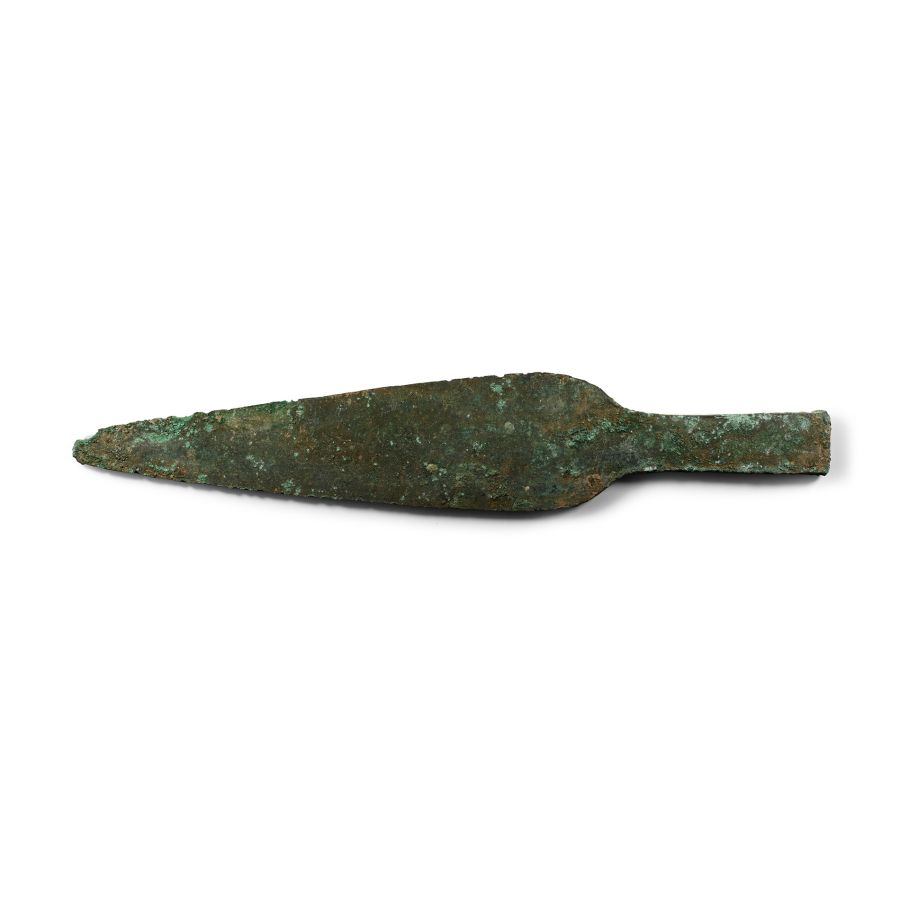
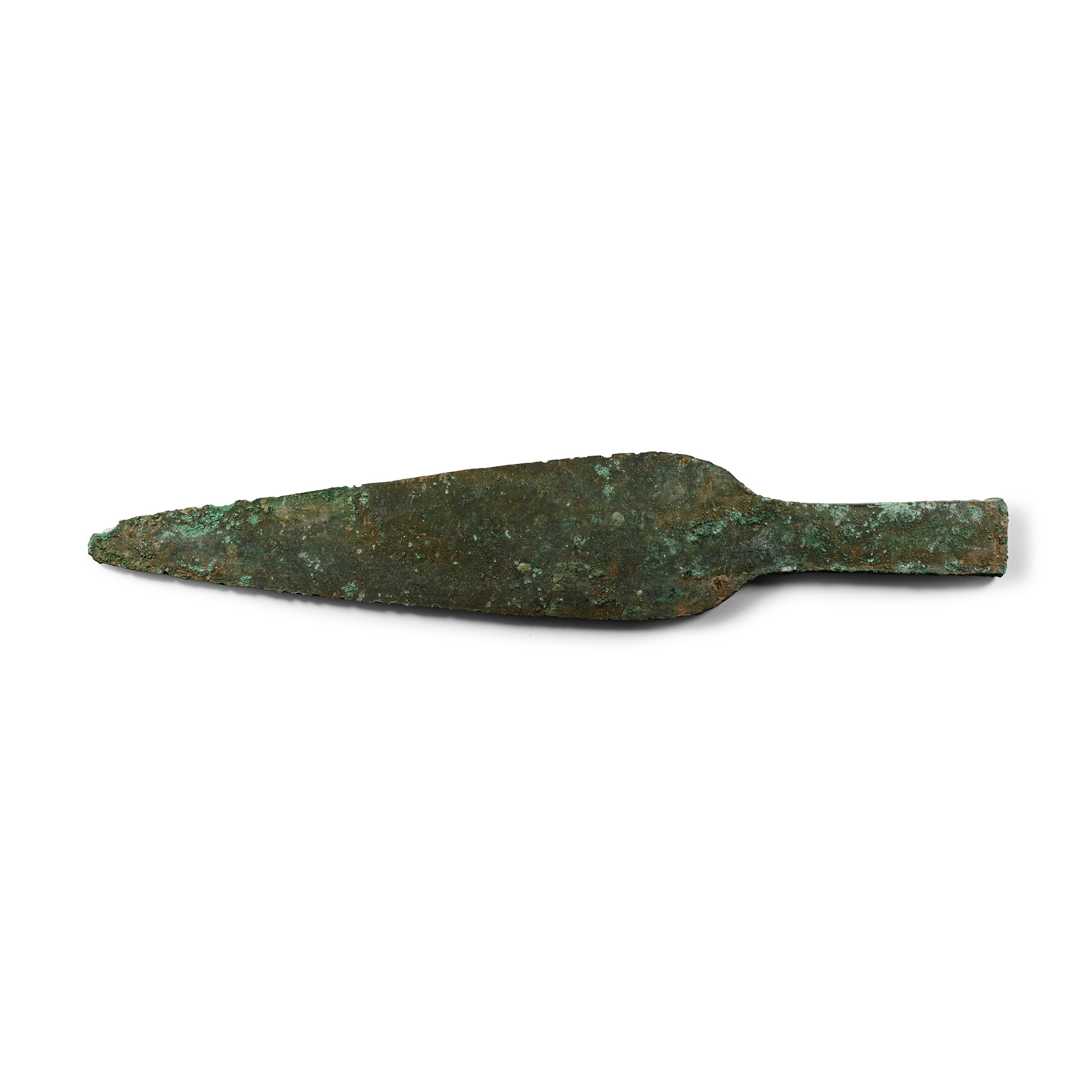
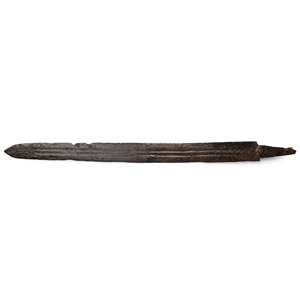
Western Asiatic Integral Hilted Bronze Short Sword
LATE 3RD-2ND MILLENNIUM B.C.
17 1/8 in. (713 grams, 43.5 cm).
With a broad, lentoid-section flat blade, rounded tip, sloping sides, well marked shoulders with wide but short tang.
ProvenanceAcquired 1980-2015.
Ex Abelita family collection.
This lot is accompanied by an illustrated lot declaration signed by the Head of the Antiquities Department, Dr Raffaele D’Amato.
This lot is accompanied by an illustrated lot declaration signed by the Head of the Antiquities Department, Dr Raffaele D'Amato.
Cf. Inassa, M., 'Daggers in ancient Mesopotamia' in Journal of Archaeological Research and Studies, vol.2, March 2018, pp.1-27, fig.1, p.26.
FootnotesThe sword finds similarity with a one from the Royal Cemetery of Ur. This is the most primitive form of dagger, consisting of a simple, pointed blade having slightly convex outline shoulders sloping to a short tang which has no rivets, and was probably hafted to wood with bitumen.
CONDITIONTimeLine Auctions follows a vetting process to ensure the authenticity and legality of all items, reinforcing our commitment to integrity and responsible trading. Each antiquity, antique, and coin lot undergoes thorough examination by a vetting committee of at least ten external specialists, professional trade association members, scientists, and archaeologists: Our Vetting Process
AUCTIONS:
TimeLine is a leading auction house specialising in antiquities, ancient art, collectables, natural history, coins, medals, and books. Our auctions offer museums, collectors, historians, and enthusiasts the opportunity to acquire unique and historically significant pieces.
-
Byzantine 'Greek Fire' Ceramic Fire Bomb or Hand Grenade
9th-11th century A.D.Sold for (Inc. bp): £117
Piriform in profile,incised concentric rings on the shoulder; intended to be filled with explosive liquid and a wick, and used as a hand grenade. 604 grams, 14 cm
From an important specialist collection, London, UK, 1990s onwards. Accompanied by an academic paper by military specialist Dr Raffaele D'Amato, dated 15 July 2019 and titled 'Eastern Roman Empire - Greek Fire Bomb or Hand Grenade (μεσαίον kακάβιον) 9th-11th century AD'.
Apart from the use of siphons or manual flame-throwers called cheirosiphona, special corps of Roman soldiers employed terracotta grenades, in the form of small jars, abundantly evidenced in archaeological excavations. They were called μεσαία kακαβιά or κυτροκακάβια where the former had a bulbous shape and the latter a more cylindrical form. -
Luristan Comb-Backed Axehead
2nd-1st millennium B.C.Estimate: £250 - 350 (+bp*)
Opening Bid: £125
With ribbed openwork socket terminating in a butt formed of four cones, the blade expanding from the socket. 400 grams, 21 cm
From a London collection, early 2000s. -
Roman Iron Spatha Sword
2nd-4th century A.D.Sold for (Inc. bp): £2,340
A double-edged blade of Lauriacum Hromówka typology with blood channels running down most of its length on both sides, parallel cutting edges tapering towards the triangular point, massive tapering tang with a bronze nail for the fastening of the pommel, and an ancient repair at the base of the tang with a flattened domed rivet. 468 grams, 70.1 cm
From the private collection of a London gentleman, from his grandfather's collection formed before the early 1970s. Accompanied by an academic report by Dr Raffaele D’Amato. This lot has been checked against the Interpol Database of stolen works of art and is accompanied by a search certificate number no.12917-245171.
Although in Latin literature the late Roman sword was often still conventionally called gladius (Ammianus Marcellinus, Historiae, XIX, 6; Passio SS. Rogatiani et Donatiani, 1859, p.323), the main kind of blade of the 3rd and 4th century Roman soldier belongs to the type so-called spatha (Scriptores Historia Augusta, Divus Claudius, XXV,7,5; 8,5) which directly derived from the long cutting Celtic sword of the La Tène III period, already used by the cavalrymen and auxilia of the previous ages. The great spatha (spathì) of the Roman heavy infantryman was considered by Julius Africanus (Fragm., I, 1, 53) as the main weapon of the armoured legionary of Alexander Severus. The frequent clashes with Germanic warriors armed with long swords and the increased recruitment of them in the Roman army quickened a more intensive use of the spathae by the milites legionarii. These longer swords slowly replaced the shorter gladius, the double-edged sword of the imperial infantry, for all types of troops.
