
Loading, please wait...
LOT 1422
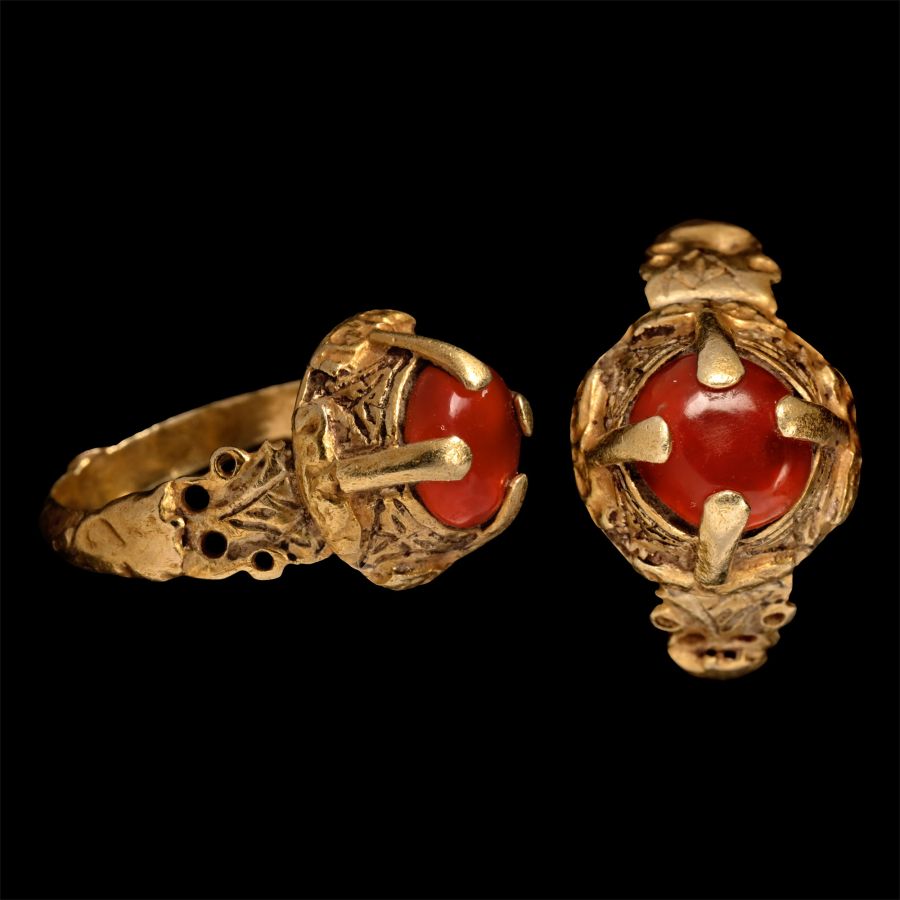
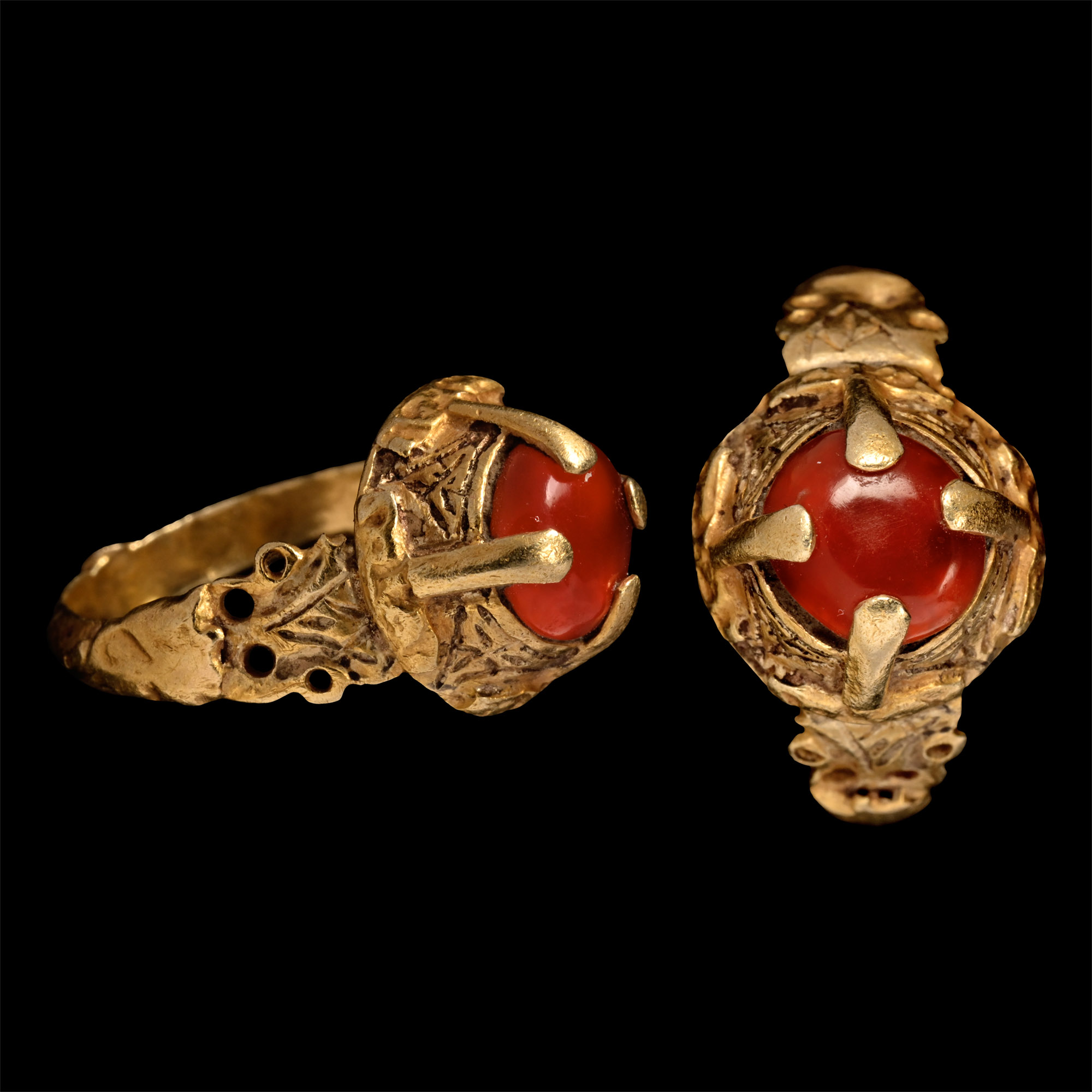
Western Asiatic Gold Ring with Cornelian Gemstone
12TH-13TH CENTURY A.D.
7/8 in. (3.51 grams, 23.66 mm overall, 15.89 mm internal diameter (approximate size British K 1/2, USA 5 1/2, Europe 10.58, Japan 10)).
D-section hoop with openwork floral shoulders, domed bezel with inset cabochon in a claw setting.
ProvenanceAcquired in the 1980s.
Private collection, Switzerland, thence by descent.
Private collection, since the late 1990s.
This lot has been cleared against the Art Loss Register database, and is accompanied by an illustrated lot declaration signed by the Head of the Antiquities Department, Dr Raffaele D'Amato.
TimeLine Auctions follows a vetting process to ensure the authenticity and legality of all items, reinforcing our commitment to integrity and responsible trading. Each antiquity, antique, and coin lot undergoes thorough examination by a vetting committee of at least ten external specialists, professional trade association members, scientists, and archaeologists: Our Vetting Process
AUCTIONS:
TimeLine is a leading auction house specialising in antiquities, ancient art, collectables, natural history, coins, medals, and books. Our auctions offer museums, collectors, historians, and enthusiasts the opportunity to acquire unique and historically significant pieces.
-

Large Western Asiatic Bronze Dagger
1800-1600 B.C.Sold for (Inc. bp): £117
Tapering blade with raised midrib developing to a short tang pierced at the finial. 218 grams, 32.5 cm
Ex London art market, 1980-1990s. This lot has been cleared against the Art Loss Register database, and is accompanied by an illustrated lot declaration signed by the Head of the Antiquities Department, Dr Raffaele D'Amato.
Around the 17th century BC, Hyksos craftsmen apparently invented daggers with an elongated, narrow blade of a subtriangular shape, sometimes with a mid-rib, but more often flat, and a handle cast together with the blade, flat, fairly wide, with a pronounced, sometimes sharply, more often smoothly, pommel and crossguard. Such daggers very quickly gained popularity in Mesopotamia and further to the east and northeast, as well as to the northwest, in the Aegean, and became almost the most widespread type of dagger in these regions up until the middle of the 1st millennium B.C. -

Amlash Terracotta Vessel with Wide Spout
1st millennium B.C. or laterSold for (Inc. bp): £52
A stylised zoomorphic bowl with bulbous body and wide U-shaped spout, two small projecting feet beneath the spout, loop handle to the rear. 465 grams, 25.3 cm
From a Mayfair gallery 1990s. Ex London, UK, collection. This lot has been cleared against the Art Loss Register database, and is accompanied by an illustrated lot declaration signed by the Head of the Antiquities Department, Dr Raffaele D'Amato. -

Sumerian Stone Lion Amulet
3rd millennium B.C.Sold for (Inc. bp): £572
Modelled in the half round as a profile head of a male lion, drilled on the underside. 14.6 grams, 30 mm
From an important gentleman's collection, London, UK, pre 1988. This lot has been cleared against the Art Loss Register database, and is accompanied by an illustrated lot declaration signed by the Head of the Antiquities Department, Dr Raffaele D'Amato.
