
Loading, please wait...


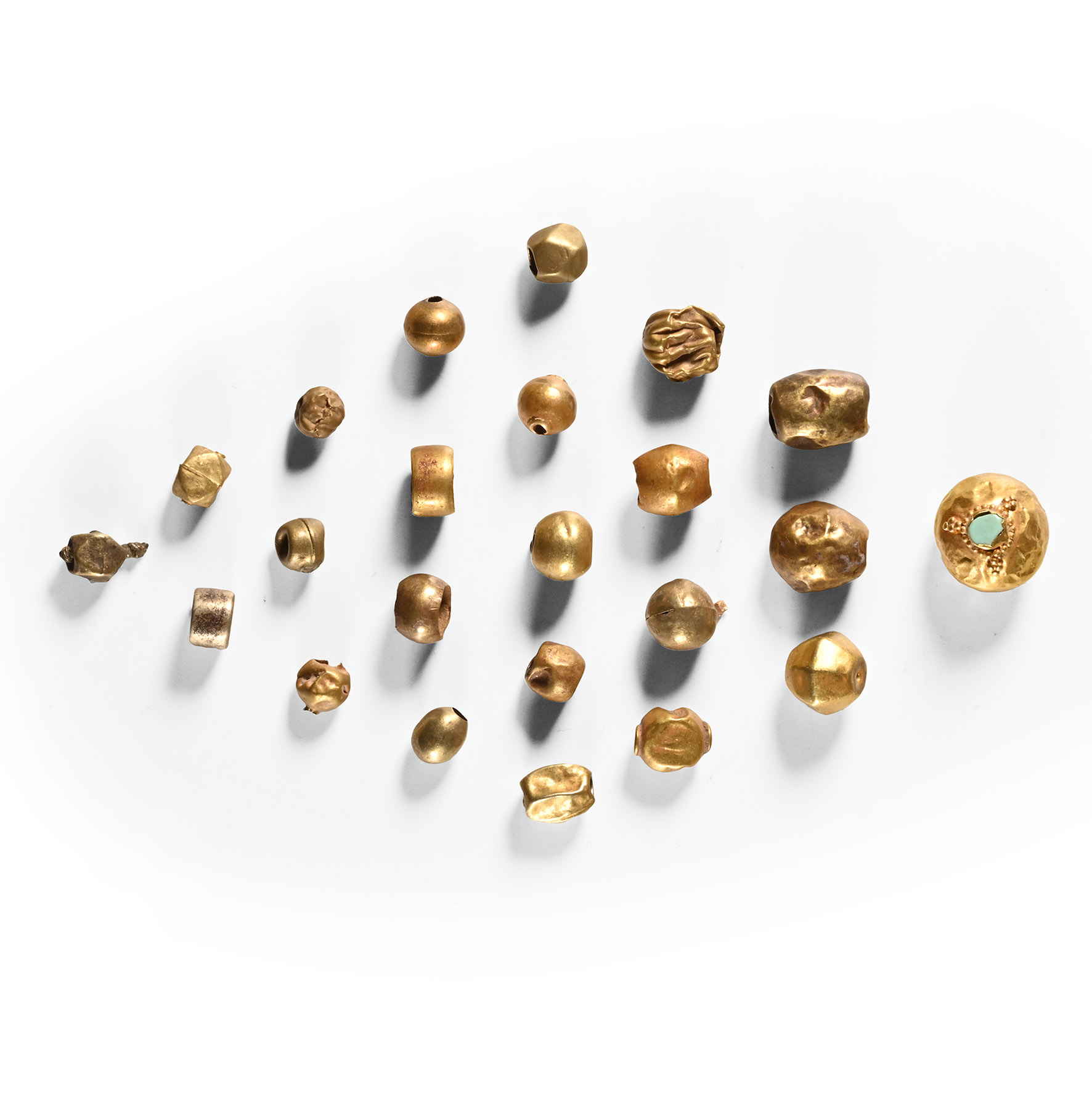
LOT 1224
Western Asiatic Gold Bead Group
2ND-1ST MILLENNIUM B.C.
1/4 - 3/8 in. (7.98 grams total, 5-12 mm).
Including spherical, biconical, barrel-shaped and other types, [23]
ProvenanceEx property of a late Japanese collector, 1970s-2000s.
CONDITIONTimeLine Auctions follows a vetting process to ensure the authenticity and legality of all items, reinforcing our commitment to integrity and responsible trading. Each antiquity, antique, and coin lot undergoes thorough examination by a vetting committee of at least ten external specialists, professional trade association members, scientists, and archaeologists: Our Vetting Process
AUCTIONS:
TimeLine is a leading auction house specialising in antiquities, ancient art, collectables, natural history, coins, medals, and books. Our auctions offer museums, collectors, historians, and enthusiasts the opportunity to acquire unique and historically significant pieces.
LOT 1224
Western Asiatic Gold Bead Group
Estimate £500 - 700€580 - 810 (for guidance only)$680 - 950 (for guidance only)
-

Aramaic Lead Magical Text Scroll Fragment
2nd-8th century A.D.Estimate: £300 - 400 (+bp*)
Opening Bid: £150
The remains of a bifacial magical lead scroll with letters written in a form of Aramaic and Greek, incised on a lead tablet preserved in a sub-rectangular fragment. 8.13 grams, 73 mm
Fine condition.
Acquired 1979-1999. London collection of the late Mr S.M., thence by descent. -

Mesopotamian Stone Butterfly Bead Necklace
4th millennium B.C.Sold for (Inc. bp): £111
Graduated group of restrung butterfly-shaped beads with labrys-shaped spacers. 29.8 grams, 37 cm
Acquired 1980-2015. Ex Abelita family collection. -

Assyrian Bronze Arm and Hand Type Brooch
Circa 7th-5th century B.C.Sold for (Inc. bp): £59
The bow decorated with circumferential grooves, one arm ending with the partially preserved wire coil; the catchplate in the form of a hand engraved with an X; accompanied by a display frame with information ticket. 186 grams total, 10 x 10.3 cm including frame
Ex Robin Symes Gallery, London, UK, 1990s. From a Leicestershire, UK, collection.
Fibulae with triangular bows (type 3 of Curtis classification) were the most common in Assyria. At least 66 bronze examples have been found at Nimrud, 32 in the graves and tombs at Ashur, 14 at Kouyunjik (some of them represented only by fragments), three at Nebbi Yunus, six at Khorsabad, three at Sharif Khan, all fragmentary, and single examples at Tell Billa and Tell al Rimah.
