
Loading, please wait...
_900x900.jpg "Western Asiatic Gold Bead Group")
_200x200.jpg "Western Asiatic Gold Bead Group")
.jpg "Western Asiatic Gold Bead Group")
LOT 1120
Western Asiatic Gold Bead Group
7TH-6TH CENTURY B.C.
1/4 - 1/2 in. (9.90 grams, 7-13 mm).
Mixed group beads of melon, oblate, and other types. [20]
ProvenanceCollected from 1969-1999.
From the collection of the late Mr S.M., London, UK.
Cf. Moscati, S., I Fenici, p.377, for a necklace with similar beads.
FootnotesIn the Phoenician civilization, there are numerous necklaces documenting a varied range of combinations of multiform beads with a prevalence of gold and silver pendants.
CONDITIONTimeLine Auctions follows a vetting process to ensure the authenticity and legality of all items, reinforcing our commitment to integrity and responsible trading. Each antiquity, antique, and coin lot undergoes thorough examination by a vetting committee of at least ten external specialists, professional trade association members, scientists, and archaeologists: Our Vetting Process
AUCTIONS:
TimeLine is a leading auction house specialising in antiquities, ancient art, collectables, natural history, coins, medals, and books. Our auctions offer museums, collectors, historians, and enthusiasts the opportunity to acquire unique and historically significant pieces.
LOT 1120
Western Asiatic Gold Bead Group
Estimate £500 - 700€580 - 810 (for guidance only)$680 - 950 (for guidance only)
-
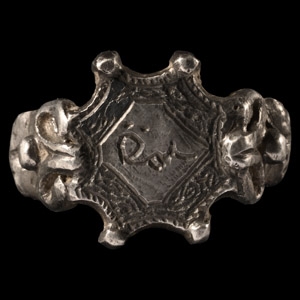
Western Asiatic Silver Ring with Inscription
Circa 15th-16th century A.D.Sold for (Inc. bp): £221
Comprising a D-section hoop with a lozenge plaque to the base, scrolled triangular plaque to each shoulder; octofoil bezel with textured field surrounding the central inscription. 4.05 grams, 21.37 mm overall, 16.86 mm internal diameter (approximate size British N, USA 6 1/2, Europe 13.72, Japan 13)
UK private collection before 2000. On the UK art market. Property of a London gentleman. -
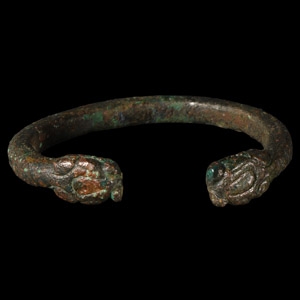
Western Asiatic Bronze Bracelet with Beast-Head Terminals
1st millennium B.C.Sold for (Inc. bp): £39
With a rounded penannular body and flattened beast-head finials with incised detailing. 47 grams, 65 mm
UK private collection before 2000. On the UK art market. Property of a London gentleman. -
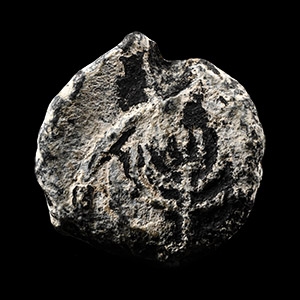
Judaean Lead Seal with Menorah
Circa 2nd century A.D.Sold for (Inc. bp): £234
The menorah design impressed to one face; impression of textile to the reverse. 3.9 grams, 13 mm
Collected from 1969-1999. From the collection of the late Mr S.M., London, UK.
