
Loading, please wait...
LOT 1177
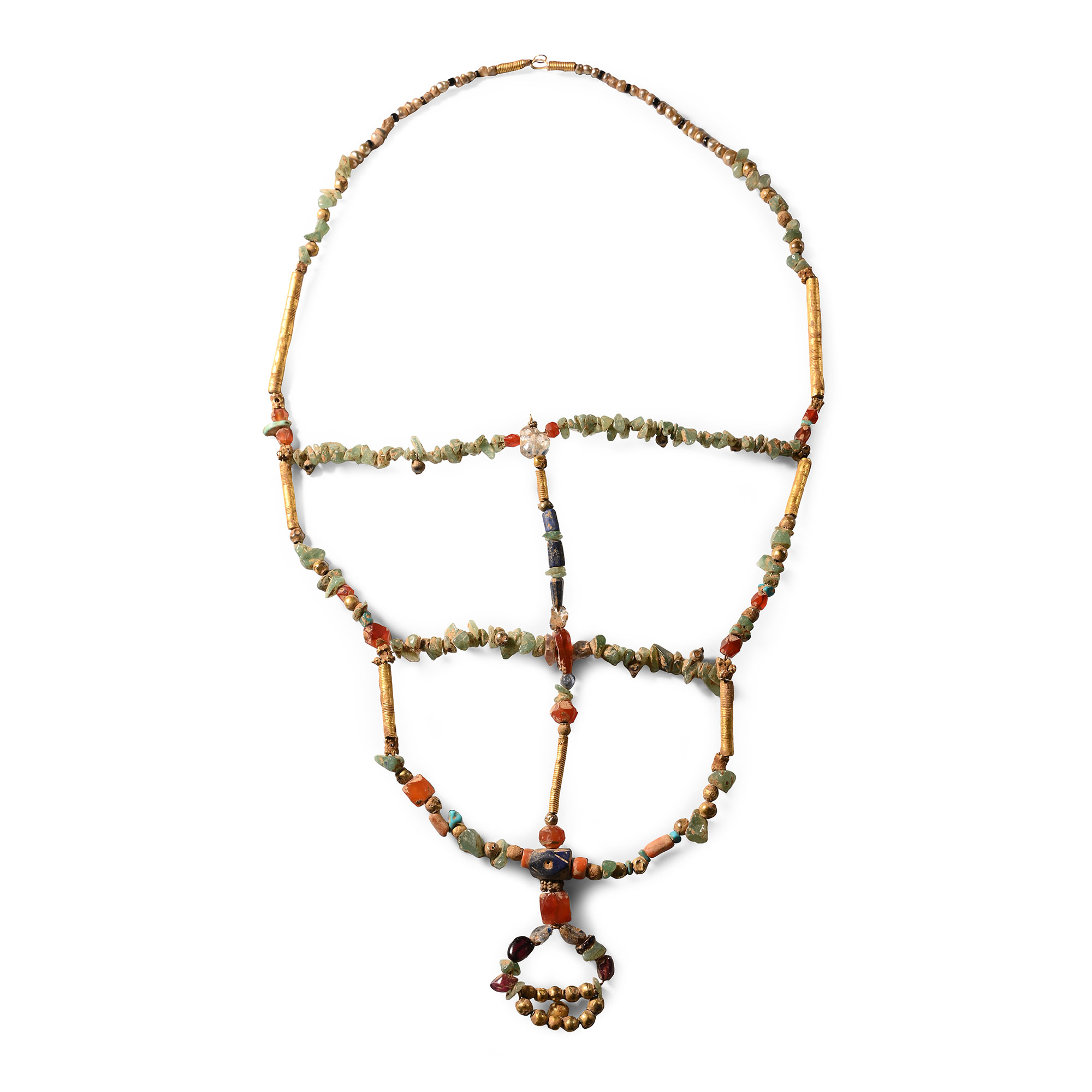
Western Asiatic Gold and Other Bead Necklace
1ST MILLENNIUM B.C.
22 3/8 in. (78 grams, 57 cm).
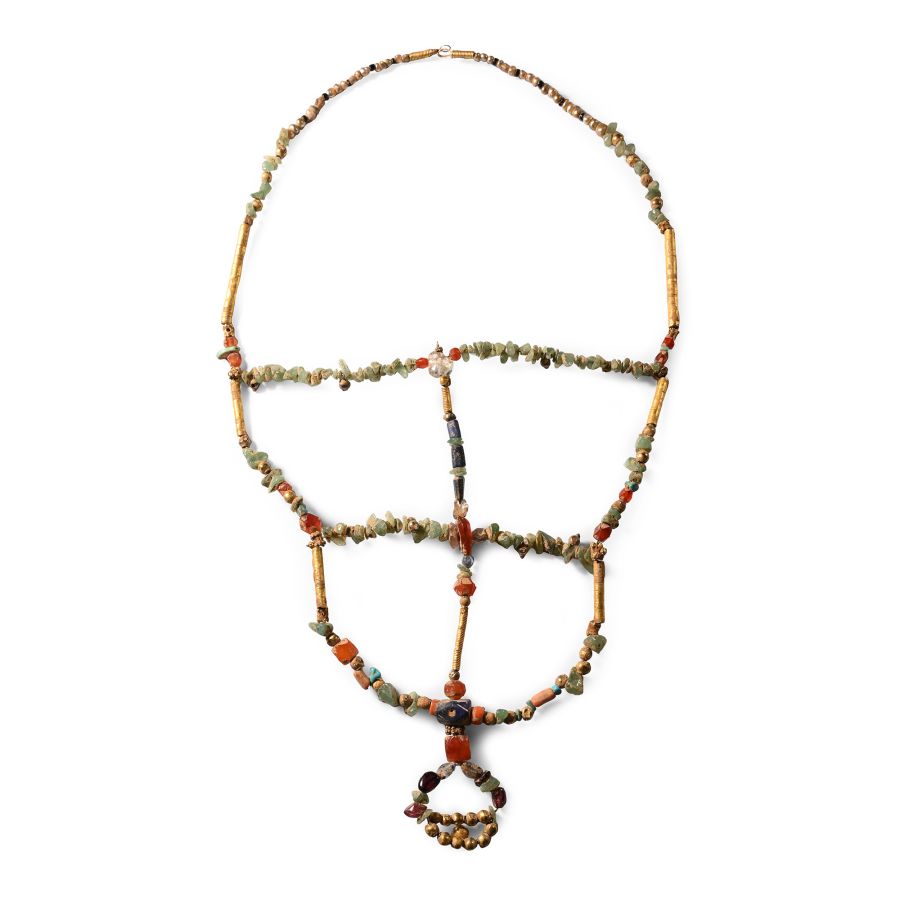
Restrung designer necklace of three strands connected by a median vertical column; comprising mainly gold tubular beads with ribbing to the outer face, polyhedral carnelian beads, irregular green glass beads, square-section lapis lazuli beads and other types; the lower node a larger polyhedral lapis lazuli bead with a loop of barrel-shaped gold beads and other types.
ProvenanceAcquired in the 1980s.
Private collection, Switzerland, thence by descent.
Private collection, since the late 1990s.
TimeLine Auctions follows a vetting process to ensure the authenticity and legality of all items, reinforcing our commitment to integrity and responsible trading. Each antiquity, antique, and coin lot undergoes thorough examination by a vetting committee of at least ten external specialists, professional trade association members, scientists, and archaeologists: Our Vetting Process
AUCTIONS:
TimeLine is a leading auction house specialising in antiquities, ancient art, collectables, natural history, coins, medals, and books. Our auctions offer museums, collectors, historians, and enthusiasts the opportunity to acquire unique and historically significant pieces.
LOT 1177
Western Asiatic Gold and Other Bead Necklace
Estimate £1,500 - 2,000€1,740 - 2,320 (for guidance only)$2,030 - 2,700 (for guidance only)
-
South Arabian Alabaster Plaque with Bull's Head
3rd-1st century B.C.Sold for (Inc. bp): £910
Comprising a square panel with a bull's head in low-relief, striated eyes and flaring nostrils, a thick tuft of hair arranged between the eyes, shallow acanthus leaf between curved horns, inscription on the rectangular space at the bottom of the panel; mounted on a custom-made display stand. 2.09 kg total, 19.8 cm including stand
UK collection, 1990s. Acquired on the UK art market, before 2000. Private collection, Mr M.V., a London-based businessman.
The presence of these representations in South Arabian cemeteries attests to the importance of the bull in the religious iconography of pre-Islamic Arabia. -
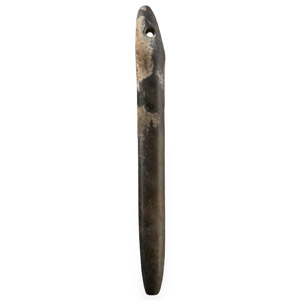
Western Asiatic Whetstone
1st millennium B.C.Sold for (Inc. bp): £156
Columnar in section with tapering tip, bulb to rear end and lateral piercing. 39 grams, 13.3 cm
Ex London, UK, gallery, 1971-early 2000s. London, UK, collection. -
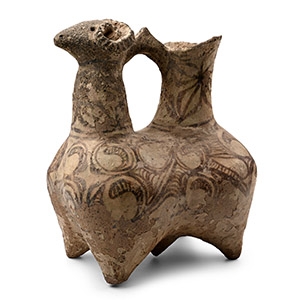
Western Asiatic Ceramic Zoomorphic Vessel
8th-9th century A.D.Estimate: £500 - 700 (+bp*)
Opening Bid: £250
Comprising four conical legs supporting a double globular body with conical neck and ram's head, spout to the rear with strainer connected by a bridging loop; applied painted hatched spiral detailing; old label to the underside: 'YAZDANI 211C LONDON'. 1.06 kg, 19.5 cm
UK collection, 1990s. Acquired on the UK art market, before 2000. Private collection, Mr M.V., a London-based businessman.
