
Loading, please wait...
_900x900.jpg "Western Asiatic Cobalt-Blue Footed Ceramic Bowl")
_200x200.jpg "Western Asiatic Cobalt-Blue Footed Ceramic Bowl")
_900x900.jpg "Western Asiatic Cobalt-Blue Footed Ceramic Bowl")
_200x200.jpg "Western Asiatic Cobalt-Blue Footed Ceramic Bowl")
.jpg "Western Asiatic Cobalt-Blue Footed Ceramic Bowl")
.jpg "Western Asiatic Cobalt-Blue Footed Ceramic Bowl")
LOT 0245
Western Asiatic Cobalt-Blue Footed Ceramic Bowl
9TH CENTURY A.D.
7 1/4 in. (498 grams, 18.5 cm).
With a carinated sidewall, rolled and everted rim, shallow foot; partial lustre-glaze to the surface with four trapezoidal panels: two with a reserved regardant bird and two with a tracery motif.
ProvenancePrivate collection, Japan, acquired prior to 1982.
Private collection, UK.
This lot has been checked against the Interpol Database of stolen works of art and is accompanied by a search certificate number no.12724-235155.
Masterpieces of Lustre-Painted Pottery: Persian Ceramics from Distant Lands (ラスタ―彩名陶展), The Asahi Shimbun Company, 1982, no. I-32, illustrated.
Exhibited:
Nihonbashi Takashimaya, Tokyo, 20–25 May 1982.
Maruei Sky Building, Nagoya, 29 May–3 June 1982.
Takashimaya, Osaka, 10–15 June 1982.
Takashimaya, Okayama, 17–22 June 1982.
TimeLine Auctions follows a vetting process to ensure the authenticity and legality of all items, reinforcing our commitment to integrity and responsible trading. Each antiquity, antique, and coin lot undergoes thorough examination by a vetting committee of at least ten external specialists, professional trade association members, scientists, and archaeologists: Our Vetting Process
AUCTIONS:
TimeLine is a leading auction house specialising in antiquities, ancient art, collectables, natural history, coins, medals, and books. Our auctions offer museums, collectors, historians, and enthusiasts the opportunity to acquire unique and historically significant pieces.
LOT 0245
Western Asiatic Cobalt-Blue Footed Ceramic Bowl
Estimate £5,000 - 7,000€5,800 - 8,120 (for guidance only)$6,750 - 9,450 (for guidance only)
-
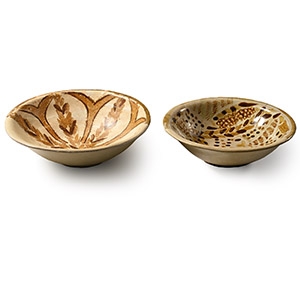
Abbasid Three-Colour Lustre Pottery Bowl Group
10th century A.D.Estimate: £1,500 - 2,000 (+bp*)
Opening Bid: £576
Of rounded form on short foot with everted lip, each with hatched decoration on the reverse; one with stylised palmettes on dense dotted and hatched ground; the other with radial composition with floral branches; restored. 598 grams total, 18-19.2 cm
with Christie's, South Kensington, Art & Textiles of The Islamic & Indian Worlds, 8 April 2011, no.142. Private collection, UK. This lot has been checked against the Interpol Database of stolen works of art and is accompanied by a search certificate number no.12723-235153. -
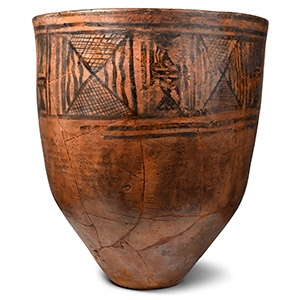
Monumental Western Asiatic Pottery Jar
Circa 3000 B.C.Estimate: £2,000 - 3,000 (+bp*)
Opening Bid: £900
Comprising a sharply tapering lower body, parallel-sided upper body and rounded rim; decorated in dark brown with thirteen square panels with central saltire on a hatched field; repaired. 17 kg, 64 cm high
with Mahboubian Gallery, London, UK, 1974. Private collection, London, UK. This lot has been checked against the Interpol Database of stolen works of art and is accompanied by search certificate number no.12972-245238. -
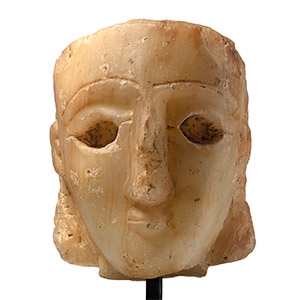
South Arabian Alabaster Head of a Female
3rd-1st century B.C.Sold for (Inc. bp): £1,170
Sculptured female head, angular nose with straight ridge, slightly rounded cheeks and triangular chin, large sockets for inlaid eyes, grooved eyebrows and high ears, long locks of hair visible below the ears; mounted on a custom-made display stand. 1.96 kg total, 18.5 cm including stand
UK collection, 1990s. Acquired on the UK art market, before 2000. Private collection, Mr M.V., a London-based businessman.
In the Arabian funerary sculptures of the period, the tops of the heads are usually cut off flat just above the hair line and left roughly tooled. The cut was due to the necessity of fitting them into niches of 'house shrines'. Large stelae with niches containing such heads were found in the Timna Cemetery.
