
Loading, please wait...
LOT 1367
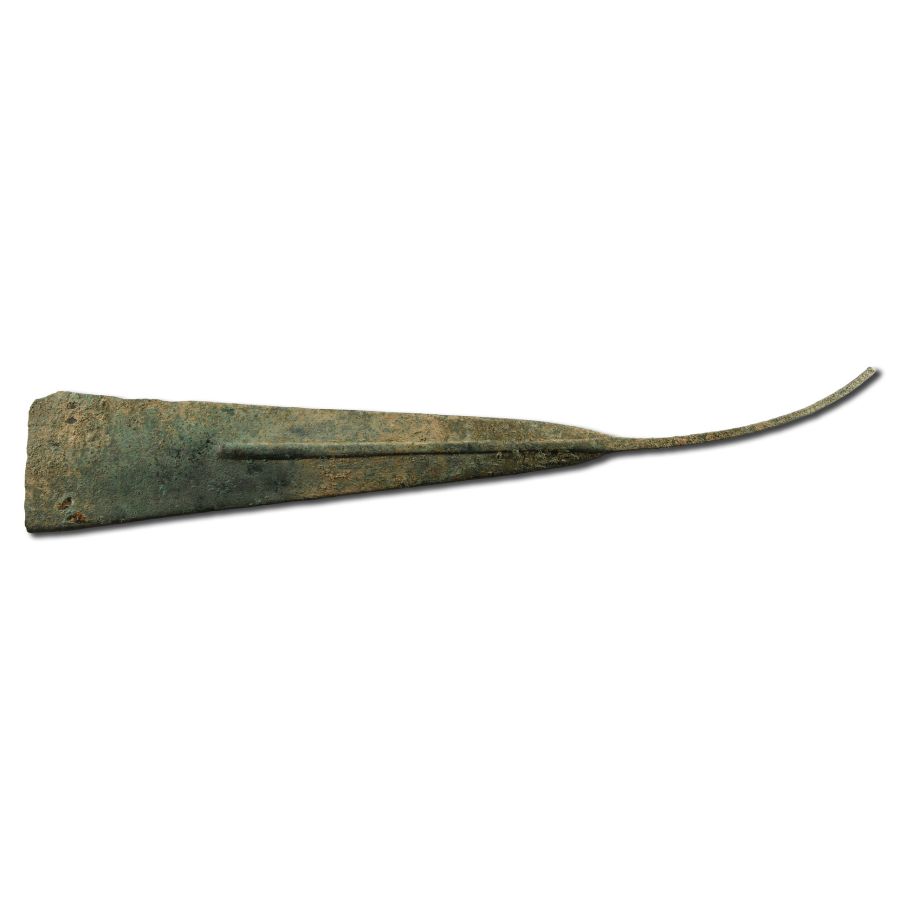
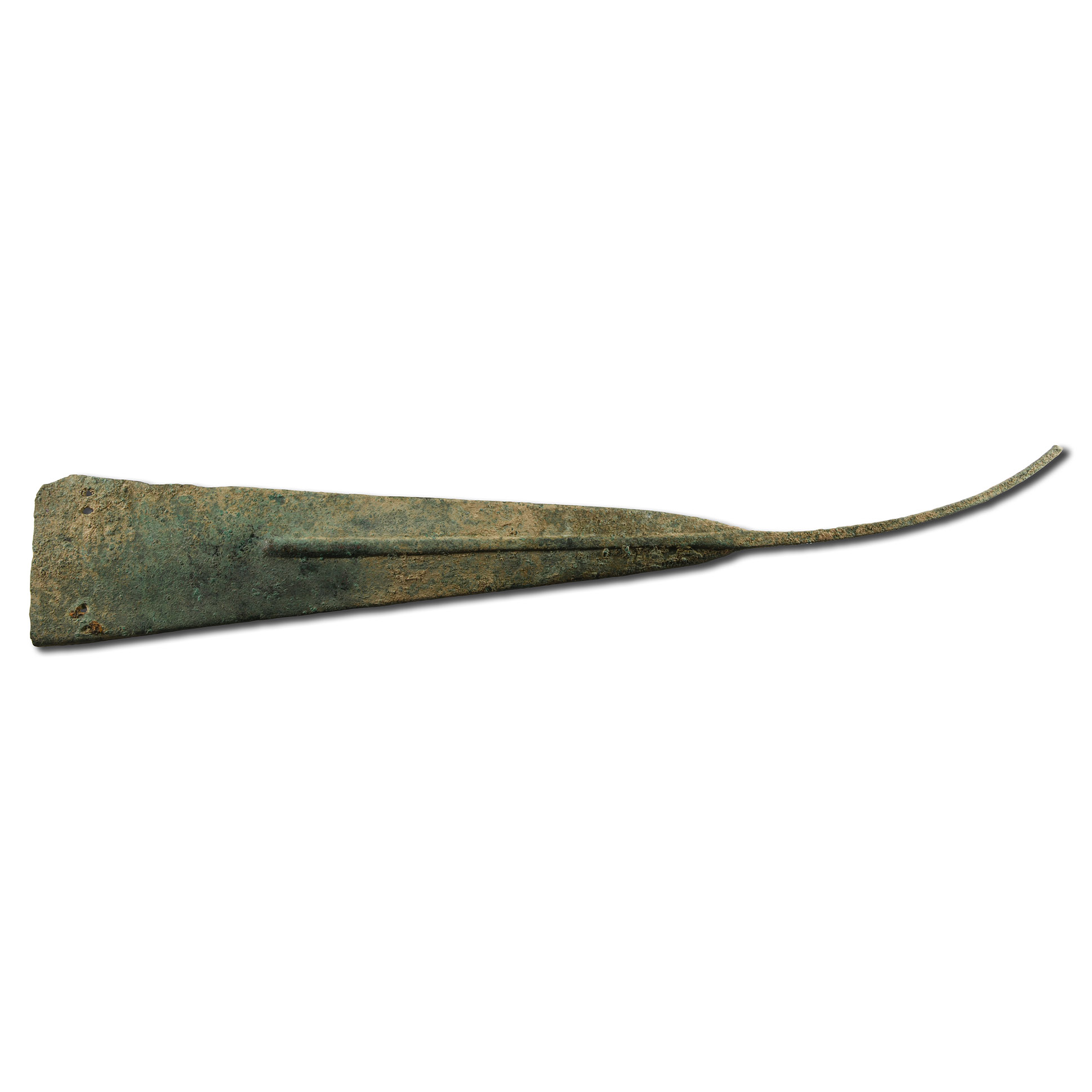
Western Asiatic Bronze Sword Sheath
2ND-1ST MILLENNIUM B.C.
22 in. (355 grams, 56 cm).
Triangular in plan, terminating in an exaggerated curving point; the outer face pierced towards the top and with a raised midrib; the convex interior possibly containing fragmentary remains of a weapon.
ProvenanceFrom a Japanese collection, 1990s.
LiteratureCf. Moorey, P., Catalogue of Ancient Persian Bronzes in the Ashmolean Museum, Oxford, 1971, no.60, for a sword contained in a similar sheath.
FootnotesScabbards with a curve at their base are shown on reliefs and seals from Anatolia from the middle of the second millennium to the 9th century B.C.
CONDITIONTimeLine Auctions follows a vetting process to ensure the authenticity and legality of all items, reinforcing our commitment to integrity and responsible trading. Each antiquity, antique, and coin lot undergoes thorough examination by a vetting committee of at least ten external specialists, professional trade association members, scientists, and archaeologists: Our Vetting Process
AUCTIONS:
TimeLine is a leading auction house specialising in antiquities, ancient art, collectables, natural history, coins, medals, and books. Our auctions offer museums, collectors, historians, and enthusiasts the opportunity to acquire unique and historically significant pieces.
-
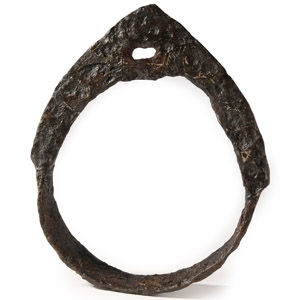
Viking Age Iron Stirrup with Silver Inlay
9th-11th century A.D.Sold for (Inc. bp): £85
Comprising an ovoid body with a rectangular void to accept a strap; the lower section broad with a rib to the underside, the upper flat in section with silver inlay in geometric forms to one face. 244 grams, 16 cm
From the private collection of a London gentleman, from his grandfather's collection formed before the early 1970s. -
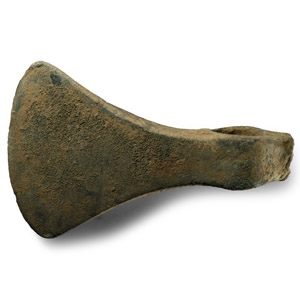
Large Western Asiatic Bronze Socketted Axehead
3rd-2nd millennium B.C.Estimate: £120 - 170 (+bp*)
Opening Bid: £60
With wide swept blade, large socket with shallow raised circumferential rib, hammer to the rear. 1.34 kg, 19 cm
Acquired 1980-2015. Ex Abelita family collection. -
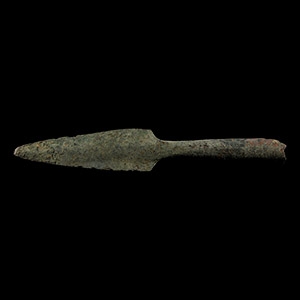
Luristan Bronze Socketted Spearhead
13th-6th century B.C.Estimate: £100 - 140 (+bp*)
Opening Bid: £50
With broad leaf-shaped blade and tapering tubular socket. 155 grams, 24 cm
Acquired 1980-2015. Ex Abelita family collection.
The spear belongs to the type VIII classified by Khorasani (spearheads with well-projecting midribs and long folded sockets) and more specifically to subtype C (with leaf-shaped blade and short hollow socket). Usually the willow-leaf blade has an almost straight shoulder base and a wide, flat midrib tapering towards the point.
