
Loading, please wait...
LOT 1376
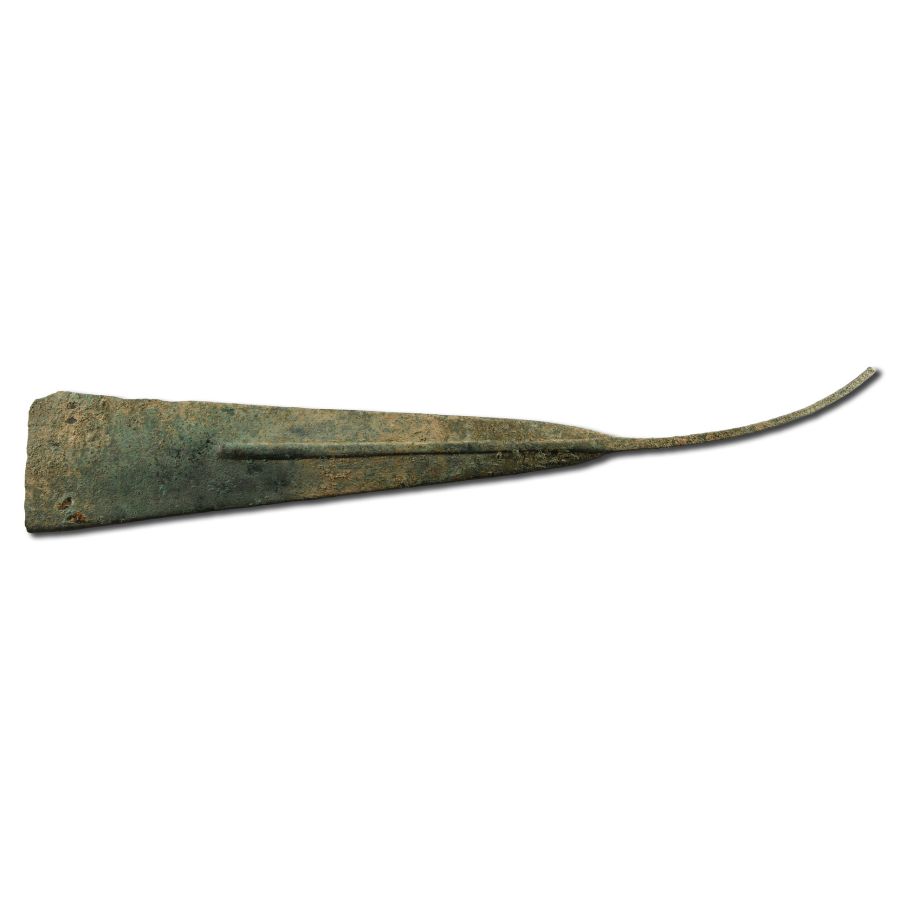
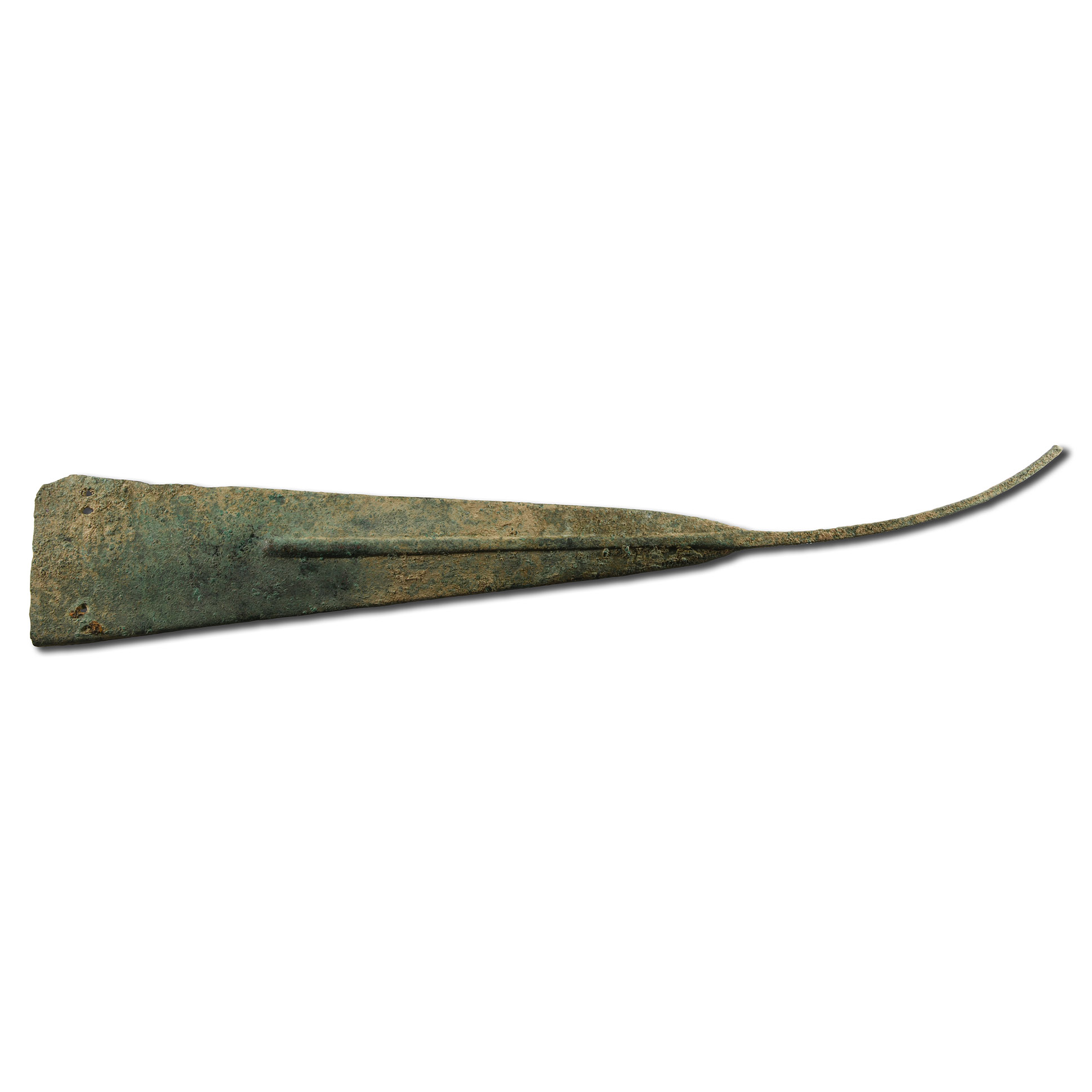
Western Asiatic Bronze Sword Sheath
2ND-1ST MILLENNIUM B.C.
22 in. (355 grams, 56 cm).
Triangular in plan, terminating in an exaggerated curving point; the outer face pierced towards the top and with a raised midrib; the convex interior possibly containing fragmentary remains of a weapon.
ProvenanceFrom a Japanese collection, 1990s.
LiteratureCf. Moorey, P., Catalogue of Ancient Persian Bronzes in the Ashmolean Museum, Oxford, 1971, no.60, for a sword contained in a similar sheath.
FootnotesScabbards with a curve at their base are shown on reliefs and seals from Anatolia from the middle of the second millennium to the 9th century B.C.
CONDITIONTimeLine Auctions follows a vetting process to ensure the authenticity and legality of all items, reinforcing our commitment to integrity and responsible trading. Each antiquity, antique, and coin lot undergoes thorough examination by a vetting committee of at least ten external specialists, professional trade association members, scientists, and archaeologists: Our Vetting Process
AUCTIONS:
TimeLine is a leading auction house specialising in antiquities, ancient art, collectables, natural history, coins, medals, and books. Our auctions offer museums, collectors, historians, and enthusiasts the opportunity to acquire unique and historically significant pieces.
LOT 1376
Western Asiatic Bronze Sword Sheath
Estimate £300 - 400€350 - 460 (for guidance only)$410 - 540 (for guidance only)
-
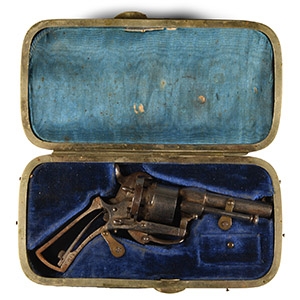
Belgian Lady's Purse Revolver
19th century A.D.Sold for (Inc. bp): £546
A Belgian-made six-shot, 5mm double action Lefaucheux type pinfire purse revolver with 52mm rifled barrel, loading gate and extractor rod to right of frame, nickel plated, folding trigger, grip scales absent; Liege proof marks to cylinder; contained in the original leather-covered twin hinged compartment purse case, one side velvet lined and moulded to receive revolver, the other with leather compartments to receive lady's accessories. 143 grams, 14cm long
Fine condition; some wear to plating and case loose. Scarce.
Acquired from J. C. Militaria. Ex property of a Kent collector.
Sold as an exempt item under Section 58 (2) of the Firearms Act, 1968, to be held as a curiosity or ornament. No license required but buyer must be over 18 years of age. -
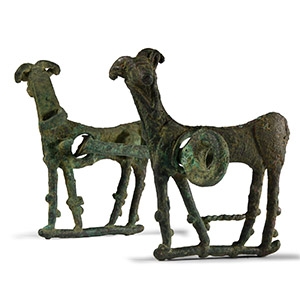
Luristan Bronze Horse Bit with Animals
Circa 11th-7th century B.C.Estimate: £1,500 - 2,000 (+bp*)
Opening Bid: £700
Comprising a pair of ram-shaped cheek-pieces with a hole through the body for the straight mouthpiece with looped terminals. 690 grams, 17.5 cm wide
From a collection formed in Paris in the 1990s.
The horse bits were transformed by Luristan people in to expressions of applied art. Metalworkers employed animal motifs, both realistic and imaginary, for their cheek-pieces. The question of whether these horse bits were for real use or only for use in a funerary context is superfluous, as signs of wear have been documented, and the goads and loops on interiors are functionally designed. The use of such horse bits is clearly documented in Assyrian reliefs of the time of Sennacherib (705-681 B.C.). -

Luristan Socketted Bronze Cudgel
13th-7th century B.C.Sold for (Inc. bp): £260
A cudgel or handle of an axe or mace reinforced at both ends by raised moulding, the handle adorned with a double spiral in relief. 473 grams, 15.5 cm wide
Fine condition.
Private family collection formed in London, mid 1980s to early 1990s.
