
Loading, please wait...
_900x900.jpg "Western Asiatic Bronze Stamp Seal")
_200x200.jpg "Western Asiatic Bronze Stamp Seal")
.jpg "Western Asiatic Bronze Stamp Seal")
LOT 1402
Western Asiatic Bronze Stamp Seal
LATE 1ST MILLENNIUM B.C.
1 3/8 in. (25 grams, 36 mm).
Comprising an ellipsoid body with lateral extensions joining to form a stem with integral suspension ring; incuse geometric design to underside. [No Reserve]
ProvenanceFrom the collection of a gentleman, acquired on the London art market in the 1990s.
This lot has been cleared against the Art Loss Register database, and is accompanied by an illustrated lot declaration signed by the Head of the Antiquities Department, Dr Raffaele D'Amato.
TimeLine Auctions follows a vetting process to ensure the authenticity and legality of all items, reinforcing our commitment to integrity and responsible trading. Each antiquity, antique, and coin lot undergoes thorough examination by a vetting committee of at least ten external specialists, professional trade association members, scientists, and archaeologists: Our Vetting Process
AUCTIONS:
TimeLine is a leading auction house specialising in antiquities, ancient art, collectables, natural history, coins, medals, and books. Our auctions offer museums, collectors, historians, and enthusiasts the opportunity to acquire unique and historically significant pieces.
-
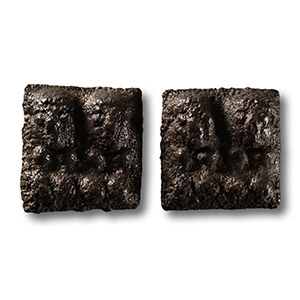
Western Asiatic Silver Inlay Pair with Human Heads and Animals
1st millennium B.C.Sold for (Inc. bp): £91
Comprising two matched inlays, each with a pair of facing heads, zoomorphic motifs below. 2.6 grams total, 16 mm each
Collected from 1970-1999. From the collection of the late Mr S.M., London, UK. This lot has been cleared against the Art Loss Register database, and is accompanied by an illustrated lot declaration signed by the Head of the Antiquities Department, Dr Raffaele D'Amato. -
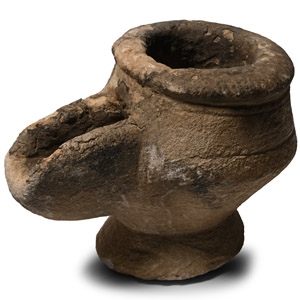
Western Asiatic Stone Libation Bowl
1st millennium B.C.Estimate: £100 - 140 (+bp*)
Opening Bid: £50
With a biconical body and flared foot set off-centre, large U-shaped spout and flat rim. 667 grams total, 11.9 cm
From a collection formed before 1988, London and Geneva. This lot has been cleared against the Art Loss Register database, and is accompanied by an illustrated lot declaration signed by the Head of the Antiquities Department, Dr Raffaele D'Amato. -
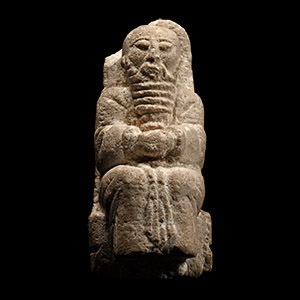
Sumerian Calcite Figure of a Priest
Uruk, 3rd millennium B.C.Sold for (Inc. bp): £1,105
Carved in the round robed figure seated on a chair; the figure with carefully dressed beard and cropped hair, wearing a long-sleeved robe reaching to his ankles with sash-cords at the front draped from his knees; the high-backed chair with D-shaped seat and reserved saltire to the rear with column and rectangular panel above; the figure with hands cupped in his lap; one foot absent. 37.8 grams, 50 mm
Ex collection of the late Mr S.M., London, UK, 1970-1990s. This lot has been cleared against the Art Loss Register database, and is accompanied by an illustrated lot declaration signed by the Head of the Antiquities Department, Dr Raffaele D'Amato.
