
Loading, please wait...
LOT 1438
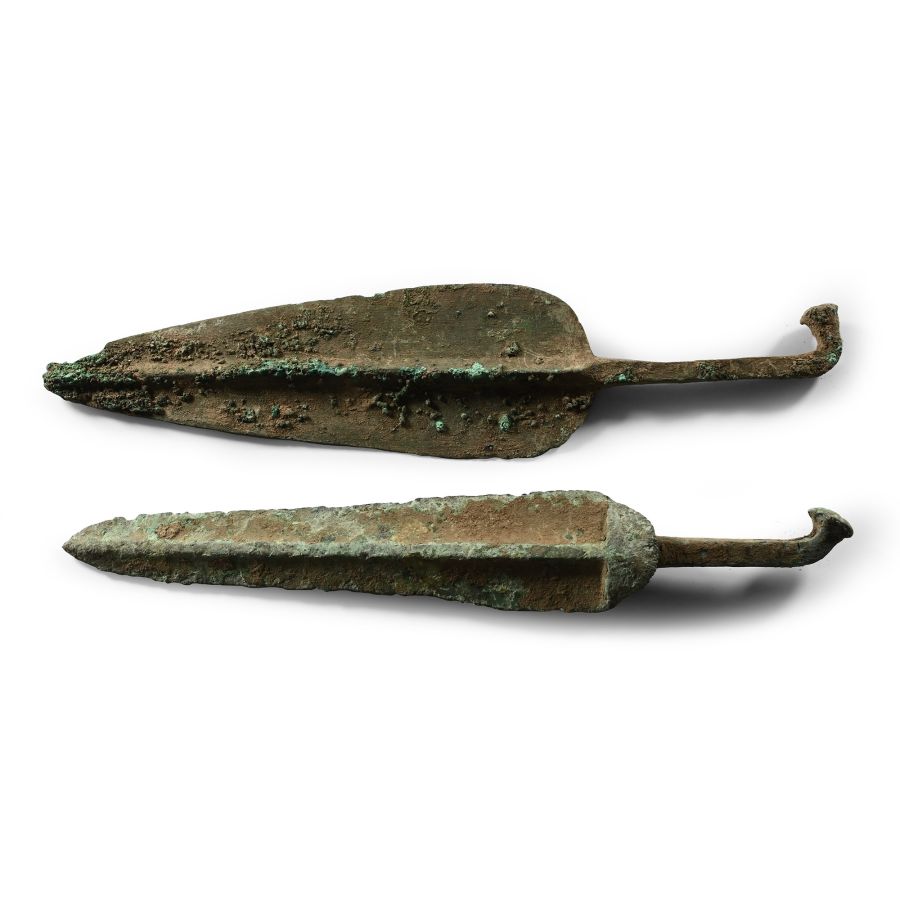
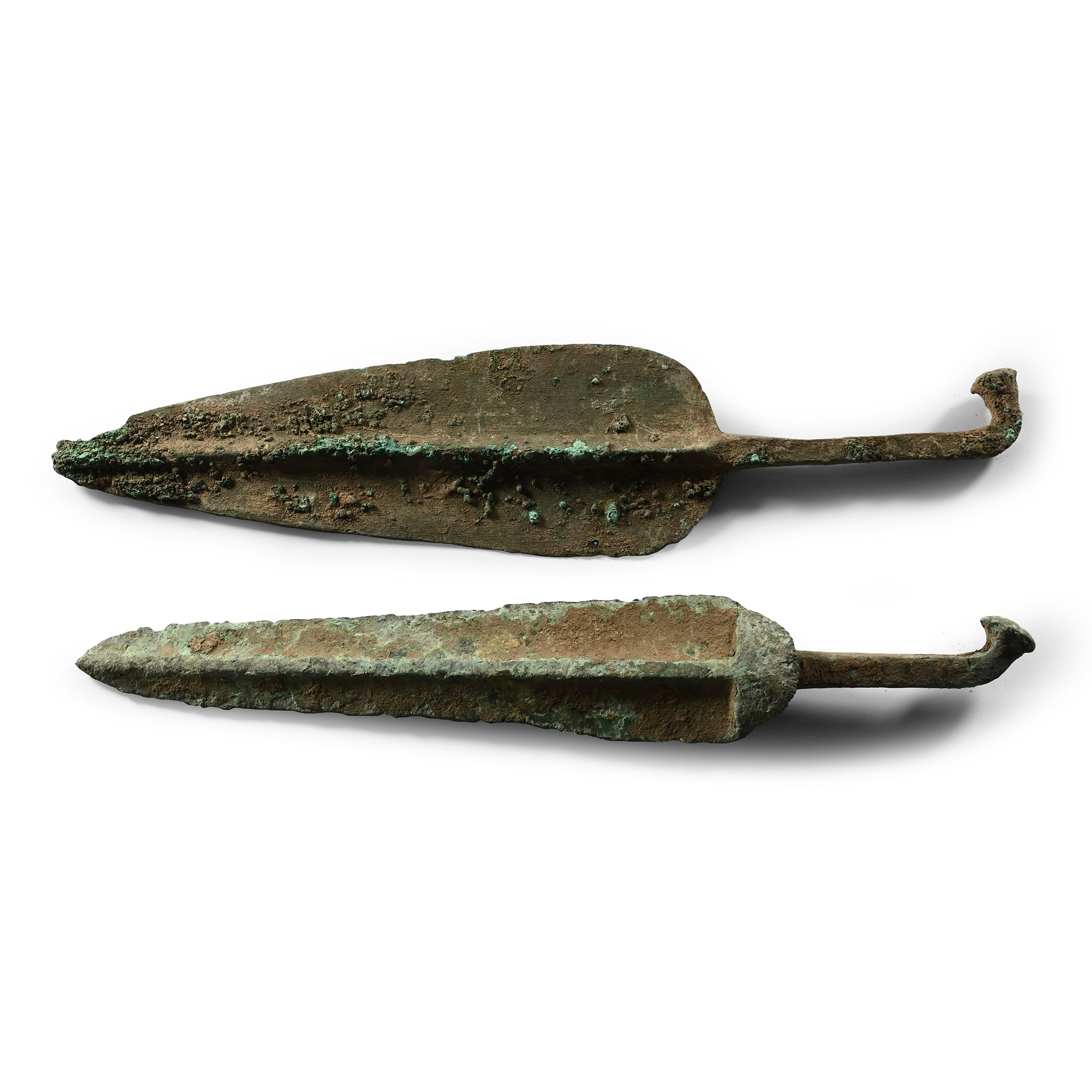
Western Asiatic Bronze Spearheads
14TH-10TH CENTURY B.C.
10 1/4 - 10 7/8 in. (507 grams total, 26-27.5 cm).
The leaf-shaped ovate blade with rounded, gently curved shoulders and raised midrib, flat rectangular-sectioned tang tapering to a bent end with a fastening button; in one specimen the tang is protruding from the 'blade sheath'. [2]
ProvenanceAcquired 1980-2015.
Ex Abelita family collection.
This lot is accompanied by an illustrated lot declaration signed by the Head of the Antiquities Department, Dr Raffaele D’Amato.
This lot is accompanied by an illustrated lot declaration signed by the Head of the Antiquities Department, Dr Raffaele D'Amato.
See Khorasani, M.M., Arms and Armour from Iran. The Bronze Age to the End of the Qajar Period, Tübingen, 2006, s.cat.270, for type.
FootnotesSimilar spearheads were excavated in the Marlik Royal cemetery by Dr Negahban, see for example in tomb 47, Trench XXIIE. They were the evolution of a typology which began much earlier in Mesopotamia and the fertile crescent, the type 4 of the Stronach classification, with straight tang and square section, usually thickened at the base with a button tang. The foliate blade was wide and exaggerated in some specimens excavated at Marlik.
CONDITIONTimeLine Auctions follows a vetting process to ensure the authenticity and legality of all items, reinforcing our commitment to integrity and responsible trading. Each antiquity, antique, and coin lot undergoes thorough examination by a vetting committee of at least ten external specialists, professional trade association members, scientists, and archaeologists: Our Vetting Process
AUCTIONS:
TimeLine is a leading auction house specialising in antiquities, ancient art, collectables, natural history, coins, medals, and books. Our auctions offer museums, collectors, historians, and enthusiasts the opportunity to acquire unique and historically significant pieces.
-
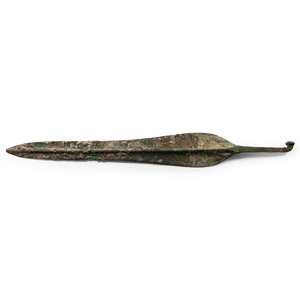
Luristan Bronze Spearhead
Early 2nd millennium B.C.Sold for (Inc. bp): £124
Having foliate blade with central rib and slender shoulders, short rectangular shaft and tang with a bent end. 412 grams, 42.5 cm
Acquired 1980-2015. Ex Abelita family collection. This lot is accompanied by an illustrated lot declaration signed by the Head of the Antiquities Department, Dr Raffaele D’Amato. This lot is accompanied by an illustrated lot declaration signed by the Head of the Antiquities Department, Dr Raffaele D'Amato.
A number of similar blades, some considered to be spearheads and others to be daggers, all with bent tang, derived from Tepe Hissar Culture III. Some of them, like our specimen, have a button terminal, some others have a plain, pointed terminal. The general dating of these specimens is fixed to the early 2nd millennium B.C. -
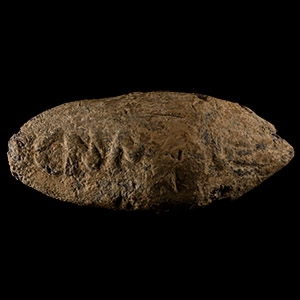
Roman Pompey the Great 'Battle of Munda' Lead Slingshot
1st century B.C.Sold for (Inc. bp): £546
Biconical lead slingshot (glans) with inscription in Latin letters 'CN' (Cneius) 'MAG' (Magnus) on one side, and 'IMP' for 'IMPERATOR' (victorious general) to the other side, i.e Gnaeus Pompeius Magnus Imperator (Pompey the Great the victorious general). 43.6 grams, 40 mm
Acquired on the UK art market. Property of a gentleman collector. This lot is accompanied by an illustrated lot declaration signed by the Head of the Antiquities Department, Dr Raffaele D'Amato.
The shot (Völling type 1C) is marked with the abbreviated name of Gnaeus Pompey; it was used in quantity at the Battle of Monda (or Munda) against Julius Caesar, 17th March 45 BC. The projectiles were made of different materials: lead (glandes) or in pottery or stone (lapides missiles). Sometimes they were signed with the name of the general, like our specimen. -
.jpg)
Marlik Bronze Spearhead
14th-10th century B.C.Sold for (Inc. bp): £195
With rounded shoulders and square-section mid-rib running to the tip; short tang. 280 grams, 38.5 cm
Acquired 1980-2015. Ex Abelita family collection. This lot is accompanied by an illustrated lot declaration signed by the Head of the Antiquities Department, Dr Raffaele D’Amato. This lot is accompanied by an illustrated lot declaration signed by the Head of the Antiquities Department, Dr Raffaele D'Amato.
The blade belongs to the type VI of Marlik spearheads according to the Khorasani classification, with a long blade and a short tang, slightly rounded shoulders and pronounced midrib. Such spearheads have been excavated from the Marlik Royal Cemetery by Dr Negahban in Tomb 15, Trench XIII G.
