
Loading, please wait...
LOT 1192
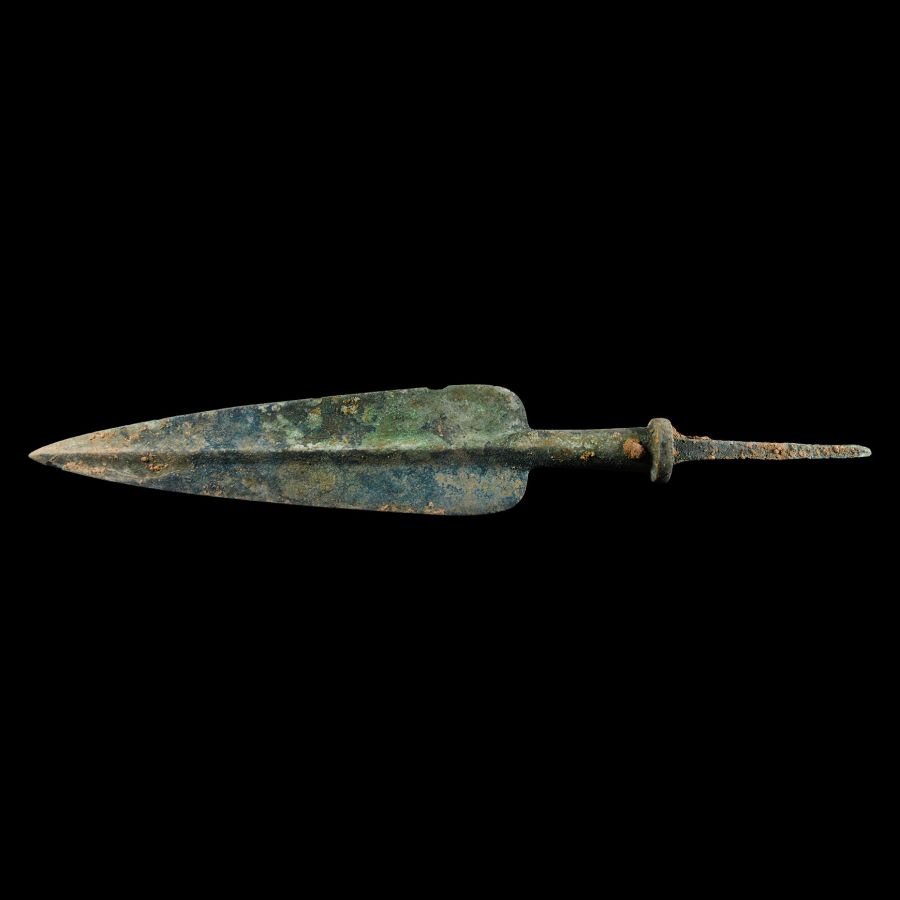
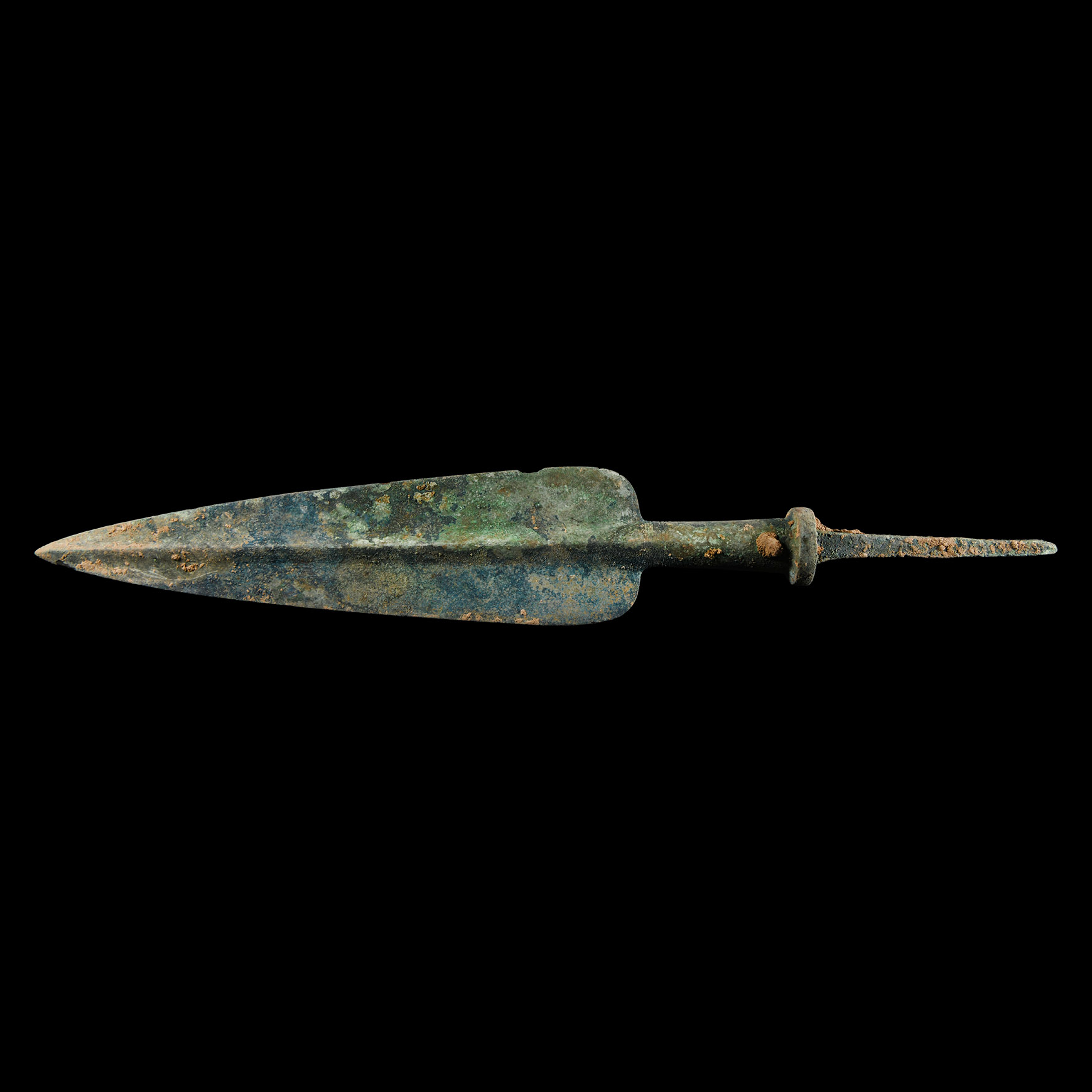
Western Asiatic Bronze Spearhead
CIRCA 2ND MILLENNIUM B.C.
11 1/4 in. (186 grams, 28.5 cm).
Triangular profile with projecting midribs, round shank with raised collar above the square-section tapered tang.
ProvenanceEx German collection, Cologne, 1980-1990s.
LiteratureCf. Gernez, G., L’armament en métal au Proche et Moyen-Orient: des origines a 1750 av. J.C., Paris, 2007, fig.2.88, subtype of tripartite spears L.2.Bc, for the type.
FootnotesThis variant of the tripartite spear is characterised by a rhomboidal or swollen section blade, often with a short intermediate part widened so as to form a clean stop and with a curved tang, sometimes ending in a button (here unfortunately missing). Most spears have medium dimensions (23 cm to 36 cm), but others are elongated (more than 50 cm).
CONDITIONTimeLine Auctions follows a vetting process to ensure the authenticity and legality of all items, reinforcing our commitment to integrity and responsible trading. Each antiquity, antique, and coin lot undergoes thorough examination by a vetting committee of at least ten external specialists, professional trade association members, scientists, and archaeologists: Our Vetting Process
AUCTIONS:
TimeLine is a leading auction house specialising in antiquities, ancient art, collectables, natural history, coins, medals, and books. Our auctions offer museums, collectors, historians, and enthusiasts the opportunity to acquire unique and historically significant pieces.
-
.jpg)
Roman Julius Caesar Lead Sling Shot from the Battle of Munda
45 B.C.Sold for (Inc. bp): £520
Bearing a monogram: a combination of the letters 'C', 'A' and 'E', for 'C A E S' referring to Julius Caesar. 65.04 grams, 37 mm
Fine condition.
Found near to a village close to Seville, 1960-1970. From an old Spanish collection. Swiss private collection. Accompanied by a copy of the Spanish export licence. Accompanied by an academic paper by military specialist Dr Raffaele D'Amato, dated 4th May 2022 and titled Roman Res Publica - Lead Slingshots (glandes) of Caesarian Age - 45 B.C circa.
The shot (type IIb of the Völling classification) is marked with the abbreviated name of Julius Caesar; it was used in quantity at the Battle of Monda (or Munda) against the last fellows of Pompey, the leaders of the Optimates, on the 17th March 45 B.C. Similar shots were used in the civil war among Pompey and Caesar, and in all Caesar's wars. The funditores of Caesar's age were part of the light infantry. Caesar speaks of his Balearic slingers during the conquest of Gaul, who were usually covered by a short tunic, leather or rope sandals, a coat to cover them, but which could also have been used to store projectiles. Rather, they used a satchel to carry very deadly lead-like stones or bullets. The men employed several slings: one was tied around the head for quick employment should the other break during the battle. -
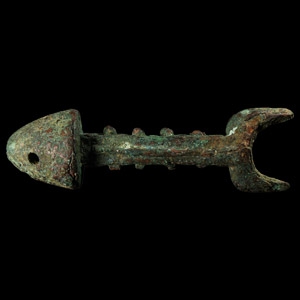
Luristan Bronze Sword Hilt
2nd millenium B.C.Sold for (Inc. bp): £234
With crescent-shaped guard to accept blade, square-section grip with central rib to two sides and four evenly-spaced studs to the other two, and a conical hollow-cast mushroom pommel pierced on three sides. 492 grams, 16.5 cm
Acquired in the early 1990s. Ex Guernsey collection. The Kusmirek Collection, UK. -
.jpg)
Byzantine 'Greek Fire' Fire Bomb or Hand Grenade
9th-11th century A.D.Sold for (Inc. bp): £182
Piriform in shape with raised lugs to the upper body with stamped concentric roundels between. 588 grams, 15.3 cm
Family collection, acquired 1980-2015. Ex property of a North London gentleman. Accompanied by an academic paper by military specialist Dr Raffaele D'Amato, dated 15 July 2019 and titled 'Eastern Roman Empire - Greek Fire Bomb or Hand Grenade (μεσαίον kακάβιον) 9th-11th century AD'.
Apart from the use of siphons or manual flame-throwers called cheirosiphona, special corps of Roman soldiers employed terracotta grenades, in the form of small jars, abundantly evidenced in archaeological excavations. Such were the γανωτα, vessels (sometimes also of bronze) used for Greek fire. They were called μεσαία kακαβιά or κυτροκακάβια where the former had a bulbous shape and the latter a more cylindrical form.
