
Loading, please wait...
LOT 1384
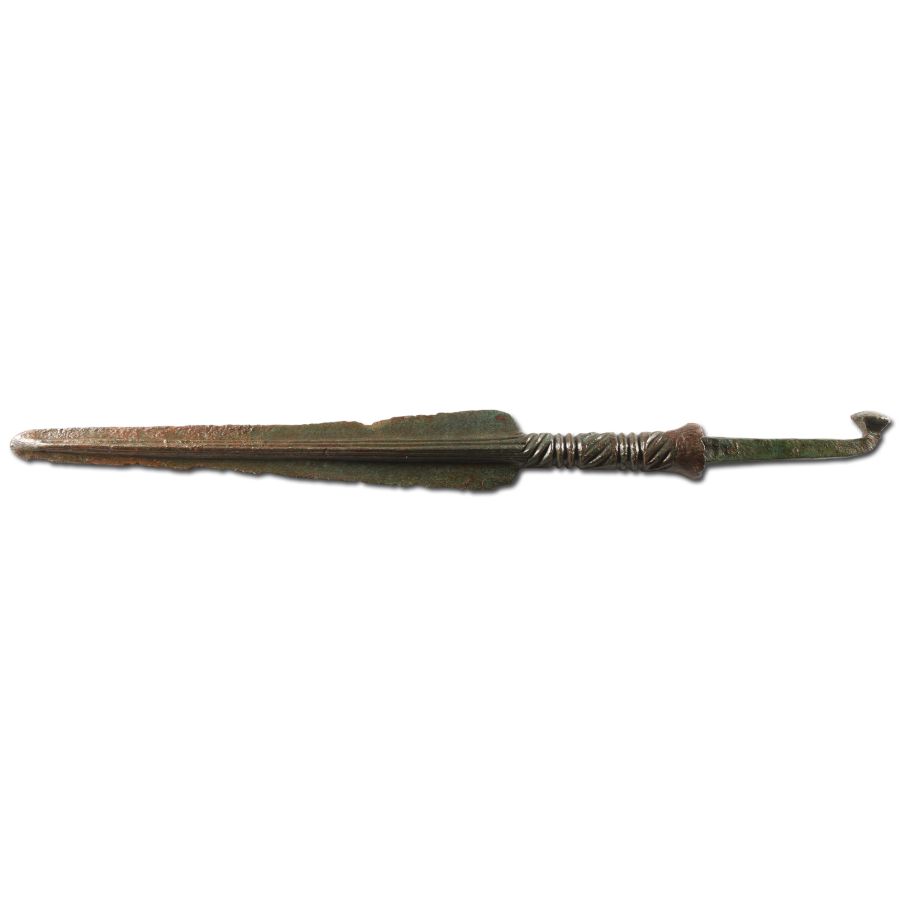
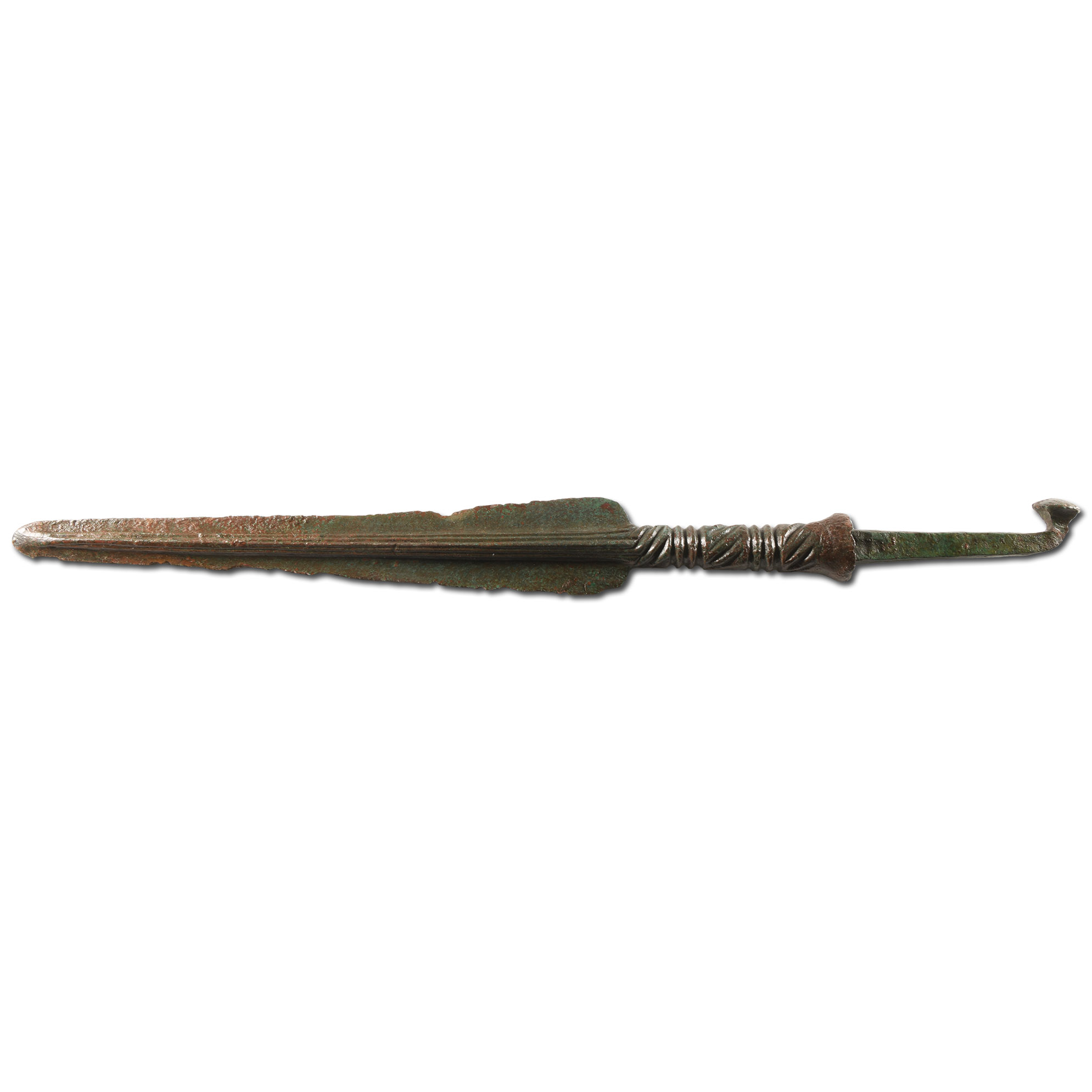
Western Asiatic Bronze Spearhead with Decorative Supports and Blood Channels
2ND MILLENNIUM B.C.
17 in. (474 grams, 43 cm).
With a long triangular blade, strongly marked midrib divided into five grooves, rectangular-section tang; engraved and reinforced shaft with diagonal and horizontal grooves.
ProvenanceAcquired 1980-2015.
Ex Abelita family collection.
Cf. Gernez, G., L’armament en métal au Proche et Moyen-Orient: des origines a 1750 av. J.C., Paris, 2007, fig.2.91, subtype L2 F.a.
FootnotesThis homogeneous subtype (LF 2a of Gernez) is characterised by a set of morphological particularities which constitute a functional and aesthetic outcome. The tapered blade, triangular (like in our case) or ogival, is reinforced by a strong median bulge. The intermediate part often bears an incised or moulded decoration and the base is with a marked widening or with a stopper disc. The tang, square in section, is curved and widens at the end almost at a right angle.
CONDITIONTimeLine Auctions follows a vetting process to ensure the authenticity and legality of all items, reinforcing our commitment to integrity and responsible trading. Each antiquity, antique, and coin lot undergoes thorough examination by a vetting committee of at least ten external specialists, professional trade association members, scientists, and archaeologists: Our Vetting Process
AUCTIONS:
TimeLine is a leading auction house specialising in antiquities, ancient art, collectables, natural history, coins, medals, and books. Our auctions offer museums, collectors, historians, and enthusiasts the opportunity to acquire unique and historically significant pieces.
LOT 1384
Western Asiatic Bronze Spearhead with Decorative Supports and Blood Channels
Estimate £300 - 400€350 - 460 (for guidance only)$410 - 540 (for guidance only)
-
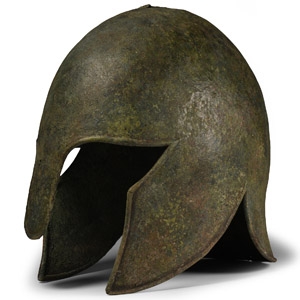
Greek Style Reproduction Helmet
20th century A.D. or earlierSold for (Inc. bp): £416
Modelled on the Corinthian form with broad nasal and fixed chek-protectors, rolled edges. 709 grams, 24.6 cm
Private collection, UK. -
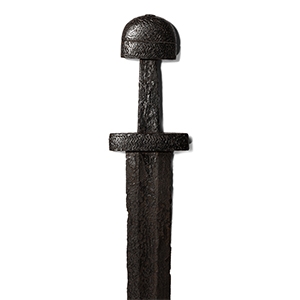
Viking Peterson Type X Sword with Inlaid Hilt
Circa 10th-11th century A.D.Sold for (Inc. bp): £3,900
With pattern-welded double-edged blade, showing well-defined shallow fullers and wide cutting edges, the fullers occupying not less than one third of the entire width and running to a point about 19 cm from the tip; massive, simply decorated hilt; the pommel, as well as the cross-guard, with visible zig-zag patterns; the pommel of solid tea-cosy type, divided into two sections by a well marked groove, the bottom being the larger, the curved top portion of the pommel further divided into three lobes; traces of inlay visible on the pommel and on the cross-guard. 1.25 kg, 94 cm
Acquired on the European art market in the 1990s. From the property of a Suffolk collector.
The blade shows in its central section, and on both cutting edges, the blodiձa style pattern-welding through the central portion of the blade (Oakeshott, 1960, fig.70). The fine pattern-welded blade patterns of Viking swords are the blodiձa (Blood-Eddy) and 'ann' (rows of mown hay) known from Norse poetry. -
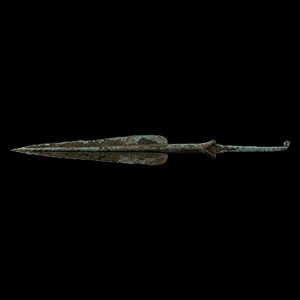
Marlik Type Bronze Tanged Spearhead
12th-11th century B.C.Estimate: £100 - 140 (+bp*)
Opening Bid: £50
With heavily ridged and tapering blade, short collared shaft and a square-section tapering tang bent at the tip. 159 grams, 31.5 cm
Acquired 1980-2015. Ex Abelita family collection.
The weapon belongs to type I of the Khorasani classification. Similar weapons have been excavated in Marlilk by Professor Negahban and dated by Stutzinger to the late 13th-early 12th century B.C.
