
Loading, please wait...
LOT 1349
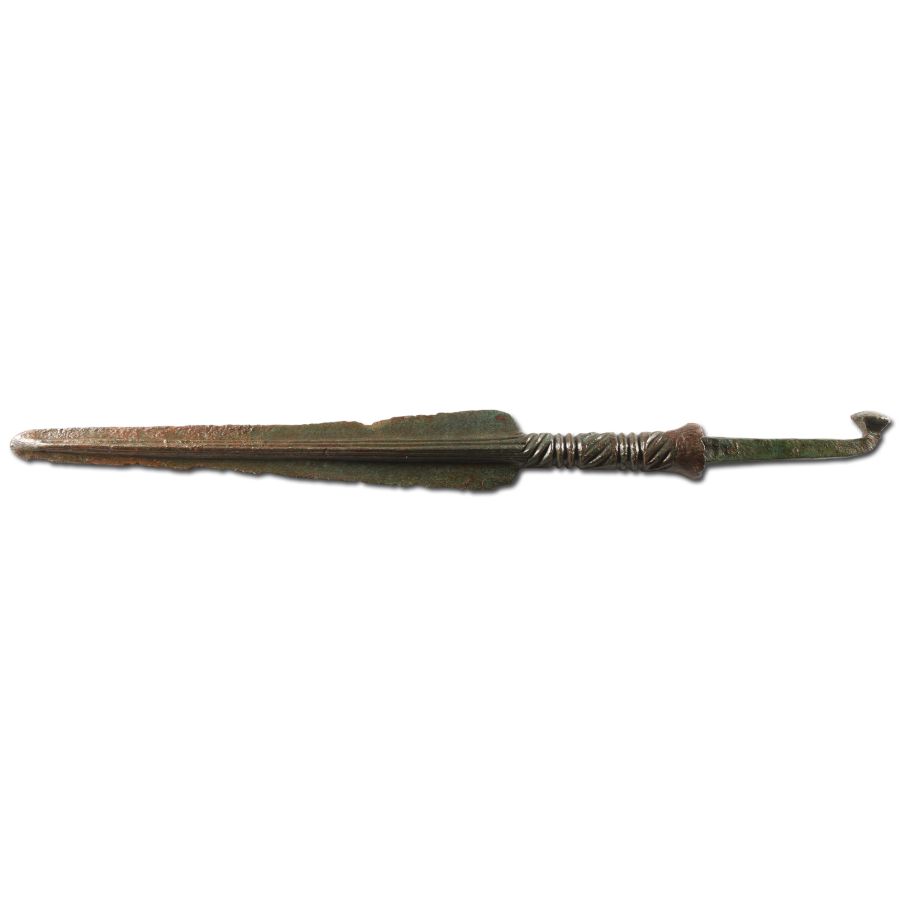
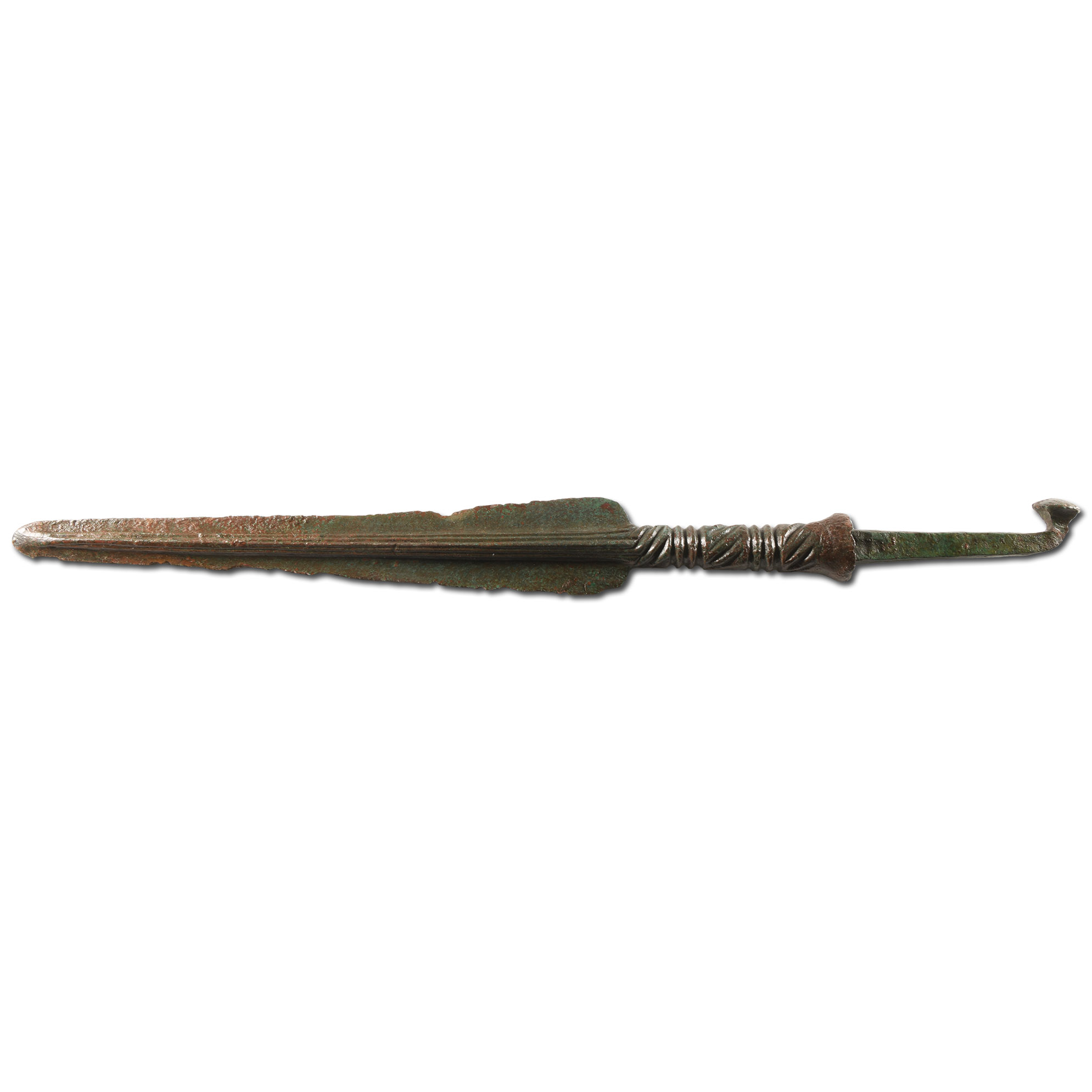
Western Asiatic Bronze Spearhead with Decorative Supports and Blood Channels
2ND MILLENNIUM B.C.
17 in. (474 grams, 43 cm).
With a long triangular blade, strongly marked midrib divided into five grooves, rectangular-section tang; engraved and reinforced shaft with diagonal and horizontal grooves.
ProvenanceAcquired 1980-2015.
Ex Abelita family collection.
Cf. Gernez, G., L’armament en métal au Proche et Moyen-Orient: des origines a 1750 av. J.C., Paris, 2007, fig.2.91, subtype L2 F.a.
FootnotesThis homogeneous subtype (LF 2a of Gernez) is characterised by a set of morphological particularities which constitute a functional and aesthetic outcome. The tapered blade, triangular (like in our case) or ogival, is reinforced by a strong median bulge. The intermediate part often bears an incised or moulded decoration and the base is with a marked widening or with a stopper disc. The tang, square in section, is curved and widens at the end almost at a right angle.
CONDITIONTimeLine Auctions follows a vetting process to ensure the authenticity and legality of all items, reinforcing our commitment to integrity and responsible trading. Each antiquity, antique, and coin lot undergoes thorough examination by a vetting committee of at least ten external specialists, professional trade association members, scientists, and archaeologists: Our Vetting Process
AUCTIONS:
TimeLine is a leading auction house specialising in antiquities, ancient art, collectables, natural history, coins, medals, and books. Our auctions offer museums, collectors, historians, and enthusiasts the opportunity to acquire unique and historically significant pieces.
LOT 1349
Western Asiatic Bronze Spearhead with Decorative Supports and Blood Channels
Estimate £400 - 600€460 - 700 (for guidance only)$540 - 810 (for guidance only)
-
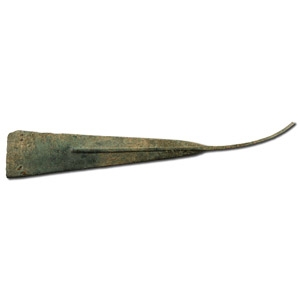
Western Asiatic Bronze Sword Sheath
2nd-1st millennium B.C.Estimate: £300 - 400 (+bp*)
Opening Bid: £150
Triangular in plan, terminating in an exaggerated curving point; the outer face pierced towards the top and with a raised midrib; the convex interior possibly containing fragmentary remains of a weapon. 355 grams, 56 cm
From a Japanese collection, 1990s.
Scabbards with a curve at their base are shown on reliefs and seals from Anatolia from the middle of the second millennium to the 9th century B.C. -
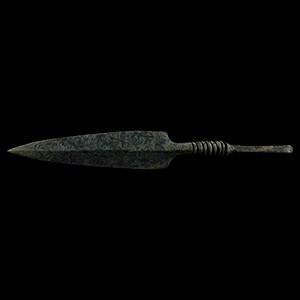
Western Asiatic Bronze Tanged Spearhead
3rd-2nd millennium B.C.Sold for (Inc. bp): £124
With long blade, shallow midrib, rectangular-section tang; engraved, reinforced shaft, and squared shoulders. 423 grams, 34.5 cm
Acquired 1980-2015. Ex Abelita family collection.
According to Gernez, this spear belongs to the group of tripartite spears with bulging biconcave ogival blade, a marked stop and tang, usually curved. The tomb KCG 14 of Carchemish, yielded a similar example, in association with spears and ceramic dated from the second half of the 3rd millennium. A very similar spear comes from a tomb at Tell Mozan. A larger example with a decoration of rings in relief on the stem belongs to the λ deposit of Byblos. Another spear, of similar form, presents a decoration of vertical lines on the stem. It was found in the tomb of the Lord of the Caprids at Ebla, making it the most recent in the series (around 1750 B.C.). -
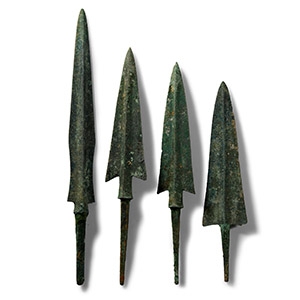
Luristan Spear Tip Group
13th-6th century B.C.Sold for (Inc. bp): £156
Comprising four tips with triangular blades; each with a raised midrib and a long tang. 143 grams total, 13.5-18.2 cm
Acquired 1980-2015. Ex Abelita family collection.
Although some of them are different in shape, these arrowheads are apparently related types of a polythetic group. Two basic deltoid forms are represented: one has a sharp, flat blade, the ends of which extend to form wings or barbs, and a prominent midrib extending into a long tang that often has a stop; the blade shape varies from deltoid to more manifestly triangular. The other form has no barbs, but it has a prominent midrib extending to the tang, and a narrow leaf-shaped blade.
