
Loading, please wait...

LOT 0298
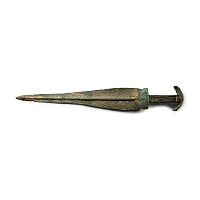
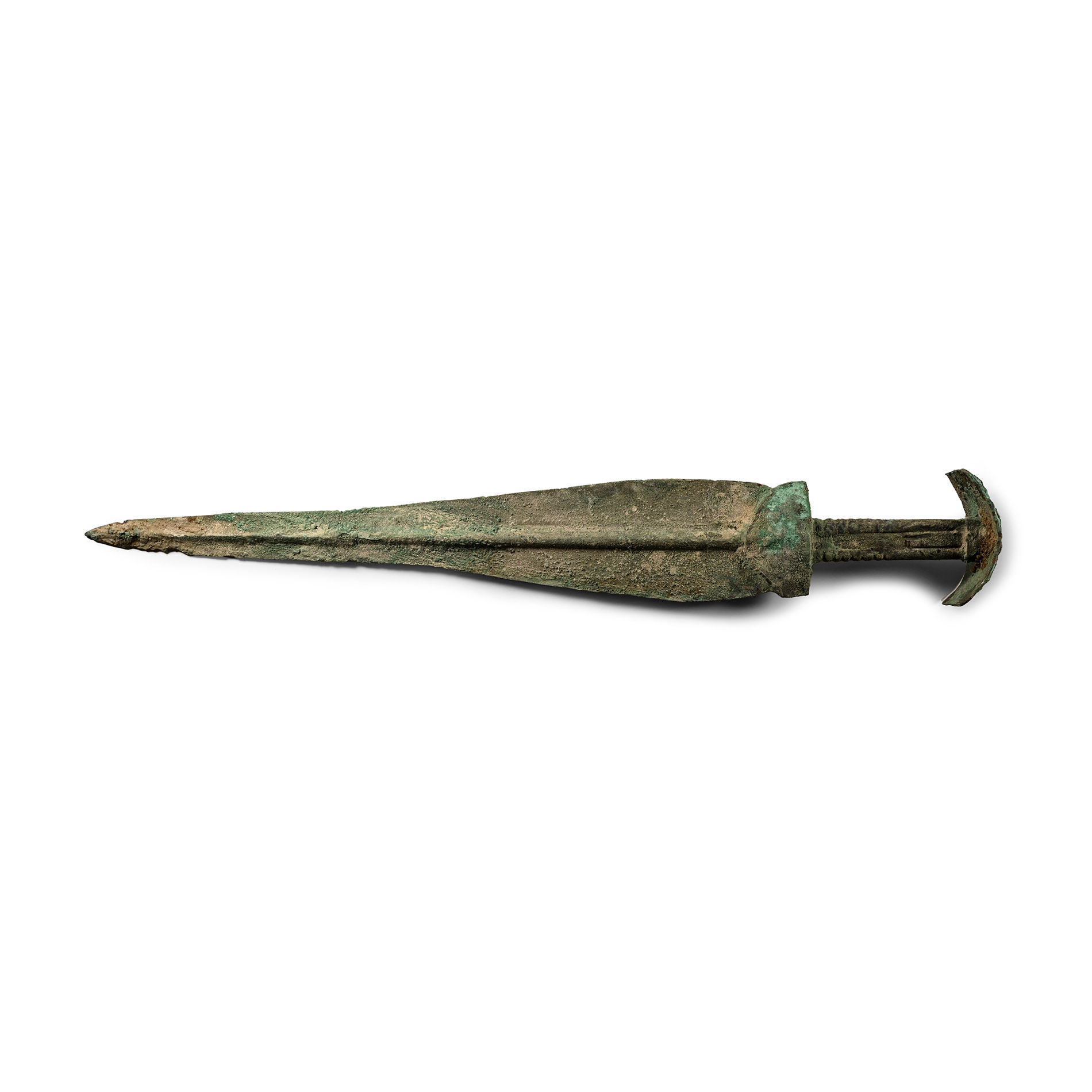
Western Asiatic Bronze Short Sword
1800-1600 B.C.
19 1/4 in. (533 grams, 49 cm).
With a rectangular grooved tang with vertical lines running to the crescent pommel, the rhomboid ricasso extending over the blade, blade with raised ridge tapering to a point.
ProvenanceEx London, UK, collection, 1990s.
LiteratureSee Maxwell-Hyslop, R., 'Daggers and swords in Western Asia: a Study from Prehistoric Times to 600BC,' in Iraq, Volume 8, 1946, pp.1-65, pl.IV, figs.32-32a.
CONDITIONTimeLine Auctions follows a vetting process to ensure the authenticity and legality of all items, reinforcing our commitment to integrity and responsible trading. Each antiquity, antique, and coin lot undergoes thorough examination by a vetting committee of at least ten external specialists, professional trade association members, scientists, and archaeologists: Our Vetting Process
AUCTIONS:
TimeLine is a leading auction house specialising in antiquities, ancient art, collectables, natural history, coins, medals, and books. Our auctions offer museums, collectors, historians, and enthusiasts the opportunity to acquire unique and historically significant pieces.
-
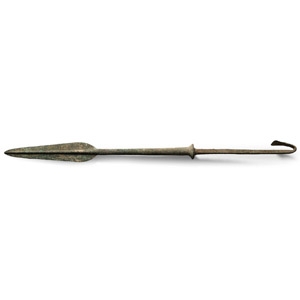
Mesopotamian Bronze Javelin Head
3rd-2nd millennium B.C.Sold for (Inc. bp): £416
With foliate blade, rhomboidal in section, raised mid-rib, medium length stem widening at its base and forming a small stop, quadrangular section tang with bent terminal. 262 grams, 45 cm
Acquired 1980-2015. Ex Abelita family collection.
The specimen belongs to the category of tripartite spears with long pointed biconvex blade and single bevelled tang. They seem to be a Mesopotamian and Susian (Elamite) variant, and this type also includes decorated blades, like the spear from Tello with the inscription 'King of Kish'. -
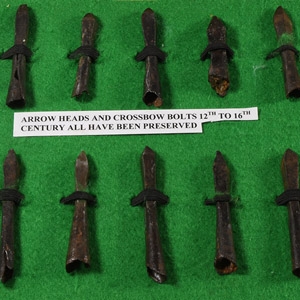
Cased Medieval to Tudor 'Published' Iron Crossbow Bolt Collection
12th-16h century A.D.Sold for (Inc. bp): £195
Comprising: 14 crossbow bolts with pyramidal point, square-section shaft, and a tubular socket. 1.24 kg total, 32.5 x 22.5 x 5 cm
From the collection of the famous author, writer and speaker, Gordon Bailey, Essex, UK; formed since 1968.
The crossbow, a bow fixed at its centre to a wooden stock, was a formidable weapon reintroduced in Western Europe in 11th century A.D.; it was used by the Genoese crossbowmen, mainly in French service, during the 100 Years War; its heavy bolt could easily penetrate a shield or armour breast plate at close range. -
.jpg)
Carolingian Iron Spur with Silver Studs
Circa 8th century A.D.Sold for (Inc. bp): £312
With D-section arms, attachment loop, prick spur with two bands of applied studs. 150 grams, 18 cm
Ex B Posey collection, 1990s. Ex Den of Antiquity, Cambridgeshire, UK. Accompanied by a dealer's catalogue information card.
