
Loading, please wait...
LOT 1387
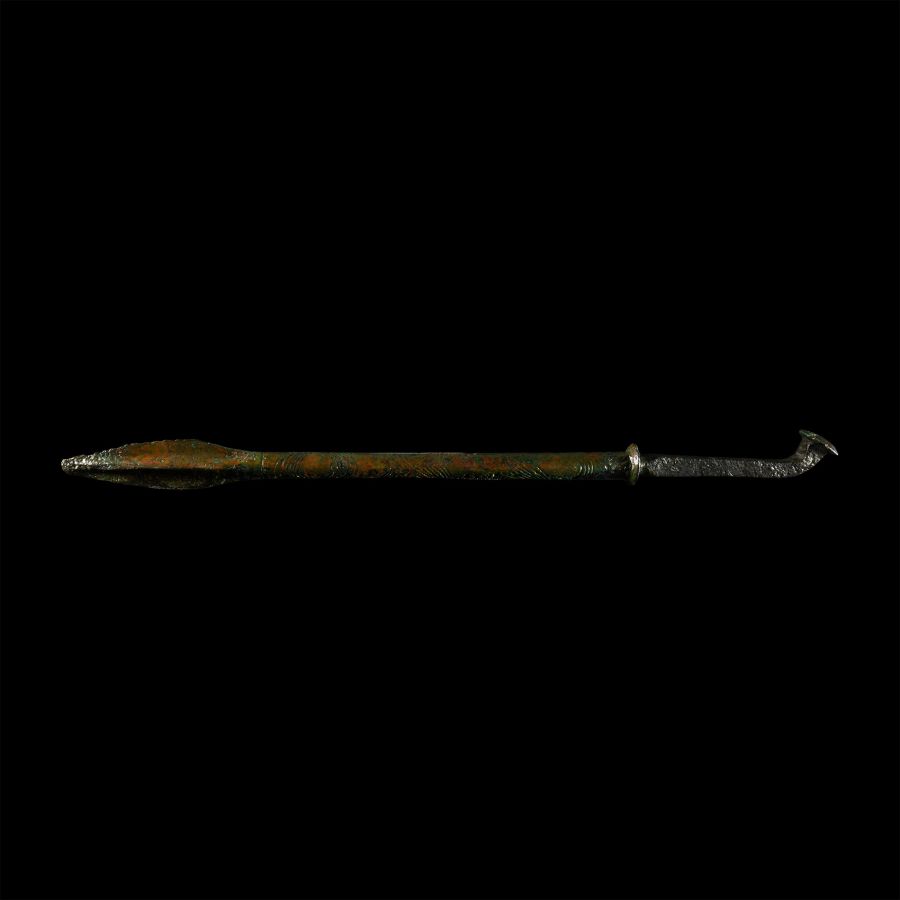
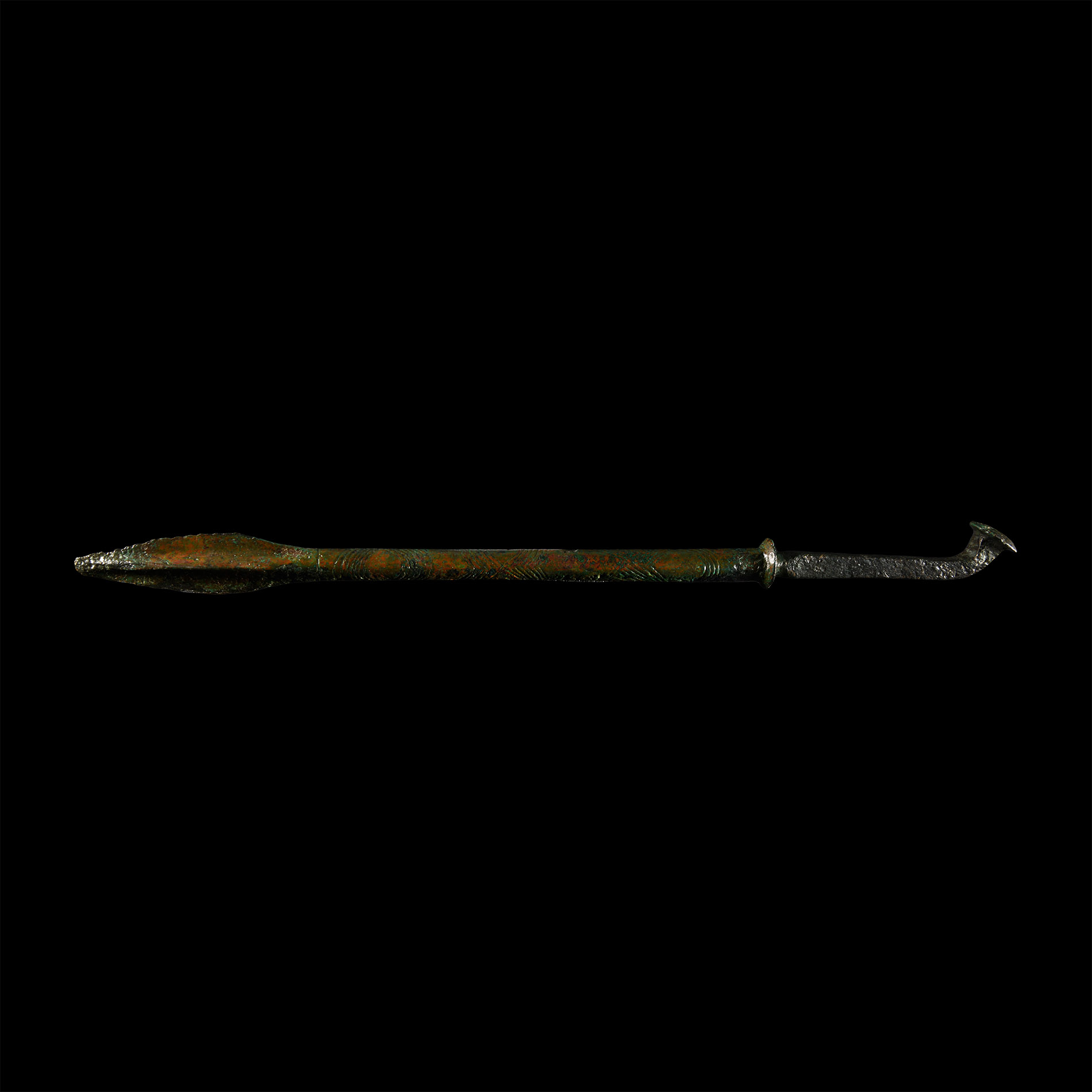
Western Asiatic Bronze Javelin Head
LATE 3RD MILLENNIUM B.C.
12 3/4 in. (220 grams, 32.3 cm).
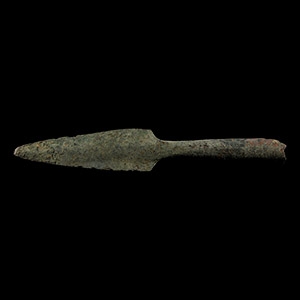
Featuring a tripartite weapon with short, narrow leafy blade, elongated stem decorated by embossed geometric lines and folded tang.
ProvenanceAcquired 1980-2015.
Ex Abelita family collection.
Cf. Gernez, G., L’armament en métal au Proche et Moyen-Orient: des origines a 1750 av. J.C., Paris, 2007, fig.2.91, subtype L2 E.a.
FootnotesThe points within this typology are biconvex or leaf-shaped, not very sharp. These types of spears have been found in the tombs of Palestine from Tell el-'Ajjul (tomb 227) to the sites of the central plains and the banks of Jordan: Yavne, 'Ain Samiya, Jebel Qa'aqir, tombs G 83 and M 13 of Jericho, tombs 2100 and 2111 of Lachish. All are dated to the last two centuries of the 3rd millennium.
CONDITIONTimeLine Auctions follows a vetting process to ensure the authenticity and legality of all items, reinforcing our commitment to integrity and responsible trading. Each antiquity, antique, and coin lot undergoes thorough examination by a vetting committee of at least ten external specialists, professional trade association members, scientists, and archaeologists: Our Vetting Process
AUCTIONS:
TimeLine is a leading auction house specialising in antiquities, ancient art, collectables, natural history, coins, medals, and books. Our auctions offer museums, collectors, historians, and enthusiasts the opportunity to acquire unique and historically significant pieces.
LOT 1387
Western Asiatic Bronze Javelin Head
Estimate £250 - 350€290 - 410 (for guidance only)$340 - 470 (for guidance only)
-
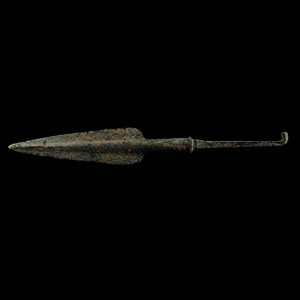
Western Asiatic Tanged Bronze Spearhead
Late 3rd-early 2nd millennium B.C.Estimate: £100 - 140 (+bp*)
Opening Bid: £50
Having foliate blade with central rib and slender shoulders, cylindrical short shaft encasing a rectangular tang with a bent end. 151 grams, 26.5 cm
Acquired 1980-2015. Ex Abelita family collection.
This variant is characterised by a blade of rhomboidal or swollen section, an intermediate part often short widened so as to form a clear stop and a curved bristle at its end, sometimes finished in a button. Most lances are of medium dimensions (23 cm to 36 cm), others are very elongated (more than 50 cm). The best parallels come from Tepe Hissar. Elements of handles found nearby the spearheads in the excavations have made it possible to reconstruct the total length of the weapon (1.40 m). -
Luristan Bronze Socketted Spearhead
13th-6th century B.C.Estimate: £100 - 140 (+bp*)
Opening Bid: £50
With broad leaf-shaped blade and tapering tubular socket. 155 grams, 24 cm
Acquired 1980-2015. Ex Abelita family collection.
The spear belongs to the type VIII classified by Khorasani (spearheads with well-projecting midribs and long folded sockets) and more specifically to subtype C (with leaf-shaped blade and short hollow socket). Usually the willow-leaf blade has an almost straight shoulder base and a wide, flat midrib tapering towards the point. -
Medieval Iron Arrowhead
Circa 14th-16th century A.D.Sold for (Inc. bp): £59
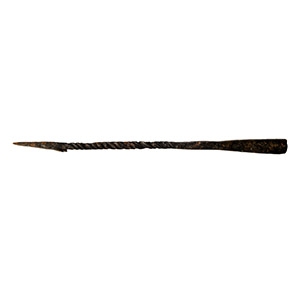
Composed of a rectangular-section tip with a single barb, twisted shank and a tubular socket with a single piercing. 7.85 grams, 12 cm
Found Norfolk, UK.
