
Loading, please wait...
LOT 1402
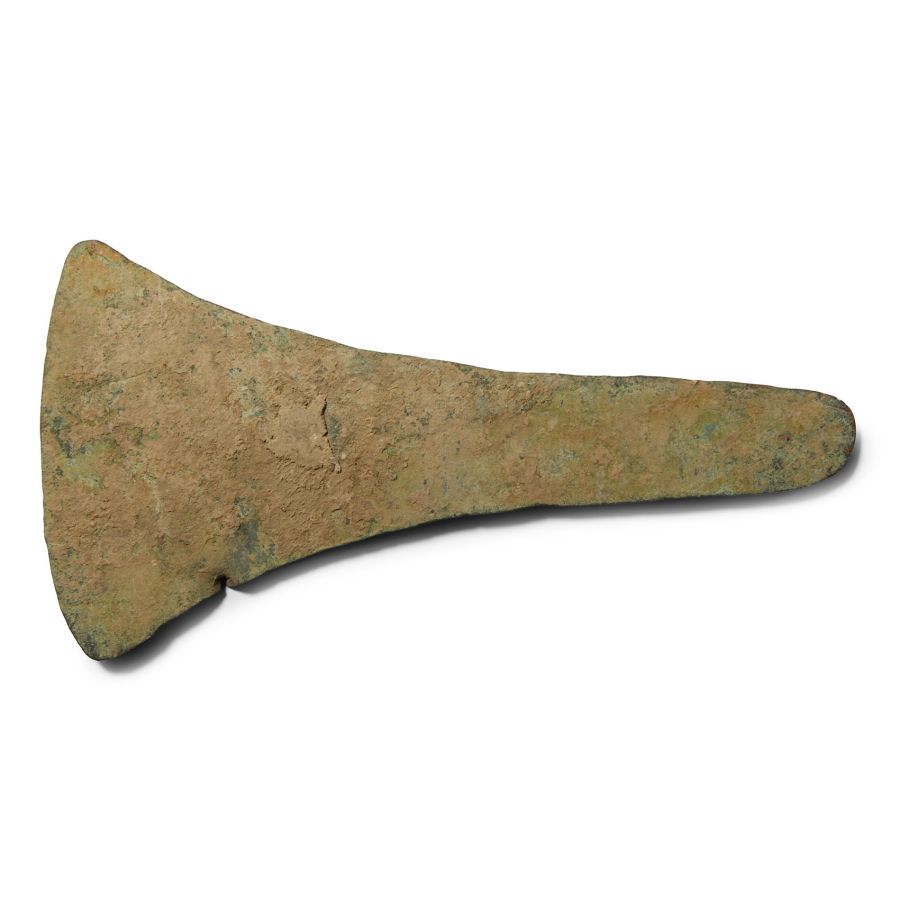
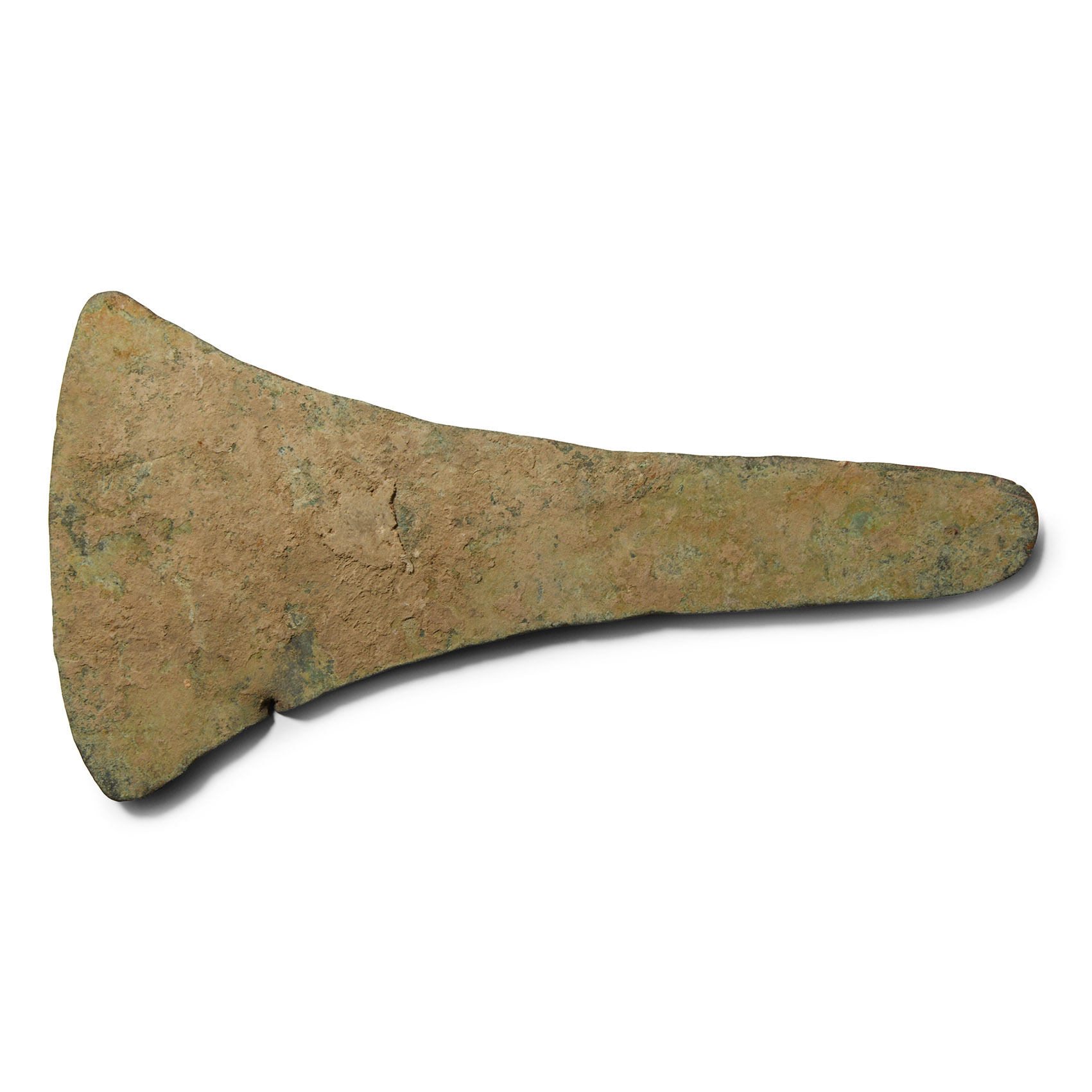
Western Asiatic Bronze Flat Axe
4TH MILLENNIUM B.C.
7 1/4 in. (138 grams, 18.5 cm).
Formed with a rounded butt and slightly flared cutting edge; flat in cross-section. [No Reserve]
ProvenanceAcquired 1980-2015.
Ex Abelita family collection.
Cf. Çetin, A., Bilgi, Ö., Weapons of the Protohistoric Age, Istanbul, 1989, figs.21-22, pp.50-51.
FootnotesThis type of flat axes appeared in the last phase of the Late Chalcolithic Age. Flat axes without lugs were used as cutting tools or in war. In the later examples the sides of the blades was gradually widening towards the convex cutting edge.
CONDITIONTimeLine Auctions follows a vetting process to ensure the authenticity and legality of all items, reinforcing our commitment to integrity and responsible trading. Each antiquity, antique, and coin lot undergoes thorough examination by a vetting committee of at least ten external specialists, professional trade association members, scientists, and archaeologists: Our Vetting Process
AUCTIONS:
TimeLine is a leading auction house specialising in antiquities, ancient art, collectables, natural history, coins, medals, and books. Our auctions offer museums, collectors, historians, and enthusiasts the opportunity to acquire unique and historically significant pieces.
-
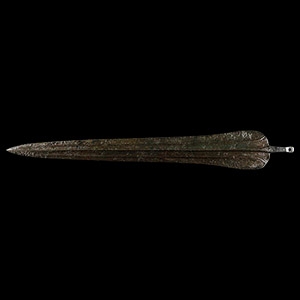
North-West Persian Bronze Short Sword with Blood Channels
2nd-1st millennium B.C.Estimate: £250 - 350 (+bp*)
Opening Bid: £125
Shaped as a two-edged bronze blade, leaf-shape with short rectangular tang with fastening hole, corrugated midrib extending almost to the tip and flared at the shoulder. 439 grams, 44.2 cm
Acquired 1980-2015. Ex Abelita family collection.
The metalworking techniques used in making bronze weapons in Luristan were very complex. Surfaces were often finished in repoussé work, and some of the weapons were chased and others engraved. Many of the graves dating from the era of Kassite hegemony contain bronze and iron artefacts, including various type of weapons. These swords with shallow fullers tapering to a sharp tip have been dated by P.R.S. Moorey to the end of the 2nd millennium B.C. -
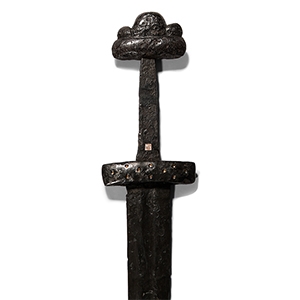
Viking Sword with Inlaid Cross and Orb Mark
Circa 10th-11th century A.D.Sold for (Inc. bp): £3,900
With three-lobe pommel and decorated guard; the blade 45mm wide at the upper end, gently tapering with fuller to both faces, rounded tip, indented ring to one face with silver inlay, scaphoid-section lower guard with two rows of shallow pellets to each face gilt or latten inlay; flat tapering tang; pommel of Petersen's Type S with traces of vertical inlaid wire. 752 grams, 93 cm
From the family collection of a London gentleman; formed in the late 1940s-1950s; thence by descent. Accompanied by metallurgic analytical report number 114366/569, written by metallurgist Dr Brian Gilmour of the Research Laboratory for Archaeology and the History of Art, University of Oxford. Accompanied by an academic report by Dr Raffaele D’Amato. This lot has been checked against the Interpol Database of stolen works of art and is accompanied by a search certificate number no.12020-214090. -
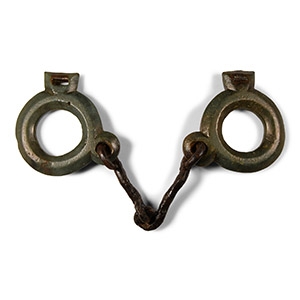
Roman Bronze and Iron Military Horse Bit
2nd-3rd century A.D.Sold for (Inc. bp): £364
Comprising a pair of curved iron bars linked at the centre, loop at each outer end attached to a substantial flat-section ring with lateral lug pierced to accept a strap. 377 grams, 26 cm
From the private collection of a London gentleman, from his grandfather's collection formed before the early 1970s.
