
Loading, please wait...
LOT 1419
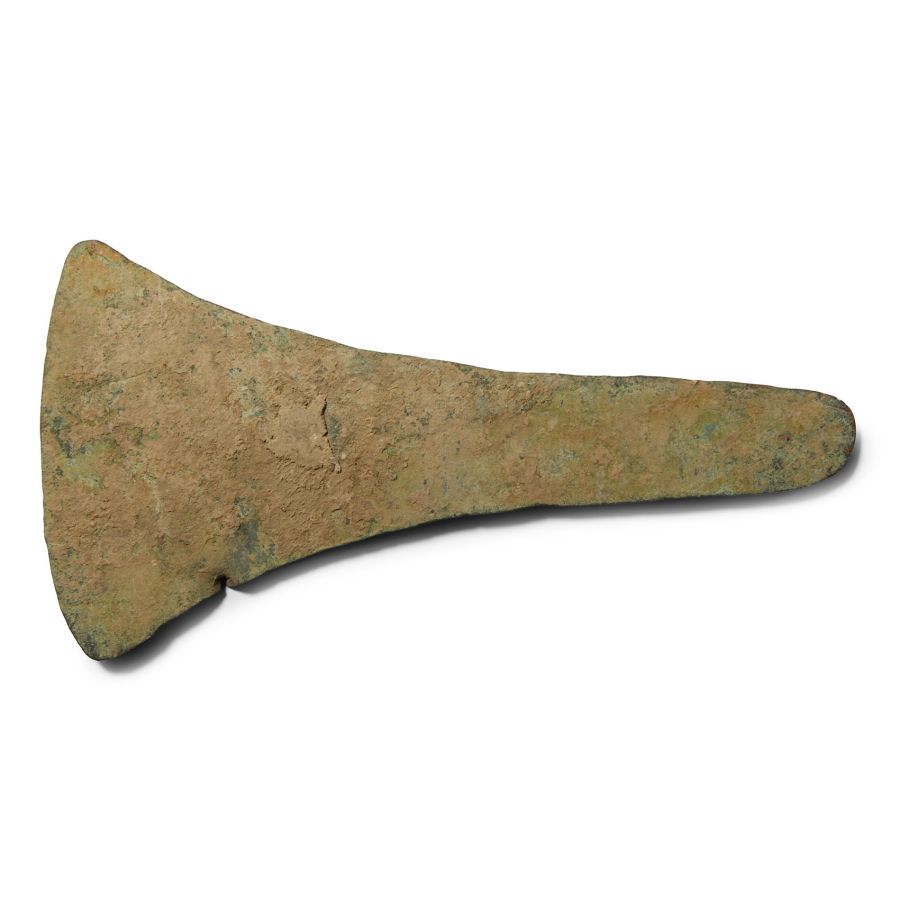
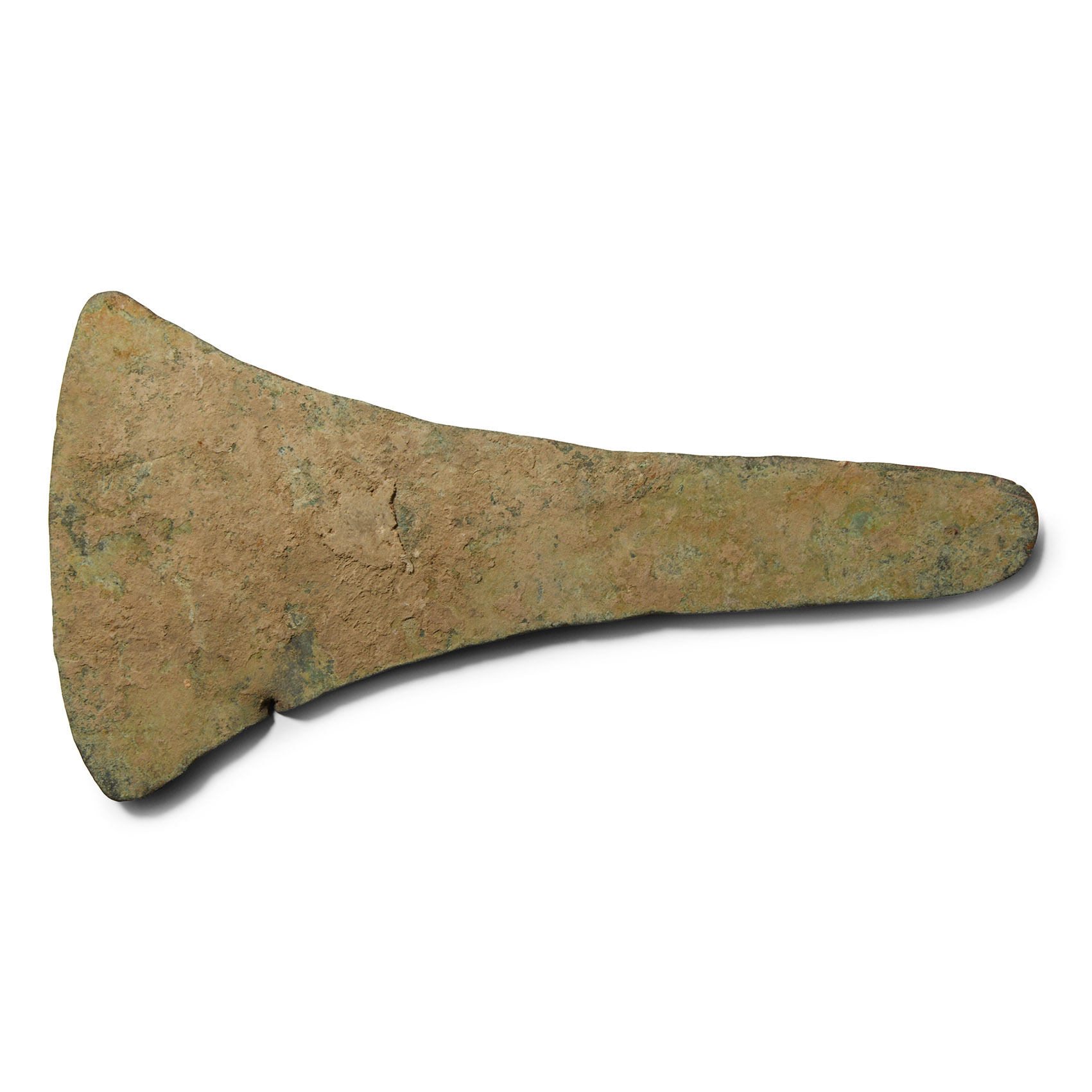
Western Asiatic Bronze Flat Axe
4TH MILLENNIUM B.C.
7 1/4 in. (138 grams, 18.5 cm).
Formed with a rounded butt and slightly flared cutting edge; flat in cross-section.
ProvenanceAcquired 1980-2015.
Ex Abelita family collection.
Cf. Çetin, A., Bilgi, Ö., Weapons of the Protohistoric Age, Istanbul, 1989, figs.21-22, pp.50-51.
FootnotesThis type of flat axes appeared in the last phase of the Late Chalcolithic Age. Flat axes without lugs were used as cutting tools or in war. In the later examples the sides of the blades was gradually widening towards the convex cutting edge.
CONDITIONTimeLine Auctions follows a vetting process to ensure the authenticity and legality of all items, reinforcing our commitment to integrity and responsible trading. Each antiquity, antique, and coin lot undergoes thorough examination by a vetting committee of at least ten external specialists, professional trade association members, scientists, and archaeologists: Our Vetting Process
AUCTIONS:
TimeLine is a leading auction house specialising in antiquities, ancient art, collectables, natural history, coins, medals, and books. Our auctions offer museums, collectors, historians, and enthusiasts the opportunity to acquire unique and historically significant pieces.
LOT 1419
Western Asiatic Bronze Flat Axe
Estimate £100 - 140€120 - 160 (for guidance only)$140 - 190 (for guidance only)
-
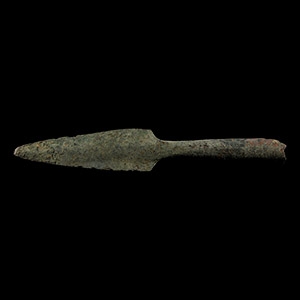
Luristan Bronze Socketted Spearhead
13th-6th century B.C.Estimate: £100 - 140 (+bp*)
Opening Bid: £50
With broad leaf-shaped blade and tapering tubular socket. 155 grams, 24 cm
Acquired 1980-2015. Ex Abelita family collection.
The spear belongs to the type VIII classified by Khorasani (spearheads with well-projecting midribs and long folded sockets) and more specifically to subtype C (with leaf-shaped blade and short hollow socket). Usually the willow-leaf blade has an almost straight shoulder base and a wide, flat midrib tapering towards the point. -
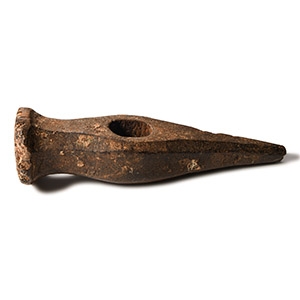
'The Customs House' Tudor Inscribed Iron Hammer-Head
16th century A.D.Sold for (Inc. bp): £156
Octagonal in section with one tapering end and one flat, circular end; square punch marks to one face in a pattern: '10B'. 2.82 kg, 24.2 cm
Found Thames foreshore, Customs House, London, UK, on Thursday 9th November 2006. Accompanied by a copy of the British Museum's Portable Antiquities Scheme (PAS) report no.LON-D6B085. -
.jpg)
Viking Age Bronze Sword Scabbard Chape Collection
9th-11th century A.D.Estimate: £500 - 700 (‡+bp*)
Opening Bid: £250
Comprising: one heater-shaped with openwork raven motif to each face; one similar with openwork raven enmeshed in tendrils; one with fleur-de-lys to the centre of each upper edge and a lobed spur to each side; one with openwork quatrefoil to each face and knop finial to the apex. 145 grams total, 55-85 mm
From the collection of a North American gentleman, formed in the 1990s.
