
Loading, please wait...
LOT 1063
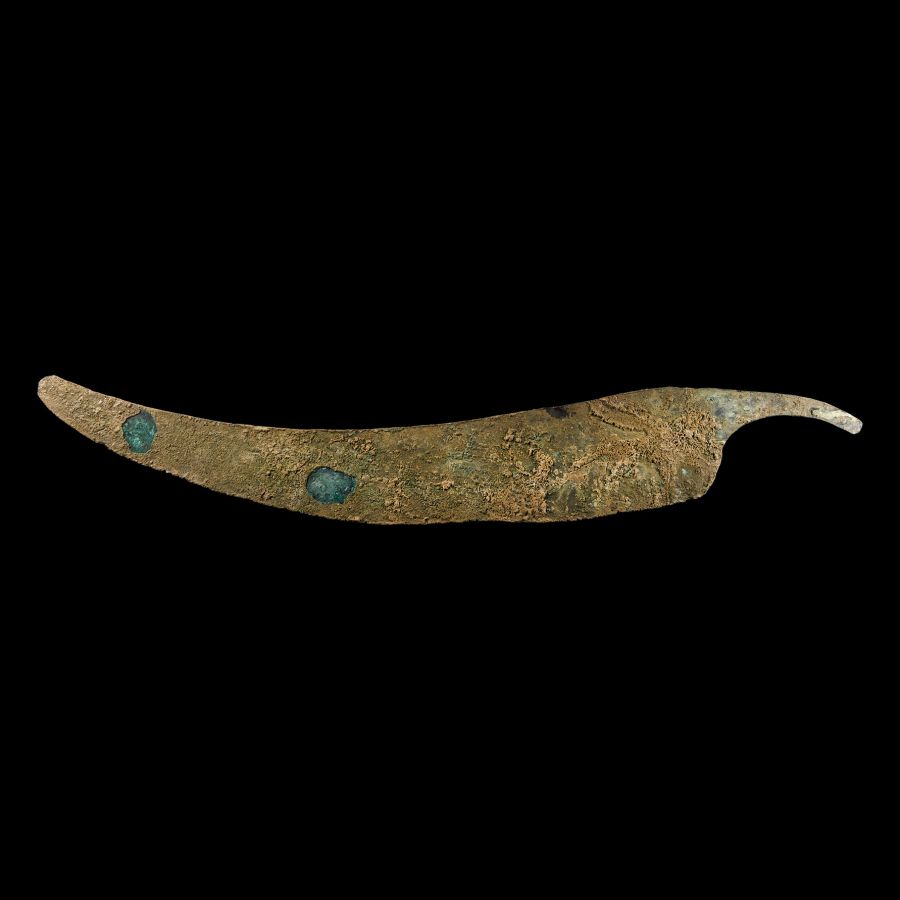
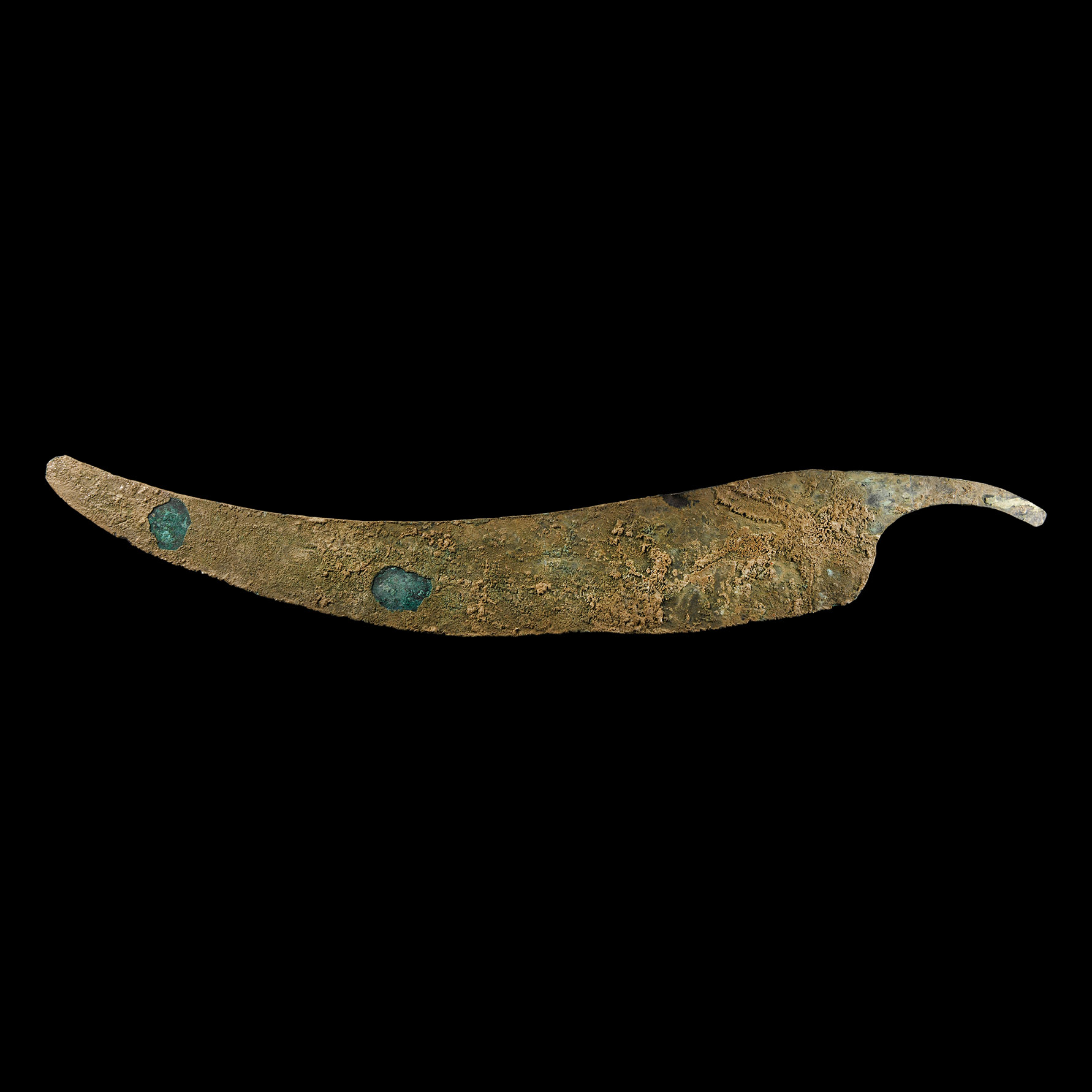
Western Asiatic Bronze Dagger
2ND-1ST MILLENNIUM B.C.
12 1/4 in. (78 grams, 31 cm).
Single-edged, curved with scooped shoulder and flat tang.
ProvenanceEx German collection, Cologne, 1980-1990s.
LiteratureSee Gorelik, M., Weapons of Ancient East, IV millennium BC-IV century BC, Saint Petersburg (2003), pl.I, no.23, from Ugarit (Ras Shamra).
FootnotesIn the middle of the 2nd millennium B.C., combat knives were widely used in Palestine and Syria. Some of them reproduced in local forms and constructions of the beginning of the 2nd millennium B.C., others had a concave blade with a humpbacked back or S-shaped blades which, apparently, should be associated with influences from Asia Minor influence.
CONDITIONTimeLine Auctions follows a vetting process to ensure the authenticity and legality of all items, reinforcing our commitment to integrity and responsible trading. Each antiquity, antique, and coin lot undergoes thorough examination by a vetting committee of at least ten external specialists, professional trade association members, scientists, and archaeologists: Our Vetting Process
AUCTIONS:
TimeLine is a leading auction house specialising in antiquities, ancient art, collectables, natural history, coins, medals, and books. Our auctions offer museums, collectors, historians, and enthusiasts the opportunity to acquire unique and historically significant pieces.
LOT 1063
Western Asiatic Bronze Dagger
Estimate £100 - 140€120 - 160 (for guidance only)$140 - 190 (for guidance only)
-
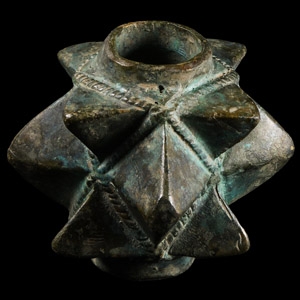
Medieval Bronze Socketted Macehead
14th-15th century A.D.Sold for (Inc. bp): £312
Comprising four large pyramidal projections, four smaller above and below, ropework detailing; circular shaft hole. 286 grams, 67 mm
Acquired in Munich in the 1970s. From an old German collection. -
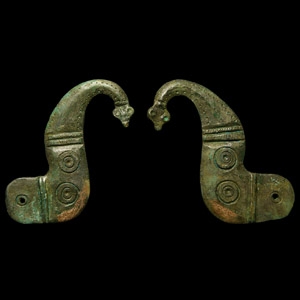
Roman Bronze Armour Double Fastening Hook
1st century A.D.Sold for (Inc. bp): £176
Each a tapering scrolled bar of zoomorphic form representing serpents or other animals with stylised geometric detailing; attachment perforations to both terminals. 32.7 grams total, 63-67 mm
Acquired on the London art market, 1980s-1990s.
In the 1st century B.C.-1st century A.D., the Celtic fastening system of the ring mail armour (gallica, lorica ferro aspera) became the standard in the Imperial Roman army, with a pivot attached to the breast and hinged to the edges of the humeralia (shoulder guards). The chest fastener had various different designs. The double hooks, S-shaped and usually with snake-head terminals, were secured by a central rivet on the chest. The system allowed excellent freedom of movement, giving greater protection to the shoulders and the arms. Similar fasteners for infantry mail have been found on the Kalkriese battlefield, some of them also decorated with niello and inscribed with the name of the soldier. -
.jpg)
George IV Inniskilling Dragoons Heavy Cavalry Officer's Sword
19th century A.D.Sold for (Inc. bp): £624
1821 Pattern, composed of a slightly curved blade marked with crown over GRIV monograms and 'The Iniskilling Dragoons'; fitted with wire-bound ray skin hilt and openwork basket guard, lion's head pommel; complete with original steel scabbard. 907 grams, 1.06 m
Acquired from MDL Historic Military Antiques, UK. The Kusmirek Collection, UK. Accompanied by a copy of the purchase invoice and regiment details.
This pattern sword would have been in use during the Crimean War period and the regiment served at Balaclava as part of the Heavy Brigade.
